Feller said don’t try writin dialect less you have a good ear. Now do I think my ear’s good? Well, I do and I don’t. Problem is, younguns ain’t mindin this store. I’m afeared we don’t get it down on paper we gonna lose it. So I went up the holler to ask Clare his mind on it.
We set a spell. He et his biscuits cold, sittin on the porch, not sayin’ much, piddlin with a pocketknife like he had a mind to whittle but couldn’t commit. Clare looked like sumpin the cat drug in. He was wore slap out from clearing the dreen so he don’t hafta tote firewood from up where the gator can’t git. “Reckon it’ll come up a cloud,” he allowed, squinting yonder at the ridge. “Might could,” I said. He nodded slow. “Don’t fret none,” he said. “That haint don’t stir in the holler less it’s fixin ta storm proper.” Then he leaned back, tuckered, fagged-out, and let the breeze do the talkin.
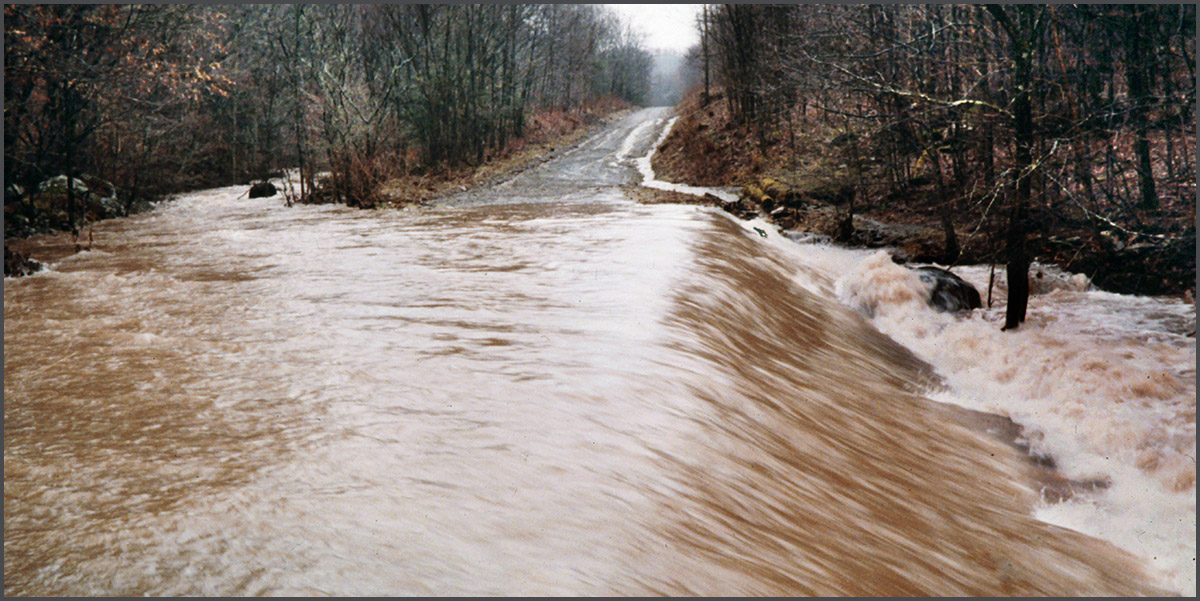
Now old Clare, he called it alright. Well, I’ll swan! The wind took up directly, then down it come. We watched the brown water push a wall of dead leaves and branches down yon valley. Dry Branch, they call it, and that’s a fact. Ain’t dry now. Feature it. One minute dry as dust, then come a gully-washer, bless yer heart. That was right smart of time ago.
If you got tolerable horse sense for Appalachian colloquialism, you’ll have understood most of that. A haint, by the way, is a spirit, a ghost, a spell, or a hex. Two terms used above make me wonder if all the technology we direct toward capturing our own shreds of actual American culture still fail to record these treasured regionalisms.
A “dreen,” according to Merriam-Webster, is “a dialectal variation of ‘drain,’ especially in Southern and South Midland American English.” Nah, not in West Virginia. That definition is a perfect example of how dictionaries flatten regional terms into their nearest Standard English cousin and, in doing so, miss the real story. It’s too broad and bland to capture what was, in practice, a topographic and occupational term used by loggers.
A dreen, down home, is a narrow, shallow but steep-sided and steeply sloping valley used to slide logs down. It’s recognized in local place-names and oral descriptions. Clear out the gully – the drain – for logs and you got yourself a dreen. The ravine’s water flow, combined with exposed shards of shale, make it slick. Drop logs off up top, catch them in a basin at the bottom. An economical means for moving logs down rough terrain without a second team of horses, specialized whiffletrees, and a slip-tongue skidder. How is it that there is zero record of what a dreen is on the web?
To “feature” something means to picture it in your mind. Like, “imagine,” but more concrete. “Picture this” + “feature picture” → “feature this.” Maybe? I found a handful of online forums where someone wrote, “I can’t feature it,” but the dictionaries are silent. What do I not pay you people for?
It’s not just words and phrases that our compulsive documentation and data ingestion have failed to capture about Appalachia. Its expressive traditions rarely survive the smooshing that comes with cinematic stereotypes. Poverty, moonshine, fiddles, a nerdy preacher and, more lately, mobile meth labs, are easy signals for “rural and backward.” Meanwhile, the texture of Appalachian life is left out.
Ever hear of shape-note music? How about lined-out singing? The style is raw and slow, not that polished gospel stuff you hear down in Alabama. The leader “lines out” a hymn, and the congregation follows in a full, droning response. It sounds like a mixture of Gaelic and plain chant – and probably is.
Hill witch. Granny women, often midwives, were herbalists and folk doctors. Their knowledge was empirical, intergenerational, and somehow female-owned. They were healers with an oral pharmacopoeia rooted in a mix of Native American and Scottish traditions. Hints of it, beyond the ginseng, still pop up here and there.
Jack tales. They pick up where Jack Frost, Jack and Jill, and Little Jack Horner left off. To my knowledge, those origins are completely unrelated to each other. Jack tales use these starting points to spin yarns about seemingly low-ambition or foolish folk who outfox them what think they’re smart. (Pronounce “smart” with a short “o” and a really long “r” that stretches itself into two distinct syllables.)
Now, I know that in most ways, none of that amounts to a hill of beans, but beyond the dialect, I fear we’re going to lose some novel expressions. Down home,
“You can’t get there from here” means it is metaphorically impossible or will require a lot of explaining.
“Puny” doesn’t mean you’re small; it means you look sick.
“That dog won’t hunt” means an idea, particularly a rebuttal or excuse, that isn’t plausible.
“Tighter than Dick’s hatband” means that someone is stingy or has proposed an unfair trade.
“Come day, go day, God send Sunday” means living day to day, e.g., hoping the drought lets up.
“He’s got the big eye” means he can’t sleep.
“He’s ate up with it” means he’s obsessed – could be jealousy, could be pride.
“Well, I do and I don’t” says more than indecision. You deliver it as a percussive anapest (da-da-DUM!, da-da-DUM!), granting it a kind of rhythmic, folksy authority. It’s a measured fence-sitting phrase that buys time while saying something real. It’s a compact way to acknowledge nuance, to say, “I agree… to a point,” followed with “It’s complicated…” Use it to acknowledge an issue as more personal and moral, less analytical. You can avoid full commitment while showing thoughtfulness. It weighs individual judgment. See also:
“There’s no pancake so thin it ain’t got two sides.”
The stoics got nothin on this baby. I don’t want you think I’m uppity – gettin above my raisin, I mean – but this one’s powerful subtle. There’s a conflict between principle and sympathy. It flattens disagreement by framing it as something natural. Its double negative ain’t no accident. Deploy it if you’re slightly cornered but not ready to concede. You acknowledge fairness, appear to hover above the matter at hand, seemingly without taking sides. Both parties know you have taken a side, of course. And that’s ok. That’s how we do it down here. This is de-escalation of conflict through folk epistemology: nothing is so simple that it doesn’t deserve a second look. Even a blind hog finds an acorn now and then. Just ‘cause the cat’s a-sittin still don’t mean it ain’t plannin.
Appalachia is America’s most misunderstood archive, its stories tucked away in hollers like songs no one’s sung for decades.
 The Multidisciplinarian
#1 by Buffet o' Blog on June 30, 2025 - 10:12 pm
At first that reminded me of Mark Twain in Huckleberry Finn, although it has several styles of dialect in it, or so it seems to me. A few phrases sounded Cajun.
After I read your post, I talked with a couple of people and realized I wanted to speak more like that. I grew up in the South, in a small town, and learned a mixture of country/redneck and ebonics. I went to college in a city and learned proper English, and gradually my dialect became more “proper” (from an English teacher perspective), unintentionally. But occasionally my old style of speaking comes out, particularly when I get excited or angry. And it’s never completely gone — my kids notice it sometimes, although they have learned some of it too, without realizing it.
#2 by Bill Storage on July 3, 2025 - 10:50 am
That material was collected from Randolph, Pocahontas, and Greenbrier counties, West Virginia. The disappearance of accent in the Lewisburg WalMart over the last five years is shocking. Get it while it’s real.