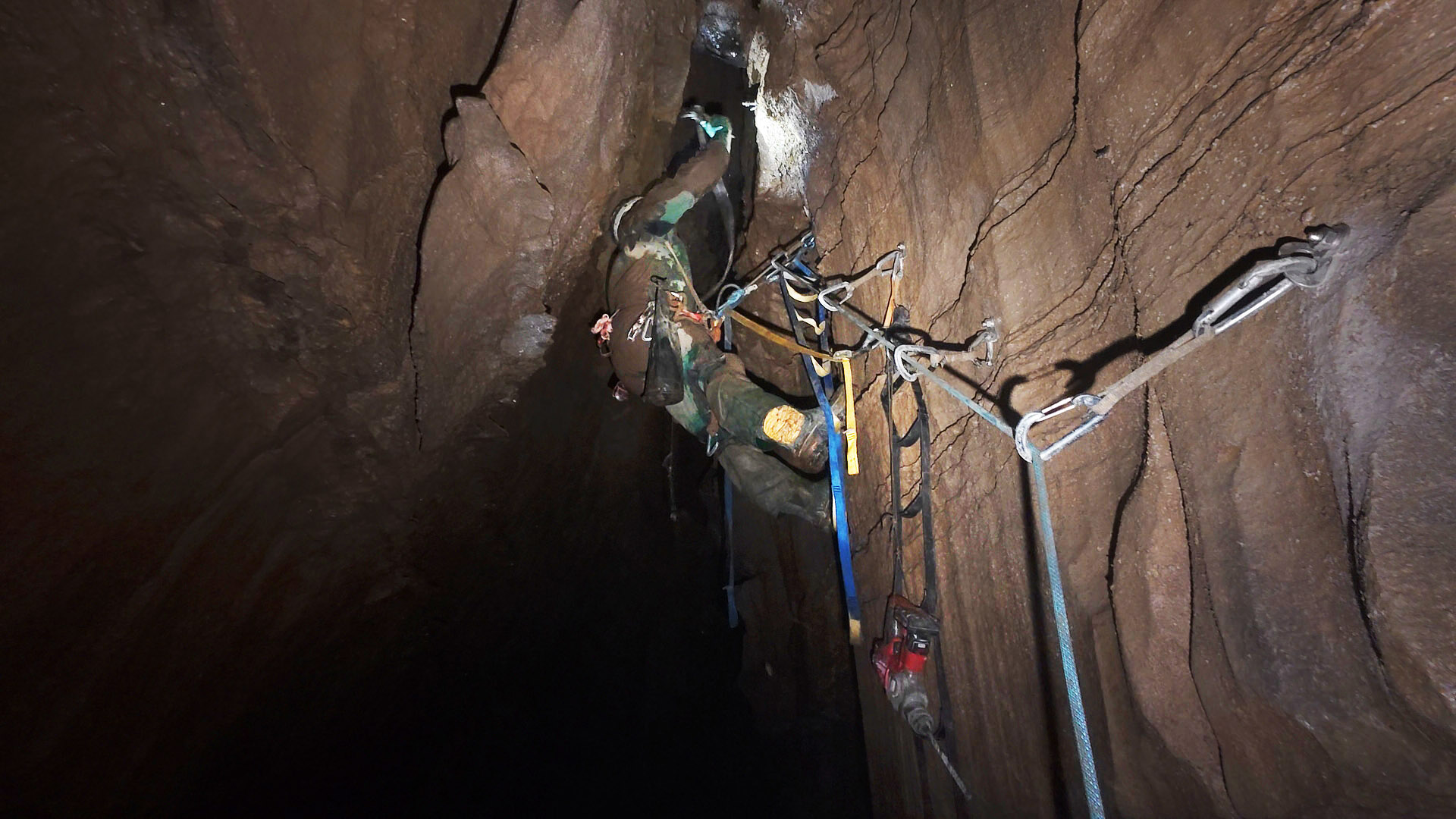
This story is about the band Wire and about using electric hammer drills in caves. That’s why I called this site The Multidisciplinarian. Not because I’m competent in many disciplines, or because I harbor disciplinarians in the basement, but because I wanted a single conversational space where unrelated things could bump into each other and see what happens. That’s what early bloggers did. Not Jorn Barger in 1997, when he coined the hideous word “blogging.” I’m still recovering. I mean the nineteenth-century social diarists. People made public diaries: Here’s my thoughts, see what you think. Beatrice Webb, aptly named, ran what was essentially a Victorian blog when she wasn’t co-founding the London School of Economics. If this social diary bores you, skip to the end and watch the 3-minute video.
I used to write record reviews for a couple of magazines. I was bad at it. I quit in frustration after reading what struck me as a devastatingly concise review of a Pere Ubu album. Pere Ubu, for the uninitiated, was an avant-garage band from northern Ohio who were far more popular on other continents than in Cleveland. Or even trendy Kent, Ohio.
The reviewer wrote something like this:
David Thomas, Ubu’s singer, though many people disputed that what he did qualified as singing, is coming from wherever Jim Morrison was heading. Pere Ubu is what Roxy Music would have been if Eno had taken over, fired Bryan Ferry, and hired a neurotic poet.
David Thomas, incidentally, later used several of my photos. Twenty years on, he told me he was thrilled that I’d captured what appear to be the only known photos of classic-era Pere Ubu, the brief and unrepeatable moment when Mayo Thompson and Richard Thompson, from opposite ends of the musical universe, were both in the band. Here’s two I took at the Cleveland Agora, after Thomas told security to let me in with a telephoto.
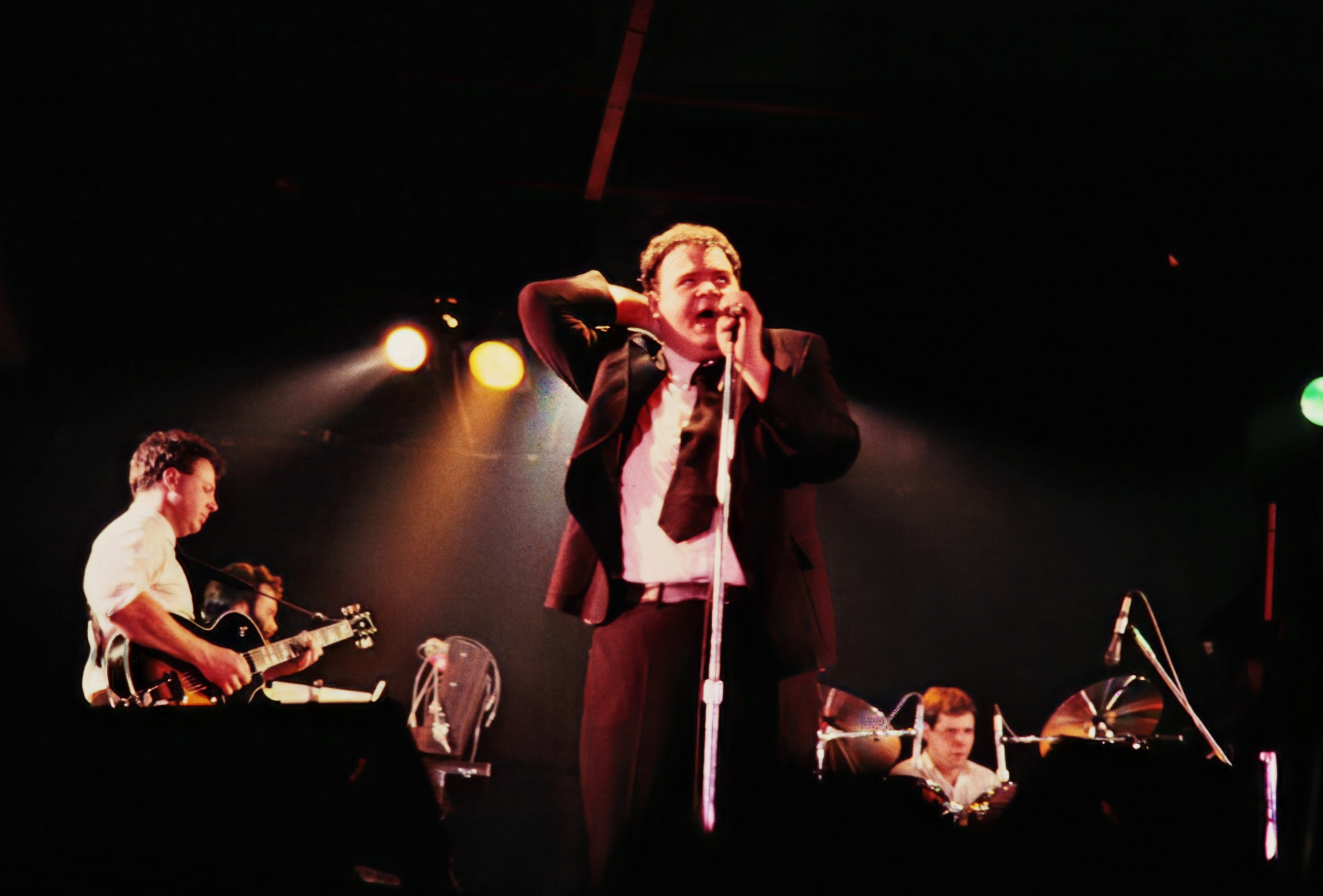
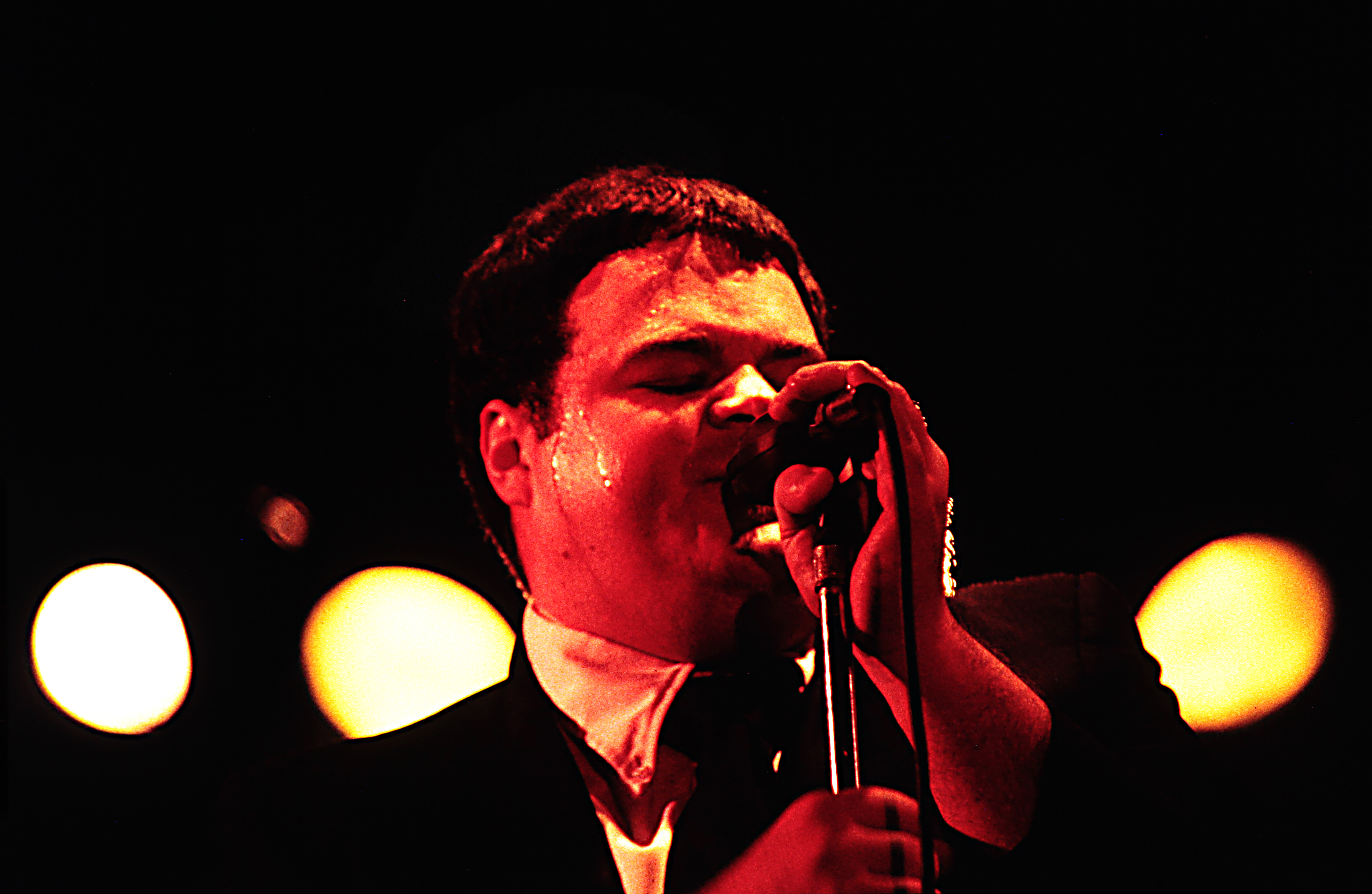
I remember thinking I could never write a review that clever. The writer, maybe Dean Suzuki, now a music professor at San Francisco State, nailed it. These days, the review impresses me slightly less. The Morrison line doesn’t really explain anything beyond “Thomas is weirder than Morrison.” You might infer that Morrison was a rock singer drifting toward the avant-garde, while Thomas was an avant-garde noise artist drifting toward rock. That’s clever, but it wouldn’t have helped me decide whether to buy The Art of Walking.
The Roxy Music comparison works better. Pere Ubu, like Roxy, made songs. They both layered noise and oddity onto them. But the key difference, the reason the “neurotic poet” line lands, is Thomas’s vocal delivery. He’s been described as yelping, barking, warbling like a distressed whale, or like a nervous art-school guy about to puke or cry. It’s stream-of-consciousness paranoia set to rhythm inside a foundry.
For readers already familiar with early Roxy Music (I discussed here), the analogy signals freaky, Eno-era art rock taken to an extreme, minus the glamour. That might hook you. But it works better as enticement than guidance. As criticism, it dodges the two questions I was supposed to answer. Was the band’s objective worth pursuing? And did they succeed?
Anyway, this piece isn’t about Pere Ubu or The Art of Walking. It’s about Wire and the art of cave exploration. The Pere Ubu detour is just throat-clearing. Amy, a caving friend, once said of my music criticism, “Once a critic, always an ass.” Fair enough.
Wire formed in London in October 1976. The members met at art school and had little prior band experience or instrumental proficiency. They were beginners leaning hard into punk’s DIY ethos. Unlike many of their contemporaries, who pursued deconstruction, Wire practiced pure reductionism. Not the Sex Pistols’ kind. Something colder and more deliberate.
From the start, their influences were eclectic: 60s pop, early Pink Floyd, Roxy Music, Brian Eno, krautrock, and punk, selectively. The Ramones for brevity, not for attitude. Wire always had internal tension between a pop impulse and an experimental or noise impulse. As Colin Newman put it, “Wire’s never really shared much taste as a band. It’s about the work. It always has been.” The tension proved unsustainable. They split in 1979.
So when Wire reappeared in 1986, touring with no advance press, it was a shock. They played none of their early material. Old Wire songs were two-minute punk bursts for intellectuals. New Wire played twenty- to thirty-minute trance pieces. What began as a rehearsal exercise became their most durable experiment. There are now roughly a hundred versions of “The Drill,” first released on the Snakedrill EP.
The band described it as monophonic, mono-rhythmic repetition. Then they translated it for the rest of us: “dugga dugga dugga.” Relentless single-line loops. Call and response. “Drill, drill, drill.” “Dugga, dugga, dugga.”
We’re milling through the grinder, and grinding through the mill,
If this is not an exercise, could it be a…
Could it be a…
…
Sometimes that unfinished line repeats long enough that you’re shouting “drill!”. Then it goes on so long you forget why you cared. Occasionally they finish the sentence. Sometimes they don’t. Drill. It’s an acquired taste.
Now I’ll describe this like a mechanical engineer who knows audio physics and a bit of music theory, but is resolved that he will never write engaging music critique.
Although “The Drill” sits nominally in 4/4, its rhythmic surface has virtually no accentuation of downbeat or tactus. You hear an isochronous pulse stream with no hierarchy. No dynamics. No phrasing cues. Meter becomes something you infer rather than perceive. The pulse just is.
Terse, right? Take that, Dean Suzuki. Who is, by the way, a very cool guy.
In 1990, Wire released The Drill, nearly an hour long, nine radically different versions of the same piece. Disco-adjacent versions, near-electronica, a sprawling twelve-minute live Chicago take, instrumentals like “Jumping Mint” and “Did You Dugga?” No sane producer would rush such a thing to market.
Also in 1990, I bought a 36-volt Hilti TE-10A battery-powered hammer drill. A Hilti dealer delivered it to my house in a red Hilti truck, which felt important. It was expensive and brutally heavy. Spare batteries were unthinkable, both for weight and cost. John Ganter and I used it for aid climbs underground. As far as I know, it was the first electric hammer drill used for cave exploration in West Virginia. The artifact now lives in John’s farmhouse garage, or museum.
That drill changed everything. On one battery you could place ten 3/8 x 3-inch wedge anchors. In hours you could do what had previously taken weeks with Rawl star drills or self-drives that barely engaged an inch of rock. Abuse followed, of course. Bolt farms sprouted. Some pristine pits gathered unnecessary hardware because someone thought they knew better than the last person. Alabama had already shown us the future.
Still, the potential was undeniable. When I returned to caving in 2021, Amy had a Bosch GBH18V-21. Drills were now lighter, and batteries were small and affordable. We had lists of high leads. We placed 108 bolts in a couple of months, none of them superfluous. Hunter, Casey, and Kyle, working the same cave, were bolting across ceilings, opening ridiculous routes.
Then Kyle, Max, Casey, and I started hauling drills through hours of low-airspace passages to climb beyond sumps. The drill became standard gear. You divided up the gear and double-dry-bagged it. And you brought earplugs. Ninety seconds of drilling in a confined space is wicked loud. Dugga dugga dugga.
On the drive to the cave, Max, Amy, and I traded Spotify tracks. I submitted “The Drill.” Not everyone’s taste, but it grows on you. Its flat pulse stream pairs well with the experience of standing in a swinging etrier, helmet lamp glaring, arm fully extended, ropes and gear tangling, water dripping down your back, mud in your eye. You are wearing goggles, right?
I started wondering whether actual drill audio could be mashed up with Wire’s “The Drill.” In theory, drill noise should be broadband, mostly non-harmonic. In practice, you hear pitch. A steady rotational component plus a reciprocating hammering component creates tonal structure.
I had helmet-cam footage, so I ran Fourier analysis. Once upon a time this required oscilloscopes and lab gear. Now software like Mixxx does it for free. Surprisingly, my Bosch drill consistently produces a dominant pitch around D#4, about 311 Hz. Hunter’s drilling hits the same pitch. Either we push identically, or push force doesn’t affect impact rate much. The advertised hammer rate is 5,100 BPM, or 85 Hz. The fourth harmonic lands near 340 Hz. Our load pulls it down roughly a semitone.
Our Milwaukee M12 rotary hammers center closer to C, with a hammer rate of 4,400 BPM, or 73 Hz. We push it harder than Milwaukee recommends. Otherwise it’s too slow. No motors have died yet. Its fourth harmonic is around 293 Hz. Analysis shows strong components at C3 and C4. We’re dragging it down a major second plus a bit.
DJs and the like probably do this in their sleep, or Mixxx does it for them. I made a spreadsheet. Wire’s Chicago “Drill” sits near D# minor. The A Bell Is a Cup version is in A minor. “Jumping Mint” is in C. I transposed everything to A, matched tempos, pitched the Bosch drill accordingly, then stitched audio and video together in DaVinci Resolve.
The six-minute version is reserved for future live drill events. Here’s the short cut. You might like it. Especially if you’ve ever enjoyed Pere Ubu’s singing or the sound of a machine shop.
 The Multidisciplinarian