Archive for category Fiction
Fattening Frogs For Snakes
Posted by Bill Storage in Fiction on December 2, 2025
(Sonny Boy Williamson’s blues classics reinterpreted)
1.
Three a.m. and the coffee skin was thick enough to skate across. I listened for heels on the stairs, the click of the screen door, but heard only the refrigerator humming a tune it couldn’t possibly know.
Took me a long time, long time to find out my mistake
You can bet your bottom dollar, ain’t fattening no more frogs for snakes
I had told her the frog-and-snake thing over venison and morels I picked myself above the ruined mill on Deep Creek. She’d worn a blue-green dress that looked like pond water reflecting setting sun. I remember thinking: that’s the color a man drowns in. She smiled at the frog and snake story. I tried to catalog the smile. Amusement? Patience? Or the kindness of someone who knows you’re performing before you know it yourself.
Now, she dreamed that I was a kissin’ her
On down by the mill
She’d dream that she’d taken me from
That girl up on the hill
Beneath the front window leaned her unicorn clock (acrylic on wood, fine art kissing kitsch), its hands frozen for years. She loved the useless thing. I measured the dead mechanism, then lost an hour on Amazon picking the exact shaft diameter, thread length, hand style. Details matter.
But first, could we find out what went wrong? I disconnected, tested continuity, checked for a bind, and listened again. The hum – or its absence – could tell me nothing. Still, I traced the edge of the case, felt for the tiniest resistance, imagined the coil shifting beneath my touch.
She asked if frogs really tasted like knowledge. I said only if you cooked them slow, with doubt and regret. She laughed so hard the candle guttered. But I’d just put more snake on the table than I’d meant to. She caught the mote of a pause when I stopped myself from straightening the candle.
She was the dreamest girl
The dreamest girl I most ever seen
The new movement arrived with six pairs of hands. I laid them out like tarot cards, wondering if anyone would notice an hour hand married to the wrong minute. I’d measured the inset twice and chosen the three-eighths movement, though I had doubts about the depth. Just in case, I’d already walked to Ace for a single Everbilt fender washer, bright enough to show every fingerprint of doubt.
Installation took thirty seconds. The old mechanism went into a drawer with all the other pieces that once belonged somewhere. The clock looked identical, but felt somehow different, like it had learned a secret.
That was the night I felt the first cold coil around my ankle.
Later, when the affair was coughing blood, I blamed more worldly men. I can’t dance – it doesn’t load right. I pictured them in Teslas, playing jazz, their beards shaped like the decisions they agonize over.
Oh been so long, been a mighty long time.
Yes a mighty long time since I seen that girl of mine
Sometimes, driving the back roads at dusk, I’d pass a slough and see her reflection in black water. Sometimes the reflection had my face. Sometimes it smiled like it knew the joke. Frog? Or snake?
2.
He was gone and the kissing dreams had faded. Who won the breakup?
I keep taking the same left past a collapsed barn with the Sinclair sign still bleeding green, and somehow I’m always coming up on it again. You saw it on Twilight Zone. The odometer isn’t moving. That’s how I know I’m still inside the dream he left me.
My mind was a room he enjoyed furnishing. I’d sit on the counter while he cooked – I couldn’t boil water when we met. I’ll grant him that. And he’d feed me concepts the way other men feed you strawberries. I grew up with X-Files and Nine Inch Nails. He gave me real art, history, literature. Not pretentious crap but the kind you hoard. I grew fat on it. Addicted.
Like I need an addiction. My thought turned sleek and cold-blooded.
My dreams inverted. I’d be sitting alone, and liking it, then there he’d be, fixing things I never used, and things that were broken but worked well enough. He seemed to audition for intimacy.
Now an’ I’m goin’ away, baby
Just to worry you off my mind
Tonight, I cook. I’m craving chicken. I’m not seeking fame here, just something with enough moving parts to keep me honest. The ingredients line up like suspects. Shallots, white wine, a sprig of thyme that’s tired but still willing. The thighs wait off to the side, trimmed and patted dry. Salt and pepper both sides. I want crisp skin.
Skin down in the pan, they hissed at me, and the smell shifted from raw to something that makes the neighbors reconsider their life choices. I did. Don’t fuss with the thighs. If you poke too early, the skin will tear.
I mince my shallots microscopic. Knife work is the closest thing I have to meditation. There’s no arguing with a blade that demands truth. From an onion or otherwise.
I remove the chicken once it loosens from the pan. In go the shallots, and the wine lifts the browned bits. The sauce pulls itself together and thickens like a story with unneeded characters. Heat on low.
I’d be walking the ridge and the ground would soften, turn to loam, then to water. I’d sink to the ankles, then the knees, and something muscular would brush my calf. No bite, just tasting the temperature. I looked down and saw his face under the surface, mouth open in a silent croak. Then it was my own face, older, eyes already filmed with the green of deep water.
I add stock, thyme, a whisper of cream. Soften it. Chicken back in the pan and then simmer. I load the D-minor Partita on Spotify and headphones.
The sauce coats the back of a spoon. I taste it, and it tastes back, which is how you know you’ve gotten somewhere. I plate the chicken with potatoes. Nothing theatrical. Just a little structure.
Snakes? Now the Bible prefers linear time, a story with a big bang and an end. Not loops, endless returns, and recurrence. The ouroboros, the snake that eats its tail, showed up in Greece and Mesopotamia. Put a cyclic symbol creature inside a linear story and you got tension.
Behind a clock face is a nest of gears that no one sees. Most folk just look at the hands. I tried replacements. They spoke depth in the voice of a dryer sheet with a taste for Wikipedia. None leave tracks when they walk across a lit room. None make the air go thick and listenable.
I wake up pounding my fist on the bed. I’m quoting dead Germans and want to bite my own tongue off. One says clocks murder everything alive about time, turn it into a corpse on a conveyor belt. I know their names. I can quote them. But why? Knowledge I wish I didn’t have, I tell myself, humming the partita.
Don’t start me to talkin’. I’ll tell everything I know.
Last week I found a morel growing through the floorboard of my car. Passenger side. I think I might be dreaming someone who’s trying to wake up from me. The Sinclair sign’s still bleeding green and the odometer hasn’t budged.
Oh been so long, been a mighty long time.
3.
The woman came at the blue hour when the bats stitch the sky together. She stood on the plank that used to be a dance floor before the flood of ’63 carried the jukebox down Deep Creek still playing Sonny Boy. She touched the face in the reflection.
She looked thinner. Hunger can do that, even if it’s the mind that’s starving.
She asked the water the questions people always ask when the music stops:
“Did he love me the way a man loves a woman, or the way a man loves a mirror?”
“Did I love him, or did I love being transformed into someone worth ruining?”
It was like she had read the script. I pressed a smile back down and let one eye break the surface.
“You loved me,” I told her.
She stood on the bank. A turtle hauled itself onto a sun-warmed log. Something regal in its refusal to hurry. The turtle blinked slowly, a gesture suggesting amusement. I nodded, thin as a drawn line – acknowledging the age, the armor, the calm.
The water held the crooked reflections of bottlebrush sedge. A few loose seeds clung to the stems. When a dragonfly landed, the stem leaned, and the whole cluster tilted just a hair.
She stepped in. The water took her weight without sound. Her hand found mine. Cold met cold. The scales remembered every classic she’d devoured whole.
I tasted the new skin budding under the old one – thin, translucent, the color of creek ice at breakup.
Above us, the mill wheel groaned. The years ran backward: the flood returned the jukebox, the mill stood up straight. The venison walked back into deer. Somewhere a screen door clicked shut.
I live it through my diary
And I read all my problems now are free
“Grow a new skin,” I told her. “You’ve earned it.”
And in that hush, I slipped beneath the water, silent on the downbeat.
Don’t start me to talkin’. I’ll tell everything I know.
___
.
Reflection Lag
Posted by Bill Storage in Fiction on June 23, 2025
Gregor Ehrenwald never excelled at conversation but had a gift for suggestion. He curated his Facebook like a diplomat, or maybe a monastic scribe. His profile boasted clips of treacherous mountain bike trails. He didn’t own a mountain bike. He was waiting for the Epic 8’s price to drop. He shared quotes from Wittgenstein and Heidegger. He’d bought Being and Time and planned to read it soon. His Friends tab showed camaraderie of a luminous, unaccountable texture. These weren’t lies, but aspirations projected from the regard he recalled holding at Canyon Lake High School. Or would still hold, had he not been forced to work nights to secure the college education that took him out of circulation for five full years. Not lies exactly, more a species of autobiographical foreshadowing.
After several years of this mild deception, a shift occurred – not dramatically, but with the soft click of remembering a movie he never saw. Gregor began composing posts with a fluency that startled even him. “Great catching up with granite master Lars, still the sickest dude on the west face of Tahquitz” he typed one night, forgetting that he’d never climbed at Tahquitz and that there was no Lars. He had, admittedly, joined the climbing club his senior year. Yet the words fell into place as though Lars had laughed and belayed and borrowed a pedal wrench he never returned. These memories did not contradict Gregor’s recollection of his real high school years but simply inserted themselves beside them, as though time had gently forked.
Gregor posted late into the night, like he didn’t have a day job. He woke to the muscle memory of reaching for his phone. His fingers danced across the screen before his eyes could adjust to the light. He dabbled in Facebook politics briefly. The algorithm offered outrage and validation. He wanted something warmer, something that remembered him.
After work, Gregor passed the hallway mirror, caught his reflection, and paused – eyes bright, almost feverish, as if he’d just heard good news.
That night, in a storage bin untouched for years, he found his high school book covers – brown grocery bags, folded with care, still taped from Algebra, Latin, Geometry. Their surfaces were scrawled with pen and Sharpie, dense with notes and swirls coiling inward.
He traced a note from Luke Stone: “Hey Library Rat – kidding, man!” A hasty “Cool guy, great P.A.” from Charlotte Brooks, who had usually looked through him. Then:
“G-money! Chemistry sucked without your jokes. Stay wild!”
“You leave a little sparkle wherever you go. Work hard and stay humble!”
There were a dozen book covers, each packed with tributes. Some comments ran in overlapping curls. Others were squeezed so narrow they had to be read with the flashlight.
He spotted this from Lauren D:
“To bestie GE – Voted Most Original Sense of Humor!!!”
And from Justin:
“Never forget that time we killed the Elsinore talent show. Wild sax!”
The names rang hollow. He didn’t remember a talent show.
He studied the doodles. Simple, repetitive shapes – coiling glyphs, chains, filigree. Clumsy figures too, but insistent: cats with mohawks, clown faces, spirals to nowhere. Probably mid-lecture boredom. Or maybe not.
On the last cover, he noticed, near the bottom, beneath a tiny saxophone outline, penned in a measured, angular hand:
“Believe in yourself as much as I believe in you! Facebook FTW!”
Facebook?
Gregor froze. He set the cover down carefully. The room leaned in, heavy with heat.
A prank, he thought at first. Someone messing with him, writing on his stuff. But no. He wondered if he’d suffered some obscure brain fever – the kind that haunt old novels, now rebranded as mild dissociative episodes.
The handwriting mimicked styles he admired: elongated Gs and Spencerian script, grand loops with a practiced flair. Some mirrored his own hand. Others from hands he’d never seen. It was as though the entries had written themselves to flatter him in the light he wished to be seen in.
Facebook – that was the breach – the hinges on which the door now swung. No Facebook back then. Nor had there been Lars. And yet: how warm the perceived laughter, how victorious up on Tahquitz, how easy the belonging.
Then he recalled a neuroscience article Lars had shared. Memories could misfire, it said, landing in the wrong slot.
He sat on the edge of the bed and devised his own Theory of Premature Memory Displacement.
Certain memories, he reasoned, do not originate in the past but arrive early, dressed in nostalgia. The mind, trying to orient them temporally, may misfile them. The Facebook entries were always meant for him – but like mail delivered to a former address, had arrived a decade late. A memory lost doesn’t vanish, it ricochets around the mind until it lands on some vacant shelf, to be recovered later.
Satisfied, he opened the last cover – the part that once faced the book’s actual cover. There he found a girl’s message:
“Never stop writing, Gregor. You see things others miss.”
He underlined her name. Trina – and then, as if prompted, recalled her fabulous voice, her rendition of Coldplay’s Viva la Vida. He refolded the covers and put them back in the bin.
He thumbed through Heidegger, hunting for a line to post. There it was – page 374:
“The ‘past’ – or better, the having-been – has its being in the future.”
The likes came in slow but steady.
–
Dialogue Concerning a Cup of Cooked Collards
Posted by Bill Storage in Fiction, History of Science on May 27, 2025
in which the estimable Signora Sagreda, guided by the lucid reasoning of Salviatus and the amiable perplexities of Simplicius, doth inquire into the nature of culinary measurement, and wherein is revealed, by turns comic and calamitous, the logical dilemma and profound absurdity of quantifying cooked collards by volume, exposing thereby the nutritional fallacies, atomic impossibilities, and epistemic mischiefs that attend such a practice, whilst invoking with reverence the spectral wisdom of Galileo Galilei.
Scene: A modest parlor, with a view into a well-appointed kitchen. A pot of collards simmers.
Sagreda: Good sirs, I am in possession of a recipe, inherited from a venerable aunt, which instructs me to add one cup of cooked collards to the dish. Yet I find myself arrested by perplexity. How, I ask, can one trust such a measure, given the capricious nature of leaves once cooked?
Salviatus: Ah, Signora, thou hast struck upon a question of more gravity than may at first appear. In that innocent-seeming phrase lies the germ of chaos, the undoing of proportion, and the betrayal of consistency.
Simplicius: But surely, Salviatus, a cup is a cup! Whether one deals with molasses, barley, or leaves of collard! The vessel measures equal, does it not?
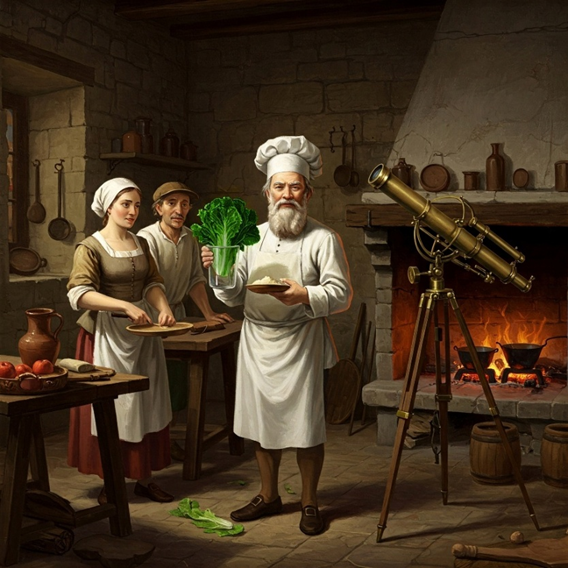
Salviatus: Ah, dear Simplicius, how quaint thy faith in vessels. Permit me to elaborate with the fullness this foolishness begs. A cup, as used here, is a measure of volume, not mass. Yet collards, when cooked, submit themselves to the will of the physics most violently. One might say that a plenty of raw collards, verdant and voluminous, upon the fire becomes but a soggy testament to entropy.
Sagreda: And yet if I, with ladle in hand, press them lightly, I may fill a cup with tender grace. But if I should tamp them down, as a banker tamps tobacco, I might squeeze thrice more into the same vessel.
Salviatus: Just so! And here lies its absurdity. The recipe calls for a cup, as though the collards were flour, or water, or some polite ingredient that hold the law of uniformity. But collards — and forgive my speaking plainly — are rogues. One cook’s gentle heap is another’s aggressive compression. Thus, a recipe using such a measure becomes not a method, but a riddle, a culinary Sphinx.
Simplicius: But might not tradition account for this? For is it not the case that housewives and cooks of yore prepared these dishes with their senses and not with scales?
Salviatus: A fair point, though flawed in its application. While the tongue and eye may suffice for the seasoned cook, the written recipe aspires to universality. It must serve the neophyte, the scholar, the gentleman abroad who seeks to replicate his mother’s collard pie with exactitude. And for these noble aims, only the scale may speak truth. Grams! Ounces! Units immutable, not subject to whim or squish!
Sagreda: You speak as though the collards, once cooked, engage in a deceit, cloaking their true nature.
Salviatus: Precisely. Cooked collards are like old courtiers — soft, pliable, and accustomed to hiding their substance beneath a veneer of humility. Only by weight can one know their worth. Or, more precisely, by its mass, the measure we know to not affect the rate at which objects fall.
Simplicius: But if all this be so, then is not every cookbook a liar? Is not every recipe suspect?
Salviatus: Not every recipe — only those who trade in volumetric folly where mass would bring enlightenment. The fault lies not in the recipe’s heart, but in its measurement. And this, dear Simplicius, we may yet amend.
Sagreda: Then shall we henceforth mark in our books, “Not a cup, but a weight; not a guess, but a truth“? For a measure of collards, like men, must be judged not by appearance, but by their substance.
Sagreda (reflecting): And yet, gentlemen, if I may permit a musing most unorthodox, does not all this emphasis on precision edge us perilously close to an unyielding, mechanical conception of science? Dare we call it… dogmatic?
Simplicius: Dogmatic? You surprise me, Signora. I thought it only the religion of Bellarmino and Barberini could carry such a charge.
Salviatus: Ha! Then you have not read the scribblings of Herr Paulus Feyerabend, who, proclaims with no small glee — and with more than of a trace of Giordano Bruno — that anything goes in the pursuit of knowledge. He teaches that the science, when constrained by method, becomes no different from myth.
Sagreda: Fascinating! And would this Feyerabend defend, then, the use of “a cup of cooked collards” as a sound epistemic act?
Salviatus: Indeed, he might. He would argue that inexactitude, even vagueness, can have its place. That Sagreda’s venerable aunt, the old wives, the village cooks, with their pinches and handfuls and mysteriously gestured “quanta bastas,” have no less a claim to truth than a chef armed with scales and thermocouples. He might well praise the “cup of cooked collards” as a liberating epistemology, a rejection of culinary tyranny.
Simplicius: Then Feyerabend would have me trust Sagreda’s aunt over the chemist?
Salviatus: Just so — he would, and be half right at least! Feyerabend’s quarrel is not with truth, but with monopoly over its definition. He seeks not the destruction of science, but the dethronement of science enthroned as sacred law. In this spirit, he might say: “Let the collards be measured by weight, or not at all, for the joy of the dish may reside not in precision, but in a dance of taste and memory.”
Sagreda: A heady notion! And perhaps, like a stew, the truth lies in the balance — one must permit both the grammar of measurement and the poetry of intuition. The recipe, then, is both science and art, its ambiguity not a flaw, but sometimes an invitation.
Salviatus: Beautifully said, Signora. Yet let us remember: Feyerabend champions chaos as a remedy for tyranny, not as an end in itself. He might defend the cook who ignores the scale, but not the recipe which claims false precision where none is due. And so, if we declare “a cup of cooked collards,” we ought either to define it, or admit with humility that we have no idea how many leaves is right to each observer.
Simplicius: Then science and the guessing of aunts may coexist — so long as neither pretends to be the other?
Salviatus: Precisely. The scale must not scorn the hunch, nor the cup dethrone the scale. But let us not forget: when preparing a dish to be replicated, mass is our anchor in the storm of leafy deception.
Sagreda (opening her laptop): Ah! Then let us dedicate this dish — to Feyerabend, to Bruno, to my venerable aunt. I will append to her recipe, notations from these reasonings on contradiction and harmony.
Cooked collards are like old courtiers — soft, pliable, and accustomed to hiding their substance beneath a veneer of humility — Salviatus
Sagreda (looking up from her laptop with astonishment): Gentlemen! I have stumbled upon a most curious nutritional claim. This USDA document — penned by government scientist or rogue dietitian — declares with solemn authority that a cup of cooked collards contains 266 grams calcium and a cup raw only 52.
Salviatus (arching an eyebrow): More calcium? From whence, pray, does this mineral bounty emerge? For collards, like men, cannot give what they do not possess.

Simplicius (waving a wooden spoon): It is well known, is it not, that cooking enhances healthfulness? The heat releases the virtues hidden within the leaf, like Barberini stirring the piety of his reluctant congregation!
Salviatus: Simplicius, your faith outpaces your chemistry. Let us dissect this. Calcium, as an element, is not born anew in the pot. It is not conjured by flame nor summoned by steam. It is either present, or it is not.
Simplicius: So how, then, can it be that the cooked collards have more calcium than their raw counterparts — cup for cup?
Sagreda: Surely, again, the explanation is compression. The cooking drives out water, collapses volume, and fills the cup more densely with matter formerly bulked by air and hubris.
Salviatus: Exactly so! A cup of cooked collards is, in truth, the compacted corpse of many cups raw — and with them, their calcium. The mineral content has not changed; only the volume has bowed before heat’s stern hand.
Simplicius: But surely the USDA, a most probable power, must be seen as sovereign on the matter. Is there no means, other than admitting the slackness of their decree, by which we can serve its authority?
Salviatus: Then, Simplicius, let us entertain absurdity. Suppose for a moment — as a thought experiment — that the cooking process does, in fact, create calcium.
By what alchemy? What transmutation?
Let us assume, in a spirit of lunatic (and no measure anachronous) generosity, that the humble collard leaf contains also magnesium — plentiful, impudent magnesium — and that during cooking, it undergoes nuclear transformation. Though they have the same number of valence electrons, to turn magnesium (atomic number 12) into calcium (atomic number 20), we must add 8 protons and a healthy complement of neutrons.
Sagreda: But whence come these subatomic parts? Shall we pluck nucleons from the steam?
Salviatus (solemnly): We must raid the kitchen for protons as a burglar raids a larder. Perhaps the protons are drawn from the salt, or the neutrons from baking powder, or perhaps our microwave is a covert collider, transforming our soup pot into CERN-by-candlelight.
But alas — this would take more energy than a dozen suns, and the vaporizing of the collards in a burst of gamma rays, leaving not calcium-rich greens but a crater and a letter of apology due. But, we know, do we not, that the universe is indifferent to apology; the earth still goes round the sun.
Sagreda: Then let us admit: the calcium remains the same. The difference is illusion — an artifact of measurement, not of matter.
Salviatus: Precisely. And the USDA, like other sovereigns, commits nutritional sophistry — comparing unlike volumes and implying health gained by heat alone, or, still worse, that we hold it true by unquestioned authority.
Let this be our final counsel: whenever the cup is invoked, ask, “Cup of what?” If it be cooked, know that you measure the ghost of raw things past, condensed, wilted, and innocent of transmutation.
The scale must not scorn the hunch, nor the cup dethrone the scale. – Salviatus
Thus ends the matter of the calcium-generating cauldron, in which it hath been demonstrated to the satisfaction of reason and the dismay of the USDA that no transmutation of elements occurs in the course of stewing collards, unless one can posit a kitchen fire worthy of nuclear alchemy; and furthermore, that the measure of leafy matter must be governed not by the capricious vulgarity of volume, but by the steady hand of mass, or else be entrusted to the most excellent judgment of aunts and cooks, whose intuitive faculties may triumph over quantification outright. The universe, for its part, remains intact, and the collards, alas, are overcooked.
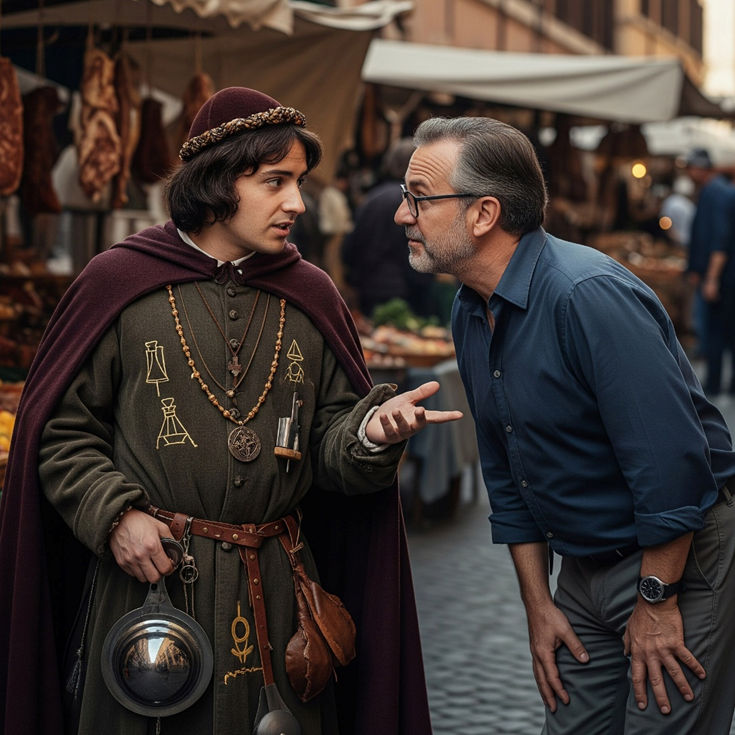
Giordano Bruno discusses alchemy with Paul Feyerabend. Campo de’ Fiori, Rome, May 1591.
Galileo’s Dialogue Concerning the Two Chief World Systems is a proto-scientific work presented as a conversation among three characters: Salviati, Sagredo, and Simplicio. It compares the Copernican heliocentric model (Earth revolves around Sun) and the traditional Ptolemaic geocentric model (Earth as center). Salviati represents Galileo’s own views and advocates for the Copernican system, using logic, mathematics, observation, and rhetoric. Sagredo is an intelligent, neutral layman who asks questions and weighs the arguments, representing the open-minded reader. Simplicio, a supporter of Aristotle and the geocentric model held by the church, struggles to defend his views and is portrayed as naive. Through their discussion, Galileo gives evidence for the heliocentric model and critiques the shortcomings of the geocentric, making a strong case for scientific reasoning based on observation rather than tradition and authority. Cardinal Roberto Bellarmino and Maffeo Barberini (Pope Urban VIII) were the central clergy figures in Galileo’s trial. In 1970 Paul Feyerabend argued that modern institutional science resembled the church more than it did Galileo. The Dominican monk, Giordano Bruno, held unorthodox ideas in science and theology. Bellarmino framed the decision leading to his conviction of heresy in 1600. He was burned at the stake in the plaza of Campo de’ Fiori, where I stood not one hour before writing this.
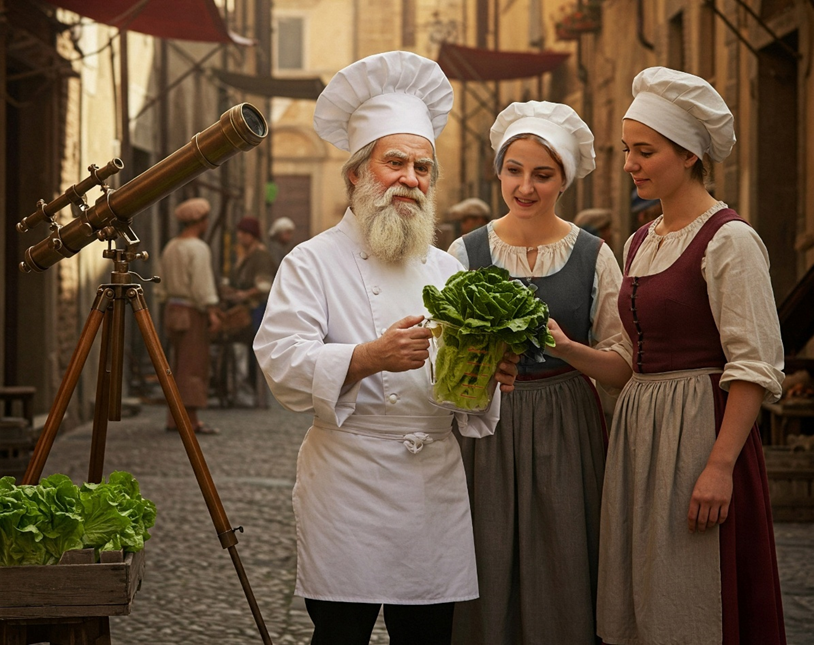
Galileo with collard vendors in Pisa
 The Multidisciplinarian