Posts Tagged humor
I’m Only Neurotic When – Engineering Edition
Posted by Bill Storage in Commentary, Engineering & Applied Physics on October 7, 2025
The USB Standard of Suffering
The USB standard was born in the mid-1990s from a consortium of Intel, Microsoft, IBM, DEC, NEC, Nortel, and Compaq. They formed the USB Implementers Forum to create a universal connector. The four pins for power and data were arranged asymmetrically to prevent reverse polarity damage. But the mighty consortium gave us no way to know which side was up.
The Nielsen Norman Group found that users waste ten seconds per insertion. Billions of plugs times thirty years. We could have paved Egypt with pyramids. I’m not neurotic. I just hate death by a thousand USB cuts.
The Dyson Principle
I admire good engineering. I also admire honesty in materials. So naturally, I can’t walk past a Dyson vacuum without gasping. The thing looks like it was styled by H. R. Giger after a head injury. Every surface is ribbed, scooped, or extruded as if someone bred Google Gemini with CAD software, provided the prompt “manifold mania,” and left it running overnight. Its transparent canister resembles an alien lung. There are ducts that lead nowhere, fins that cool nothing, and bright colors that imply importance. It’s all ornamental load path.
To what end? Twice the size and weight of a sensible vacuum, with eight times the polar moment of inertia. (You get the math – of course you do.) You can feel it fighting your every turn, not from friction, but from ego. Every attempt at steering carries the mass distribution of a helicopter rotor. I’m not cleaning a rug, I’m executing a ground test of a manic gyroscope.
Dyson claims it never loses suction. Fine, but I lose patience. It’s a machine designed for showroom admiration, not torque economy. Its real vacuum is philosophical: the absence of restraint. I’m not neurotic. I just believe a vacuum should obey the same physical laws as everything else in my house. I’m told design is where art meets engineering. That may be true, but in Dyson’s case, it’s also where geometry goes to die. There’s form, there’s function, and then there’s what happens when you hire a stylist who dreams in centrifugal-manifold Borg envy.
Frank Lloyd Wright’s Physics
No one but Frank Lloyd Wright could have designed these cantilevered concrete roof supports, the tour guide at the Robie House intoned reverently, as though he were describing Moses with a T-square. True – and Mr. Wright couldn’t have either. The man drew poetry in concrete, but concrete does not care for poetry. It likes compression. It hates tension and bending. It’s like trying to make a violin out of breadsticks.
They say Wright’s genius was in making buildings that defied gravity. True in a sense – but only because later generations spent fifty times his budget figuring ways to install steel inside the concrete so gravity and the admirers of his genius wouldn’t notice. We have preserved his vision, yes, but only through subterfuge and eternal rebar vigilance.
Considered the “greatest American architect of all time” by people who can name but one architect, Wright made it culturally acceptable for architects to design expressive, intensely personal museums. The Guggenheim continues to thrill visitors with a unique forum for contemporary art. Until they need the bathroom – a feature more of an afterthought for Frank. Try closing the door in there without standing on the toilet. Paris hotels took a cue.
The Interface Formerly Known as Knob
Somewhere, deep in a design studio with too much brushed aluminum and not enough common sense, a committee decided that what drivers really needed was a touch screen for everything. Because nothing says safety like forcing the operator of a two-ton vehicle to navigate a software menu to adjust the defroster.
My car had a knob once. It stuck out. I could find it. I could turn it without looking. It was a miracle of tactile feedback and simple geometry. Then someone decided that physical controls were “clutter.” Now I have a 12-inch mirror that reflects my fingerprints and shame. To change the volume, I have to tap a glowing icon the size of an aspirin, located precisely where sunlight can erase it. The radio tuner is buried three screens deep, right beside the legal disclaimer that won’t go away until I hit Accept. Every time I start the thing. And the Bluetooth? It won’t connect while the car is moving, as if I might suddenly swerve off the road in a frenzy of unauthorized pairing. Design meets an army of failure-to-warn attorneys.
Human factors used to mean designing for humans. Now it means designing obstacles that test our compliance. I get neurotic when I recall a world where you could change the volume by touch instead of prayer.
Automation Anxiety
But the horror of car automation goes deeper, far beyond its entertainment center. The modern car no longer trusts me. I used to drive. Now I negotiate. Everything’s “smart” except the decisions. I rented one recently – some kind of half-electric pseudopod that smelled of despair and fresh software – and tried to execute a simple three-point turn on a dark mountain road. Halfway through, the dashboard blinked, the transmission clunked, and without warning the thing threw itself into Park and set the emergency brake.
I sat there in the dark, headlamps cutting into trees, wondering what invisible crime I’d committed. No warning lights, no chime, no message – just mutiny. When I pressed the accelerator, nothing. Had it died of fright? Then I remembered: modern problems require modern superstitions. I turned it off and back on again. Reboot – the digital age’s holy rite of exorcism. It worked.
Only later did I learn, through the owner’s manual’s runic footnotes, that the car had seen “an obstacle” in the rear camera and interpreted it as a cliff. In reality it was a clump of weeds. The AI mistook grass for death.
So now, in 2025, the same species that landed on the Moon has produced a vehicle that prevents a three-point turn for my own good. Not progress, merely the illusion of it – technology that promises safety by eliminating the user. I’m not neurotic. I just prefer my machines to ask before saving my life by freezing in place as headlights come around the bend.
The Illusion of Progress
There’s a reason I carry a torque wrench. It’s not to maintain preload. It’s to maintain standards. Torque is truth, expressed in foot-pounds. The world runs on it.
Somewhere along the way, design stopped being about function and started being about feelings. You can’t torque a feeling. You can only overdo it. Hence the rise of things that are technically advanced but spiritually stupid. Faucets that require a firmware update, refrigerators with Twitter accounts. Cars that disable half their features because you didn’t read the EULA while merging onto the interstate.
I’m told this is innovation. No, it’s entropy with a bottomless budget. After the collapse, I expect future archaeologists to find me in a fossilized Subaru, finger frozen an inch from the touchscreen that controlled the wipers.
Until then, I’ll keep my torque wrench, thank you. And I’ll keep muting TikTok’s #lifehacks tag, before another self-certified engineer shows me how to remove stripped screws with a banana. I’m not neurotic. I’ve learned to live with people who do it wrong.
I’m Only Neurotic When You Do It Wrong
Posted by Bill Storage in Commentary on October 6, 2025
I don’t think of myself as obsessive. I think of myself as correct. Other people confuse those two things because they’ve grown comfortable in a world that tolerates sloppiness. I’m only neurotic when you do it wrong.
In Full Metal Jacket, Stanley Kubrick mocks the need for precision. Gunnery Sergeant Hartman, played by R. Lee Ermey, has a strict regimen for everything from cellular function on up. Kubrick has Hartman tell Private Pyle, “If there is one thing in this world that I hate, it is an unlocked footlocker!” Of course, Hartman hates an infinity of things, but all of them are things we secretly hate too. For those who missed the point, Kubrick has the colonel later tell Joker, “Son, all I’ve ever asked of my Marines is that they obey my orders as they would the word of God.”
The facets of life lacking due attention to detail are manifold, but since we’ve started with entertainment, let’s stay there. Entertainment budgets dwarf those of most countries. All I’ve ever asked of screenwriters is to hire historical consultants who can spell anachronism. Kubrick is credited with meticulous attention to detail. Hah. He might learn something from Sgt. Hartman. In Kubrick’s Barry Lyndon duel scene, a glance over Lord Bullingdon’s shoulder reveals a map with a decorative picture of a steam train, something not invented for another fifty years. The scene of the Lyndon family finances shows receipts bound by modern staples. Later, someone mentions the Kingdom of Belgium. Oops. Painterly cinematography and candlelit genius, yes – but the first thing that comes to mind when I hear Barry Lyndon is the Dom Pérignon bottle glaring on the desk, half a century out of place.
Soldiers carry a 13-star flag in The Patriot. Troy features zippers. Braveheart wears a kilt. Andy Dufresne hides his tunnel behind a Raquel Welch poster in Shawshank Redemption. Forrest Gump owns Apple stock. Need I go on? All I’ve ever asked of filmmakers is that they get every last detail right. I’m only neurotic when they blow it.
Take song lyrics. These are supposedly the most polished, publicly consumed lines in the English language. Entire industries depend on them. There are producers, mixers, consultants galore – whole marketing teams – and yet no one, apparently, ever said, “Hold on, Jim, that doesn’t make any sense.
Jim Morrison, I mean. Riders on the Storm is moody and hypnotic. On first hearing I settled in for what I knew, even at twelve, was an instant classic. Until he says of the killer: “his brain is squirming like a toad.” Not the brain of a toad, not a brain that toaded. There it was – a mental image of a brain doing a toad impression. The trance was gone. Minds squirm, not toads. Toads hold still, then hop, then hold still again. Rhyming dictionaries existed in 1970. He could have found anything else. Try: “His mind was like a dark abode.” Proofreader? Editor? QA department? Peer review? Fifty years on, I still can’t hear it without reliving my early rock-crooner trauma.
Rocket Man surely ranks near Elton’s John’s best. But clearly Elton is better at composition than at contractor oversight. Bernie Taupin wrote, “And all this science, I don’t understand.” Fair. But then: “It’s just my job, five days a week.” So wait, you don’t understand science, but NASA gave you a five-day schedule and weekends off because of what skill profile? Maybe that explains Challenger and Columbia.
Every Breath You Take by The Police. It’s supposed to be about obsession, but Sting (Sting? – really, Gordon Sumner?) somehow thought “every move you make, every bond you break” sounded romantic. Bond? Who’s out there breaking bonds in daily life? Chemical engineers? Sting later claimed people misunderstood it, but that’s because it’s badly written. If your stalker anthem is being played at weddings, maybe you missed a comma somewhere, Gordon.
“As sure as Kilimanjaro rises like Olympus above the Serengeti,” sings Toto in Africa. Last I looked, Kilimanjaro was in Tanzania, 200 miles from the Serengeti. Olympus is in Greece. Why not “As sure as the Eiffel Tower rises above the Outback”? The lyricist admitted he wrote it based on National Geographic photos. Translation: “I’m paid to look at pictures, not read the captions.”
“Plasticine porters with looking glass ties,” wrote John Lennon in Lucy in the Sky with Diamonds. Plasticine must have sounded to John like some high-gloss super-polymer. But as the 1960s English-speaking world knew, Plasticine is a children’s modeling clay. Were these porters melting in the sun? No other psychedelic substances available that day? The smell of kindergarten fails to transport me into Lennon’s hallucinatory dream world.
And finally, Take Me Home, Country Roads. This one I take personally. John Denver, already richer than God, sat down to write a love letter to West Virginia and somehow imported the Blue Ridge Mountains and Shenandoah River from Virginia. Maybe he looked at an atlas once, diagonally. The border between WV and VA is admittedly jagged, but at least try to feign some domain knowledge. Apologists say he meant blue-ridged mountains or west(ern) Virginia – which only makes it worse. The song should have been called Almost Geographically Adjacent to Heaven.
Precision may not make art, but art that ignores precision is just noise with a budget. I don’t need perfection – only coherence, proportion, and the occasional working map. I’m not obsessive. I just want a world where the train on the wall doesn’t leave the station half a century early. I’ve learned to live among the lax, even as they do it all wrong.
If the Good Lord’s Willing and the Creek Don’t Rise
Posted by Bill Storage in Commentary on June 30, 2025
Feller said don’t try writin dialect less you have a good ear. Now do I think my ear’s good? Well, I do and I don’t. Problem is, younguns ain’t mindin this store. I’m afeared we don’t get it down on paper we gonna lose it. So I went up the holler to ask Clare his mind on it.
We set a spell. He et his biscuits cold, sittin on the porch, not sayin’ much, piddlin with a pocketknife like he had a mind to whittle but couldn’t commit. Clare looked like sumpin the cat drug in. He was wore slap out from clearing the dreen so he don’t hafta tote firewood from up where the gator can’t git. “Reckon it’ll come up a cloud,” he allowed, squinting yonder at the ridge. “Might could,” I said. He nodded slow. “Don’t fret none,” he said. “That haint don’t stir in the holler less it’s fixin ta storm proper.” Then he leaned back, tuckered, fagged-out, and let the breeze do the talkin.
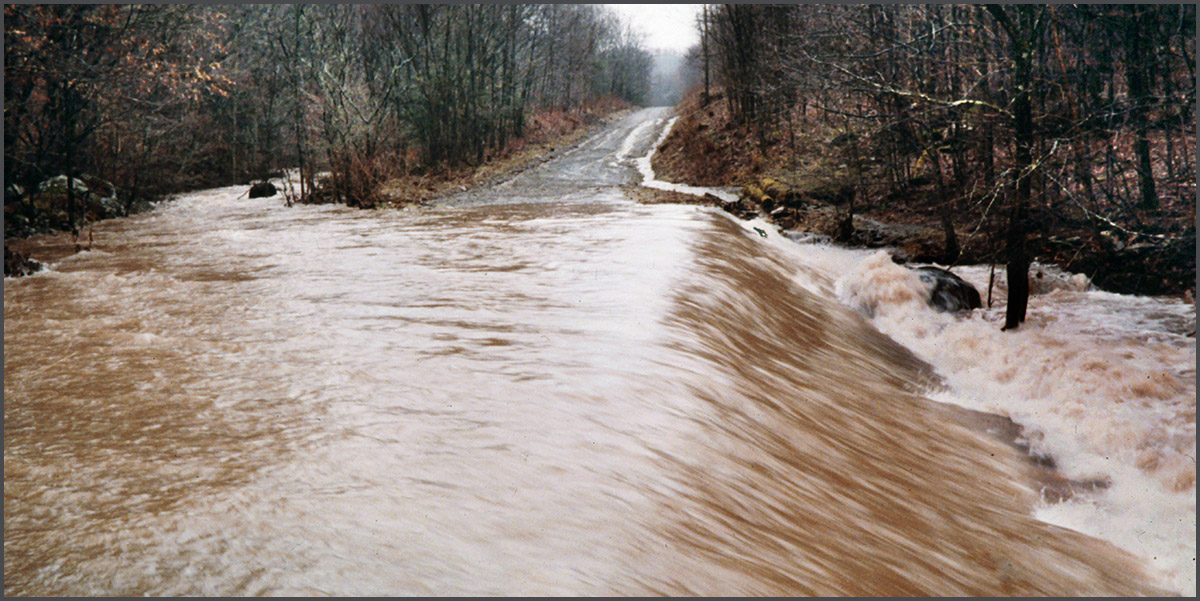
Now old Clare, he called it alright. Well, I’ll swan! The wind took up directly, then down it come. We watched the brown water push a wall of dead leaves and branches down yon valley. Dry Branch, they call it, and that’s a fact. Ain’t dry now. Feature it. One minute dry as dust, then come a gully-washer, bless yer heart. That was right smart of time ago.
If you got tolerable horse sense for Appalachian colloquialism, you’ll have understood most of that. A haint, by the way, is a spirit, a ghost, a spell, or a hex. Two terms used above make me wonder if all the technology we direct toward capturing our own shreds of actual American culture still fail to record these treasured regionalisms.
A “dreen,” according to Merriam-Webster, is “a dialectal variation of ‘drain,’ especially in Southern and South Midland American English.” Nah, not in West Virginia. That definition is a perfect example of how dictionaries flatten regional terms into their nearest Standard English cousin and, in doing so, miss the real story. It’s too broad and bland to capture what was, in practice, a topographic and occupational term used by loggers.
A dreen, down home, is a narrow, shallow but steep-sided and steeply sloping valley used to slide logs down. It’s recognized in local place-names and oral descriptions. Clear out the gully – the drain – for logs and you got yourself a dreen. The ravine’s water flow, combined with exposed shards of shale, make it slick. Drop logs off up top, catch them in a basin at the bottom. An economical means for moving logs down rough terrain without a second team of horses, specialized whiffletrees, and a slip-tongue skidder. How is it that there is zero record of what a dreen is on the web?
To “feature” something means to picture it in your mind. Like, “imagine,” but more concrete. “Picture this” + “feature picture” → “feature this.” Maybe? I found a handful of online forums where someone wrote, “I can’t feature it,” but the dictionaries are silent. What do I not pay you people for?
It’s not just words and phrases that our compulsive documentation and data ingestion have failed to capture about Appalachia. Its expressive traditions rarely survive the smooshing that comes with cinematic stereotypes. Poverty, moonshine, fiddles, a nerdy preacher and, more lately, mobile meth labs, are easy signals for “rural and backward.” Meanwhile, the texture of Appalachian life is left out.
Ever hear of shape-note music? How about lined-out singing? The style is raw and slow, not that polished gospel stuff you hear down in Alabama. The leader “lines out” a hymn, and the congregation follows in a full, droning response. It sounds like a mixture of Gaelic and plain chant – and probably is.
Hill witch. Granny women, often midwives, were herbalists and folk doctors. Their knowledge was empirical, intergenerational, and somehow female-owned. They were healers with an oral pharmacopoeia rooted in a mix of Native American and Scottish traditions. Hints of it, beyond the ginseng, still pop up here and there.
Jack tales. They pick up where Jack Frost, Jack and Jill, and Little Jack Horner left off. To my knowledge, those origins are completely unrelated to each other. Jack tales use these starting points to spin yarns about seemingly low-ambition or foolish folk who outfox them what think they’re smart. (Pronounce “smart” with a short “o” and a really long “r” that stretches itself into two distinct syllables.)
Now, I know that in most ways, none of that amounts to a hill of beans, but beyond the dialect, I fear we’re going to lose some novel expressions. Down home,
“You can’t get there from here” means it is metaphorically impossible or will require a lot of explaining.
“Puny” doesn’t mean you’re small; it means you look sick.
“That dog won’t hunt” means an idea, particularly a rebuttal or excuse, that isn’t plausible.
“Tighter than Dick’s hatband” means that someone is stingy or has proposed an unfair trade.
“Come day, go day, God send Sunday” means living day to day, e.g., hoping the drought lets up.
“He’s got the big eye” means he can’t sleep.
“He’s ate up with it” means he’s obsessed – could be jealousy, could be pride.
“Well, I do and I don’t” says more than indecision. You deliver it as a percussive anapest (da-da-DUM!, da-da-DUM!), granting it a kind of rhythmic, folksy authority. It’s a measured fence-sitting phrase that buys time while saying something real. It’s a compact way to acknowledge nuance, to say, “I agree… to a point,” followed with “It’s complicated…” Use it to acknowledge an issue as more personal and moral, less analytical. You can avoid full commitment while showing thoughtfulness. It weighs individual judgment. See also:
“There’s no pancake so thin it ain’t got two sides.”
The stoics got nothin on this baby. I don’t want you think I’m uppity – gettin above my raisin, I mean – but this one’s powerful subtle. There’s a conflict between principle and sympathy. It flattens disagreement by framing it as something natural. Its double negative ain’t no accident. Deploy it if you’re slightly cornered but not ready to concede. You acknowledge fairness, appear to hover above the matter at hand, seemingly without taking sides. Both parties know you have taken a side, of course. And that’s ok. That’s how we do it down here. This is de-escalation of conflict through folk epistemology: nothing is so simple that it doesn’t deserve a second look. Even a blind hog finds an acorn now and then. Just ‘cause the cat’s a-sittin still don’t mean it ain’t plannin.
Appalachia is America’s most misunderstood archive, its stories tucked away in hollers like songs no one’s sung for decades.
 The Multidisciplinarian
Carving the Eagle
Posted by Bill Storage in Commentary on November 27, 2025
If Ben Franklin had gotten his way, we’d have an edible national bird. Or no one would eat turkey on Thanksgiving. That might be ok by me.
Franklin was obsessed with it. He pushed for the wild turkey as our national bird. “Bird of courage” he said, roasting the bald eagle as having “bad moral character” for stealing fish from hard-working hawks. Imagine Franklin’s Thanksgiving. Either we’d be carving an eagle, or we’d eat ham, and nobody would miss two weeks of dry breast meat.
America, commerce always first, probably opted for turkey because it’s big and easy to farm, once tamed by government subsidy. Franklin lost that round, but he did get his face on the hundred-dollar bill.
“Turkey!” as an insult peaked in the US in the 1980s, due to National Lampoon’s 1975 Gold Turkey, and then Christmas Vacation (1989). It originated in theater. A “turkey” was a flop show that opened on Thanksgiving, anticipating a run til New Year, and closed fast. By the 50s it was niche. Belushi brought it back. Kids still use it.
Despite Franklin, Congress went with the eagle as the official bird, and 250 years later the turkey’s ultimate revenge was becoming the official insult. Turkey was relegated to grocery store and playground.
That’s a truly American outcome. We didn’t crown the turkey, we commodified it, mocked it, and ate it out of habit. Poor Ben. We turned his bird of courage into a riff for failure. For a man who valued thrift, civic virtue, and self-improvement, that must be the final insult.
If Franklin could see us now, he’d shake his head, pocket his hundred, and call us what we’ve become. Turkeys.
family, food, holidays, humor, thanksgiving
3 Comments