in which the estimable Signora Sagreda, guided by the lucid reasoning of Salviatus and the amiable perplexities of Simplicius, doth inquire into the nature of culinary measurement, and wherein is revealed, by turns comic and calamitous, the logical dilemma and profound absurdity of quantifying cooked collards by volume, exposing thereby the nutritional fallacies, atomic impossibilities, and epistemic mischiefs that attend such a practice, whilst invoking with reverence the spectral wisdom of Galileo Galilei.
Scene: A modest parlor, with a view into a well-appointed kitchen. A pot of collards simmers.
Sagreda: Good sirs, I am in possession of a recipe, inherited from a venerable aunt, which instructs me to add one cup of cooked collards to the dish. Yet I find myself arrested by perplexity. How, I ask, can one trust such a measure, given the capricious nature of leaves once cooked?
Salviatus: Ah, Signora, thou hast struck upon a question of more gravity than may at first appear. In that innocent-seeming phrase lies the germ of chaos, the undoing of proportion, and the betrayal of consistency.
Simplicius: But surely, Salviatus, a cup is a cup! Whether one deals with molasses, barley, or leaves of collard! The vessel measures equal, does it not?
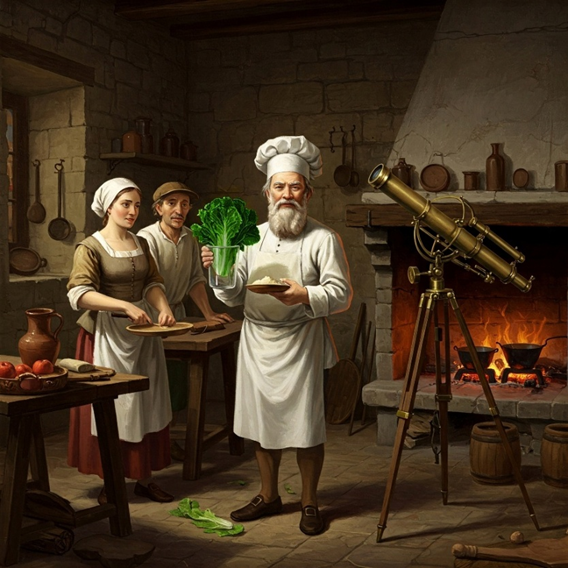
Salviatus: Ah, dear Simplicius, how quaint thy faith in vessels. Permit me to elaborate with the fullness this foolishness begs. A cup, as used here, is a measure of volume, not mass. Yet collards, when cooked, submit themselves to the will of the physics most violently. One might say that a plenty of raw collards, verdant and voluminous, upon the fire becomes but a soggy testament to entropy.
Sagreda: And yet if I, with ladle in hand, press them lightly, I may fill a cup with tender grace. But if I should tamp them down, as a banker tamps tobacco, I might squeeze thrice more into the same vessel.
Salviatus: Just so! And here lies its absurdity. The recipe calls for a cup, as though the collards were flour, or water, or some polite ingredient that hold the law of uniformity. But collards — and forgive my speaking plainly — are rogues. One cook’s gentle heap is another’s aggressive compression. Thus, a recipe using such a measure becomes not a method, but a riddle, a culinary Sphinx.
Simplicius: But might not tradition account for this? For is it not the case that housewives and cooks of yore prepared these dishes with their senses and not with scales?
Salviatus: A fair point, though flawed in its application. While the tongue and eye may suffice for the seasoned cook, the written recipe aspires to universality. It must serve the neophyte, the scholar, the gentleman abroad who seeks to replicate his mother’s collard pie with exactitude. And for these noble aims, only the scale may speak truth. Grams! Ounces! Units immutable, not subject to whim or squish!
Sagreda: You speak as though the collards, once cooked, engage in a deceit, cloaking their true nature.
Salviatus: Precisely. Cooked collards are like old courtiers — soft, pliable, and accustomed to hiding their substance beneath a veneer of humility. Only by weight can one know their worth. Or, more precisely, by its mass, the measure we know to not affect the rate at which objects fall.
Simplicius: But if all this be so, then is not every cookbook a liar? Is not every recipe suspect?
Salviatus: Not every recipe — only those who trade in volumetric folly where mass would bring enlightenment. The fault lies not in the recipe’s heart, but in its measurement. And this, dear Simplicius, we may yet amend.
Sagreda: Then shall we henceforth mark in our books, “Not a cup, but a weight; not a guess, but a truth“? For a measure of collards, like men, must be judged not by appearance, but by their substance.
Sagreda (reflecting): And yet, gentlemen, if I may permit a musing most unorthodox, does not all this emphasis on precision edge us perilously close to an unyielding, mechanical conception of science? Dare we call it… dogmatic?
Simplicius: Dogmatic? You surprise me, Signora. I thought it only the religion of Bellarmino and Barberini could carry such a charge.
Salviatus: Ha! Then you have not read the scribblings of Herr Paulus Feyerabend, who, proclaims with no small glee — and with more than of a trace of Giordano Bruno — that anything goes in the pursuit of knowledge. He teaches that the science, when constrained by method, becomes no different from myth.
Sagreda: Fascinating! And would this Feyerabend defend, then, the use of “a cup of cooked collards” as a sound epistemic act?
Salviatus: Indeed, he might. He would argue that inexactitude, even vagueness, can have its place. That Sagreda’s venerable aunt, the old wives, the village cooks, with their pinches and handfuls and mysteriously gestured “quanta bastas,” have no less a claim to truth than a chef armed with scales and thermocouples. He might well praise the “cup of cooked collards” as a liberating epistemology, a rejection of culinary tyranny.
Simplicius: Then Feyerabend would have me trust Sagreda’s aunt over the chemist?
Salviatus: Just so — he would, and be half right at least! Feyerabend’s quarrel is not with truth, but with monopoly over its definition. He seeks not the destruction of science, but the dethronement of science enthroned as sacred law. In this spirit, he might say: “Let the collards be measured by weight, or not at all, for the joy of the dish may reside not in precision, but in a dance of taste and memory.”
Sagreda: A heady notion! And perhaps, like a stew, the truth lies in the balance — one must permit both the grammar of measurement and the poetry of intuition. The recipe, then, is both science and art, its ambiguity not a flaw, but sometimes an invitation.
Salviatus: Beautifully said, Signora. Yet let us remember: Feyerabend champions chaos as a remedy for tyranny, not as an end in itself. He might defend the cook who ignores the scale, but not the recipe which claims false precision where none is due. And so, if we declare “a cup of cooked collards,” we ought either to define it, or admit with humility that we have no idea how many leaves is right to each observer.
Simplicius: Then science and the guessing of aunts may coexist — so long as neither pretends to be the other?
Salviatus: Precisely. The scale must not scorn the hunch, nor the cup dethrone the scale. But let us not forget: when preparing a dish to be replicated, mass is our anchor in the storm of leafy deception.
Sagreda (opening her laptop): Ah! Then let us dedicate this dish — to Feyerabend, to Bruno, to my venerable aunt. I will append to her recipe, notations from these reasonings on contradiction and harmony.
Cooked collards are like old courtiers — soft, pliable, and accustomed to hiding their substance beneath a veneer of humility — Salviatus
Sagreda (looking up from her laptop with astonishment): Gentlemen! I have stumbled upon a most curious nutritional claim. This USDA document — penned by government scientist or rogue dietitian — declares with solemn authority that a cup of cooked collards contains 266 grams calcium and a cup raw only 52.
Salviatus (arching an eyebrow): More calcium? From whence, pray, does this mineral bounty emerge? For collards, like men, cannot give what they do not possess.

Simplicius (waving a wooden spoon): It is well known, is it not, that cooking enhances healthfulness? The heat releases the virtues hidden within the leaf, like Barberini stirring the piety of his reluctant congregation!
Salviatus: Simplicius, your faith outpaces your chemistry. Let us dissect this. Calcium, as an element, is not born anew in the pot. It is not conjured by flame nor summoned by steam. It is either present, or it is not.
Simplicius: So how, then, can it be that the cooked collards have more calcium than their raw counterparts — cup for cup?
Sagreda: Surely, again, the explanation is compression. The cooking drives out water, collapses volume, and fills the cup more densely with matter formerly bulked by air and hubris.
Salviatus: Exactly so! A cup of cooked collards is, in truth, the compacted corpse of many cups raw — and with them, their calcium. The mineral content has not changed; only the volume has bowed before heat’s stern hand.
Simplicius: But surely the USDA, a most probable power, must be seen as sovereign on the matter. Is there no means, other than admitting the slackness of their decree, by which we can serve its authority?
Salviatus: Then, Simplicius, let us entertain absurdity. Suppose for a moment — as a thought experiment — that the cooking process does, in fact, create calcium.
By what alchemy? What transmutation?
Let us assume, in a spirit of lunatic (and no measure anachronous) generosity, that the humble collard leaf contains also magnesium — plentiful, impudent magnesium — and that during cooking, it undergoes nuclear transformation. Though they have the same number of valence electrons, to turn magnesium (atomic number 12) into calcium (atomic number 20), we must add 8 protons and a healthy complement of neutrons.
Sagreda: But whence come these subatomic parts? Shall we pluck nucleons from the steam?
Salviatus (solemnly): We must raid the kitchen for protons as a burglar raids a larder. Perhaps the protons are drawn from the salt, or the neutrons from baking powder, or perhaps our microwave is a covert collider, transforming our soup pot into CERN-by-candlelight.
But alas — this would take more energy than a dozen suns, and the vaporizing of the collards in a burst of gamma rays, leaving not calcium-rich greens but a crater and a letter of apology due. But, we know, do we not, that the universe is indifferent to apology; the earth still goes round the sun.
Sagreda: Then let us admit: the calcium remains the same. The difference is illusion — an artifact of measurement, not of matter.
Salviatus: Precisely. And the USDA, like other sovereigns, commits nutritional sophistry — comparing unlike volumes and implying health gained by heat alone, or, still worse, that we hold it true by unquestioned authority.
Let this be our final counsel: whenever the cup is invoked, ask, “Cup of what?” If it be cooked, know that you measure the ghost of raw things past, condensed, wilted, and innocent of transmutation.
The scale must not scorn the hunch, nor the cup dethrone the scale. – Salviatus
Thus ends the matter of the calcium-generating cauldron, in which it hath been demonstrated to the satisfaction of reason and the dismay of the USDA that no transmutation of elements occurs in the course of stewing collards, unless one can posit a kitchen fire worthy of nuclear alchemy; and furthermore, that the measure of leafy matter must be governed not by the capricious vulgarity of volume, but by the steady hand of mass, or else be entrusted to the most excellent judgment of aunts and cooks, whose intuitive faculties may triumph over quantification outright. The universe, for its part, remains intact, and the collards, alas, are overcooked.
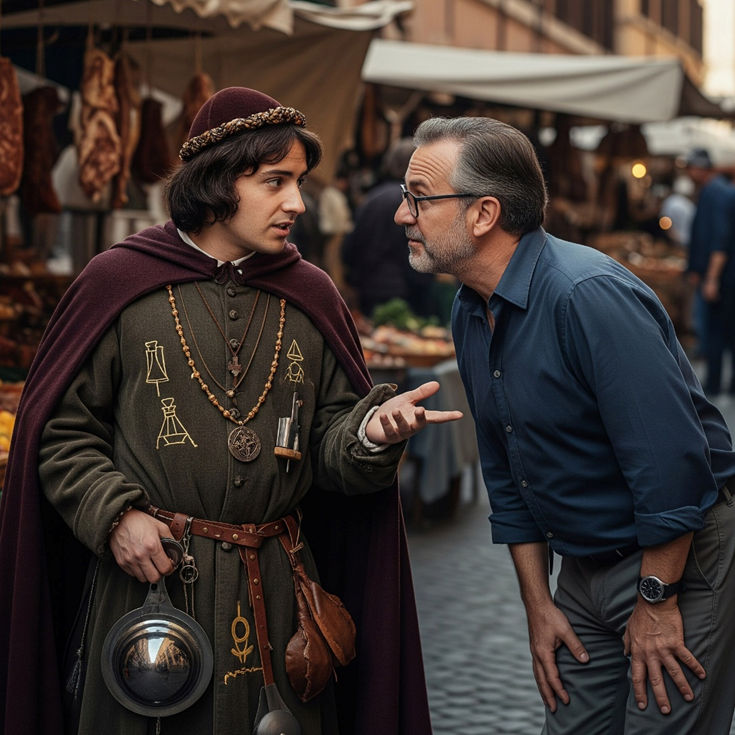
Giordano Bruno discusses alchemy with Paul Feyerabend. Campo de’ Fiori, Rome, May 1591.
Galileo’s Dialogue Concerning the Two Chief World Systems is a proto-scientific work presented as a conversation among three characters: Salviati, Sagredo, and Simplicio. It compares the Copernican heliocentric model (Earth revolves around Sun) and the traditional Ptolemaic geocentric model (Earth as center). Salviati represents Galileo’s own views and advocates for the Copernican system, using logic, mathematics, observation, and rhetoric. Sagredo is an intelligent, neutral layman who asks questions and weighs the arguments, representing the open-minded reader. Simplicio, a supporter of Aristotle and the geocentric model held by the church, struggles to defend his views and is portrayed as naive. Through their discussion, Galileo gives evidence for the heliocentric model and critiques the shortcomings of the geocentric, making a strong case for scientific reasoning based on observation rather than tradition and authority. Cardinal Roberto Bellarmino and Maffeo Barberini (Pope Urban VIII) were the central clergy figures in Galileo’s trial. In 1970 Paul Feyerabend argued that modern institutional science resembled the church more than it did Galileo. The Dominican monk, Giordano Bruno, held unorthodox ideas in science and theology. Bellarmino framed the decision leading to his conviction of heresy in 1600. He was burned at the stake in the plaza of Campo de’ Fiori, where I stood not one hour before writing this.
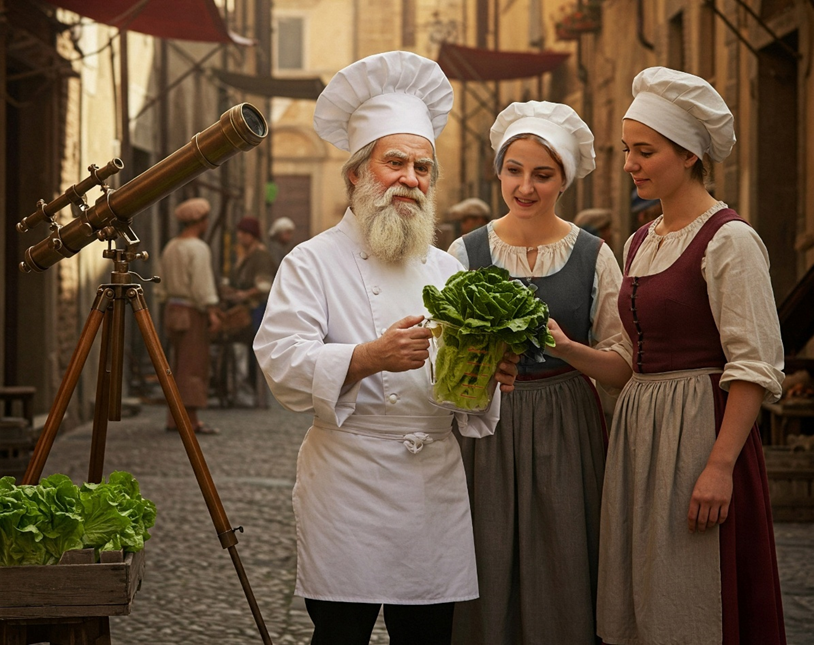
Galileo with collard vendors in Pisa
 The Multidisciplinarian
#1 by Anonymous on May 28, 2025 - 4:40 am
A most amusing and enlightening exchange, my good sir! Your wit and erudition coexist happily and hath provided a most pleasant diversion this day!
#2 by Atty at Purchasing on June 1, 2025 - 6:46 am
simplicious would make a good ‘experts’ in, say, the usda. Like a priest to ensure, even induce, adherence to orthodoxy, which is its own ‘truth’