Archive for August, 2025
Roxy Music and Forgotten Social Borders
Posted by Bill Storage in History of Art on August 20, 2025
In the early 1970s rock culture was diverse, clannish and fiercely territorial. Musical taste usually carried with it an entire identity, including hair length and style, clothing – including shoes/boots – politics, and which record stores you could haunt. King Crimson, Yes, Pink Floyd, and Emerson, Lake & Palmer belonged to the progressive end of the spectrum.
By the early 1970s, progressive rock (prog, as shorthand began to appear in music press) was musical descriptor and social signal. Calling a band “progressive” implied a certain seriousness, technical sophistication, and intellectual ambition. It marked a listener as someone who prized virtuosity, complexity, and concept albums over pop singles. The label carried subtle class and educational connotations: prog fans were expected to appreciate classical references, odd time signatures, extended solos, and experimental studio techniques. King Crimson was often called avant-garde rock, though Henry Cow deserved the label much more. ELP was called symphonic rock, Pink Floyd was psychedelic rock, and Yes was Epic rock – but they were all prog. And listening to all this stuff made you smart. Or pretentious.

Across the divide, the early 70s saw greaser rock and the emerging ’50s nostalgia circuit. Sha Na Na, the sock-hop revival, the idea that a gold lamé suit was a passport to a simpler age ushered in the Happy Days craze and its music. Few people straddled those camps. A Crimson devotee wouldn’t admit to liking Sha Na Na if he wanted to keep his dignity. Rock music was attitude, self-image, and worldview.
Into that landscape stepped Roxy Music in 1972, and they were utterly bewildering. Bryan Ferry came dressed like a lounge lizard from a time-warped jukebox, crooning with a sincerity that clearly wasn’t parody or caricature. Still, it was far too stylized to be mere mimicry. His band conjured a storm of dissonant non-keyboard electronics, angular rhythms, and Brian Eno’s futuristic treatments. Roxy Music embraced rather than mocked the early rock gestures of Elvis’s era. Ferry gave listeners permission to take Jerry Lee Lewis seriously, even reverently. Lewis was suddenly an avant-garde icon, pounding the keys with the same abandon that Eno applied to his electronics (witness Richard Trythall’s 1977 musique concrète: Omaggio a Jerry Lee Lewis).
That was the radicalism of early Roxy Music, which cannot be grasped retrospectively, even by the most avid young musicologist. Roxy dissolved the borders that the tribes of 1972 held sacred. They showed that ’50s rock, glam stylization, and avant-garde electronics could coexist in an unstable but persistent alloy. The shock of that is hard to grasp from today’s vantage point, when music is not tied to identity and “classic-rock” Roxy Music is remembered for Ferry’s Avalon-era suave crooning.
Oddly, and I think almost uniquely, as the band moved mainstream over the next fifteen years, the noisy, Eno-era chaos was retroactively smoothed into the same brand identity as Avalon. For later fans, there was no sharp rupture; the old chaos was domesticated and folded back into the same style sensibility.
But the rupture had existed. Their cover art reinforced it. Roxy Music (1972) with Kari-Ann Muller posing like a mid-century pin-up, was tame in skin exposure compared to H.R. Giger’s biomechanical nudity on ELP’s Brain Salad Surgery. The boldness of Roxy Music’s cover lay in context, not ribaldry. The sleeve was bluntly terrestrial. For a prog listener used to studying a Roger Dean landscape on a first listen of a new Yes album, Roxy Music surely seemed an insult to seriousness.
When Fleetwood Mac reinvented themselves in 1975, new listeners treated it as rebirth. The Peter Green blues band that authored Black Magic Woman and the Buckingham–Nicks hit machine lived in separate mental compartments. Very few Rumours-era fans felt obliged to revisit Then Play On or Kiln House, and most who did saw them as curiosities. Similarly, Genesis underwent a hard split. Its listeners did not treat Foxtrot and Invisible Touch as facets of a single project.
Roxy Music’s retrospective smoothing is almost unique in rock. Their chaos was polished backward into elegance. The Velvet Underground went the other way. At first their noise was cultish, even disposable. But as the legend of Reed, Cale, and Nico grew, the past was recoded as prophecy. White Light/White Heat became the seed of punk. The Velvet Underground & Nico turned into the Bible of indie rock. Even Loaded – a deliberate grab for radio play, stripped of abrasion – was absorbed into the myth and remembered as avant-garde. It wasn’t. But the halo of the band’s legend bled forward and made every gesture look radical.
Roxy Music remains an oddity. The suave Avalon listener in 1982 could put on Virginia Plain without embarrassment and believe that those early tracks were nearby on a continuum. Ferry’s suave sound bled backward and redefined the chaos. He retroactively re-coded the Eno-era racket. The radical rupture was smoothed out beneath the gloss of brand identity.
That’s why early Roxy is so hard to hear as it was first heard. In 1972 it was unclassifiable, a collision of tribes and eras. To grasp it, you have to forget everything that came after. Imagine a listener whose vinyl shelf ended with The Yes Album, Aqualung, Tarkus, Ash Ra Tempel, Curved Air, Meddle, Nursery Cryme, and Led Zeppelin IV. Sha Na Na was a trashy novelty act recycling respected antiques – Dion and the Belmonts, Ritchie Valens, Danny and the Juniors. Disco, punk, new wave? They didn’t exist.
Now, in that silence, sit back and spin up Ladytron.
“He Tied His Lace” – Rum, Grenades and Bayesian Reasoning in Peaky Blinders
Posted by Bill Storage in Probability and Risk on August 4, 2025
“He tied his lace.” Spoken by a jittery subordinate halfway through a confrontation, the line turns a scene in Peaky Blinders from stylized gangster drama into a live demonstration of Bayesian belief update. The scene is a tightly written jewel of deadpan absurdity.
(The video clip and a script excerpt from Season 2, Episode 6 appears at the bottom of this article – rough language. “Peaky blinders,” for what its worth, refers to young brits in blindingly dapper duds and peaked caps in the 1920s.)
The setup: Alfie Solomons has temporarily switched his alliance from Tommy Shelby to Darby Sabini, a rival Italian gangster, in exchange for his bookies being allowed at the Epsom Races. Alfie then betrayed Tommy by setting up Tommy’s brother Arthur and having him arrested for murder. But Sabini broke his promise to Alfie, causing Alfie to seek a new deal with Tommy. Now Tommy offers 20% of his bookie business. Alfie wants 100%. In the ensuing disagreement, Alfie’s man Ollie threatens to shoot Tommy unless Alfie’s terms are met.
Tommy then offers up a preposterous threat. He claims to have planted a grenade and wired it to explode if he doesn’t walk out the door by 7pm. The lynchpin of this claim? That he bent down to tie his shoe on the way in, thereby concealing his planting the grenade among Alfie’s highly flammable bootleg rum kegs. Ollie falls apart when, during the negotiations, he recalls seeing Tommy tie his shoe on the way in. “He tied his lace,” he mutters frantically.
In another setting, this might be just a throwaway line. But here, it’s the final evidence given in a series of Bayesian belief updates – an ambiguous detail that forces a final shift in belief. This is classic Bayesian decision theory with sequential Bayesian inference, dynamic belief updates, and cost asymmetry. Agents updates their subjective probability (posterior) based on new evidence and choose an action to maximize expected utility.
By the end of the negotiation, Alfie’s offering a compromise. What changes is not the balance of lethality or legality, but this sequence of increasingly credible signals that Tommy might just carry through on the threat in response to Alfie’s demands.
As evidence accumulates – some verbal, some circumstantial – Alfie revises his belief, lowers his demands, and eventually accepts a deal that reflects the posterior probability that Tommy is telling the truth. It’s Bayesian updating with combustible rum, thick Cockney accents, and death threats delivered with stony precision.
Bayesian belief updating involves (see also *):
- Prior belief (P(H)): Initial credence in a hypothesis (e.g., “Tommy is bluffing”).
- Evidence (E): New information (e.g., a credible threat of violence, or a revealed inconsistency).
- Likelihood (P(E|H)): How likely the evidence is if the hypothesis is true.
- Posterior belief (P(H|E)): Updated belief in the hypothesis given the evidence.
In Peaky Blinders, the characters have beliefs about each other’s natures, e.g., ruthless, crazy, bluffing.
The Exchange as Bayesian Negotiation
Initial Offer – 20% (Tommy)
This reflects Tommy’s belief that Alfie will find the offer worthwhile given legal backing and mutual benefits (safe rum shipping). He assumes Alfie is rational and profit-oriented.
Alfie’s Counter – 100%
Alfie reveals a much higher demand with a threat attached (Ollie + gun). He’s signaling that he thinks Tommy has little to no leverage – a strong prior that Tommy is bluffing or weak.
Tommy’s Threat – Grenade
Tommy introduces new evidence: a possible suicide mission, planted grenade, anarchist partner. Alfie must now update his beliefs:
- What is the probability Tommy is bluffing?
- What’s the chance the grenade exists and is armed?
Ollie’s Confirmation – “He tied his lace…”
This is independent corroborating evidence – evidence of something anyway. Alfie now receives a report that raises the likelihood Tommy’s story is true (P(E|¬H) drops, P(E|H) rises). So Alfie updates his belief in Tommy’s credibility, lowering his confidence that he can push for 100%.
The offer history, which controls their priors and posteriors:
- Alfie lowers from 100% → 65% (“I’ll bet 100 to 1”)
- Tommy rejects
- Alfie considers Tommy’s past form (“he blew up his own pub”)
This shifts the prior. Now P(Tommy is reckless and serious) is higher. - Alfie: 65% → 45%
- Tommy: Counters with 30%
- Tommy adds detail: WWI tunneling expertise, same grenade kit, he blew up a mine
- Alfie checks for inconsistency (“I heard they all got buried”)
Potential Bayesian disconfirmation. Is Tommy lying? - Tommy: “Three of us dug ourselves out” → resolves inconsistency
The model regains internal coherence. Alfie’s posterior belief in the truth of the grenade story rises again. - Final offer: 35%
They settle, each having adjusted credence in the other’s threat profile and willingness to follow through.
Analysis
Beliefs are not static. Each new statement, action, or contradiction causes belief shifts. Updates are directional, not precise. No character says “I now assign 65% chance…” but, since they are rational actors, their offers directly encode these shifts in valuation. We see behaviorally expressed priors and posteriors. Alfie’s movement from 100 to 65 to 45 to 35% is not arbitrary. It reflects updates in how much control he believes he has.
Credibility is a Bayesian variable. Tommy’s past (blowing up his own pub) is treated as evidence relevant to present behavior. Social proof is given by Ollie. Ollie panics on recalling that Tommy tied his shoe. Alfie chastises Ollie for being a child in a man’s world and sends him out. But Alfie has already processed this Bayesian evidence for the grenade threat, and Tommy knows it. The 7:00 deadline adds urgency and tension to the scene. Crucially, from a Bayesian perspective, it limits the number of possible belief revisions, a typical constraint for bounded rationality.
As an initial setup, let:
- T = Tommy has rigged a grenade
- ¬T = Tommy is bluffing
- P(T) = Alfie’s prior that Tommy is serious
Let’s say initially:
P(T) = 0.15, so P(¬T) = 0.85
Alfie starts with a strong prior that Tommy’s bluffing. Most people wouldn’t blow themselves up. Tommy’s a businessman, not a suicide bomber. Alfie has armed men and controls the room.
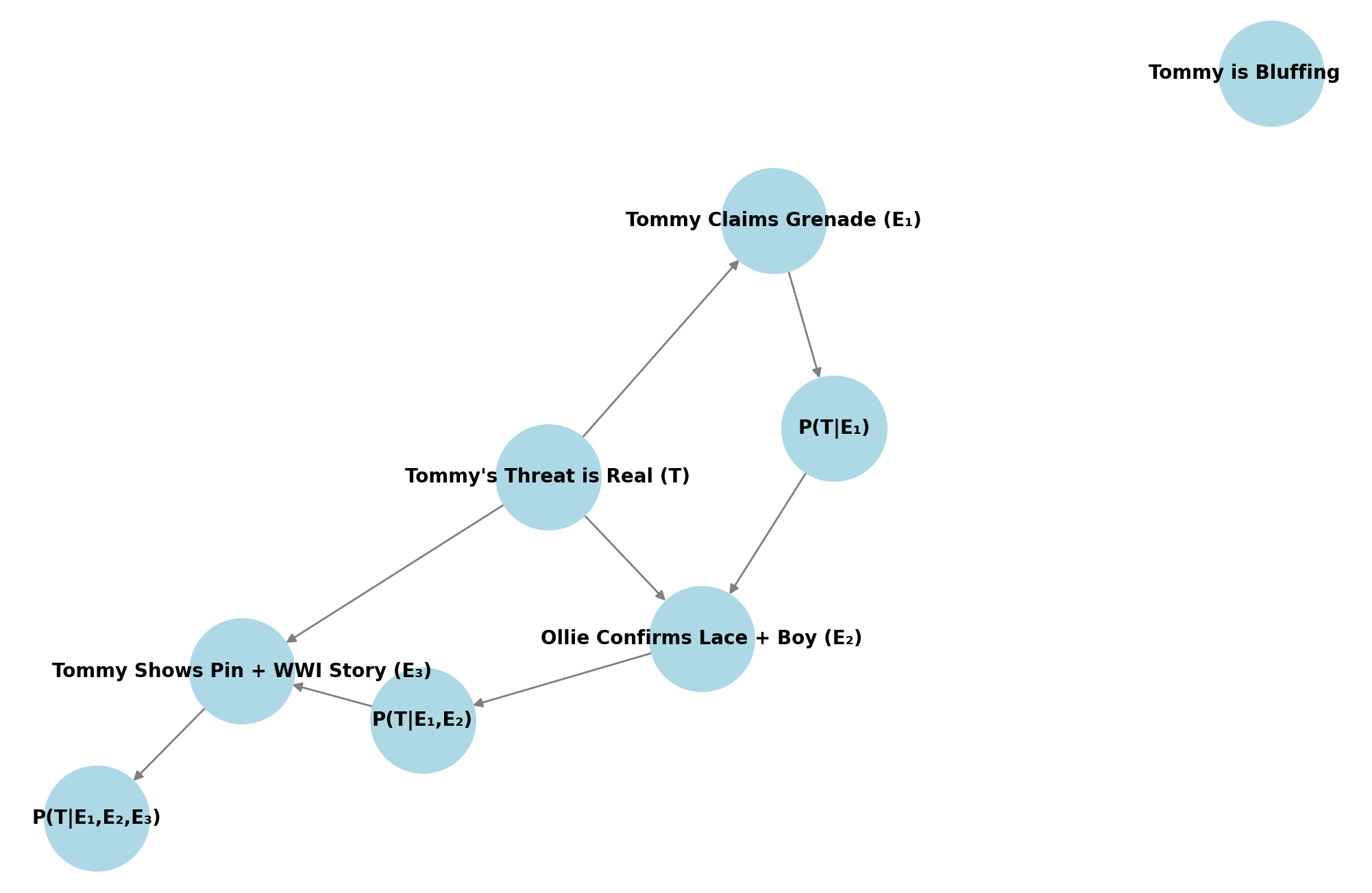
Sequence of Evidence and Belief Updates
Evidence 1: Tommy’s grenade threat
E₁ = Tommy says he planted a grenade and has an assistant with a tripwire
We assign:
- P(E₁|T) = 1 (he would say so if it’s real)
- P(E₁|¬T) = 0.7 (he might bluff this anyway)
Using Bayes’ Theorem:
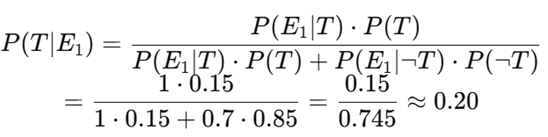
So now Alfie gives a 20% chance Tommy is telling the truth. Behavioral result: Alfie lowers the offer from 100% → 65%.
Evidence 2: Ollie confirms the lace-tying + nervousness
E₂ = Ollie confirms Tommy bent down and there’s a boy at the door
This is independent evidence supporting T.
- P(E₂|T) = 0.9 (if it’s true, this would happen)
- P(E₂|¬T) = 0.3 (could be coincidence)
Update:
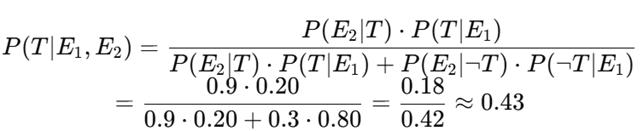
So Alfie now gives 43% probability that the grenade is real. Behavioral result: Offer drops to 45%.
Evidence 3: Tommy shows grenade pin + WWI tunneler claim
E₃ = Tommy drops the pin and references real tunneling experience
- P(E₃|T) = 0.95 (he’d be prepared and have a story)
- P(E₃|¬T) = 0.5 (he might fake this, but riskier)
Update:

Now Alfie believes there’s nearly a 60% chance Tommy is serious. Behavioral result: Offer rises slightly to 35%, the final deal.
Simplified Utility Function
Assume Alfie’s utility is:
U(percent) = percent ⋅ V−C ⋅ P(T)
Where:
- V = Value of Tommy’s export business (let’s say 100)
- C = Cost of being blown up (e.g., 1000)
- P(T) = Updated belief Tommy is serious
So for 65%, with P(T) = 0.43:
U = 65 – 1000 ⋅ 0.43 = 65 – 430 = −365
But for 35%, with P(T) = 0.59:
U = 35 – 1000 ⋅ 0.59 = 35 – 590 = −555
Here we should note that Alfie’s utility function is not particularly sensitive to the numerical values of V and C; using C = 10,000 or 500 doesn’t change the relative outcomes much. So, why does Alfie accept the lower utility? Because risk of total loss is also a factor. If the grenade is real, pushing further ends in death and no gain. Alfie’s risk appetite is negatively skewed.
At the start of the negotiation, Alfie behaves like someone with low risk aversion by demanding 100%, assuming dominance, and later believing Tommy is bluffing. His prior is reflect extreme confidence and control. But as the conversation progresses, the downside risk becomes enormous: death, loss of business, and, likely worse, public humiliation.
The evidence increasingly supports the worst-case scenario. There’s no compensating upside for holding firm, no added reward for risking everything to get 65% instead of 35%.
This flips Alfie’s profile. He develops a sharp negative skew in risk appetite, especially under time pressure and mounting evidence. Even though 35% yields a worse expected utility than 65%, it avoids the long tail – catastrophic loss.
***
[Tommy is seated in Alfie’s office]
Alfie (to Tommy): That’ll probably be for you, won’t it?
Tommy: Hello? Arthur. You’re out.
Alfie: Right, so that’ll be your side of the street swept up, won’t it? Where’s mine? What you got for me?
Tommy: Signed by the Minister of the Empire himself. Yeah? So it is.
Tommy: This means that you can put your rum in our shipments, and no one at Poplar Docks will lift a canvas.
Alfie: You know what? I’m not even going to have my lawyer look at that.
Tommy: I know, it’s all legal.
Alfie: You know what, mate, I trust you. That’s that. Done. So, whisky… There is, uh, one thing, though, that we do need to discuss.
Tommy: What would that be?
Alfie: It says here, “20% “paid to me of your export business.”
Tommy: As we agreed on the telephone…
Alfie: No, no, no, no, no. See, I’ve had my lawyer draw this up for us, just in case. It says that, here, that 100% of your business goes to me.
Tommy: I see.
Alfie: It’s there.
Tommy: Right.
Alfie: Don’t worry about it, right, because it’s totally legal binding. All you have to do is sign the document and transfer the whole lot over to me.
Tommy: Sign just here, is it?
Alfie: Yeah.
Tommy: I see. That’s funny. That is.
Alfie: What?
Tommy: No, that’s funny. I’ll give you 100% of my business.
Alfie: Yeah.
Tommy: Why?
[Ollie appears and aims a revolver at Tommy]
Alfie: Ollie, no. No, no, no. Put that down. He understands, he understands. He’s a big boy, he knows the road. Now, look, it’s just non-fucking-negotiable. That’s all you need to know. So all you have to do is sign the fucking contract. Right there.
Tommy: just sign here?
Alfie: With your pen.
Tommy: I understand.
Alfie: Good. Get on with it.
Tommy: Well, I have an associate waiting for me at the door. I know that he looks like a choir boy, but he is actually an anarchist from Kentish Town.
Alfie: Tommy… I’m going to fucking shoot you. All right?
Tommy: Now, when I came in here, Mr. Solomons, I stopped to tie my shoelace. Isn’t that a fact? Ollie?
Tommy: I stopped to tie my shoelace. And while I was doing it, I laid a hand grenade on one of your barrels.
Tommy: Mark 15, with a wired trip. And my friend upstairs… Well, he’s like one of those anarchists that blew up Wall Street, you know? He’s a professional. And he’s in charge of the wire. If I don’t walk out that door on the stroke of 7:00, he’s going to trigger the grenade and… your very combustible rum will blow us all to hell. And I don’t care… because I’m already dead.
Ollie: He tied his lace, Alfie. And there is a kid at the door.
Tommy: From a good family, too. Ollie, it’s shocking what they become…
Alfie (to Ollie): What were you doing when this happened?
Ollie: He tied his lace, nothing else.
Alfie: Yeah, but what were you doing?
Ollie: I was marking the runners in the paper.
Alfie: What are you doing?
Tommy: Just checking the time. Carry on.
Alfie: Right, Ollie, I want you to go outside, yeah, and shoot that boy in the face – from the good family, all right?
Tommy: Anyone walks through that door except me, he blows the grenade.
Ollie: He tied his fucking lace…
Tommy: I did tie my lace.
Alfie: I bet, 100 to 1, you’re fucking lying, mate. That’s my money.
Tommy: Well, see, you’ve failed to consider the form. I did blow up me own pub… for the insurance.
Alfie: OK right… Well, considering the form, I would say 65 to 1. Very good odds. And I would be more than happy and agree if you were to sign over 65% of your business to me. Thank you.
Tommy: Sixty-five? No deal.
Alfie: Ollie, what do you say?
Ollie: Jesus Christ, Alfie. He tied his fucking lace, I saw him! He planted a grenade, I know he did. Alfie, it’s Tommy fucking Shelby…
[Alfie smacks Ollie across the face, grabs him by the collar, pulls him close and looks straight into his face.]
Alfie to Ollie: You’re behaving like a fucking child. This is a man’s world. Take your apron off, and sit in the corner like a little boy. Fuck off. Now.
Tommy: Four minutes.
Alfie: All right, four minutes. Talk to me about hand grenades.
Tommy: The chalk mark on the barrel, at knee height. It’s a Hamilton Christmas. I took out the pin and put it on the wire.
[Tommy produces a pin from his pocket and drops it on the table. Alfie inspects it.]
Alfie: Based on this… forty-five percent. [of Tommy’s business]
Tommy: Thirty.
Alfie: Oh, fuck off, Tommy. That’s far too little.
Tommy: In France, Mr. Solomons, while I was a tunneller, a clay-kicker. 179. I blew up Schwabenhöhe. Same kit I’m using today.
Alfie: It’s funny, that. I do know the 179. And I heard they all got buried.
[Alfie looks at Tommy as though he has caught him in an inconsistency]
Tommy: Three of us dug ourselves out.
Alfie: Like you’re digging yourself out now?
Tommy: Like I’m digging now.
Alfie: Fuck me. Listen, I’ll give you 35%. That’s your lot.
Tommy: Thirty-five.
[Tommy and Alfie shake hands. Tommy leaves.]
Gospel of Mark: A Masterpiece Misunderstood, Part 7 – Mark Before Modernism
Posted by Bill Storage in History of Christianity on August 3, 2025
See Part 1, Part 2, Part 3, Part 4, Part 4, Part 5, Part 6
In ancient Greek theater, like Sophocles’s Oedipus Rex, dramatic irony was central. Audiences knew Oedipus’s fate while he remained ignorant. This technique was carried into Roman drama, like Seneca’s tragedies. As described earlier, Christian writers moved away from irony in the late antique period.
During the Renaissance, Shakespeare used dramatic irony heavily. In Romeo and Juliet, the audience knows Juliet’s “death” is staged, but Romeo doesn’t. Such irony remained common in 17th- and 18th-century European drama, as in Molière’s comedies, but less structurally central than in Greek tragedy. The 19th century saw it in melodrama and novels (e.g., Thomas Hardy’s Tess of the d’Urbervilles), where readers grasped fates characters couldn’t.
In the 20th century, dramatic irony shifted. Modernist works like Brecht’s epic theater used it deliberately to alienate audiences, encouraging critical reflection. O’Neill’s plays (Long Day’s Journey into Night) leaned on it for emotional weight.
The Gospel of Mark seems to anticipate literary modernism. Mark didn’t invent stream of consciousness or set his gospel in a world of urban alienation. But the instincts of modernist storytelling – deliberate ambiguity, refusal to explain, the layering of voices, the elevation of reader above character, the fragmentary sense of time – are already alive in Mark. They are what make the gospel feel so strange to readers trained on the smoother harmonies of Matthew and Luke. In literary style, Mark seems to reach both far back, to the ancient Greeks, and far ahead, to modernism. He writes more as dramatist than as evangelist, putting him in unexpected company.
Withheld Meaning: Proust’s Readers and Mark’s
Modernist literature often refuses to say what it means. It circles themes without resolving them. It trusts the reader to infer. Mark gives riddles disguised as parables, miracles that aren’t explained, and a resurrection that isn’t shown. Not glory, but silence.
In Swann’s Way, Proust captures this same dynamic, not in plot, but in psychological structure. Swann, obsessively reading the behavior of the woman he loves, becomes a figure of frustrated interpretation:
“He belonged to that class of men who… are capable of discovering in the most insignificant action a symbol, a menace, a piece of evidence, and who are no more capable of not interpreting a movement of the person they love than a believer is of not interpreting a miracle.”
There’s the reader Mark aimed for, watching every detail, looking for signs.
Beckett and the Failed Witness
Beckett’s characters, like Vladimir and Estragon in Waiting for Godot and Winnie in Happy Days are excluded from understanding. They wait for voices that don’t explain, and they continue despite knowing the endpoint will never come.
Vladimir (Waiting for Godot): Suppose we repented.
Estragon: Repented what?
Vladimir: Oh… (He reflects.) We wouldn’t have to go into the details.
Estragon: Our being born?
In Mark, the reader continues after the characters collapse. The women flee the tomb. The disciples abandon the frame. The gospel stops, but the reader continues – because Mark has structured the story so that you see what they don’t.
Beckett once said that Joyce was always adding to his prose, and that he himself was working in the opposite direction: “I realized that my own way was in impoverishment, in lack of knowledge and in taking away.”
Mark takes away. He subtracts resurrection appearances and erases resolution. What remains is a void that insists on meaning – not through declaration, but through the reader’s isolation.
Unreliable Perception and Faulkner’s Disciples
In Faulkner’s works like The Sound and the Fury, characters narrate their experiences through fragmented, subjective lenses, often unaware of the full scope of their stories. Their voices – Quentin Compson’s anguished stream-of-consciousness or Addie Bundren’s posthumous reflections – clash and contradict, leaving gaps that the reader must navigate. This aligns with reader-response criticism, which emphasizes the reader’s active role in interpreting and reconstructing meaning from incomplete or biased accounts. Faulkner’s narrators don’t deliver a tidy “truth”; they offer perspectives clouded by personal trauma, guilt, or limited understanding. Quentin, for instance, obsesses over time and his sister Caddy’s fall, but his mental collapse distorts his narrative, forcing the reader to piece together the Compson family’s decay from his fractured memories and those of his brothers.
Faulkner’s unreliable narrators force the reader to rise above their limitations, synthesizing disparate voices to uncover a truth that no single character fully grasps.
Mark gives us the same through the disciples. They speak, but they are not to be trusted. They fear Jesus’s passion predictions and change the subject. And unlike Luke, Mark never rehabilitates them.
As with Faulkner, their unreliability is device. Mark lets them fall so you can rise, just as Faulkner allows Quentin’s breakdown to weave time, memory, and guilt into the fabric of the narrative. Faulkner’s chaos of competing voices reflects the human condition – fragmented, subjective, and burdened by history. In Mark, the disciples’ failures underscore the radical nature of Jesus’s mission, which defies human expectations of power and glory.
Beckett on the Death of the Subject
Samuel Beckett, writing on Proust in 1931, described the modern condition as a crisis, not of plot, but of self:
“We are not merely more weary because of yesterday, we are other, no longer what we were before the calamity of yesterday… The subject has died – and perhaps many times – on the way.”
This is the shape of Mark’s gospel. The narrator sees all but explains nothing. The disciples begin as named voices and end as absences. The final scene gives no resolution. Time, once galloping forward with Mark’s “immediately” at every step, halts in a tomb that no one enters.
The reader is left standing outside the story with a question its characters cannot answer.
Gospel of Ellipsis: Hemingway’s Surface Tension
Hemingway’s prose derives its emotional power from deliberate restraint, a technique often described as the “iceberg theory,” where the bulk of meaning lies beneath the surface of the text. In stories like Hills Like White Elephants, he employs sparse, minimalist dialogue and understated narration to convey profound emotional and thematic weight without explicitly stating the core issues. The story’s central conflict – an implied discussion about abortion between a man and a woman at a train station – is never directly named. Instead, Hemingway embeds the tension in clipped exchanges, pregnant pauses, and subtle imagery.
This restraint amplifies the emotional force by forcing readers to engage actively with the subtext. The silences between sentences – where characters avoid articulating their fears, desires, or regrets – carry the weight of unspoken truths. For example, when Jig says, “They look like white elephants,” and the man responds dismissively, the dialogue skirts the real issue, revealing their emotional disconnect and the power imbalance in their relationship. The unsaid looms larger than the said, making the reader feel the characters’ anxiety, uncertainty, and isolation.
Mark doesn’t explain the fig tree or narrate the resurrection. He doesn’t say why the women told no one. And when Jesus speaks cryptically, the narrator does not clarify. Mark doesn’t mismanage meaning, he suppresses it for effect. Like Hemingway, Mark trusts the reader to feel the weight of what isn’t said.
Kafka’s Gospel: Parable Without Answer
Kafka’s stories are often structured as parables – but not the kind that end in moral resolution. His parables frustrate the interpretive impulse. Their logic seems to point to something just beyond reach.
In Before the Law, a man spends his life trying to gain access to a door that was meant only for him. He dies without ever passing through. The priest in The Trial tells Joseph K. the parable – and then refuses to explain it.
In Mark 13:14, Jesus warns of an “abomination of desolation” and then stops mid-sentence. The narrator breaks in: “Let the reader understand.” Who is this reader? Not Peter, James, or John. You. Understand what? Mark’s narrator refuses to explain it.
Like Kafka, Mark knows the parable won’t resolve. He knows it exists to sharpen the hunger to understand. And the gospel itself becomes that hunger’s object.
Conclusion – Mark’s Gospel Came Too Soon
Even sympathetic readers struggle to see it. Because Mark says less the other gospels say, it is nearly impossible to read him without filling in what he left out. Harmonization is a habit learned in childhood. An untrained, unbiased, innocent reading – a first reading – by a western reader is almost unavailable. And so the masterpiece goes unnoticed because the broader story has been too thoroughly absorbed for the real Mark to be seen.
By theological or historical standards, Mark has long ranked lowest by far among the gospel writers. In early Christian citation, he accounts for barely 4% of gospel references. He is by far the shortest and the roughest, some say the least theologically rich. I disagree.
By modern literary standards – those that distrust omniscient narration and place the burden of meaning on the reader – Mark might be the rhetorical master of millennia.
That achievement is easily missed. I think it a shame that readers of modern literature rarely turn to the gospels, starting with Mark. And if they do, prior convictions prevent them from imagining it could house a work this strange, this far ahead of its time. Mark wasn’t experimenting with form for its own sake. He was a storyteller – one whose narrative instincts ran far ahead of his genre.
In his world of early Christianity, stories were expected to explain, miracles to prove, and heroes to be understood. Mark resists all of that. He gives us a Messiah who is misunderstood, a story that ends in silence, and a text that refuses to explain itself.
In other words, he wrote a modernist gospel – a work of quiet fire – before modernism existed.
Postscript: The Gospel That Leaves You Standing
Mark ends with absence– with flight, silence, and a rolled-away stone. That was the final move of a writer who trusted you to finish what he started.
Across this series, I haven’t treated Mark as theology but as what it so clearly is, once you stop trying to fix it: a story designed to be misunderstood by its characters and grasped by its reader. None of that should bear on your theology, beliefs, or lack thereof; it works regardless.
That story does not yield its truth by accumulating facts. It yields by withholding enough to make you reach. And when you do, something happens. You see what others miss. You feel the silence grow louder than the speech.
Even now, twenty centuries later, the final question still hangs–not in the mouths of the women at the tomb, but in yours: What are you going to do with what you’ve seen?
Gospel of Mark, Masterpiece Misunderstood, Part 6 – Mark, Paul and James: The Silence, the Self and the Law
Posted by Bill Storage in History of Christianity on August 2, 2025
Mark vs. Matthew and Luke: Redaction, Not Clarification
Matthew and Luke didn’t set out to clarify Mark, as many scholars have claimed. They were authors writing for different communities with different needs. They either misunderstood Mark’s rhetorical style, understood it but disliked it, or were indifferent to it altogether, merely reusing his stories and text. They took Mark’s gospel and Q as starting points, then reshaped them to fit their theological goals. In doing so, they smoothed its edges, filled in its silences, and reframed its mysteries using their own rhetorical styles.
Matthew, by most accounts, is rhetorically more refined than Mark. His Greek is more polished, and his theological framing is clearer. But Matthew and Luke lose Mark’s vividness. In my view, the most rhetorically daring gospel in Christianity was overwritten by its successors, and it is inaccurate or disingenuous to frame this as clarification.
Matthew and Luke reworked the fig tree. Mark’s fig tree vignette (11:12–14, 20–21) is famously strange, as discussed earlier: Jesus curses a tree for having no fruit out of season and Mark wraps the episode around the cleansing of the temple to enforce the metaphor.
Matthew’s version (21:18–22) changes the tempo: the tree withers immediately. The temple scene is unlinked. And the point is made explicit: it’s a lesson about faith and prayer. Luke (13:6–9) avoids the destructive miracle and cursing the tree, giving instead a parable that calls for repentance while there’s still time. A summary shows the transformation:
| Feature | Mark | Matthew | Luke |
| Type | miracle + symbol | miracle + moral | parable |
| Timing of Withering | next day | immediate | not applicable |
| Commentary | faith and prayer | faith and prayer | repentance and mercy |
| Relation to Temple | surrounds cleansing | follows cleansing | precedes healing on sabbath |
| Theological Emphasis | judgment, irony, failure of temple | power, faith, moral clarity | warning, grace, call for repentance |
What was rhetorical structure in Mark becomes illustrative theology in Matthew and Luke. Riddle becomes sermon; the silence is gone.
A comparison of approaches to the fig tree shows the progression toward theological evolution and loss of irony:
| Detail | Mark | Matthew | Luke |
| Fig tree cursed | Yes | Yes | No (parable only) |
| Disciples mentioned | Yes: “heard it”, “Peter remembered” | Yes: they “marveled” | No |
| Delayed withering | Yes | No | N/A |
| Delayed narrative payoff | Yes | No | N/A |
| Irony/suspension | Yes | No | No |
A comparison of the way Mark and Matthew mention the disciples in this story shows still more about their rhetorical mindsets. Mark (11:14) reports:
And he said to it, “May no one ever eat fruit from you again.” And his disciples heard it. (ESV)
His disciples heard it? Of course they did. But what an odd thing for Mark, given his economic prose, to include. The statement doesn’t advance the plot and interprets nothing. No, this is Mark the author signaling that he’s hung Chekov’s gun (give a reader no false promises) on the wall. Take notice, something is going to happen, so remember what is being marked here.
What’s going to happen is that Jesus will cleanse the temple. The marker (they heard him) marks the curse and is a small, almost invisible trigger, narratively minimal, ironically loaded, and structurally strategic. Matthew and Luke steered clear. Mark delays firing Chekov’s gun until he returns to the tree. Bang, it’s dead.
Mark ends his gospel with silence and fear. The women flee the tomb. No resurrection appearances. “They said nothing to anyone, for they were afraid.”
Matthew and Luke add resurrection appearances, dialogue, comfort, and commissions. Matthew gives us theatrical effects: guards, earthquakes, angelic speech. Luke gives us the road to Emmaus, meals, and final instructions.
These endings do more than continue the story. They close a loop Mark left open. They give theological assurance where Mark offered emotional tension. By explaining what Mark left implied, they take the burden of interpretation off the reader and place it into the narrative.
Mark’s disciples are never right. They botch the parables and miss the miracles. They sleep, flee, and deny. Mark never resolves that arc. The disciples have no epiphany. Peter is given a beatitude in Matthew: “Blessed are you, Simon… you are Peter, and on this rock I will build my church” (Matt. 16:17–18).
Luke dials back the disciples’ failures and paints a more stable community. By the time we reach Acts, the apostles are the theological center of gravity.
Modern scholarship tends to treat Matthew and Luke as consciously adapting Mark rather than misunderstanding him or cringing at his telling. But their treatment of the fig tree is revealing. Whether their changes stem from narrative or theological agendas, the result is a loss of Mark’s narrative complexity. In that sense, even if they didn’t misunderstand or dislike Mark’s meaning, they did dismantle his rhetorical scaffolding – and with it, the deeper tension he built into the scene.
In Mark, Jesus says explicitly that parables are designed to (in order that they) conceal, not clarify (4:11–12). It’s a shocking claim. Jesus doesn’t teach in parables to illustrate the truth, but to hide it from those unready to hear it. It’s a clear challenge to you to show your readiness.
Matthew retains many of the same parables but softens the intent. He writes:
This is why I speak to them in parables, because seeing they do not see… (Matt. 13:13)
The subtle change from “in order that” to “because” shifts the parables’ purpose from concealment to explanation. This contrast doesn’t result from translation; it’s present in the Koine manuscripts. I agree with scholars like R.T. France and Joel Marcus that Matthew must have deliberately changed Mark’s ἵνα to ὅτι to soften the implication that Jesus’s parables intentionally obscure truth. That implication was theologically problematic for Matthew. What Mark presents as rhetorical filtering, Matthew turns into compassionate pedagogy. Matthew and Luke, in moving away from literary puzzle toward religion, wrote for churches, for instruction, for catechesis. Their redactions obscured the most subversive thing Mark had done: trust the reader.
Paul vs. Mark
While the epistles – especially those commonly attributed to Paul – show formidable rhetorical skill, their style is strikingly different from Mark’s. Paul’s prose is argumentative, insistent, full of digression and appeal. He leads the reader, often with intensity, sometimes with exasperation, and always with a strong sense of his own position in the exchange. Paul’s voice dominates. There’s no narrative mask, little humble pretense. The authority of the letter comes not from its structure but from the voice behind it. Even Paul’s moments of self-deprecation – “I speak as a fool” – seem more performative than self-effacing.
In 2 Corinthians 11, Paul all but dares his audience to compare him to rival apostles, saying,
Are they Hebrews? so am I. Are they Israelites? so am I. Are they the seed of Abraham? so am I. Are they ministers of Christ? (I speak as one beside himself) I more; in labors more abundantly… (2 Cor 11:22-23 ASV)
In Galatians, Paul shows that he is the conduit. He is bound to his message; it’s his claim, his proof, his identity. He states outright that he is bypassing both tradition and community—no apostolic succession, no collective discernment. It’s just him and revelation.
For I would have you know, brothers, that the gospel that was preached by me is not man’s gospel. For I did not receive it from any man, nor was I taught it, but I received it through a revelation of Jesus Christ. (Gal 1:11–12 ESV)
In 1 Corinthians 9, Paul defends his apostleship with personal passion and rhetorical intensity:
Am I not free? Am I not an apostle? Have I not seen Jesus our Lord? Are not you my workmanship in the Lord? If to others I am not an apostle, at least I am to you… (1 Cor 11:1-2 ESV)
Here, Paul’s rhetorical command is on full display, but so is his presence. He becomes part of the message. He is its defender and its embodiment. Mark, by contrast, disappears. His narrator rarely intrudes, and when he does, it is briefly, obliquely, or through broken syntax. The reader, not the writer, is meant to emerge in command. That difference of posture – one text rhetorical to persuade, the other rhetorical to implicate the reader in the story’s meaning and cost – is perhaps the clearest sign of Mark’s literary distinctiveness.
James – Rhetoric Without a Narrator
The Epistle of James warrants a mention because its rhetoric is also shrewd. The book is famous for its assertion that “faith without works is dead.” He sets up a contrast between empty belief and active compassion:
If a brother or sister is poorly clothed and lacking in daily food… what good is that? (2:14–17 ESV)
Here, “works” clearly means acts of charity and mercy. The moral framing is universal, hard to argue with, and rhetorically effective. It appeals to shared values. But elsewhere in James, “works” may implicitly include behaviors not so obviously ethical at root:
Religion that is pure and undefiled before God… is this: to visit orphans and widows… and to keep oneself unstained from the world. (1:27)
The second clause – “unstained from the world” – is vague, but loaded. It likely gestures toward purity behaviors that are more Jewish than Christian in tone.
Do you not know that friendship with the world is enmity with God? (4:4)
Again, this moves from moral to separatist rhetoric – potentially reinforcing ethnic or cultural boundaries. We can’t be certain, but James seems to be framing his argument in terms everyone can agree on. Then he gradually broadening the meaning of “works” to smuggle in a stricter behavioral code, includes Jewish law-adjacent customs. Cunning. He avoids direct confrontation with Paul’s theology, but still answers it implicitly but forcefully.
James often sounds like Proverbs or Sirach, surely no accident. His use of tight, balanced structures gives his writing an oracular, gnomic quality:
Let every person be quick to hear, slow to speak, slow to anger… (1:19 ESV)
From the same mouth come blessing and cursing. My brothers, these things ought not to be so. (3:10 ESV)
Do not swear, either by heaven or by earth or with any other oath; but your yes is to be yes, and your no, no (5:12 NASB – note the syntactic ellipsis between “no” and “no”, lost in many translations)
James’s imagery is concrete, unlike Mark and Paul. He compares the tongue to a spark, an uncertain man to a bobbing wave, and the rich to withering grass. His imagery persuades while bypassing formal argument.
A short comparison between Mark, Paul, and James shows:
| Writer | Narrative Presence | Rhetorical Voice | Ego/ Authority | Style of Engagement |
| Mark | Minimal, oblique | Structural, ironic | Effaced | Reader discovers meaning |
| Paul | Occasional but strongly personal | Assertive, argumentative | Central | Reader is persuaded |
| James | None | Moral, aphoristic | Neutral | Reader exhorted, corrected |
Mark is the early outlier, followed by a literary trend toward clarity and control. The text becomes the instrument of the Church, not a provocation to the reader. Tastes of the church turned institutional, doctrinal, and mass-oriented. Mark wrote for those with ears to hear (4:9). The Church wrote for those who sought a creed.
Next and final: Mark Before Modernism
The Gospel of Mark: A Masterpiece Misunderstood, Part 5 – Mark’s Interpreter Speaks
Posted by Bill Storage in History of Christianity on August 1, 2025
See Part 1, Part 2, Part 3, Part 4
Mark’s narrator very rarely offers commentary. His most overt interpretations are tucked into parentheses or framed as almost self-effacing asides. In Mark 7:2–4, he breaks the flow of Jesus’s confrontation with the Pharisees to explain handwashing customs:
(For the Pharisees, and all the Jews, do not eat unless they wash their hands properly, holding to the tradition of the elders; and when they come from the marketplace, they do not eat unless they wash. And there are many other traditions they observe, such as the washing of cups and pots and copper vessels.) (ESV)
This form of direct exposition appears nowhere else in the gospel, and its tone is uncharacteristically anxious. The syntax is crowded and accumulative, almost list-like. There’s no attempt to link this aside tightly to the main dialogue, and it reads like a clarification added for a reader who simply wouldn’t understand the stakes of the debate without it. In that sense, it’s a breach where Mark momentarily acknowledges the gap between the world of the story and the world of the reader.
But it’s not clear who is being addressed. A Jewish narratee wouldn’t need the explanation. A Roman reader might, but Mark doesn’t frame it as such. There’s no “as you know” or direct narrative address. Instead, the narrator drops the aside in mid-stream, then promptly disappears again. The result is strangely destabilizing. It invites the reader to notice that this gospel knows it’s being read across cultural lines but doesn’t want to say so too loudly.
Scholars have long noted this passage as evidence that Mark’s intended audience may have included Gentile readers unfamiliar with Jewish purity laws. But its narrative awkwardness may be more important than its audience implications. The digression doesn’t belong to Jesus’s speech, and it isn’t integrated into the narrator’s voice. It hangs slightly askew, as if the narrator is not quite practiced in speaking outside the bounds of his scenes. And that narrative unease may be the point.
In rhetoric, dubitatio is the technique of feigning hesitation or uncertainty, often to enhance credibility. Mark’s aside in 7:2–4 isn’t classic dubitatio. It’s not self-aware enough to feel like artful hesitation, but it does feel like narrative restraint forced into speech. It overexplains in a crowded string of clauses and lacks a clear addressee. Mark’s narrator shows a kind of structural dubitation.
Mark is quiet, especially where we would most expect it to explain itself. The narrator rarely steps in to clarify, summarize, or instruct. When he does, it’s with restraint and can seem indecisive. Odd, parenthetical elements are syntactically jarring. Is Mark’s narrator hesitant to break the rhetorical spell, or is he intentionally breaking rhythm?
This piece looks at the breaches in Mark’s otherwise minimalist storytelling and argues that they are meant to highlight his indirection. Mark’s rare authorial voice is self-referential: not so much pointing to the meaning of events, but to the process of reading and interpreting them. Even when he speaks, Mark still makes you work.
Parentheses in the Wilderness: Ritual Washing
In Mark 7:2–4, the Pharisees confront Jesus about his disciples eating with unwashed hands. Notice how the narration breaks:
(For the Pharisees and all the Jews do not eat unless they wash their hands properly… and there are many other traditions that they observe.) (ESV)
On the surface, this parenthetical is meant to help the reader. But which reader? Again, a Jewish reader wouldn’t need this to be explained, assuming the statement is correct. A Gentile might. So this comment could be the voice of the narrator to the real-world reader, not the narratee within the gospel world.
But it’s not introduced formally. It adds a tangent. Its syntax is overloaded. It’s explanatory, but clunky. It breaks the flow, and it reads like an interlinear gloss that drifted into the body of the text – as some scholars argue it is.
But comparison with Mark’s other parentheses shows it to be consistent. It emphasizes his deliberate method of resisting interpretation at the narrator level.
Dramatically, in 7:19, Jesus says that nothing entering a person from the outside can defile him. It’s a provocative statement – but it’s not a formal abrogation of dietary law. Yet Mark’s narrator follows it with a striking editorial aside: “Thus he declared all foods clean.” Mark tells us that this is his narrator’s gloss, not what Jesus said. It’s what the narrator concludes – or wants the reader to conclude. This is a major theological claim, especially in a first-century Jewish context. Yet it’s not put in Jesus’s mouth but tacked onto the end. The comment is not timeless; it’s contextual. But most readers fail to notice this; they remember the story as if this were Jesus’s claim.
In Greek, this phrase is syntactically ambiguous. It’s an editorial comment, awkwardly inserted and easily overlooked. Yet it’s doing a lot of work.
If it’s Mark’s voice, then it’s one of the rare times he interprets Jesus’s meaning for the reader. But even here, he does it indirectly, after the fact, as a kind of explanatory shrug. He doesn’t say, “Here’s what Jesus meant.” His “thus” leaves us wondering.
In the healing of Jairus’s daughter, Jesus takes the child by the hand and says:
“Talitha koum”–which means, “Little girl, I say to you, arise.” (5:41 NASV)
Koine Greek has no quotation marks. It’s unclear whether this translation, internal to the text, is Jesus speaking to the girl, Jesus speaking to others in the room, or the narrator speaking to the reader. The effect is subtle: Jesus has just used Aramaic; so someone has translated it. But the grammar doesn’t make it obvious who that is.
This is one of several places where Mark’s narration blurs into character speech. It mirrors the overall strategy of the gospel, where author and narrator are not fully aligned, and where the reader is constantly asked to track perspective.
Let the Reader Misunderstand: Parentheses and Self-Reference
A curious moment where Mark breaks from letting actions and dialogue tell the story is the anointing story. Here’s the core moment:
Truly I tell you, wherever the gospel is preached in the whole world, what she has done will be told in memory of her. (14:9)
The narrator up to this point has played things relatively straight – omniscient without interpretation. But here, something unusual happens. A character (Jesus) speaks with a global-historical voice, predicting the preservation of this woman’s story. But this prediction is, ironically, already fulfilled by the gospel in which it appears.
The moment is self-aware. It feels like the author breaking through the narrator using Jesus’s words. Jesus says her story will be told wherever the gospel goes, and the truth of his prophecy is in the reader’s hands. Look, you’re reading it.
Mark 14:9 collapses narrative time and reader time. It’s a moment of reflexivity, not just a character’s prediction, but a cue from the authorial level that this story you’re reading is already enacting the prediction. Mark doesn’t break the fourth wall directly, but this is the next closest thing: Jesus’s voice carries authorial weight.
Mark asserts a form of meta-claim: this anonymous woman, unnamed by everyone in the room, is now known to you, the reader of this gospel because this is that telling, “told in memory of her.”
The clearest and strangest example of Mark’s self-referential voice appears in Mark 13:14. Jesus is giving a long apocalyptic speech about future tribulation. He says:
When you see the abomination of desolation standing where it ought not to be… (let the reader understand) …then let those who are in Judea flee to the mountains. (ESV)
In 13:14, translators struggle not with tense but with punctuation. Who’s talking? The phrase “let the reader understand” interrupts the discourse. It’s not addressed to the disciples. It’s not part of the speech’s internal logic. It’s not “let the listener understand,” or “let him who sees understand.” It’s: ὁ ἀναγινώσκων νοείτω: “Let the one who is reading understand.”
Jesus doesn’t speak this way elsewhere. This line isn’t addressed to anyone in the story. It’s aimed past them – to the reader. Though a few evangelists (William L. Lane, Craig Evans, and Robert Gundry) suggest that it could be Jesus’s voice, I think that highly unlikely. The phrase’s address to a “reader” is anachronistic for Jesus’ oral context if he spoke to disciples, not a reading audience. Its parenthetical form and alignment with Mark’s asides (e.g., Mark 7:19) suggest an editorial hand. Matthew’s clarification (“spoken of through the prophet Daniel”) and Luke’s omission (Luke 21:20) imply the phrase was seen by them as a saying of Jesus.
Instead, this is the voice of both the author and the narrator – conflated here – breaking through the frame to speak directly to the reader, not the narratee. Joel Marcus sees it as Mark’s instruction to interpret the “abomination” as destruction of the temple by Romans under Vespasian in 70 AD. Others suggest a reference to the more severe Roman response to the Simon bar Kokhba revolution under Hadrian in 136 AD.
Its literary significance holds regardless of the reference. It is the moment the gospel becomes unarguably self-referential. It admits it’s a text and knows it’s being read. It tells the reader to pay attention – to spot something. Remarkably, that something will not be explained.
This comes at one of the gospel’s most cryptic moments. Rather than clarify the “abomination of desolation” (reference to Daniel 9:27), Mark points directly to its ambiguity and places the burden of interpretation on you.
Ironically, this passage shows boldly that even when Mark speaks, he withholds. His parenthetical interjection is paradoxically employed to direct the reader’s gaze at the absence of explanation.
In a rhetorical move that could have been pulled straight from Samuel Beckett, Mark breaks the fourth wall to report that the fourth wall exists (let the reader understand).
Next: Strategies of Mark, Paul and James: The Silence, the Self and the Law
 The Multidisciplinarian