Posts Tagged Iconography
Render Unto Caesar His Complexion
Posted by Bill Storage in History of Art on June 14, 2025
Imago Imperatoris
The ancient sources – Cassius Dio, Suetonius, and Tacitus – provide limited, unreliable details about Emperor Caligula’s (Gaius Julius Caesar Augustus Germanicus) physical appearance, as they wrote decades after his death and relied on secondhand accounts, often colored by political bias or sensationalism. Despite their limitations, these sources, combined with archaeological evidence and historical context, offer some clues about Caligula’s hair and eye color, though any conclusions remain speculative.
Suetonius, in his Life of Caligula (Chapter 50), describes Caligula as tall, pale, with a hairy body but thinning hair on his head, and notes he was sensitive about his baldness. He does not explicitly mention hair or eye color. Cassius Dio and Tacitus also lack specific references to these traits, focusing more on Caligula’s actions and reputation. The absence of direct descriptions forces us to consider secondary evidence and the broader context of Roman aristocratic genetics.
Archaeological evidence, such as busts and statues of Caligula, provides some insight. Surviving sculptures, like the one in the Ny Carlsberg Glyptotek in Copenhagen, depict him with short, wavy hair, typical of Roman portraiture, but these are marble and unpainted, so they reveal nothing about color. However, Roman statues were often painted, and trace pigments on other contemporary busts suggest that elite Romans were typically shown with dark hair – brown or black – to align with idealized Roman features. Eye color is harder to infer from statues, as even painted ones rarely preserve such details.
Genetically, Caligula came from the Julio-Claudian dynasty, a mix of Roman aristocratic families with likely Italic ancestry. Roman elites, based on descriptions of other figures and surviving frescoes (e.g., from Pompeii), often had dark hair, ranging from brown to black, though lighter shades like blonde or reddish hair were not unknown, especially in northern Italy or among those with mixed ancestry. For example, Nero, a later Julio-Claudian, was described by Suetonius as having light blonde or reddish hair (Life of Nero, Chapter 51). Caligula’s mother, Agrippina the Elder, and father, Germanicus, have no clear descriptions of hair or eye color, but Germanicus’ family ties to northern provinces might suggest a chance of lighter traits. Eye color in Roman populations likely varied, with brown being most common, but blue or green possible, especially in families with connections to northern regions.
Given the lack of definitive evidence, we can make an educated guess based on probabilities: Caligula likely had dark brown or black hair, consistent with Roman elite portraiture and the general Italic population, though a lighter shade (e.g., light brown) is also possible given his lineage. His eye color was probably brown, the most common in the region, but blue or green can’t be ruled out due to potential northern European ancestry via Germanicus.
Ultimately, without contemporary records or preserved organic material (e.g., a lock of hair or detailed colored portrait), any guess about Caligula’s hair and eye color remains speculative, grounded only in the limited context of Roman art, genetics, and the unreliable anecdotes of ancient historians.
I digitally painted three versions of the marble Caligula portrait at the Metropolitan Museum of Art, inv 14.37. See whatcha think:
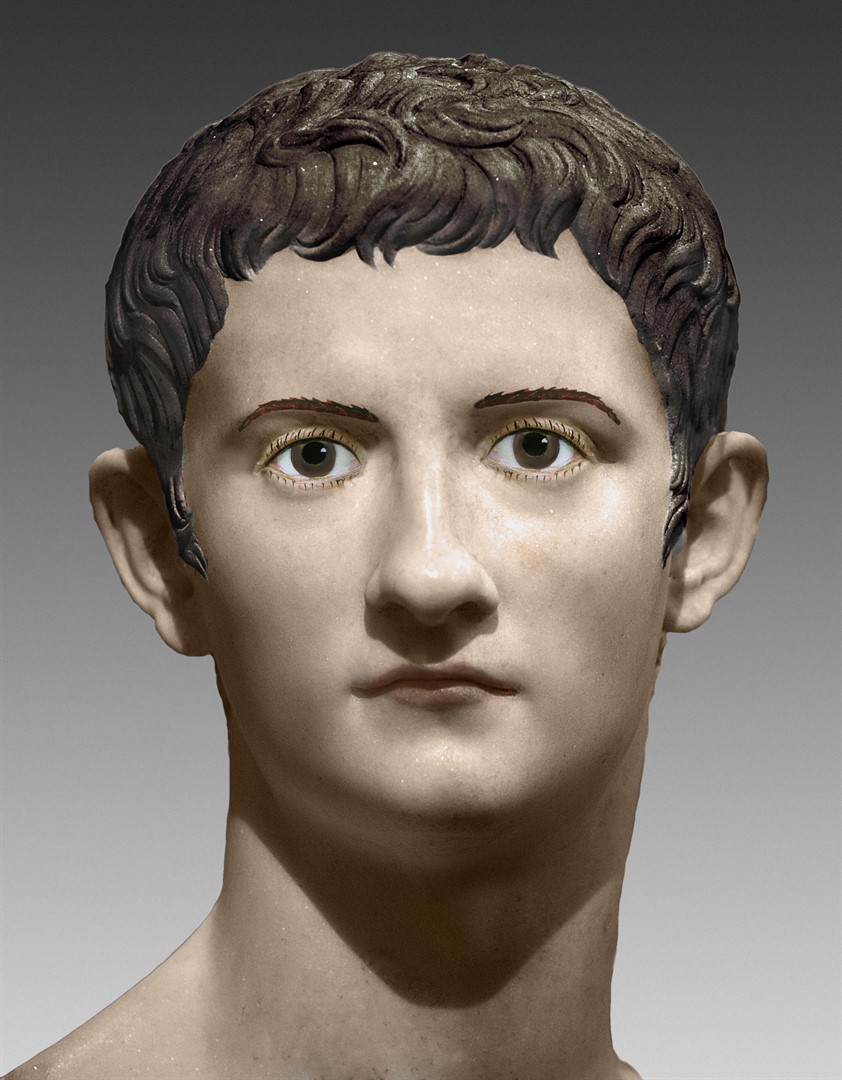
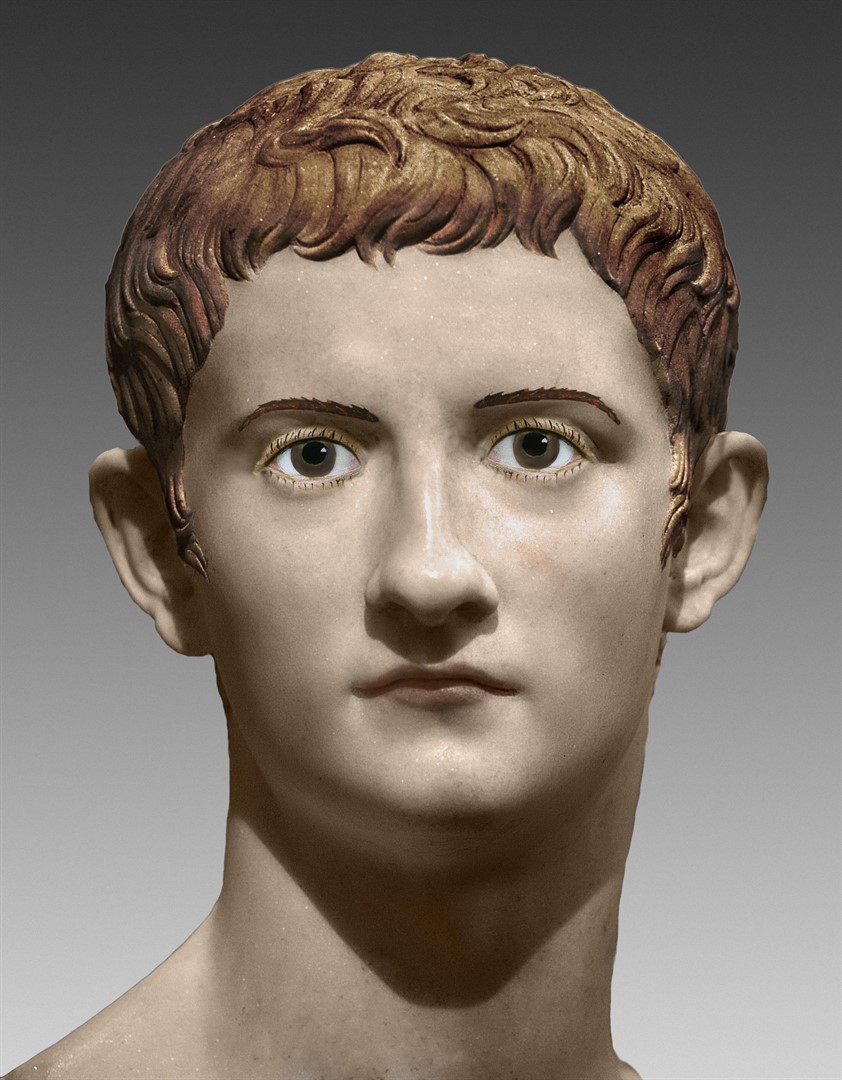
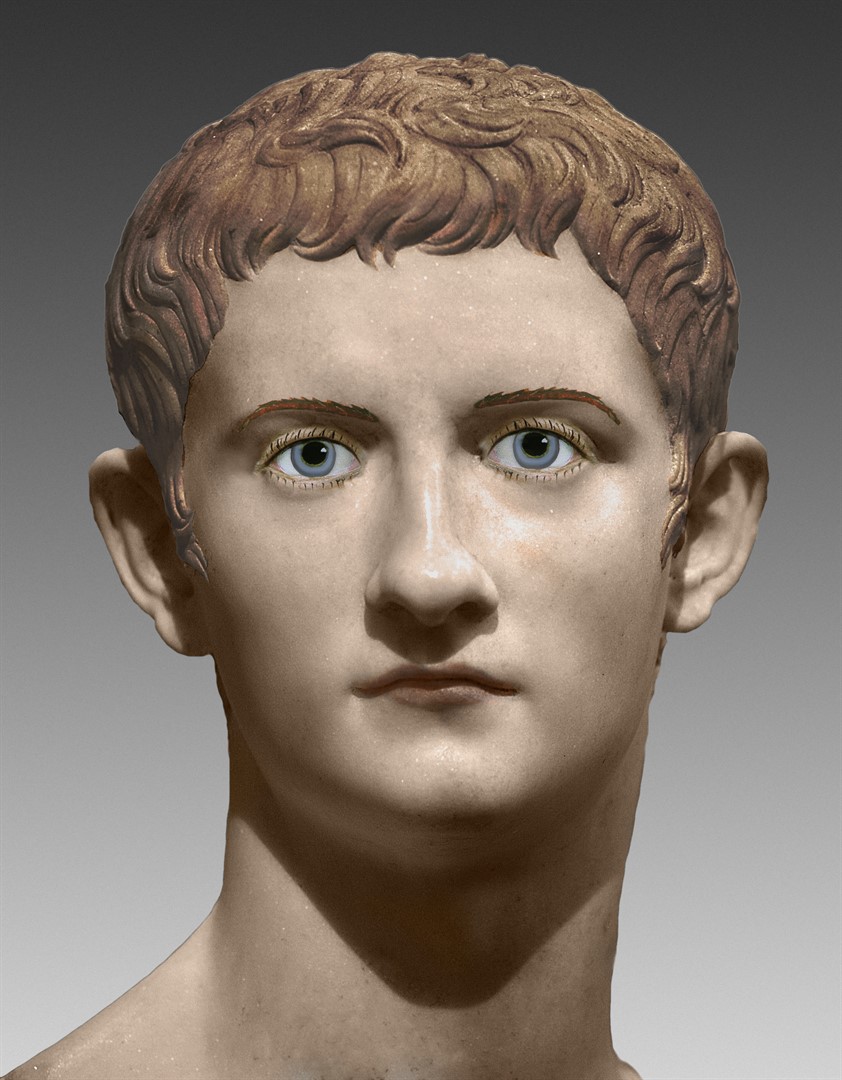
For many more photos of Caligula portraits, visit my Caligula page.
Keywords: ancient, marble, portraiture, Roman, Rome, imperial, iconography, physiognomy, princeps
New Marble Portrait of Augustus
Posted by Bill Storage in History of Art on May 24, 2025
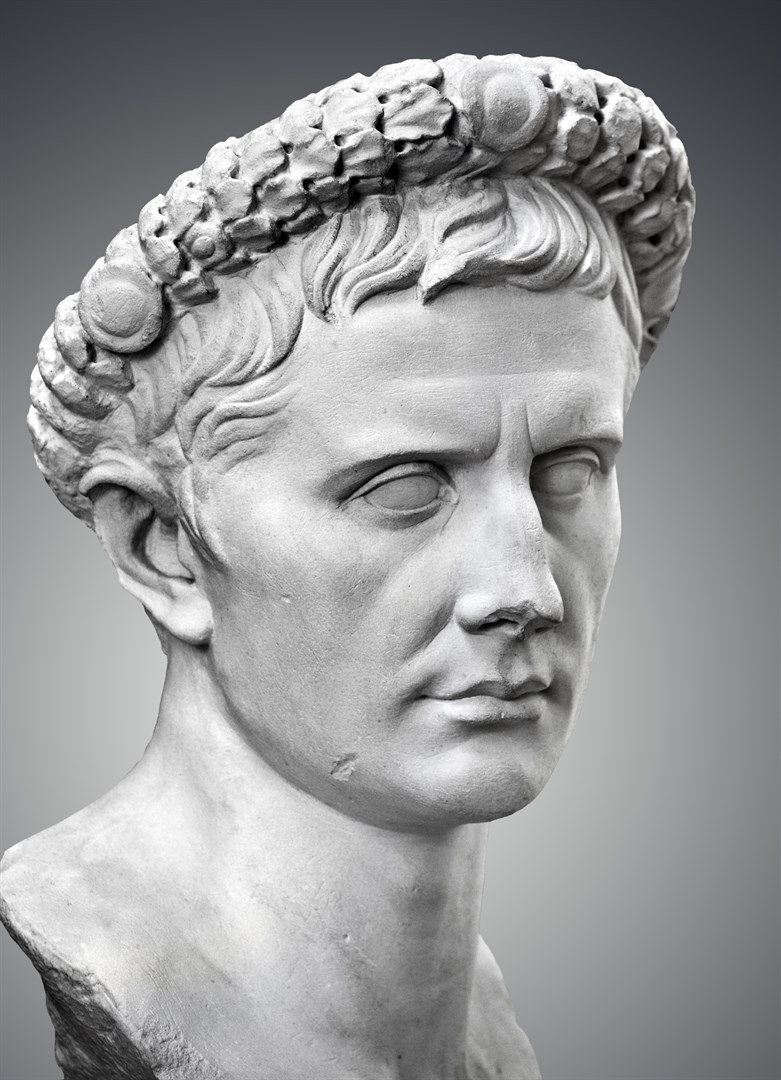


For 23 years Laura Maish and I have been shooting photos of republican and imperial portraits. We’ve accumulated 30,000 photos of ancient marble and bronze heads.
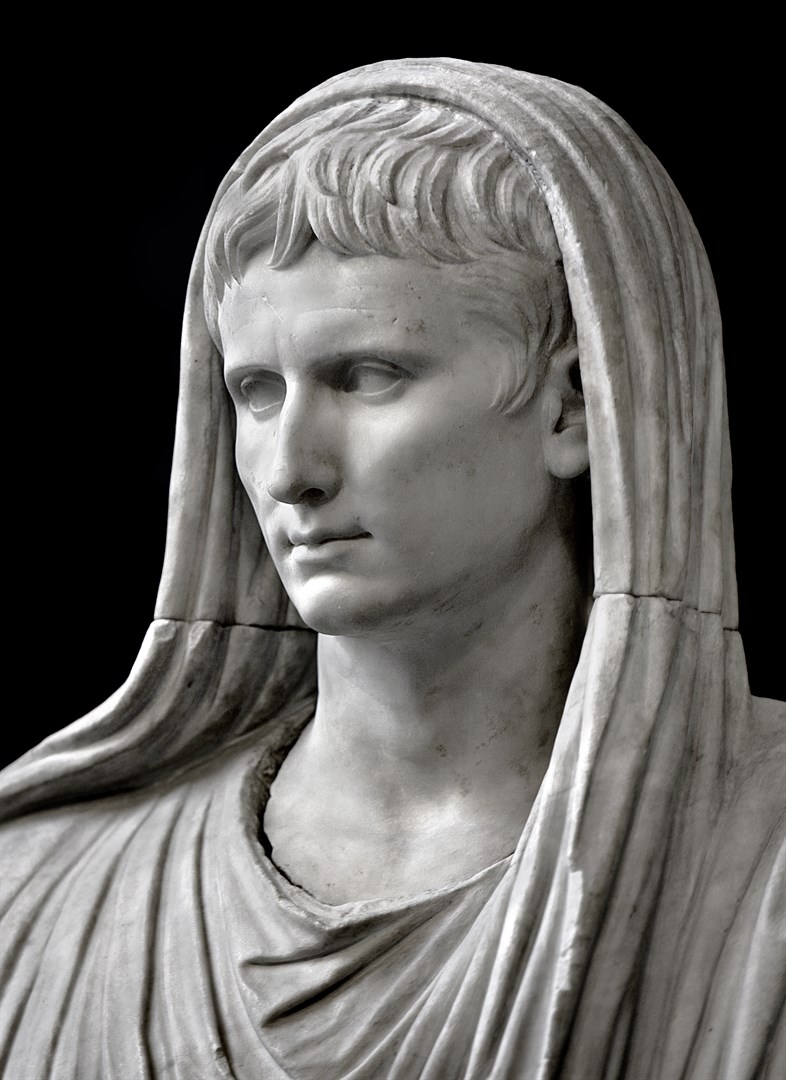
Our latest addition, just photographed this week in Rome, is the below Alcudia-type head of Augustus discovered in 2019 along Via Alessandrina in Rome Mercati di Traiano and recently put on display in the Trajan’s Market museum. This typology, named after a similar portrait found in Alcudia, Spain, dates to 40–38 BCE and depicts Octavian in his early twenties. This type aligns with Augustus’ adoption of the title Divi Filius (Son of the Deified*) following Julius Caesar’s deification. Alcudia-type portraits of Augustus are rare, so this was a significant find.
* This is often incorrectly translated as “Son of the Divine.” Divus (from which Divi comes) refers specifically to a mortal who has been deified after death, not to an eternal or inherently divine being (like a traditional god such as Jupiter). Deus, by contrast, refers to a god or divine being in a more traditional, eternal sense.


This Alcúdia type bust portrays Augustus with a youthful face, featuring a broad forehead, sharp brow, and almond-shaped eyes with thin lids. The facial modeling is restrained, part realistic individualism and part classicizing elements inspired by Greek sculpture, particularly the works like the Doryphoros of Polykleitos. His expression is calm and dignified, reflecting the Augustan ideal of serene authority.
A defining feature is the distinctive arrangement of hair, with thick, comma-shaped locks combed forward, often with a pronounced central “clip” formed by two locks curving to the right and one to the left. The hair over the forehead is voluminous, with some strands undercut for a three-dimensional effect, and it closely follows the skull, contrasting with later types like the Prima Porta, where the hair is more simplified. As with the other Alcúdia-type portraits the rest of the hair is smoother and less detailed compared to later Augustan portraits.
This piece appears to be carved from Parian marble. I could not find any info on it and I’m unskilled in petrography. It is some kind of high-quality, fine-grained, homogeneous lychnite.
Visit this page for photos of many more portraits of Augustus.

 The Multidisciplinarian