Posts Tagged politics
I’m Not Saying Neil deGrasse Tyson Is an Idiot
Posted by Bill Storage in Commentary, History of Science on March 19, 2026
A clip from a 2023 interview with Neil deGrasse Tyson is making the rounds. The key move comes here:
“you can say Trump is an idiot… get him out of there. But wait a minute. There’s still the matter of the 80 million people who voted for him.”
That “but wait a minute” frames the opposition view in a compressed, caricatured form, then pivots to what Tyson wants to emphasize, the scale of voter support. It’s a familiar courtroom tactic: summarize the other side just enough to dismiss it.
Grammatically, it is steelmanning. He states the strongest version of the anti-Trump position without owning the offense, then challenges the adequacy of the idea that we can “just swap the leader.” The logic doesn’t require him to endorse the insult, only to note that it fails to persuade tens of millions of voters.
The framing isn’t neutral. My Kuhn/Feyerabend reflex kicks in whenever a scientist steps into politics. Kuhn reminds us that observation is theory-laden. Tyson’s background inclines him toward a systems view, voters as the underlying structure, leaders as surface phenomena. That’s a perspective, a model, a theory. Evidentiary support?
Feyerabend helps with the second layer. Tyson doesn’t speak as just another citizen. He speaks as a public scientist whose words hold epistemic weight because of a lab coat. He carries borrowed authority. In a lab, that authority is constrained and earned. In politics, it floats freely. What sounds like analysis can double as worldview advocacy with a credentialed accent.
Tyson’s brand is built on empiricism – evidence-based thinking. When he wades into polarized territory, the man-of-science hat amplifies his inferences beyond what he literally says. The clip explicitly avoids calling Trump and voters idiots. Yet by staging a hypothetical view as “Trump is an idiot, remove him,” it hands audiences a simplified target. In the echo chambers where the clip circulates, the move often completes itself. The conclusion becomes, “people who disagree are ignorant,” now tacitly endorsed by an astrophysicist.
From what surfaced in reactions to the Tyson clip, viewers do leap to exactly the conclusion: “yeah, those voters are uneducated (or they would know Trump is an idiot).” Comments frame large voter blocs as gullible, anti-intellectual hilljacks, with Tyson positioned as the authoritative validator. The authority halo makes it potent. The leap feels licensed because the astrophysicist said (implied) it.
Let’s examine the alternative Tyson the scientist might have taken. Treat the 80 million votes not as a rhetorical endpoint but as a dataset. What motivates them? Economic stress, distrust of institutions, cultural alignment, media ecosystems? Which of those factors are well supported, which are not? That would model inquiry rather than closure. It would look like science, not like New York Times propaganda.
Instead, he treats the voter count as brute fact. The “spinning wheel” metaphor does the work. It gestures at a cycle of anger without examining its causes. American political theory has long assumed exactly this kind of friction, not as a bug but as a feature of competing viewpoints. The mess is structural. Has Tyson read the Federalist Papers?
Tyson teaches, by implication, that you can borrow the prestige of science to shortcut messy social inquiry. When expertise bleeds unchecked into values-laden domains, it inadvertently – in the most charitable interpretation of his words – credentials tribal intuitions instead of challenging them.
From the lens of science, the issue isn’t Tyson’s conclusion but his method. When scientific authority migrates without marking its limits, it can validate the intuitions it ought to probe. Listeners don’t just hear the argument, they hear who is making it.
Public scientists don’t need to stay in their lane, but when they step out, the burden shifts. They should, above all else, reinforce the habit of interrogating assumptions with rigor. Less metaphor, more mechanism. Otherwise the lab coat becomes too persuasive, for all the wrong reasons.
Anger As Argument – the Facebook Dividend
Posted by Bill Storage in Commentary, Ethics on January 16, 2026

1. Your partner has ordered the trolley conductor to drive away. If you order her to step out of the vehicle, and you briefly set foot on the track, you can repeatedly shoot her in the head and send the trolley careening out of control, possibly taking out another commie liberal, and the president will hail you as a hero. What do you do?
2. You’re at a crossroads and the only way to save your governor’s career and reputation is to take one for the team. Out of nowhere the frazzled ICE agent you’ve been threatening for days steps onto the trolley track. You can choose to sacrifice yourself in a final heroic act, slamming into that threat, keeping the governor safe and leaving your child an orphan. Do it now, or let Trump’s chaos reign. What’s your move?
The original trolley problems aimed at making you think. It was a philosophical puzzle used to explore moral reasoning, utilitarianism and deontology. Both versions above turn the trolley problem into a caricature. One paints federal force as the unstoppable threat that must be violently halted, the other paints civil disobedience as the lethal danger that must be neutralized. Each is designed to elicit tribal fervor.
These caricatures work on Facebook not because they clarify moral structure but because they flatter the reader and stage moral theater. The audiences already know who the villain is and get to enjoy the feeling of having seen through it all. Smug sarcasm supplies the laugh track.
What’s most depressing is the way such “humor” gets conscripted. Old fashioned wit punctured pretension and left everyone a bit exposed. This humor is ritualized sneer, a war cry that signals membership. Moral superiority and righteous indignation arrive prepackaged.
Whichever side you pick, your rage is justified. Anger becomes proof of righteousness. If I can mock you, I don’t need to understand you. If I can make others laugh at you, I don’t need to persuade them. Emotional reward comes first, the argument is decorative trim. I am furious. Therefore the offense must be enormous. My fury is not only justified but morally required. Anger stops being a response and becomes evidence. The hotter it burns, the stronger the proof. On Facebook this logic is amplified.
Philosophy, ethics, and moral reasoning slow things down. Facebook collapses time, context, and agency into a single cinematic moment. Pull the lever and cue the likes. Facebook rewards train people out of moral curiosity. Once sarcasm becomes the marker of insight, asking a genuine question is read as weakness. The platform punishes those who don’t escalate.
If something is free, the product is you. Facebook loves your self-justifying rage because rage compresses so well. A qualified objection is no match for indignation. Agreement becomes a reflex response. Once anger functions as proof, escalation is inevitable. Disagreement cannot be good faith. Arguments cease to be about the original claim and switch to the legitimacy of self-authenticating anger itself.
Facebook provides the perfect stage because it removes the costs that normally discipline rage. There’s no awkward pause, just instant feedback and dopamine.
To be taken seriously, you have to be outraged. You have to perform belief that the stakes are absolute. If your performance is good, you convince yourself. Likes makes right. Everything is existential. Restraint is complicity. The cycle continues. Facebook counts the clicks and sells them to Progressive Insurance, Apple, and Amazon.
___
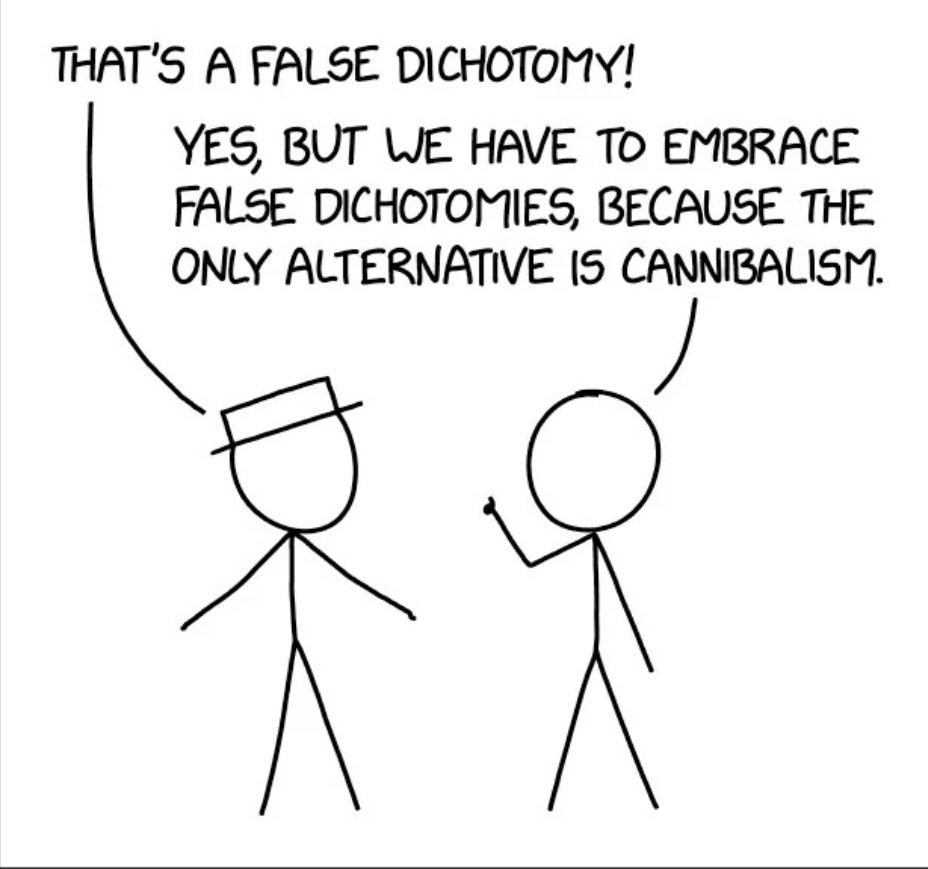
Via Randall Munroe, xkcd
Robert Reich, Genius
Posted by Bill Storage in Commentary on December 25, 2025
Is Robert Reich a twit, or does he just play one for money on the internet?
I never cared about Monica Lewinsky. Bill Clinton was a big-picture sort of president, like Ronald Reagan, oddly. Flawed personally, but who are we to be critical? Marriage to Hillary might test anyone’s resolve with cigars and Big Macs. Yet somehow Clinton elevated Robert Reich to Secretary of Labor. Maybe he thought Panetta and Greenspan could keep the ideologue in check.
Reich later resigned and penned Locked in the Cabinet, a “memoir” devoured by left-wing academics despite its fabricated dialogues – proven mismatches with transcripts and C-SPAN tapes. Facts are optional when the narrative sings.
Fast-forward: Reich posted this on December 23:
“Around 70% of the U.S. economy depends on consumer spending. As wealth concentrates in the richest 10%, the rest of America can’t afford to buy enough to keep the economy running.”
Classic Reich: tidy slogan, profound vibe, zero nuance, preached to the CNN faithful.
Yes, consumption is ~70% of GDP. But accounting isn’t causation. Saying the economy “runs on” consumption is like saying a car runs on exhaust because that’s what comes out the back.
Wealth concentration doesn’t vanish spending:
- High earners save more per dollar, true – but they do spend (luxury, services) and, crucially, invest.
- Investment isn’t hoarded in vaults; it funds factories, tech, startups, real estate – creating jobs and future demand. U.S. history proves inequality and growth coexist.
- The economy isn’t a closed moral ecosystem: Government spending, exports, debt expansion, asset bubbles, and credit substitution all prop things up, sometimes for a long time and sometimes disastrously. Reich’s “can’t afford” is doing heroic rhetorical labor here.
Reich smuggles in a fixed “enough” consumption – for full employment? Asset bubbles? Entitlements? That’s the debate, not premise.
His real point is political: Extreme inequality risks instability in a consumption-heavy model. Fair to argue. But he serves it as revealed truth, as if Keynes himself chiseled it.
Reich champions “labor and farmers” while blaming Trump’s tariffs for the price of beef. Thank you Robert, but, as Deming argued (unsuccessfully) to US auto makers, some people will pay more for quality. Detroit disagreed, and Toyota cleaned their clocks. Yes, I’m willing to pay more for local beef. I’m sure Bill Clinton would, had he not gone all vegan on us. Moderation, Bill, like Groucho said about his cigar.
Reich’s got bumper-sticker economics. Feels good, thinks shallow.
It’s the Losers Who Write History
Posted by Bill Storage in Commentary on November 24, 2025
The victors write first drafts. They get to seize archives, commission official chronicles, destroy inconvenient records, and shape the immediate public memory. Take Roman accounts of Carthage and Spanish on the Aztecs. What happens afterward and indefinitely is where Humanities departments play an outsized role in canonization.
Such academics are the relativist high priests of the safe-space seminary – tenured custodians of western-cultural suicide. Their scripture is the ever-shifting DEI bulletin. Credentialed barbarians stand behind at the gates they themselves dismantled. They are moral vacationers who turned the university into a daycare for perpetual adolescents. The new scholastic is the aristocracy of mediocrity. Historicist gravediggers have pronouncing the West dead so they can inherit its estate.
Several mechanisms make this possible. Academic historians, not primary sources – whether Cicero or Churchill – decide which questions are worth asking. Since the 1970s especially, new methodologies like social history, postcolonial studies, gender studies, and critical race theory have systematically shifted focus away from political, military, and diplomatic chronicling toward power structures, marginalized voices, and systemic oppression. These are not neutral shifts. They reflect the political priorities of the post-Nixon academic left, which has dominated western humanities departments since.
Peer-reviewed journals, university presses, hiring committees, and tenure standards are overwhelmingly controlled by scholars who share an ideological range scarcely wider than a breath. Studies of political self-identification among historians routinely show ratios of 20:1 or higher in favor of the left – often contented Marxists. Dissenting or traditional interpretations that challenge revisionist views on colonialism, the Soviet Union, or America’s founding are marginalized, denied publication, and labeled “problematic.” A career is erased overnight.
K-12 and undergraduate curricula worship academic consensus. Here, again, is a coherence theory of truth subjugating the correspondence model. When the consensus changes – when a critical mass of scholars finds an even more apologetic lens – textbooks follow, almost instantly. The portrayal of the European Age of Exploration, for example, went overnight from celebration of discovery to exclusive emphasis on conquest and genocide. American Founding Fathers went from flawed but visionary innovators of a unique government to rich slave-owning hypocrites, especially after the 1619 Project gained academic traction. A generation or two of Humanities college grads have no clue that “rich white man” Alexander Hamilton was born illegitimate in the Caribbean, was a lifelong unambiguous abolitionist, despised the slave-based Southern economic model, and died broke. They don’t know that the atheist Gouverneur Morris at the Constitutional Convention called slavery “a nefarious institution … the curse of heaven on the states where it prevailed.” They don’t know this because they’ve never heard of Gouverneur Morris, the author of the final draft of the Constitution. That’s because Ken Burns never mentions Morris in his histories. It doesn’t fit his caricature. Ken Burns is where intellectuals learn history. His The Vietnam War is assigned in thousands of high-school and college courses as authoritative history.
Modern historians openly admit that they mean their work to serve social justice goals. The past is mined for precedents, cautionary tales, or moral leverage rather than reconstructed for its own sake. The American Historical Association’s own statements have emphasized “reckoning with the past” in explicitly activist language. Howard Zinn (A People’s History of the United States) boasted, “I don’t pretend to be neutral.”
The academic elite – professional mourners at the funeral of the mind they themselves poisoned – have graduated an entire generation who believe Nixon escalated (if not started) the Vietnam War. This is a textbook (literally) case of the academic apparatus quietly rewriting the emphasis of history. Safe-space sommeliers surely have access to original historical data, but their sheep are too docile to demand primary sources. Instead, border patrollers of the settler-colonial imagination serve up moral panic by the pronoun to their trauma-informed flock.
The numbers. Troop levels went from 1000 when Kennedy took office to 184,000 in 1965 under Johnson. A year later they hit 385,000, and peaked at 543,000 when Nixon took office in 1969. Nixon’s actual policy was systematic de-escalation; he reduced US troops to 24,000 by early 1973, then withdrew the U.S. from ground combat in March. But widely used texts like The American Pageant, Nation of Nations, and Visions of America ignore Kennedy’s and Johnson’s role while framing Nixon as the primary villain of the war. And a large fraction of the therapeutic sheep with Che Guevara posters in their dorms graze contentedly inside an electric fence of approved opinions. They genuinely believe Nixon started Vietnam, and they’re happy with that belief.
If Allan Bloom – the liberal Democrat author of The Closing of the American Mind (1987) – were somehow resurrected in 2025 and lived through the Great Awokening, I suspect he’d swing pretty far into the counter-revolutionary space of Victor Davis Hanson. He’d scorch the vanguardist curators of the neopuritan archival gaze and their pronoun-pious lambs who bleat “decolonize” while paying $100K a year to be colonized by the university’s endowment.
Ken Burns said he sees cuts to the Corporation for Public Broadcasting as a serious existential threat. He did. The republic – which he calls a democracy – is oh so fragile. He speaks as though he alone has been appointed to heal America’s soul. It’s the same sacerdotal NPR manner that Bloom skewered in the humanities professoriate: the priestly conviction that one is engaged in something higher than mere scholarship, something redemptive. And the nation keeps paying Burns for it, because it’s so much more comfortable to cry over a Burns film than to wrestle with the actual complexity Burns quietly edits out. He’s not a historian. He’s the high priest of the officially sanctioned memory palace. It’s losers like Burns who write history.
NPR: Free Speech and Free Money
Posted by Bill Storage in Commentary on May 6, 2025
The First Amendment, now with tote bags – because nothing says “free speech” like being subsidized.
Katherine Maher’s NPR press release begins: “NPR is unwavering in our commitment to integrity, editorial independence, and our mission to serve the American people in partnership with our NPR Member organizations. … We will vigorously defend our right to provide essential news, information and life-saving services to the American public.” (emphasis mine)
Maher’s claim that NPR will “defend our right to provide essential news, information, and life-saving services” is an exercise in rhetorical inflation. The word “right” carries weight in American political language – usually evoking constitutional protections like freedom of speech. But no clause in the First Amendment guarantees funding for journalism. The right to speak is not the right to be subsidized.
By framing NPR’s mission as a right, Maher conflates two distinct ideas: the freedom to broadcast without interference, and the claim to a public subsidy. One is protected by law; the other is a policy preference. To treat them as interchangeable is misleading. Her argument depends not on logic but on sentiment, presenting public funding as a moral obligation rather than a choice made by legislators.
Maher insists federal funding is a tiny slice of the budget – less than 0.0001% – and that each federal dollar attracts seven more from local sources. If true, this suggests NPR’s business model is robust. So why the alarm over defunding? The implication is that without taxpayer support, NPR’s “life-saving services” will vanish. But she never specifies what those services are. Emergency broadcasts? Election coverage? The phrase is vague enough to imply much while committing to nothing.
The real issue Maher avoids is whether the federal government should be funding media at all. Private outlets, large and small, manage to survive without help from Washington. They exercise their First Amendment rights freely, supported by subscriptions, ads, or donations. NPR could do the same – especially since its audience is wealthier and more educated than average. If its listeners value it, they can pay for it.
Instead of making that case, Maher reaches for historical authority. She invokes the Founding Fathers and the 1967 Public Broadcasting Act. But the founders, whatever their views on an informed citizenry, did not propose a state-funded media outlet. The Public Broadcasting Act was designed to ensure editorial independence – not guarantee permanent federal funding. Appealing to these sources lends NPR an air of legitimacy it should not need, and cannot claim in this context.
Then there’s the matter of bias. Maher praises NPR’s “high standards” and “factual reporting,” yet sidesteps the widespread perception that NPR leans left. Dismissing that concern doesn’t neutralize it – it feeds it. Public skepticism about NPR’s neutrality is a driving force behind calls for defunding. By ignoring this, Maher doesn’t just miss the opposition’s argument – she reinforces it, confirming the perception of bias by acting as if no other viewpoint is worth hearing.
In the end, Maher’s defense is a polished example of misdirection. Equating liberty with a line item is an argument that flatters the overeducated while fooling no one else. She presents a budgetary dispute as a constitutional crisis. She wraps policy preferences in the language of principle. And she evades the real question: if NPR is as essential and efficient as she claims, why can’t it stand on its own?
It is not an attack on the First Amendment to question public funding for NPR. It is a question of priorities. Maher had an opportunity to defend NPR on the merits. Instead, she reached for abstractions, hoping the rhetoric would do the work of reason. It doesn’t.
 The Multidisciplinarian
Demonstration Studies: Interdisciplinary Approaches to Policy Frameworks and Educational Pathways in Collective Action
Posted by Bill Storage in Commentary, Interdisciplinary learning on March 28, 2026
At some point we have to confront the labor imbalance head-on. Our guidance counselors still push the same tired pipeline, STEM, pre-med, maybe a grudging nod to business during the late-capitalism era, while a clearly underdeveloped sector sits right outside our school doors, chanting.
The protest industry is no longer a cottage operation. It has matured into a complex, vertically integrated field with roles spanning logistics, messaging, performance, risk management, and, most crucially, optics. Yet high school seniors are given exactly zero structured exposure. We march past an opportunity that stands before us.
A modern curriculum would correct this. Introductory coursework might range from Slogan Compression, the art of reducing a dubious causal claim to five words and a rhyme, to Sign Engineering, where students learn the tensile limits of corrugated plastic under high wind conditions. Advanced pre-college topics could tackle Strategic Outrage Calibration, a delicate discipline balancing moral fervor with camera awareness.
Internships are obvious and plentiful. Students could rotate through departments: Street Presence, Social Media Amplification, and the always critical Rapid Narrative Adjustment Unit, which specializes in pivoting within the first news cycle. Apprenticeships with seasoned professionals would provide invaluable field experience, especially in high-stakes environments where the difference between “grassroots” and “organized” must remain tastefully subliminal.
Naturally, certification would follow. A tiered credentialing system would help employers distinguish between casual enthusiasts and those with demonstrated competencies in crowd choreography and chant synchronization. Continuing education would be required, given the field’s rapid evolution and the half-life of yesterday’s outrage, an inescapable facet the multidisciplinary practitioner simply must address.
Demand appears remarkably resilient. Issues may change, but the underlying need for visible indignation shows no sign of decline. Automation threatens many traditional careers, but it’s difficult to algorithmically replicate the human capacity for performative sincerity in front of a camera.
In the end, this is also about equity of opportunity. Not every student need submit to the oppression of differential equations or patient care. Some have a natural gift for megaphones, timing, and the instinctive sense of where the lens is. It seems only fair that our educational system recognize such talent, nurture it, and send it out into the world fully credentialed, well-practiced, and ready to make a difference.
Sustainable outrage demands long-term career planning in high-intensity advocacy. Tomorrow’s performative conviction will require assessment models for demonstrative competence. Recent trends show that raw spontaneity is simply unable to meet market demands. Elite programs won’t eliminate it, they will curate it.
My own experience in curriculum design is limited to outmoded domains of engineering and science. With that caveat I humbly propose, as a rough framework for expansion by high school curriculum professionals, something like the following. Underlying this introductory program would be the doctrine of teaching sincerity as a deployable skill rather than a personal trait:
Students workshop facial expressions and vocal strain until they land somewhere between “deeply moved” and “media-ready.” Overacting is penalized, underacting is remediated.
A close reading of acceptable deviation. How far one can drift from the script while still being invited back.
Live exercises where students are prompted with unexpected cues, then evaluated on how convincingly their responses appear unprompted. Focus on plausible deniability.
The old paradox, solved with mirrors and playback. Students learn to anticipate where to stand, sensory memory, and emotional immersion to achieve authentic, realistic performances.
Each student stages a fully “unscripted” episode, complete with organic escalation and tasteful resolution. External reviewers assess authenticity using a standardized index, revised each year to ensure relevance.
Of course, we must face the market reality that not all are cut out for client-facing roles. Fortunately, the industry is flush with blue-ocean organizational and infrastructural opportunities. Emerging industries eventually discover that selling isn’t merely the visible thing, it’s forging everything that makes the visible thing possible. Examples include:
Third-party auditors who certify that a demonstration meets recognized standards of organic feeling. Think ISO, but for indignation. “This protest conforms to Authenticity Protocol 9001.”
Uber, but for turnout. Need 50 people who look plausibly local, available within 90 minutes, with a mix of ages and photogenic diversity? Surge pricing during major news cycles.
Not quite PR, not quite a legal department. Their job is to anticipate how an action will be reframed within the first six hours and pre-position counter-narratives. A kind of high-frequency trading desk for moral framing.
The field still runs on vibes. That’s inefficient. We will standardize KPIs: chant retention rate, sign legibility at 30 feet, camera capture frequency, virality half-life. If you can measure it, your client will pay for improving it.
Borrowing from theme parks, choreographed “journeys” through a demonstration, emotional arcs, moments of crescendo. Participants leave feeling they’ve had an experience, not just attended an event. Premium tier tickets include curated photo opportunities.
Most demonstrations peak in the moment and fade. A firm that repackages footage, testimonials, and authentic reactions into a longer tail of content will extend the lifecycle, with revenue sharing back to organizers.
As the field professionalizes, so will its exposure. Insurance products, permitting strategy, de-escalation protocols that still look spontaneous. While strictly back-office, they are lucrative and indispensable.
None of these involve changing the underlying product. Visible moral urgency remains the headline. The opportunity is everything that sits just behind it, quietly shaping, measuring, and monetizing what calls itself spontaneous.
Conclusion
Professionalizing an emerging dissent exigence requires a structured, forward-looking framework for youth engagement, one that recognizes protest not as episodic expression but as a durable component of the political expression economy. Data-driven communication competencies in activist contexts can be cultivated systematically, if still described as organic, through pedagogies that integrate growth-minded inclusivity, social-emotional calibration, and context-sensitive cultural fluency.
The task before us is not to encourage participation – that threshold has long been crossed – but to formalize preparation. Absent such efforts, we risk perpetuating an inequitable landscape in which only the informally trained achieve visibility, while others remain under-amplified despite comparable conviction. A coordinated educational response will ensure that future cohorts enter the field with passion, demonstrable proficiency, adaptive awareness, and a shared vocabulary of practice.
In this light, the institutionalization of dissent will align existing educational pathways with an already normalized mode of civic engagement, and, in doing so, quietly resolve the longstanding gap between expression and employability.
ai, education, parody, politics, technology
2 Comments