This was my script for a video I just posted on YouTube (Subscribe – more of these are coming). I departed slightly from the script when I narrated, but it is close. The video illustrates all the points made in the text, so I see no point in grabbing a large number of stills from it to include here. Just watch the video; I think it came out well. I uploaded 4K video. You can select resolution with the video settings button to ensure you are getting full res.
The best guess is that the Ludovisi Sarcophagus was made in the third century, probably around AD 260.
We don’t know who the man in the middle is. That, beyond the fact that the thing is an incredible piece of art, is one of the reasons the sarcophagus gets so much attention.
He’s on horseback, bareheaded, no weapon, riding straight into a mass of Roman soldiers and defeated barbarians. Everyone around him is caught up in the violence. Men are falling, fighting, and dying.
And he’s pretty much untouched by it. His right hand is raised, as though he doesn’t even need a sword. He isn’t just another soldier. The whole composition points toward him. So naturally, we want to know who he was.
Answering that is tough. 1800 years has taken its toll on the evidence.
The sarcophagus was discovered in Rome in 1621, in a vineyard outside the Porta San Lorenzo. It was acquired by Cardinal Ludovico Ludovisi and became part of his remarkable collection of ancient sculpture. Eventually the collection passed into the Museo Nazionale Romano. You can see it in person at the Palazzo Altemps across the street from Piazza Navona.
Once you’ve concluded that the figure must represent somebody important, then you start studying the face. He seems important because an immense amount of precision work went into it. He has a triangular face, a broad cranium and narrow chin, smooth skin, prominent eyebrows, a moustache and a short beard. His hair is arranged in little comma-shaped locks across his forehead.
The hairstyle looks backward. It recalls earlier Roman imperial portraits the Julio-Claudians, Augustus in particular, and Trajan. But its closest parallels, according to modern scholarship, are in what is called the Gallienic revival, the renewed interest in classical styles during the reign of Emperor Gallienus.
That leads most scholars toward the imperial families of the middle of the third century. Two names in particular come up. Herennius Etruscus and his younger brother Hostilianus, the sons of the emperor Trajan Decius.
Herennius was actually killed fighting the Goths in 251. Hostilianus didn’t die in battle. He died of the plague later that year. And there is something particularly interesting about Hostilianus.
Some of those who’ve proposed that this guy is Hostilian see the curious mark on his forehead as a sphragis, a sign associated with the Mithraic mysteries
And that brings us to the curious mark on his forehead. It is a cross-shaped mark, cut deeply into the marble. It has been interpreted as a sphragis, a sign associated with the Mithraic mysteries. But that interpretation has a complicated history I’ll get to later.
Except for the beard, some coin portraits of Hostilian do look strikingly like the one on the sarcophagus.
More recent scholarship has tended to put the Ludovisi Sarcophagus around 260 rather than 251, partly because of the way its figures are organized across the relief and its relationship to other sculpture of the period. We have to accept that the young commander can’t be securely connected with any known emperor or general.
But I’m not sure nine years should have quite the authority that it sometimes gets. A date of around 260 is just an art-historical judgment.
A sculptor in 260 could have been looking at something made in 240. A sculptor in 251 could have been looking at something made a century earlier. A fashion can begin before we notice it, persist after we think it has ended, or simply refuse to fit neatly into the period labels we give it. The main figure’s face could have been carved forty years after the rest of the sarcophagus.
So I don’t think Herennius or Hostilianus can be dismissed simply because somebody has decided the sarcophagus belongs to 260. But I don’t think either can be identified solely from the resemblance.
It may be a portrait of a member of the imperial family. It may be an important military commander. Or we may be looking at a very wealthy Roman aristocrat whose name has disappeared completely. The quality of the sarcophagus tells us that its patron was somebody near the top of Roman society. But that’s about as far as the evidence can take us.
There’s another possibility we can’t rule out. Perhaps the face wasn’t intended to identify the deceased as a particular emperor or general at all. The sculptor may have been making an ideal Roman commander. He is bareheaded, carries no weapon, and yet he’s riding directly into battle.
Diana Kleiner compared him to the invincible general represented by Alexander the Great, particularly the famous mosaic from the House of the Faun at Pompeii, which itself copies a lost Hellenistic painting.
In that reading, the point isn’t that the subject was Alexander. It’s that he was being made to look like the kind of man who could be Alexander. The dead man didn’t necessarily need to have conquered the barbarians. He needed to be shown as the sort of man who would have.
And then there is the X. It doesn’t look to me like the work of the sculptor who carved the face. It could have been made later in antiquity. It could have been made centuries later. We don’t know when the sarcophagus disappeared from view, when it was buried, or what happened to it before it was found in 1621.
So we know roughly when the sarcophagus was carved. We know exactly when it was dug out of the ground, but we can’t date the X at all. We don’t really even know that it wasn’t added after it was dug up. And since we can’t know how long it was around before being buried we can’t rule out that someone in late antiquity added the X to ward off demons. There is evidence of that sort of thing, right up to modern times.
20th century scholars couldn’t let go of a Tertullian quote. He mentions Mithras in a passage attacking pagan religion. He says that the Devil marks his soldiers on their foreheads. That’s all he says.
Tertullian wrote about 200 AD, and he couches the claim with “if I remember Mithras,” not exactly the voice of a man presenting carefully verified ethnography. He is making a rhetorical point: Satan had preemptively counterfeited Christian sacraments in pagan religion.
Historian Franz Cumont, in 1899, interprets Tertullian’s mark as a “brand.”
In 1959, German archaeologist Hilga von Heintze reads Cumont and starts the business about the Ludovisi Sarcophagus “X” being a Mithraic sign.
Beskow, in 1979, dismatles the long-standing academic belief that initiates of Mithras were branded on their foreheads.
Diana Kleiner, in 1992, accepts von Heintze, misses or dismisses Beskow, and claims, without citation, that coin portraits of Hostilian sometimes have an X. Kleiner did not reply to my inquiry about this.
Years ago I asked historian Richard Gordon, a leading scholar of Roman Mithraism. His answer was blunt. No evidence of Mithraic branding, particularly with an X.
That’s an extraordinary little piece of scholarly history. Because we can watch the idea being constructed, and watch counterevidence being ignored. We have zero evidence of such a Mithraic symbol. And the American Numismatic Society database knows of no Hostilian coinage with an X. So we have an argument that is not only circular, but rests on false starts that reinforce one another.
It also shows us just how self-referential academic scholarship can be. Bad scholarship gets cast in stone. People, especially those who must publish or perish, crave certainty. A Richard Feynman quote seems tailor-made: “We absolutely must leave room for doubt or there is no progress and no learning.”
So here the Ludovisi Sarcophagus becomes interesting for other reasons. It tells us something about ourselves.
But there is one more thing I find interesting. In 1621 the sarcophagus entered a world in which ancient sculpture had enormous value. Cardinal Ludovisi was building one of the great collections of antiquities in Rome. It became famous.
There another unidentified Roman head, over in the Capitoline collection, with an X on his forehead. And he looks quite a bit like you know who.
Frontally, they look pretty similar, considering that one is life sized and one is miniature. When I photographed the two heads in profile and put them side by side, I was struck by an uncanny similarity. The Capitoline head has a reworked nose, so I’ve removed that part of the comparison, because the restoration may well have been based on the sarcophagus.
But look at the rest of the face: the forehead, the brow, the eye, the cheek, the mouth, the chin, the overall profile.
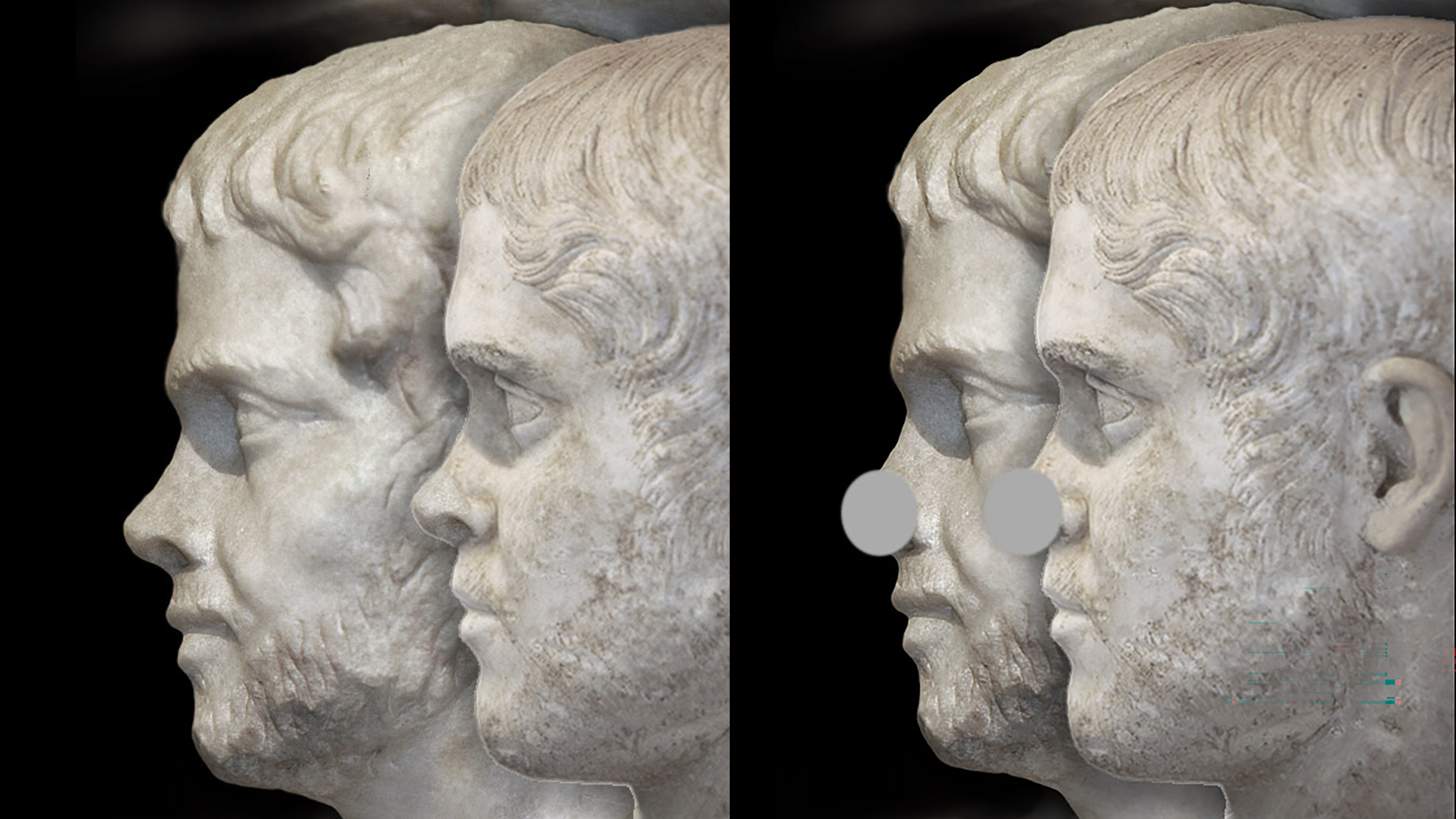
The resulting resemblance could then be taken as independent evidence that the two heads represent the same person. But regardless of the date of the Ludovisi “X”, the X’s are not independent evidence, given what we know of the antique market.
The heads are so similar that I wonder if somebody else noticed the resemblance long ago, possibly after the sarcophagus head got its X but before the Capitoline head did.
Max Vegner, writing in 1979, judged the head to have been extensively reworked. I read the surviving evidence as more superficial than he did. I agree that the X was added later, and that the head was polished after the X was added. When the head was polished by a restorer, the X was already there when that happened. Whether five minutes before, or a thousand years before, we cannot say. I disagree that the locks have been extensively reworked to imitate those of the guy on the sarcophagus. Follow them up to the top of the head. The extent of reworking Vegner proposes would make the thing the equivalent of a complete forgery, which it might be. If it is, it is a very good one.
I’m not saying the two heads portray the same man. They may, or the Ludovisi figure may itself be an idealization. It means only that the two faces are similar enough that someone restoring or selling the Capitoline head might have seen an opportunity to associate it with the much more famous Ludovisi portrait.
I’ve shot thirty thousand photos of Roman heads and have spent enough time looking at recut portraits that I am reasonably confident of that judgment. But it’s a judgment. And I’ve convinced museums to change their claims about recarving and revise their placards. But it’s still a judgment.
All this changes the way I look at the two objects, because there are now several histories to consider. There is the history of the Roman man represented by the sarcophagus. There is the history of the Capitoline head. And there is the history of what later people thought and did about the similarity between them.
We form theories, at least some of which are wrong. One might be right.
And some may be wrong in ways that are now very difficult to see, because they have been written down and copied so many times. The sarcophagus is eighteen hundred years old. The X might be 1,000 years old. The interpretation of the X is 130 years old. The confidence with which the interpretation is now 60 years old. Yet when we encounter the thing today, all those layers arrive simultaneously.


#1 by joegeranio1 on September 22, 2026 - 11:42 am
Thanks for this Bill. Joe G.
#2 by sstorage31 on September 22, 2026 - 12:25 pm
Billy, Excellent but did you show me this in rome? Shame on you>
#3 by joegeranio1 on September 25, 2026 - 8:33 am
Great use of portrait/ numismatic agreement. I’m also currently studying the chronological order of Tertullian and trinitas. Wonderful video!! Joe Geranio