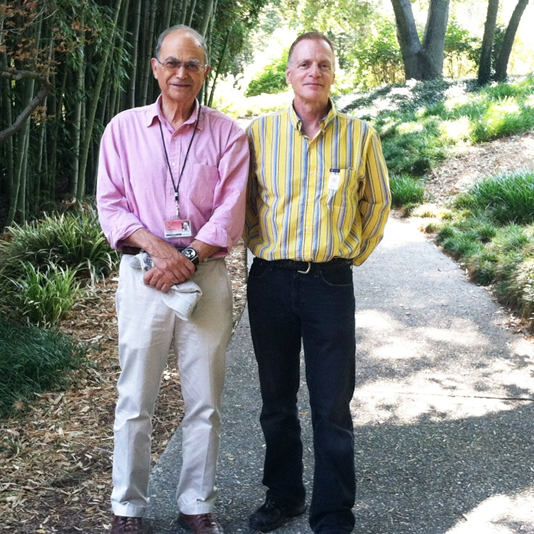
In 2012, I spoke with John Heilbron, historian of science and Professor Emeritus at UC Berkeley, about his career, his work with Thomas Kuhn, and the legacy of The Structure of Scientific Revolutions on its 50th anniversary. We talked late into the night. The conversation covered his shift from physics to history, his encounters with Kuhn and Paul Feyerabend, and his critical take on the direction of Science and Technology Studies (STS).
The interview marked a key moment. Kuhn and Feyerabend’s legacies were under fresh scrutiny, and STS was in the midst of redefining itself, often leaning toward sociological frameworks at the expense of other approaches.
Thirteen years later, in 2025, this commentary revisits that interview to illuminate its historical context, situate Heilbron’s critiques, and explore their relevance to contemporary STS and broader academic debates.
Over more than a decade, I had ongoing conversations with Heilbron about the evolution of the history of science – history of the history of science – and the complex relationship between History of Science and Science, Technology, and Society (STS) programs. At UC Berkeley, unlike at Harvard or Stanford, STS has long remained a “Designated Emphasis” rather than a department or standalone degree. Academic conservatism in departmental structuring, concerns about reputational risk, and questions about the epistemic rigor of STS may all have contributed to this decision. Moreover, Berkeley already boasted world-class departments in both History and Sociology.
That 2012 interview, the only one we recorded, brought together themes we’d explored over many years. Since then, STS has moved closer to engaging with scientific content itself. But it still draws criticism, both from scientists and from public misunderstanding. In 2012, the field was still heavily influenced by sociological models, particularly the Strong Programme and social constructivism, which stressed how scientific knowledge is shaped by social context. One of the key texts in this tradition, Shapin and Schaffer’s Leviathan and the Air-Pump (1985), argued that even Boyle’s experiments weren’t simply about discovery but about constructing scientific consensus.
Heilbron pushed back against this framing. He believed it sidelined the technical and epistemic depth of science, reducing STS to a sociological critique. He was especially wary of the dense, abstract language common in constructivist work. In his view, it often served as cover for thin arguments, especially from younger scholars who copied the style but not the substance. He saw it as a tactic: establish control of the conversation by embedding a set of terms, then build influence from there.
The influence of Shapin and Schaffer, Heilbron argued, created the impression that STS was dominated by a single paradigm, ironically echoing the very Kuhnian framework they analyzed. His frustration with a then-recent Isis review reflected his concern that constructivism had become doctrinaire, pressuring scholars to conform to its methods even when irrelevant to their work. His reference to “political astuteness” pointed to the way in which key figures in the field successfully advanced their terminology and frameworks, gaining disproportionate influence. While this gave them intellectual clout, Heilbron saw it as a double-edged sword: it strengthened their position while encouraging dogmatism among followers who prioritized jargon over genuine analysis.
Bill Storage: How did you get started in this curious interdisciplinary academic realm?
John Heilbron: Well, it’s not really very interesting, but I was a graduate student in physics but my real interest was history. So at some point I went down to the History department and found the medievalist, because I wanted to do medieval history. I spoke with the medievalist ad he said, “well, that’s very charming but you know the country needs physicists and it doesn’t need medievalists, so why don’t you go back to physics.” Which I duly did. But he didn’t bother to point out that there was this guy Kuhn in the History department who had an entirely different take on the subject than he did. So finally I learned about Kuhn and went to see him. Since Kuhn had very few students, I looked good; and I gradually I worked my way free from the Physics department and went into history. My PhD is in History; and I took a lot history courses and, as I said, history really is my interest. I’m interested in science too of course but I feel that my major concerns are historical and the writing of history is to me much more interesting and pleasant than calculations.
You entered that world at a fascinating time, when history of science – I’m sure to the surprise of most of its scholars – exploded onto the popular scene. Kuhn, Popper, Feyerabend and Lakatos suddenly appeared in The New Yorker, Life Magazine, and The Christian Century. I find that these guys are still being read, misread and misunderstood by many audiences. And that seems to be true even for their intended audiences – sometimes by philosophers and historians of science – certainly by scientists. I see multiple conflicting readings that would seem to show that at least some of them are wrong.
Well if you have two or more different readings then I guess that’s a safe conclusion. (Laughs.)
You have a problem with multiple conflicting truths…? Anyway – misreading Kuhn…
I’m more familiar with the misreading of Kuhn than of the others. I’m familiar with that because he was himself very distressed by many of the uses made of his work – particularly the notion that science is no different from art or has no stronger basis than opinion. And that bothered him a lot.
I don’t know your involvement in his work around that time. Can you tell me how you relate to what he was doing in that era?
I got my PhD under him. In fact my first work with him was hunting up footnotes for Structure. So I knew the text of the final draft well – and I knew him quite well during the initial reception of it. And then we all went off together to Copenhagen for a physics project and we were all thrown together a lot. So that was my personal connection and then of course I’ve been interested subsequently in Structure, as everybody is bound to be in my line of work. So there’s no doubt, as he says so in several places, that he was distressed by the uses made of it. And that includes uses made in the history of science particularly by the social constructionists, who try to do without science altogether or rather just to make it epiphenomenal on political or social forces.
I’ve read opinions by others who were connected with Kuhn saying there was a degree of back-peddling going by Kuhn in the 1970s. The implication there is that he really did intend more sociological commentary than he later claimed. Now I don’t see evidence of that in the text of Structure, and incidents like his telling Freeman Dyson that he (Kuhn) was not a Kuhnian would suggest otherwise. Do you have any thoughts on that?
I think that one should keep in mind the purpose of Structure, or rather the context in which it was produced. It was supposed to have been an article in this encyclopedia of unified science and Kuhn’s main interest was in correcting philosophers. He was not aiming for historians even. His message was that the philosophy practiced by a lot of positivists and their description of science was ridiculous because it didn’t pay any attention to the way science was actually done. So Kuhn was going to tell them how science was done, in order to correct philosophy. But then much to his surprise he got picked up by people for whom it was not written, who derived from it the social constructionist lesson that we’re all familiar with. And that’s why he was an unexpected rebel. But he did expect to be rebellious; that was the whole point. It’s just that the object of his rebellion was not history or science but philosophy.
So in that sense it would seem that Feyerabend’s question on whether Kuhn intended to be prescriptive versus descriptive is answered. It was not prescriptive.
Right – not prescriptive to scientists. But it was meant to be prescriptive to the philosophers – or at least normalizing – so that they would stop being silly and would base their conception of scientific progress on the way in which scientists actually went about their business. But then the whole thing got too big for him and he got into things that, in my opinion, really don’t have anything to do with his main argument. For example, the notion of incommensurability, which was not, it seems to me, in the original program. And it’s a logical construct that I don’t think is really very helpful, and he got quite hung up on that and seemed to regard that as the most important philosophical message from Structure.
I wasn’t aware that he saw it that way. I’m aware that quite a few others viewed it like that. Paul Feyerabend, in one of his last books, said that he and Kuhn kicked around this idea of commensurability in 1960 and had slightly different ideas about where to go with it. Feyerabend said Kuhn wanted to use it historically whereas his usage was much more abstract. I was surprised at the level of collaboration indicated by Feyerabend.
Well they talked a lot. They were colleagues. I remember parties at Kuhn’s house where Feyerabend would show up with his old white T shirt and several women – but that’s perhaps irrelevant to the main discussion. They were good friends. I got along quite well with Feyerabend too. We had discussions about the history of quantum physics and so on. The published correspondence between Feyerabend and Lakatos is relevant here. It’s rather interesting in that the person we’ve left out of the discussion so far, Karl Popper, was really the lighthouse for Feyerabend and Lakatos, but not for Kuhn. And I think that anybody who wants to get to the bottom of the relationship between Kuhn and Feyerabend needs to consider the guy out of the frame, who is Popper.
It appears Feyerabend was very critical of Kuhn and Structure at the time it was published. I think at that point Feyerabend was still essentially a Popperian. It seems Feyerabend reversed position on that over the next decade or so.
JH: Yes, at the time in question, around 1960, when they had these discussions, I think Feyerabend was still very much in Popper’s camp. Of course like any bright student, he disagreed with his professor about things.
How about you, as a bright student in 1960 – what did you disagree with your professor, Kuhn, about?
Well I believe in the proposition that philosophers and historians have different metabolisms. And I’m metabolically a historian and Kuhn was metabolically a philosopher – even though he did write history. But his most sustained piece of history of science was his book on black body theory; and that’s very narrowly intellectualist in approach. It’s got nothing to do with the themes of the structure of scientific revolutions – which does have something to say for the historian – but he was not by practice a historian. He didn’t like a whole lot of contingent facts. He didn’t like archival and library work. His notion of fun was take a few texts and just analyze and reanalyze them until he felt he had worked his way into the mind of their author. I take that to be a necromantic feat that’s not really possible.
I found that he was a very clever guy and he was excellent as a professor because he was very interested in what you were doing as soon it was something he thought he could make some use of. And that gave you the idea that you were engaged in something important, so I must give him that. On the other hand he just didn’t have the instincts or the knowledge to be a historian and so I found myself not taking much from his own examples. Once I had an argument with him about some way of treating a historical subject and I didn’t feel that I got anything out of him. Quite the contrary; I thought that he just ducked all the interesting issues. But that was because they didn’t concern him.
James Conant, president of Harvard who banned communists, chair of the National Science Foundation, etc.: how about Conant’s influence on Structure?
It’s not just Conant. It was the whole Harvard circle, of which Kuhn was part. There was this guy, Leonard Nash; there was Gerald Holton. And these guys would get together and l talk about various things having to do with the relationship between science and the public sphere. It was a time when Conant was fighting for the National Science Foundation and I think that this notion of “normal science” in which the scientists themselves must be left fully in charge of what they’re doing in order to maximize the progress within the paradigm to bring the profession swiftly to the next revolution – that this is essentially the Conant doctrine with respect to the ground rules of the National Science Foundation, which is “let the scientists run it.” So all those things were discussed. And you can find many bits of Kuhn’s Structure in that discussion. For example, the orthodoxy of normal science in, say, Bernard Cohen, who didn’t make anything of it of course. So there’s a lot of this Harvard group in Structure, as well as certain lessons that Kuhn took from his book on the Copernican Revolution, which was the textbook for the course he gave under Conant. So yes, I think Conant’s influence is very strong there.
So Kuhn was ultimately a philosopher where you are a historian. I think I once heard you say that reading historical documents does not give you history.
Well I agree with that, but I don’t remember that I was clever enough to say it.
Assuming you said it or believe it, then what does give you history?
Well, reading them is essential, but the part contributed by the historian is to make some sense of all the waste paper he’s been reading. This is essentially a construction. And that’s where the art, the science, the technique of the historian comes into play, to try to make a plausible narrative that has to satisfy certain rules. It can’t go against the known facts and it can’t ignore the new facts that have come to light through the study of this waste paper, and it can’t violate rules of verisimilitude, human action and whatnot. But otherwise it’s a construction and you’re free to manipulate your characters, and that’s what I like about it.
So I take it that’s where the historian’s metabolism comes into play – avoidance of leaping to conclusions with the facts.
True, but at some point you’ve got to make up a story about those facts.
Ok, I’ve got a couple questions on the present state of affairs – and this is still related to the aftermath of Kuhn. From attending colloquia, I sense that STS is nearly a euphemism for sociology of science. That bothers me a bit, possibly because I’m interested in the intersection of science, technology and society. Looking at the core STS requirements on Stanford’s website, I see few courses listed that would give a student any hint of what science looks like from the inside.
I’m afraid you’re only too right. I’ve got nothing against sociology of science, the study of scientific institutions, etc. They’re all very good. But they’re tending to leave the science out, and in my opinion, the further they get from science, the worse their arguments become. That’s what bothers me perhaps most of all – the weakness of the evidentiary base of many of the arguments and conclusions that are put forward.
I thought we all learned a bit from the Science Wars – thought that sort of indeterminacy of meaning and obfuscatory language was behind us. Either it’s back, or it never went away.
Yeah, the language part is an important aspect of it, and even when the language is relatively comprehensible as I think it is in, say, constructivist history of science – by which I mean the school of Schaffer and Shapin – the insistence on peculiar argot becomes a substitute for thought. You see it quite frequently in people less able than those two guys are, who try to follow in their footsteps. You get words strung together supposedly constituting an argument but which in fact don’t. I find that quite an interesting aspect of the business, and very astute politically on the part of those guys because if you can get your words into the discourse, why, you can still hope to have influence. There’s a doctrinaire aspect to it. I was just reading the current ISIS favorable book review by one of the fellow travelers of this group. The book was not written by one of them. The review was rather complimentary but then at the end says it is a shame that this author did not discuss her views as related to Schaffer and Shapin. Well, why the devil should she? So, yes, there’s issues of language, authority, and poor argumentation. STS is afflicted by this, no doubt.
 The Multidisciplinarian