Posts Tagged bronze
The Lancellotti Discobolus
Posted by Bill Storage in History of Art on June 9, 2026
Engineering meets art history
The Discobolus of Myron is one of the most famous sculptures in the world, despite the fact that it no longer exists.
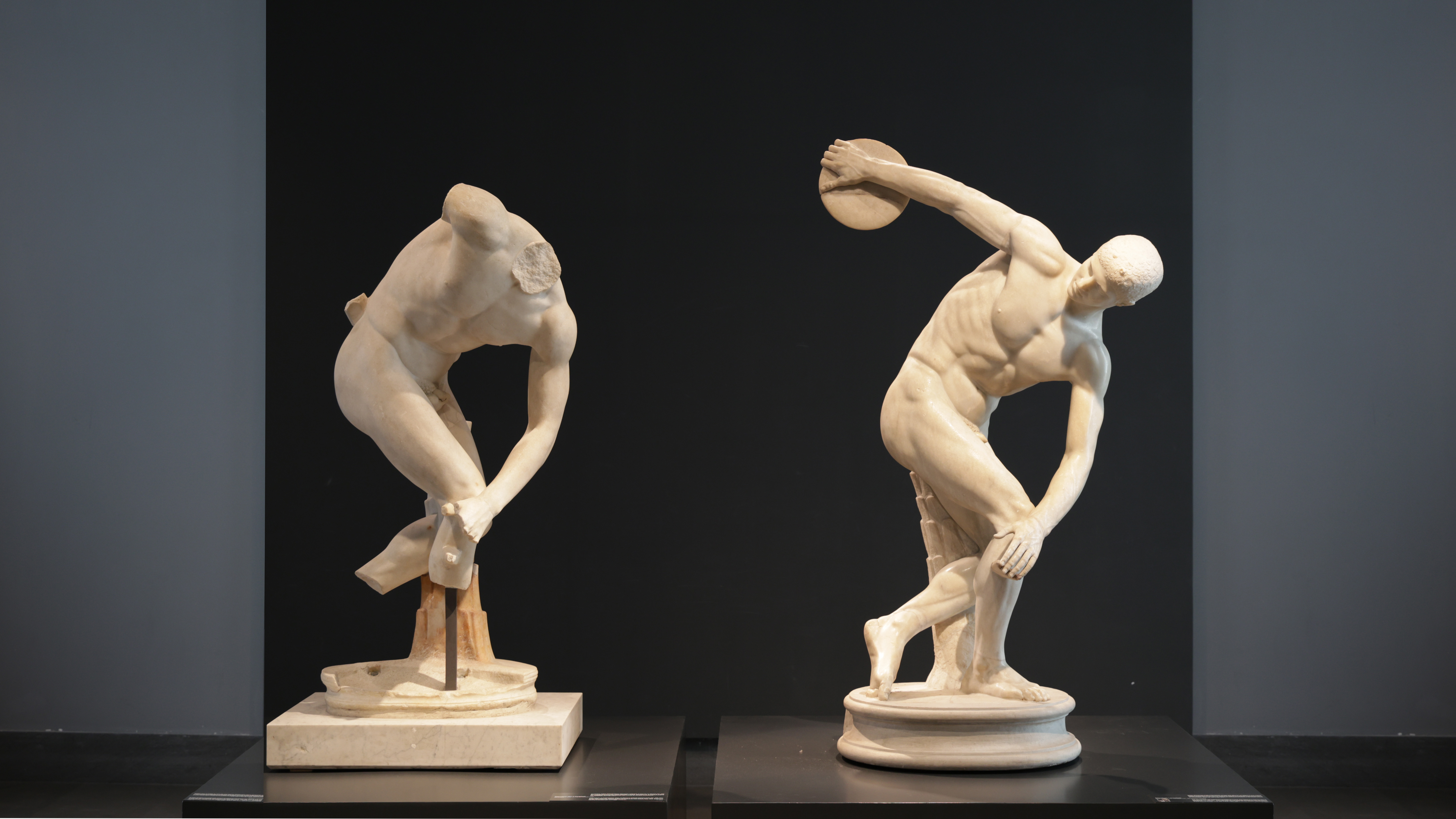
What you see here are two Roman marble copies of an original Greek bronze, made perhaps four hundred years earlier. As I stand in Palazzo Massimo, looking at the famous Discobolus Lancellotti and the more damaged version to its left, It seems to me that “copy” doesn’t tell the whole story.
How do we know it’s a copy if the original is lost? We don’t. Not really. But a few pieces of evidence support it. Multiple Roman statues survive showing nearly the same composition with variations. Ancient writers, especially Pliny the Elder, mention a famous Discobolus by Myron. From this, scholars infer a lost Greek prototype.
But that inference depends on assumptions. That Roman versions derive from a single famous original. That the literary references correspond to these sculptures. That the similarities are too strong to be coincidence,
and that Roman sculptors were reproducing admired earlier works rather than improvising freely and copying each other.
Reasonable conclusions, but not certain. Classical archaeology, seems to me, often speaks with a certitude that conceals how inferential the whole enterprise is. The “original Myron Discobolus” is a scholarly composite. The original survives as an intellectual reconstruction.
The nearly-complete Discobolus Lancellotti looks so perfect that people instinctively assume it must be the “best” copy. But the fragmentary version beside it in some ways preserves more truthful structural details. In particular, traces of the massive support on the hip show how difficult the pose really was in marble. Bronze could suspend limbs in space. Marble – not as much. The cleaner version partly hides the engineering problem.
The first thing that strikes you about the Discobolus is motion. Or rather, suspended motion. The body is wound tight, almost like a spring under torsion. The torso twists against the hips. The shoulders oppose the legs. We see stored rotational-energy.
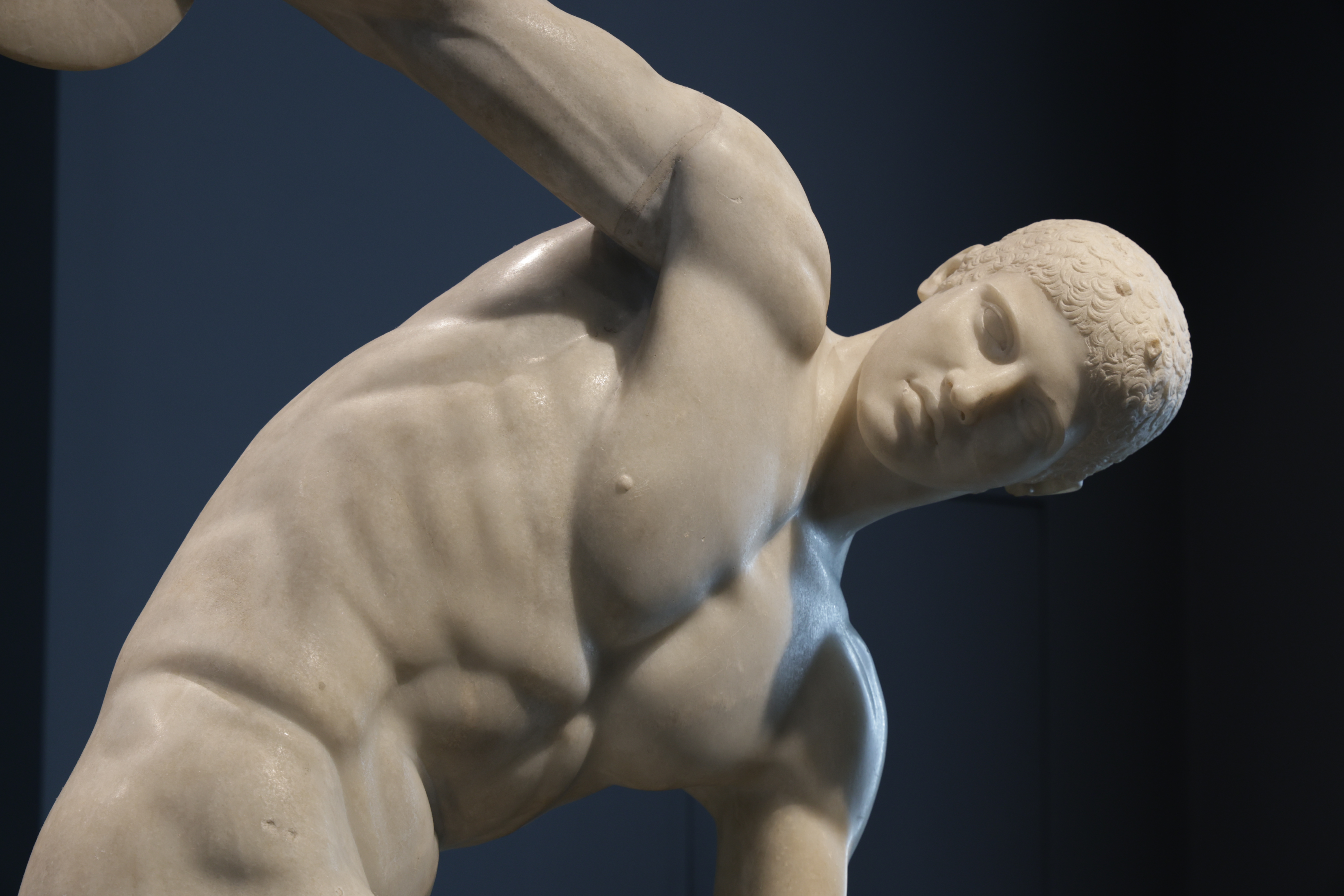
But the face remains calm, almost indifferent. Modern athletes grimace and strain. Our culture likes that. Greek classical sculpture often suppresses it. The ideal athlete is not simply powerful. He is self-controlled. Emotionally disciplined. The body may be near maximum exertion, but the face refuses to surrender composure. It feels uncanny to modern viewers. Pliny criticized the lack of facial expression. Cicero wrote that “Myron’s works are not yet very close to the truth.”
The Discobolus doesn’t look like someone throwing a discus. He looks like the idea of controlled effort. I’m guessing that’s what Myron intended. This pose is deeply awkward in marble. The original bronze allowed limbs to extend freely into space. Thin structures are possible in bronze.
Marble is less forgiving. It wants support, and mass underneath the stress points. Roman sculptors adapting Greek bronzes had to add engineering solutions into the composition. Tree trunks, struts, and short connecting bridges. The damaged copy exposes more of that hidden problem. It looks slightly less like a perfect Platonic form and more like a negotiation with gravity.
We are taught to think of these sculptures as serene embodiments of timeless ideals, floating above ordinary technical concerns. But ancient sculptors were also engineers. They had to deal with leverage, fracture points, and concepts like center of mass.
A Roman copyist translating bronze into marble was solving a physics problem, and altering the sculpture in the process.
And we should clarify this idea of Roman copyists. By the imperial period, elite Roman culture was saturated with Greek art, Greek education, Greek teachers, Greek craftsmen. Many sculptors working in Rome were ethnically Greek, culturally Greek, or trained in Greek workshops and traditions. Some even signed their works with Greek names.
So when we say “Roman copy,” don’t imagine a guy in a toga photocopying ancient Greece. He might speak Greek, train in Athens, and sculpt Italian marble for a Roman patron.
“Roman copy of a Greek original” is misleading shorthand. By the imperial period, elite Greco-Roman culture was deeply entangled. Roman aristocrats consumed Greek art as cultural legitimacy. Entire chapters of Greek visual culture survive because wealthy Romans liked decorating their villas.
This all contributes to why art historians argue about copies. Every copy contains interpretation.
From different angles, this composition changes radically. One viewpoint produces clarity and balance. Another produces compressed confusion. Limbs overlap and his body seems almost tangled. Greek sculpture was increasingly designed for controlled viewing angles.
This Discobolus was discovered in 1781 on the Esquiline Hill. It emerged during the great age of aristocratic Roman collecting, when antiquities were prestige objects.
Like other classical sculptures, the Discobolus was recruited into political ideology. It was in the first load of artwork confiscated during Napoleon’s Italian campaign. Nazi aesthetics seized upon these athletic bodies as evidence of racial ideals, despite the obvious inconvenience that the sculpture was Greco-Roman.
Hitler personally admired the Lancellotti Discobolus. Hermann Göring purchased it in 1938 from Prince Lancelotti. It seems every era reinvents antiquity in its own image. The statue somehow survived.
See it in moving pictures:

