The Gospel of Mark: A Masterpiece Misunderstood, Part 3 – Rhetorical Strategies
Posted by Bill Storage in History of Christianity on July 30, 2025
When Matthew rewrites Mark, he gives names to faceless characters, supplies motives, removes redundancies, and adds explanation. These edits have historically been interpreted as clarifications, refinements, or improvements, a claim rooted in late classical ideas of rhetorical polish.
I take issue with that interpretation. To call these additions clarifications is, at best, apologetic. A post-resurrection appearance doesn’t clarify Mark – it changes the story. Whether Matthew refined Mark is a theological judgment. Whether he improved him is an aesthetic one. Rhetorical skill, in the end, lies in the eye of the reader.
If we shift the criteria used to judge a gospel from didactic elegance to the ability to implicate the reader, then Mark is doing something monumental. By examining Mark’s tools, we can see his strategy at work. At the heart of that strategy is a tool most of us associate with sarcasm, but in Greek literature runs deeper: irony.
When modern readers use the word, they usually mean something like “when the opposite of what you expect happens,” or they simply mean a dry or mocking tone. For the ancient Greeks, irony was more refined. At its core, irony occurs when there’s a gap between what a character and the reader understand.
In Mark, the gap is huge. The disciples repeatedly fail to understand who Jesus is or what he’s doing. Jesus will explain something directly, and they still miss the point. But you, the reader, can see it. That’s dramatic irony, and Mark uses it repeatedly. Here we’ll explore Mark’s irony and the rhetorical devices he couples with it.
In Mark’s crucifixion scene, bystanders taunt Jesus as he dies on the cross, sneering:
He saved others; He cannot save Himself! Let this Christ, the King of Israel, come down now from the cross, so that we may see and believe! (15:31-32, NAS)
The irony works on two levels. First, the mockers’ words drip with sarcasm, derisively labeling Jesus as the Christ and King of Israel (irony as the term is popularly used). Second, unbeknownst to them, their taunts actually ring true (ancient irony). You the reader, unlike the characters, accept the narrator’s firm belief that Jesus is indeed the Christ, the King of Israel, making the mockery unintentionally truthful. Then at the cross, only the Roman centurion – and you the reader – realize what just happened (15:39).
That’s Ernest Hemingway’s iceberg principle 2000 years before A Farewell to Arms. It’s Mark letting the reader rise above both the narrator and the narratee. It’s how he creates an experience of epiphany rather than exposition.
Antithesis and Parataxis
Antithesis sets opposites side by side – darkness and light, silence and speech. (That sentence uses literal antithesis.) Parataxis is this: short clauses, side by side, no hierarchy, no conjunctions. (That sentence is paratactic.)
Mark uses literal antithesis (e.g., “not to be served but to serve”, 10:45, 7:15, 10:34) like the other gospels do, but he does so much less often. He uses conceptual antithesis (e.g. 9:35, first and last, greatness and servanthood) at roughly the same frequency as the other gospels, but his style is less systematic. Mark’s antithesis builds narrative tension rather than highlighting explicit teaching moments.
As an example, consider the demoniac of Mark 5:1–20. He recognizes Jesus immediately, begs to stay with him, and is sent out as a witness. The disciples, who are with Jesus constantly, resist his identity and mission (Mark 4:13, 6:52). The narrative antithesis is that those who should be inside the circle of understanding are blind while the demon-possessed outsider sees clearly.
The Widow’s Offering vs. Temple Grandeur contrasts the poor widow who gives all she had with lavish display and institutional grandeur. The juxtaposition does the work without a sermon. James and John ask Jesus for status (Mark 10:35–45) while Bartimaeus, a blind beggar, “sees” Jesus as Son of David and follows him immediately. The supposedly enlightened are self-seeking while the blind man has true sight.
Mark 1:32–34 shows his parataxis at work, particularly in Young’s Literal Translation. Each clause lands like a drumbeat, event after event, rough and ready, without transitions, no reflection or interiority, just stacked actions at a ballistic pace:
And evening having come, when the sun did set, they brought unto him all who were ill, and who were demoniacs, and the whole city was gathered together near the door,and he healed many who were ill of manifold diseases, and many demons he cast forth, and was not suffering the demons to speak, because they knew him.
In Mark 37-39, the storm escalates clause by clause, each introduced with and. No breath taken, no interpretive because. It throws the reader into the middle of the chaos and preserves the disciples’ panic. Mark phrases this in the historic present, bouncing between present and past tense, a device we’ll examine later:
“And there cometh a great storm of wind, and the waves were beating on the boat, so that it is now being filled, and he himself was upon the stern, upon the pillow sleeping, and they wake him up, and say to him, ‘Teacher, art thou not caring that we perish?’” (YLT)
If rhetorical skill is measured only by traditional standards – the kind favored by W. D. Davies, B. H. Streeter, R. T. France, and Dale Allison – such as formal balance, polished diction, or sermonic structure – then Mark fares poorly. But judged by how rhetoric drives tension, irony, and narrative momentum, Mark excels. His narrative and linguistic oddities are strategies – winning strategies I think – effective ones, as a comparison with Matthew makes clear:
| Passage | Mark’s Devices | Matthew’s Devices |
| Messiah’s mission | parataxis, sharp antithesis, irony | polished antithesis, didactic tone |
| Demoniac healing | parataxis, symbolism, psychological depth, inversion | pacing, emphasis on danger, Jesus’s authority |
| Fig tree judgment | symbolism, narrative antithesis | explicit moralizing, longer narrative |
| Peter’s confession | irony, abruptness, parataxis | theological exposition, smoother narrative |
| Blind man healing | symbolism, narrative pacing | miracle story, immediate healing |
| Jesus’s baptism | cosmic rupture, lean narration | fulfillment formula, dialog with John |
| Temptation in the wilderness | brevity, starkness, no dialogue | extended dialogue, scriptural quotation |
| Parables of the kingdom | cryptic delivery, framing with irony | explanatory framing, allegorical expansion |
| Walking on water | parataxis, abrupt shift from fear to awe, irony | clearer theological emphasis, worship motif |
| Cleansing the temple | sudden action, compressed sequence | moral explanation, Old Testament citation |
| Passion narrative | escalating irony, silence, fractured pacing | narrative order, fulfillment citations, dramatic clarity |
Rudolf Bultmann and other early form critics dismissed Mark’s Gospel as a loose patchwork of oral traditions, lightly stitched together by a primitive eschatological scheme. In their view, Matthew provided the literary and theological coherence that Mark lacked. But further analysis of Mark’s rhetorical devices – beyond the narrow frame of late-classical Greek norms – undermines that judgment. If we assess Mark using modern literary standards, the contrast with Matthew becomes a matter of aesthetics, not competence.
Two of Mark’s favorite narrative devices are incomplete vignettes and doublets. Matthew rarely uses incomplete vignettes, and when he does they are smoothed. Mark’s are abrupt. Matthew and Mark both use doublets extensively, but in Matthew they are didactic and thematic – reinforcing ethical teachings (emphatic parallelism). Mark’s doublets increase the tension between what Jesus teaches and what the disciples want, putting the reader in cognitive competition with the disciples. Incomplete vignettes and doublets are used by the writers for very different purposes.
Incomplete Vignettes
One of Mark’s strangest and most troubling moments is an incomplete vignette that has perplexed or embarrassed some evangelists. In Mark 11:12–14, Jesus sees a fig tree in the distance. He approaches it, finds it has no fruit, and curses it. The next day, the disciples notice the tree has withered. Mark states explicitly that it wasn’t the season for figs.
This, on a simplistic reading, either makes Jesus foolish and ill-tempered or Mark a sloppy writer. Matthew “fixes” it by making the tree wither immediately and not mentioning that figs are out of season. Luke omits the story entirely.
Mark knows it’s weird, and he likes it that way. We can tell that from what Mark does next: he sandwiches the fig tree scene around another one, the cleansing of the temple. First, Jesus curses the fig tree. Then he drives out the money changers in the temple. Then they pass by the now-dead tree. Fig tree → temple → fig tree.
Mark’s execution is ruthlessly efficient. The fig tree has leaves but no fruit, just like the temple – and possibly Jerusalem itself – which looks holy but is spiritually barren. Jesus’s rage and actions in the temple are the fulfillment of the fig tree’s parable. The tree is the temple. It’s been weighed, found wanting, and marked for death.
In Mark 14:3–9, Jesus is at the house of Simon the leper in Bethany. An unnamed woman enters, breaks an alabaster jar of expensive nard, and pours it on Jesus’ head. Some present criticize her for wasting the ointment, suggesting it could have been sold with the proceeds given to the poor. Jesus defends her, saying she has done a “beautiful thing,” anointing his body for burial, and her act will be remembered wherever the gospel is preached. The woman’s identity, motives, and fate are unstated; the critics are anonymous; and the transition to the next scene (Judas’ betrayal, Mark 14:10–11) is abrupt.
Scholars have addressed the perceived incompleteness of Mark 14:3–9 through several lenses. I think Adela Yarbro Collins best accounts for the abrupt transition to Judas. It underscores Mark’s theme of misunderstanding versus true discipleship, with the woman as a model disciple. Its brevity heightens dramatic impact, focusing on the anointing as a prophetic act. The promise that the woman’s act will be remembered (14:9) serves as a meta-narrative climax, linking her deed to the gospel’s spread. A story-level climax would be both unnecessary and distracting.
In Mark 5:25–34, a woman who has suffered from a hemorrhage for twelve years, having spent all her money on ineffective physicians, hears about Jesus, touches his garment in a crowd, and is immediately healed. Mark 5:30 states:
And Jesus, perceiving in himself that power had gone out from him, immediately turned about in the crowd and said, “Who touched my garments?” And His disciples said to Him, “You see the crowd pressing in on You, and You say, ‘Who touched Me?’” (ESV).
The disciples question his inquiry given the crowd’s size. The woman confesses, and Jesus affirms her faith, sending her in peace. The verse begs for detail about Jesus’ perception process, his emotional state, and the crowd’s reaction to his question. The question creates cinematic-style suspense, prompting readers to anticipate the woman’s revelation. Past scholars saw the scene as inviting questions about Jesus’s human limitations, but surely, gospel harmonization is behind that consideration. Mark’s gospel shows no sign of concern with Jesus’s human limitations.
While Mark 5:25–34 is narratively complete, it contains the kind of internal tension that characterizes Mark’s larger rhetorical style. Jesus does not seem to control the miracle. And while the woman’s healing is affirmed, the scene exposes threads that Mark forces the reader to notice though they are left theologically dangling.
Mark’s narrator withholds the interpretation, even when the narrator sees everything. In this sense, the assertion by past reader-response critics that Mark’s narrator is omniscient is simply too broad a brush to accurately paint this scene. Omniscient yes, but to what end, if the narrator withholds what he knows? The distance between author and narrator here is clear. Mark the author, isn’t asking you to see and believe, but to notice and wonder.
Parables, Concealment, and the Reader’s Role
At first glance, Mark’s explanation of parables sounds disturbingly exclusionary. In 4:11–12, Jesus says to his disciples:
To you has been given the secret of the kingdom of God, but for those outside, everything is in parables, so that they may indeed see but not perceive… (ESV)
This seems, on its face, to make parables a kind of punishment – an obscuring of the truth. If Jesus came to proclaim good news, why deliver it in riddles that no one can understand?
The problem fades if we stop imagining Mark’s portrayal as being of real-time recipients of salvation, and start understanding them as dramatic figures in a rhetorical composition. The parables are not traps laid for first-century peasants. They are tests set before the readers of this gospel. In Mark’s world, the disciples are slow, as are the crowds. But the reader sees what they don’t. The parables are there not to communicate with the characters but to reveal the reader’s insight by comparison.
If we assume the story as told exists to be interpreted, then the parables make perfect sense: they are devices that reward attention. They are rhetorical mirrors. They divide not the faithful from the wicked, but the passive from the alert. In that division, Mark shifts the focus of the gospel – from belief taken on command to perception earned by reading.
The Function of Doublets
The disciples’ failure becomes even more pointed in Mark’s use of doublets – two similar episodes placed in sequence, almost as echoes. Clearly not accidental repetitions, they’re literary devices used to reveal (or withhold) understanding.
Take the feeding miracles, the feeding of the 5,000 (6:35–44) and the feeding of the 4,000 (8:1–10). In both cases, Jesus is surrounded by a hungry crowd. In both, the disciples doubt how the people can be fed. And in both, Jesus provides. The second episode reads almost like parody–how could the disciples not recall the first?
Matthew combines the feeding miracles into one but retains both incidents, and Luke includes only one. suggesting they found Mark’s repetitive, ambiguous style inadequate for their needs.
Matthew retains both of Mark’s feeding miracles but smooths their edges, while Luke includes only one, suggesting that Mark’s repetition and ambiguity didn’t suit Luke’s narrative aims.
Some have suggested that the two feeding stories were preserved because of the numbers they contain – that each version carried symbolic or even mystical significance. Robert M. Price, for instance, has speculated that early redactors may have retained both accounts because the numbers in each were thought to hold cabalistic or talismanic weight.
I find this unlikely. In my view, the differing numbers serve a simpler, more narrative purpose: to make clear that the doublet is no accident. Mark means the repetition to be noticed. The numerical variation helps distinguish the events just enough to resist conflation, while the repetition itself builds rhetorical force – a strategy reinforced by Jesus’s own reference back to both feedings in 8:14–21.
In the first story, the disciples are clueless about how Jesus can feed 5,000 in the wilderness, yet he does so with their help. In the second, they’re just as oblivious, despite witnessing the first miracle.
Some critics reject the idea that the author intended such stupidity, though clues like Mark 6:52 and 8:14-21 suggest otherwise. The stories showcase the author’s use of irony to highlight the disciples’ repeated failure to grasp Jesus’s power. This is stark when, in the second story, they question how to feed a crowd with few loaves and fish, ignoring Jesus’ prior miracle (8:4). The author doesn’t call out their ignorance. It is obvious, but the irony prompts readers to notice and question it.
The clearest and simplest answer is that Mark wants the reader to notice the repetition. Not to scoff at the disciples, but to let the reader experience: I got what they didn’t. Why do they keep failing to understand who Jesus is, even after miracle upon miracle? Mark the writer knows, Mark the narrator doesn’t mention it, the narratee is challenged to figure it out, and you the reader solve the puzzle: Jesus is Lord. You are an active participant.
In the first of two boat scenes (Mark 4:35–41), Jesus calms a storm on the Sea of Galilee, rebuking the disciples’ lack of faith. The disciples respond by asking who is this that even the wind and sea obey. In the second (Mark 6:45–52), Jesus sends his disciples ahead to Bethsaida in a boat while he goes to pray on a mountain. Later, Jesus walks on the Sea of Galilee to meet the disciples, who are struggling in the boat against strong wind. When they see Jesus walking on the water, they mistake him for a ghost and are terrified. Jesus reassures them, and the wind stops. Here, the narrator explicitly states that they had not gained insight from the feeding incident. Mark has increased the contrast between Jesus’s revealed power and the disciples’ stagnant comprehension.
Mark reports two healings of blind men. At Bethsaida (8:22–26), Jesus takes the man out of the village. The man sees partially: “I see people, but they look like trees walking.” Jesus lays hands again – then the man sees clearly. Jesus tells him to go home but not into the village. In the second, Bartimaeus calls Jesus “Son of David.” Others rebuke him, but he persists. Jesus heals him immediately, no second touch. Bartimaeus follows Jesus “on the way.”
The first is ambiguous, gradual, private. The second is direct, public, declarative. Together they form a bracket around a major transition (the Passion predictions start in 8:31). The blind man at Bethsaida is like the disciples: partially seeing, but still confused. Bartimaeus, in contrast, recognizes Jesus as Messiah, persists in faith, and becomes a model disciple. The two-stage healing mirrors a gradual revelation of Jesus’ identity, while Bartimaeus’ immediate response highlights the ideal response to Jesus’ call that Mark expects the reader to repeat. This doublet brackets the “way” section, where Jesus teaches about suffering and discipleship, reinforcing the theme of seeing and following correctly.
Mark repeats predictions of the Passion twice (8:31, 9:31, 10:33). I’ll discuss these in more detail in a following piece, specifically looking at Mark’s redefinition of Jesus’s power.
These scenes are literary refrains. Mark is using repetition to test the reader. Each doublet invites us to notice what the disciples do not, to hear what the narrator does not explain, to experience a personal victory by understanding what the narratee didn’t grasp.
Mark never says that outright or even winks to the reader. His narrator describes the events but does not interpret. He lets the structure speak for itself.
In the later gospels, especially Luke and John, the disciples eventually grow into spiritual insight. They struggle, but they arrive. They ultimately understand. Not in Mark. The disciples in Mark start confused and stay that way. They ask Jesus what his parables mean (4:10). They panic during a storm even after seeing him calm the sea (4:35–41). They marvel when he feeds a crowd, and then marvel again when he does it a second time. How could they forget this? (6:35–44; 8:1–10). They forget to bring bread, panic about it in a boat, and earn a withering rebuke from Jesus: “Do you not yet understand?” (8:21).
It’s easy to assume that this is just crude storytelling, primitive theology, or both. But Mark is, despite his relatively modest Greek (possibly also by design) a sophistic and sophisticated writer.
Grammar of Urgency and the Historical Present
Mark is called the most breathless gospel. One reason is his use of the word εὐθύς (euthys)– usually translated as “immediately.” It occurs over 40 times in Mark, far more than in the other gospels combined. In Mark 1 alone, it appears 10 times, driving the narrative from event to event with little reflection or transition. English readers feel the effect, but a bit is lost in translation: a rhetorical grammar of urgency, rooted in Greek aspect and tense.
Modern English has tense but not aspect in the way Koine (New Testament Greek) does. Greek verbs distinguish both the time when something happens (past/present/future) and how it unfolds: whether as a whole (aorist), as a process (imperfect), or as an ongoing or repeated action (imperfect). Mark often switches tense and aspect in the middle of a narrative, something you were probably taught not to do. Mark jumps from past to present tense while describing past events, a technique known as the historical present, to create immediacy and vividness, as though the events are unfolding in front of the reader. For example:
And they went into Capernaum, and immediately on the Sabbath he enters the synagogue and teaches…
That is Mark 1:21 as I translate it from the Koine. I’m attempting to capture the nuances of Mark’s tense transitions. Even Young’s Literal Translation struggles to map it onto English:
And they go on to Capernaum, and immediately, on the sabbaths, having gone into the synagogue, he was teaching.
In Greek, διδάσκει (“he teaches”) is present tense, even though here it describes past actions. This jolts the narrative into real-time.
When Jesus calms the sea, Mark switches tenses within a single sentence (three verses, as numbered by Robert Estienne in 1551), several times.
And there cometh a great storm of wind, and the waves were beating on the boat… and he is sleeping on the cushion, and they awake him… and he, having waked up, rebuked the wind… (YLT)
Cometh – is sleeping – awake – rebuked. He bounces between present and past. Young’s Literal Translation does its best to preserve how this works in Greek, though it’s more impressive in the Greek.
Here’s the Koine Greek, abbreviated for clarity:
- καὶ γίνεται λαῖλαψ μεγάλη – And there comes (present tense) a great storm
- τὰ κύματα ἐπέβαλλεν – the waves were beating (imperfect)
- αὐτὸς ἦν ἐπὶ τῇ πρύμνῃ καθεύδων – he was in the stern, sleeping (imperfect + present participle)
- ἐγείρουσιν αὐτόν – they wake him up (present)
- καὶ λέγουσιν αὐτῷ – and they say to him (present)
- καὶ διεγερθεὶς ἐπετίμησεν – and having been awakened, he rebuked (aorist)
Extracting the verbs:
- γίνεται (“there comes”) and ἐγείρουσιν (“they wake”) are historic present.
- ἐπέβαλλεν (“were beating”) and ἦν (“was”) are standard past/imperfect.
- ἐπετίμησεν (“rebuked”) is aorist, simple past.
The sentence yields something disorienting but engaging:
Past (setting) – present (storm hits) – past (ongoing waves) – past (Jesus sleeping) – present (they wake him) – present (they speak) – aorist (he rebuked)
Mark’s bold construction injects urgency and immediacy. He wants you in the boat, living this scene in real time. The YLT tries to preserve that effect – hence the strange-seeming tense shifts that modern translations often iron out, favoring doctrine, coherence, and interpretation over narrative technique, dissonance, and voice.
Mark 4:37–39 raises a point at the intersection of rhetorical technique and reader-response criticism. A casual but persistent assumption in popular criticism is that translation doesn’t matter, at least among decent ones like ASV, NASB, and ESV. But if you care about hearing what the author actually said, translation matters. The smoothing over of the Greek – what YLT tries valiantly to resist – changes how the reader experiences the text. Even if your aim is evangelistic or devotional, polishing away Mark’s strange rhetorical choices may dull their force. Clerics likely assumed a smoother text would attract more converts. But some readers, especially new ones, might find Mark’s rawness more persuasive.
Rhetorical tools exist for a reason. So do the rough edges Mark shapes with them.
Coming next: Silence and Power
The Gospel of Mark: A Masterpiece Misunderstood, Part 2 – Reader-Response Criticism
Posted by Bill Storage in History of Christianity on July 29, 2025
See Part 1
What Is Reader-Response Criticism?
Reader-response criticism posits that a text’s meaning is not solely determined by the author’s words or its historical context but is actively constructed through the reader’s engagement with it. This approach views a text as an experiential framework shaped by the reader’s imagination, emotions, and interpretive choices. As Marcel Proust articulates in Time Regained (1927), “The writer’s work is only a kind of optical instrument he provides the reader so he can discern what he might never have seen in himself without this book.” In this perspective, the author functions as a rhetorician, deliberately crafting the text to guide the reader’s experience through structure, omission, and suggestion, eliciting specific responses in the act of reading.
Some versions of reader-response criticism wander into social constructivism and weird academic territory. I won’t follow them. All I mean here is that reading is a two-way act. Writers don’t just write; they anticipate, provoke, and reward certain kinds of readers. This doesn’t mean “the reader makes the meaning,” and it shouldn’t be confused with the more radical forms of reader-response criticism found in modern legal theory or postmodern academia.
In the Gospel of Mark, this rhetorical artistry is particularly evident. Unlike a text that explicitly states its conclusions, Mark subtly invites readers to participate actively in constructing meaning – meaning he points to but leaves you to claim. He arranges, but makes you assemble. The Gospel’s narrative is marked by ambiguity and restraint, leaving gaps that prompt reflection, questioning, or wonder. For instance, Mark’s portrayal of the disciples as persistently misunderstanding Jesus’ identity and mission (e.g., Mark 8:17–21) challenges readers to discern truths that the characters fail to grasp. Rather than providing overt explanations, Mark guides readers toward insights through understated cues, such as the abrupt ending at Mark 16:8, where the women’s fear and silence invite contemplation of the resurrection’s mystery. This approach contrasts with the more explicit narratives of Matthew, Luke, and John, which offer detailed resolutions. Mark’s unique strategy engages readers by trusting their interpretive faculties, fostering a profound and personal encounter with the text’s theological implications. He points you toward conclusions – without ever letting on that he knows them too.
Four Roles in the Story
To see this clearly, I need to distinguish four roles at work in Mark: the author, the narrator, the narratee, and the reader.
These aren’t my invention. They come from literary theory, but I’m streamlining them. Theorists (e.g., Seymour Chatman, Wayne Booth, and Robert Fowler, separately) propose more roles, or define them differently, but these four suffice for our purposes:
- Author
The historical person(s) who composed the text. In our case, this is Mark – whoever he was. Despite some signs of redaction, Mark’s syntax, style, and rhetorical unity suggest a single, coherent, literary mind. The author controls everything but may choose to hide his hand. - Narrator
The voice telling the story inside the text. Mark’s narrator sees all but does not explain all. I differ from the above theorists by arguing that Mark’s narrator is not omniscient in the theological sense. He presents events plainly, sometimes cryptically, and lets the reader draw connections. In literary terms, the author engages in discourse; the narrator engages in storytelling. - Narratee
The implied audience within the story – the fictional listener to whom the narrative is directed. In Huck Finn, it’s a culturally naive frontier audience. In Mark, it is someone sympathetic to Jesus and familiar with Jewish customs, but still needing to be brought along. The narratee doesn’t grasp everything – and isn’t meant to. - Reader
That’s us. Real readers, both ancient and modern, who internalize the story and bring their own beliefs, doubts, and histories. Ideally, the real reader becomes the reader Mark hoped for – someone who can notice more than the narrator says and more than the narratee understands.
My position diverges from some common critical accounts. In popular analyses of the gospels, the difference between narratee and reader is often collapsed or ignored. But in Mark, I believe that distinction is crucial. Mark’s narratee is being led, sometimes gently, sometimes ironically, through the text, while the real reader is being asked to go further. His craft lies in how he engineers that difference.
Scholars like Fowler and Chapman have nearly said as much. They open the door – brilliantly – but seem unwilling to walk through it. In Fowler’s case, the hesitation feels less like a lack of insight than a reluctance to name what he clearly sees.
Seymour Chatman, in Story and Discourse (1978), distinguishes between author (implied author, the text’s constructed persona, in Chatman’s model) and the narrator (the voice telling the story). He argues that in most narratives, the narrator serves as a vehicle for the author’s perspective, but they are analytically separable. In texts with an unreliable narrator, the gap between narrator and implied author becomes evident.
Chatman’s framework, as applied by scholars like Stephen Moore, suggests a reliable, omniscient narrator who conveys the implied author’s theological perspective. The narrator’s omniscience aligns with the author’s intent to present Jesus as the Messiah, with no significant interpretive gap between them. In contrast, I argue that Mark’s narrator is not omniscient – not as the term is usually understood – as is apparent from his failure to notice and report the disciples’ cluelessness. Chapman’s narrator embodies the author’s interpretive stance, where I limit the narrator’s role to showing, not telling.
Wayne Booth’s framework (The Rhetoric of Fiction, 1961), as applied by David Rhoads and Donald Michie in Mark as Story, sees Mark’s narrator as reliable and aligned with the author’s goal of persuading the reader of Jesus’ divine identity. By positing a narrator who sees all but does not explain all, and who avoids theological interpretation, I challenge the Booth-inspired view that Mark’s narrator is a direct extension of the author’s rhetorical agenda.
Robert Fowler, in Let the Reader Understand (1991), applies reader-response criticism to Mark, focusing on how the text manipulates the reader’s experience. He views Mark’s narrator as reliable and omniscient. He distinguishes between the narrator’s voice and the author’s design but sees them as working in tandem. Fowler sees the narrator as omniscient in all senses and actively shaping the reader’s interpretation under the author’s direction. I argue that the narrator is deliberately non-interpretive, presenting the gospel events without theological commentary. Mark’s narrator doesn’t interpret or even comment on the disciples’ inability to interpret.
By separating the narrator and author more sharply than Chatman, Booth, or Fowler, we can use a fresh lens for reader-response analysis. There is a fine line here, but it is distinct. Mark’s narrator calls Jesus “the Son of Man” (8:31, 10:45) providing clear interpretive cues, but he does not state any interpretation in his text. Matthew and Luke sometimes avoid stating an interpretation in text (e.g., Matthew 13:44), but often supply it directly, as in his description of fulfilling prophecies (Matthew 1:22-23): “to fulfill what the Lord had spoken by the prophet.” Matthew uses this formula at least ten times, often explicitly and mechanically (e.g., 2:17, 2:23, 4:14, 8:17, 12:17, 13:18–23, 13:35, 21:4, 27:9). But Mark’s restraint is nearly absolute.
Cases where Mark might be said to be interpreting are nuanced. In the Parable of the Sower (4:13-20) it is Jesus who gives an allegorical interpretation, not Mark. The same applies to the Passion Predictions (8:31; 9:31; 10:33–34). In each, Jesus explicitly interprets what will happen to him: betrayal, death, resurrection. Mark 2:27 (Sabbath was made for man) similarly puts the interpretation in the mouth of Jesus. The only clear editorial comment in Mark is in 7:19: “Thus he declared all foods clean.”
The fact that Mark’s rare interpretive moments come only from the mouth of Jesus, with the lone exception of 7:19, is one of the strongest rhetorical signals that Mark is consciously avoiding interpretation at the level of the narrator. When the narrator steps in to say “this was to fulfill what the prophet said” (as Matthew does), it guides the reader’s understanding. It’s a cue: Here’s how to read this. For Mark, interpretation, when it occurs, is located within the dramatic world, not outside it. That preserves the narrative distance between story and reader – an open space for interpretation to arise through structure and implication.
Further, even when Jesus interprets, it creates tension. Jesus’s interpretive moments in Mark often fall flat within the story (e.g., the passion predictions), because not only do the characters themselves fail to interpret, they fail to understand an interpretation handed to them by Jesus. This creates a second-order irony that intensifies Mark’s rhetorical strategy.
What Mark is doing is common in modern fiction. There, narrators, unlike their authors, often have limited knowledge.
In The Adventures of Huckleberry Finn, Mark Twain writes in the voice of a semi-literate boy who often reports impossible events. Twain doesn’t expect you to believe that Huck is telling the truth. He expects you to get inside Huck’s head. You suspend disbelief, not to believe nonsense, but to experience the story’s reasoning. Twain’s narrator doesn’t speak to the reader; he speaks to a fictional version of the reader, the narratee – one who suspends disbelief and allows himself to be lead by Twain’s narrator. Twain’s narrator is confident that he can pull the wool over the narratee’s eyes, not those of the reader.
In most nonfiction, the author and narrator are the same entity, though not always.
Joan Didion’s “I” is quite distinct from Didion the person. The “I” on the page is meticulously crafted – not fictional, but filtered, curated, and stylized. The opening line of The Moment of Death, where she describes her husband’s heart attack, reads:
Life changes fast. Life changes in the instant. You sit down to dinner and life as you know it ends.
The Didion “I” narrator is restrained. It watches itself grieve from a distance.
I remember the EMT asking if he had a history of heart disease. Had he had a heart attack before. I remember saying only once, a mild one.
Note Didion’s repetition of “I remember.” Instead of giving us unmediated access to her emotions, she’s documenting memory fragments. The narrator is observing events but is disoriented.
That line also dramatizes the narrator’s confusion and emotional dissociation without explicitly naming it. The phrase “only once, a mild one” is haunting because it reveals a failure to register the gravity of the moment, a subconscious downplaying of trauma, and an inner voice that hasn’t caught up to reality.
This flawed cognition is uncommented upon by the narrator. Didion the author is entirely in control; she sees the disjunction and weakness of that statement, but Didion the narrator doesn’t pause to flag it. She lets the poor thinking stand, preserved in the amber of memory.
I could not give away the rest of his shoes. I stood there for a moment, then realized why: he would need shoes if he was to return.
Didion the author shows that that Didion the narrator is delusional.
Historians like Shelby Foote and Barbara Tuchman similarly adopt narrative voices shaped by genre and tone.
I’m not saying that the Gospel of Mark’s author-narrator distinction is the same as Didion’s split-self, or that Twain’s Huck is a rhetorical twin to Jesus in Mark. The textures and aims are different. But Huckleberry Finn and Mark are both anti-epic moral quests, shaped by radical irony, and are built to leave the reader suspended between understanding and action, between knowledge and responsibility.
What Twain and Mark share with Didion is this: in each case, a sophisticated author creates distance between author and narrator, not to obscure meaning, not the deliberate opacity sometimes prized in postmodern literature, but to invite the reader into it. The withholding is structural. The narrator holds back so the reader can move forward.
I’ll compare Mark to other modern writers later in this series. Next I’ll explore Mark’s rhetorical strategies. I won’t be interpreting Mark doctrinally, historically, or devotionally. I’ll be reading it as a work of literature that hides its method so the reader can have an epiphany.
The Gospel of Mark: A Masterpiece Misunderstood
Posted by Bill Storage in History of Christianity on July 28, 2025
PART 1 – Introduction and Premises
This series of posts is my attempt to distill a decade of notes on only one aspect of the Gospel of Mark. It’s long. I’ll divide it into digestible pieces. If you’re already familiar with biblical criticism, you might want to skip this post and move on to the next one.
Introduction
The Gospel of Mark is widely regarded as the earliest, the shortest, and the least theologically or rhetorically polished of the four canonical gospels. In early 20th-century scholarship. B. H. Streeter called Mark a “source document.” W. D. Davies, R. T. France, and Dale Allison describe Matthew as correcting or improving Mark’s syntax, arrangement, and clarity. Rudolf Bultmann famously dismissed Mark as a patchwork of oral units loosely strung together by a primitive eschatological framework. Mark accounts for just four percent of citations of the four gospels.
The idea, implicit or explicit, is that Mark is a rough draft. The real polish came later, first in Matthew, then in Luke, and ultimately in John, where style and theology finally reach their high form. This view depends on certain assumptions: that rhetorical excellence is a matter of formality and symmetry, that coherence requires direct explanation, and that more surface clarity leads to better persuasion, enlightenment, and epiphany.
What if Mark is playing a different game altogether? I’ll argue that the qualities that earlier critics judged as defects – abrupt transitions, ambiguity, repetition, narrative asymmetry – are not signs of immaturity but deliberate rhetorical strategies. What if the reader is not a passive recipient of doctrine, but the only character in the story intended to see clearly?
This essay argues that Mark’s lack of disclosure is calculated. I suggest that accepting the reader as a character in the story explains Mark’s apparent incongruities. By withholding, he provokes instead of sermonizing. Mark doesn’t seek exposition through polished antithesis. Instead, it combines dramatic irony drawn from the Greeks with innovations like rhetorical compression and a consistent narrative inversion of expectation. Where Matthew teaches, Mark tests, leaving characters in the dark, signaling to the reader through omission, and forcing interpretation through tension. Radical innovations in Mark’s time, these devices are common in 20th century literature.
This approach puts me, as writer of this essay, at odds with a long tradition of biblical criticism, but it frees a reader to see Mark on its own terms – as a standalone literary performance unequalled in the New Testament.
What follows is a reading of Mark attentive to narrative strategy, reader positioning, and the rhetorical use of silence, irony, and repetition. Along the way, I’ll contrast Mark with Matthew to highlight the aesthetic and rhetorical choices that shape each gospel’s voice. I’ll also compare Mark’s rhetorical approach to that of ancient Greeks, the other gospels, the epistles, and finally, to modern literature.
The focus here has gone largely unexamined: how the rhetorical effect of changes to Mark by Matthew and Luke reshapes the reader’s experience. What would a Christianity based solely on Mark look like? How would it feel?
One of the greatest barriers to reading Mark as Mark intended is overexposure to other gospels. Even more, it’s exposure to a whole cultural composite of “gospel truth,” much of it untethered from the texts themselves. Readers come to Mark not just having heard Matthew and Luke, but having absorbed centuries of harmonized retelling, devotional imagery, and theological overlay. They know what to expect. Shepherds, wise men, angels, a calm nativity scene, and Mary with a halo. And they see it even when it’s not there.
Nearly every nativity scene includes an ox and an ass, though no gospel mentions them. The Old Testament reference is clear (Isaiah 1:3), but the animals themselves are part of the interpretive afterlife of scripture, not scripture itself.
To read Mark on its own terms, to hear its urgency and feel its narrative shocks, you’d need to forget not only Matthew, Luke, John, and Acts, but centuries of art, sermons, and Christmas cards. If you could do that – if you could read Mark fresh – it would feel strange, stark, and full of unanswered questions. Mark wants his readers off-balance.
This analysis of Mark’s rhetoric relies on two premises, each widely but not universally accepted in biblical studies: Markan Priority and Short Ending. Markan Priority involves a related topic of scripture studies, the Synoptic Problem.
The Synoptic Problem
Matthew, Mark, and Luke share many of the same stories, sometimes word for word. Nearly 90% of Mark’s content appears in Matthew, and roughly 50% in Luke, sometimes verbatim. This cannot be merely coincidental. This shared structure and language is what scholars call the Synoptic Problem, because the gospels can be “seen together” (syn-optic), but don’t always agree. Who borrowed from whom?
The Two-Source Hypothesis posits that Mark and a hypothetical source called Q, containing material shared by Matthew and Luke but absent in Mark, account for the similarities and differences among the Gospels. Matthew and Luke sometimes agree in wording that is different from Mark. This logically necessitates the existence of Q by set theory: Q = (Luke ∩ Matthew) – Mark.
The possibility that Luke used Matthew directly (Farrer Hypothesis) eliminates the need for Q but faces challenges explaining Luke’s omitting major Matthean material. Other non-canonical source like Gospel of Thomas and the Logia of Jesus cloud the picture, and volumes have been written on the topic. But this simple summary, which roughly represents consensus, will serve our needs.
Markan Priority
Most scholars agree that Mark was the first of the canonical gospels to be written. Augustine of Hippo thought otherwise but did so on theological grounds. Markan priority has been the dominant view in New Testament studies for over a century.
Here’s why:
- Triple Tradition: Scholars estimate that 90–95% of the content in the Gospel of Mark (measured by verses or words) appears in either Matthew or Luke, often with similar wording or structure. Matthew incorporates about 600–620 of Mark’s 661 verses (90–93%), either verbatim or with modifications, while Luke includes about 350–400 (53–60%).
- Directional Dependence (redaction evidence): When Matthew and Luke both draw on the same Markan passage, they tend to revise or clarify Mark’s wording, suggesting they were using him as a source. The direction of influence runs from Mark to Matthew and from Mark to Luke because both sets of changes move from rough to refined.
- Theological Development: Mark’s accounts of events are often shorter, less polished, and present theological or narrative difficulties that Matthew and Luke appear to smooth over or “fix.” This suggests Mark was written first, and later authors refined its content to align with developing theological needs or to address potential misunderstandings. In Mark 6:5, Jesus “could not do any miracles” in Nazareth due to unbelief, implying a limitation. Matthew 13:58 softens this to “he did not do many miracles there because of their lack of faith,” removing the suggestion of inability. Mark 10:18 (“Why do you call me good?”) is similarly rephrased in Matthew 19:17.
- Indifference to the Synoptic Problem: The Two-Source Hypothesis posits that Matthew and Luke are based on Mark Q because minor agreements between Matthew and Luke necessitate it. Markan priority holds regardless of theory choice between Two-Source and Farrer.
- Markan Agreements: Matthew and Luke rarely agree against Mark, a pattern that fits if they both used him independently, but not if they used each other. Triadic comparison entails that if Matthew and Luke were independent, or if one used the other, you’d expect them to sometimes agree with each other against Mark. They rarely do. Instead, they either both agree with Mark or they diverge from Mark independently. The three synoptics share the healing of the paralytic (Mark 2:1–12; Matthew 9:1–8; Luke 5:17–26). Matthew and Luke deviate independently from Mark. Matthew simplifies the story, omitting details about the four men and the roof, and adds “Take heart” to Jesus’s words, a unique Matthean flourish. Luke retains Mark’s detail about the roof but specifies “through the tiles,” a detail absent in Mark. He changes “Son” to “Man” in Jesus’s address. The Parable of the Sower and the feeding miracles show similar independent deviations.
- Augustinian Hypothesis Flaws: Augustine’s Mark-as-summary theory entails that a Christian (Mark), in summarizing Matthew, could somehow deem the annunciation and virgin birth secondary details. Matthew 1:18–25 establishes Jesus’s divine origin. For early Christians, this element was central to the story of Jesus. Omitting core doctrinal claims in a summary would be unthinkable. Mark also lacks other material key to the Christian agenda including post-resurrection appearance and Sermon on the Mount.
If Mark came first, then Matthew and Luke aren’t just telling the same stories but are reacting directly to Mark, often repeating his words. And when they change him, we can learn a lot about what they found unacceptable or confusing.
Modern readers now have the opportunity to read Mark as I argue its author intended, though doing so isn’t easy, for reasons stated above. Mark’s omission of post-resurrection appearances and other key theological events are striking – and consequential. I hold that Mark was an original, complete work capable of delivering its message perfectly – for readers trained to read rhetorically and who treasure ironic writing.
This argument about Mark also relies on the notion that the short ending of Mark is the original, not the longer version.
Short Ending – the Manuscript Problem
The “short ending” of Mark’s Gospel ends abruptly at Mark 16:8:
And they went out and fled from the tomb, for trembling and astonishment had seized them, and they said nothing to anyone, for they were afraid. (ESV)
Whether this or a longer version that includes post-resurrection appearances was original has caused scholarly debate for centuries. Concluding with the women fleeing, afraid, and saying nothing seems anticlimactic or unsettling to many modern Christians, as it did in ancient times. Inerrantists often seek to harmonize Gospel accounts to maintain consistency, but some inerrantists, like the Evangelical Theological Society, conclude that the short ending is original and defend it as intentional, suggesting it conveys a theological point: awe at the resurrection. I agree.
More comprehensive analysis in recent decades leaves little doubt that the long version is a later addition:
- Manuscript Evidence The earliest and most reliable Greek manuscripts, such as Codex Sinaiticus and Codex Vaticanus (both 4th century), conclude the Gospel of Mark at 16:8, with the women fleeing in fear and saying nothing. So do the earliest Syriac and Latin translations. These manuscripts, considered among the best-preserved and closest to the original texts, show no trace of the Longer Ending (16:9–20). Additionally, no early manuscript ends mid-sentence or shows signs of physical damage (e.g., a torn page) that might suggest an accidental loss of text after 16:8. This textual stability in the earliest copies strongly supports the Short Ending as the original, as later manuscripts (from the 5th century onward) introduce the Longer Ending, indicating it was a subsequent addition rather than part of Mark’s original composition.
- External Testimony Early church fathers provide compelling evidence that the Short Ending was the original. Figures like Clement of Alexandria (late 2nd century) and Origen (early 3rd century) quote extensively from Mark but show no awareness of the Longer Ending (16:9–20), suggesting it was absent from their texts. Later, Eusebius and Jerome (4th century) explicitly note that the majority of Greek manuscripts known to them ended at 16:8 (at what we call 16:8 – numbered verses came much later), with Eusebius stating that “accurate” copies stopped there. This testimony from early Christian writers, combined with their silence on the Longer Ending, indicates that 16:8 was the widely accepted conclusion in the earliest centuries, before alternative endings appeared in later traditions.
- Textual Style and Vocabulary The Longer Ending (Mark 16:9–20) exhibits a distinct shift in style and vocabulary that sets it apart from the rest of Mark’s Gospel. Unlike Mark’s typically concise and vivid Greek, the Longer Ending uses words, such as poreuomai (“go”) and theaomai (“see”), that are absent elsewhere in Mark but common in later New Testament writings. Its polished, summary-like tone contrasts with Mark’s rugged narrative style. For example, the Longer Ending’s list of resurrection appearances and signs (handling snakes, drinking poison) feels formulaic and unlike Mark’s enigmatic storytelling. This linguistic discontinuity strongly suggests that 16:9–20 was written by a different author, likely to provide a more conventional conclusion.
- Abruptness Fits Mark’s Strategy The abrupt ending at Mark 16:8, with the women fleeing in “trembling and astonishment” and saying “nothing to anyone, for they were afraid,” aligns with Mark’s narrative strategy of emphasizing silence, mystery, ambiguity, and human failure. Throughout the Gospel, Mark portrays disciples who misunderstand Jesus (e.g., 8:21) and uses enigmatic statements to challenge readers (e.g., 4:11–12, where the purpose of parables is to obscure understanding for outsiders). The Short Ending’s lack of resolution invites readers to wrestle with the resurrection’s implications, fitting Mark’s pattern of leaving questions open-ended to provoke faith and reflection. This deliberate ambiguity makes the Short Ending consistent with Mark’s theological and literary goals, rather than a mistake or truncation.
- Internal Coherence The Short Ending at Mark 16:8 is internally coherent with the Gospel’s themes and tone. The women’s reaction is fear and silence in response to the angelic announcement of Jesus’ resurrection. This is a plausible human response to a divine encounter, echoing Mark’s portrayal of awe and fear elsewhere (e.g., 4:41, 5:15). In contrast, the Longer Ending shifts abruptly to a series of post-resurrection appearances and a commission, which feels like an attempt to resolve the ambiguity of 16:8 and align Mark with the more detailed accounts in Matthew and Luke. This shift disrupts the narrative flow and theological emphasis of Mark.
- Scribal Additions The Longer Ending appears in later manuscripts (from the 5th century onward, e.g., Codex Alexandrinus) and shows signs of being a composite text, likely drawn from elements in Matthew, Luke, and Acts (e.g., the Great Commission in Matthew 28:19–20, signs in Acts 2:4). Some manuscripts include an “Intermediate Ending” or other variants after 16:8, indicating scribal attempts to provide closure. These multiple endings suggest that later copyists, uncomfortable with the abruptness of 16:8, added material to make Mark’s conclusion more consistent with other gospel traditions.
On the matter of external testimony (2, above), I should say a bit more, because the argument here uses logic that comes up repeatedly in a study of Mark. The logic of this argument is what the ancients called argumentum ex silentio, an argument from silence. This reasoning infers a conclusion from the absence of evidence or statements where one might expect them.
Argument from silence is a contentious topic in biblical criticism. Apologist William Lane Craig challenges arguments from silence in debates, particularly on the matter of historicity. Apologist Greg Bahnsen judged arguments from silence sharply, arguing that unbelievers’ suppression of truth (Romans 1:18–20) makes silence on divine matters irrelevant.
But the silences supporting the Short Ending are from Christian writers themselves. Origen and Clement wrote lengthy, detailed analyses of what Mark had to say, but with no mention of Mark beyond 16:8. These prolific early Christian scholars focused on Christology, resurrection, and apostolic testimony, making it very likely they would have referenced the longer ending’s post-resurrection appearances (e.g., Jesus’s commission in 16:15-18) if they knew of them, because they align with their theological interests and would support their apologetic arguments. Their omission is not neutral; it’s powerful evidence that the longer ending was unknown to them.
Darrell J. Doughty (via Robert M. Price) proposed that Mark’s gospel may be circular in structure, the Short Ending intentionally echoing the beginning, prompting the reader to loop back to the opening scene of Jesus calling his disciples. While this idea remains speculative, the suggestion reflects a broader recognition that Mark’s structure is too intentional to be accidental.
The figure or figures responsible for assembling the New Testament canon – whether an ecclesiastical redactor, as David Trobisch argues, or a clerical-scribal network shaping a proto-canon – likely viewed the Short Ending of Mark as a theological and narrative deficiency. The women’s flight in fear and silence contrasts sharply with triumphant accounts in Matthew, Luke, and John, potentially creating unease for early Christians seeking a unified Gospel message. Despite this, the redactor or clerics recognized Mark’s foundational influence on Matthew and Luke, as evidenced by the significant textual overlap. Excluding Mark was not an option, given its historical and literary significance. Placing Mark second in the canonical order, after Matthew’s comprehensive narrative, masks any perceived shortcomings of Mark’s ending, allowing readers to encounter Matthew’s resurrection appearances first and thus harmonize the accounts. This positioning may suggest anxiety around Mark’s rhetorical style before the canon was formalized. Note on canonization: It did not occur at the Council of Nicaea as popularly believed, or at any other specific event. The Synod of Hippo in 393 addressed canon directly, but much earlier manuscripts show the modern ordering of books.
One other bit of housekeeping is worth noting here. The debates regarding Markan synthesis and scriptural construction – the claim that the Gospel of Mark constructs its Jesus narrative solely from Old Testament texts – is interesting but tangential to examining Mark’s rhetorical approach. Mark uses OT scripture to narrate meaning, regardless of whether its author was writing history or inventing fiction. He’s producing sacred narrative in a form recognizable to his audience. To narrate meaningfully was to echo scripture. Whether Mark saw the parallels as a signal of divine orchestration (fulfilment of prophecy, loosely) or solely as a literary device doesn’t matter. Mark likely courted that ambiguity like many others in his gospel.
I will argue that Mark is the most strategically self-effacing writer in early Christian literature, canonical or otherwise, hiding his own brilliance so you can experience something mysterious. He hides his craft by separating Mark the author from Mark the narrator, who seems slightly puzzled and slow, so that the reader can outpace the story itself. Differentiating author from narrator is the realm of reader-response criticism.
Coming next: What Is Reader Response Criticism?
Six Days to Failure? A Case Study in Cave Bolt Fatigue
Posted by Bill Storage in Engineering & Applied Physics on July 17, 2025
The terms fatigue failure and stress-corrosion cracking get tossed around in climbing and caving circles, often in ways that would make an engineer or metallurgist cringe. This is an investigation of a bolt failure in a cave that really was fatigue.
In October, we built a sort of gate to keep large stream debris from jamming the entrance to West Virginia’s Chestnut Ridge Cave. After placing 35 bolts – 3/8 by 3.5-inch, 304 stainless – we ran out. We then placed ten Confast zinc-plated mild steel wedge anchors of the same size. All nuts were torqued to between 20 and 30 foot-pounds.
The gate itself consisted of vertical chains from floor to ceiling, with several horizontal strands. Three layers of 4×4-inch goat panel were mounted upstream of the chains and secured using a mix of 304 stainless quick links and 316 stainless carabiners.
No one visited the entrance from November to July. When I returned in early July and peeled back layers of matted leaves, it was clear the gate had failed. One of the non-stainless bolts had fractured. Another had pulled out about half an inch and was bent nearly 20 degrees. Two other nuts had loosened and were missing. At least four quick links had opened enough to release chain or goat panel rods. Even pairs of carabiners with opposed gates had both opened, freeing whatever they’d been holding.

I recovered the hanger-end of the broken bolt and was surprised to see a fracture surface nearly perpendicular to the bolt’s axis, clearly not a shear break. The plane was flat and relatively smooth, with no sign of necking or the cup-and-cone profile typical of ductile tensile failure. Under magnification, the surface showed slight bumpiness, indicating the smoothness didn’t come from rubbing against the embedded remnant of the bolt. These features rule out a classic shear failure from preload loss (e.g., a nut loosening from vibration) and also rule out simple tensile overload and ductile fracture.
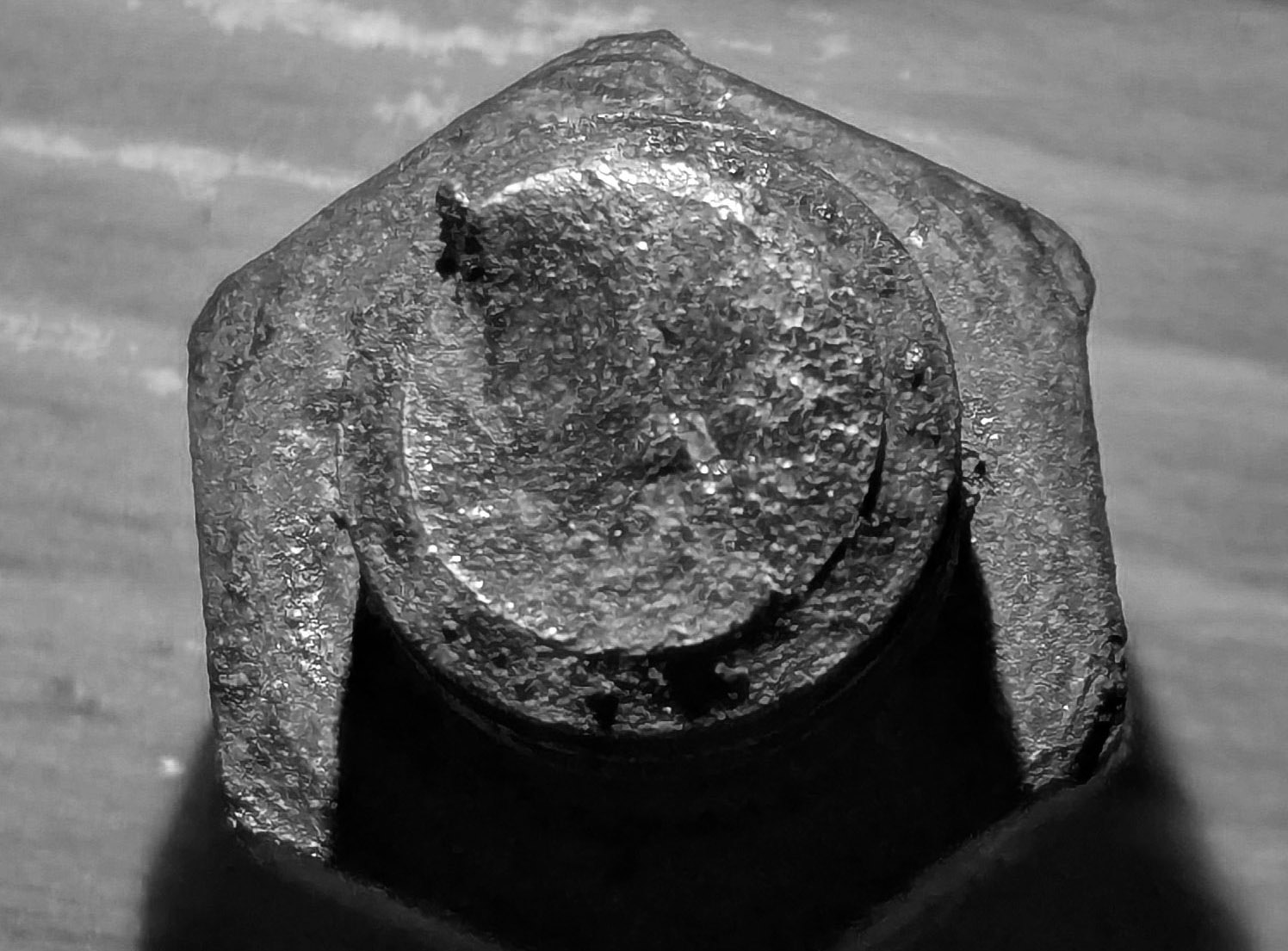
That leaves two possibilities: brittle tensile fracture or fatigue failure under higher-than-expected cyclic tensile load. Brittle fracture seems highly unlikely. Two potential causes exist. One is hydrogen embrittlement, but that’s rare in the low-strength carbon steel used in these bolts. The zinc-plating process likely involved acid cleaning and electroplating, which can introduce hydrogen. But this type of mild steel (probably Grade 2) is far too soft to trap it. Only if the bolt had been severely cold-worked or improperly baked post-plating would embrittlement be plausible.
The second possibility is a gross manufacturing defect or overhardening. That also seems improbable. Confast is a reputable supplier producing these bolts in massive quantities. The manufacturing process is simple, and I found no recall notices or defect reports. Hardness tests on the broken bolt (HRB ~90) confirm proper manufacturing and further suggest embrittlement wasn’t a factor.
While the available hydraulic energy at the cave entrance would seem to be low, and the 8-month time to failure is short, tensile fatigue originating at a corrosion pit emerges as the only remaining option. Its viability is supported by the partially pulled-out and bent bolt, which was placed about a foot away.
The broken bolt remained flush with the hanger, and the fracture lies roughly one hanger thickness from the nut. While the nut hadn’t backed off significantly, it had loosened enough to lose all preload. This left the bolt vulnerable to cyclic tensile loading from the attached chain vibrating in flowing water and from impacts by logs or boulders.
A fatigue crack could have initiated at a corrosion pit. Classic stress-corrosion cracking is rare in low-strength steel, but zinc-plated bolts under tension in corrosive environments sometimes behave unpredictably. The stream entering the cave has a summer pH of 4.6 to 5.0, but during winter, acidic conditions likely intensified, driven by leaf litter decay and the oxidation of pyrites in upstream Mauch Chunk shales after last year’s drought. The bolt’s initial preload would have imposed tensile stresses at 60–80% of yield strength. In that environment, stress-corrosion cracking is at least plausible.
More likely, though, preload was lost early due to vibration, and corrosion initiated a pit where the zinc plating had failed. The crack appears to have originated at the thread root (bottom right in above photo) and propagated across about two-thirds of the cross-section before sudden fracture occurred at the remaining ligament (top left).
The tensile stress area for 3/8 x 16 bolt would be 0.0775 square inches. If 65% was removed by fatigue, the remaining area would be 0.0271 sq. in. Assuming the final overload occurred at a tensile stress of around 60 ksi (SAE J429 Grade 2 bolts), then the final rupture would have required a tensile load of about 1600 pounds, a plausible value for a single jolt from a moving log or sudden boulder impact, especially given the force multiplier effect of the gate geometry, discussed below.
In mild steel, fatigue cracks can propagate under stress ranges as low as 10 to 30 percent of ultimate tensile strength, given a high enough number of cycles. Based on published S–N curves for similar material, we can sketch a basic relationship between stress amplitude and cycles to failure in an idealized steel rod (see columns 1 and 2 below).
Real-world conditions, of course, require adjustments. Threaded regions act as stress risers. Standard references assign a stress concentration factor (Kₜ) of about 3 to 4 for threads, which effectively lowers the endurance limit by roughly 40 percent. That brings the endurance limit down to around 7.5 ksi.
Surface defects from zinc plating and additional concentration at corrosion pits likely reduce it by another 10 percent. Adjusted stress levels for each cycle range are shown in column 3.
Does this match what we saw at the cave gate? If we assume the chain and fencing vibrated at around 2 Hz during periods of strong flow – a reasonable estimate based on turbulence – we get about 172,000 cycles per day. Just six days of sustained high flow would yield over a million cycles, corresponding to a stress amplitude of roughly 7 ksi based on adjusted fatigue data.
Given the bolt’s original cross-sectional area of 0.0775 in², a 7 ksi stress would require a cyclic tensile load of about 540 pounds.
| Cycles to Failure | Stress amplitude (ksi) | Adjusted Stress |
| ~10³ | 40 ksi | 30 ksi |
| ~10⁴ | 30 ksi | 20 ksi |
| ~10⁵ | 20 ksi | 12 ksi |
| ~10⁶ | 15 ksi | 7 ksi |
| Endurance limit | 12 ksi | 5 ksi |
Could our gate setup impose 540-pound axial loads on ceiling bolts? Easily – and the geometry shows how. In load-bearing systems like the so-called “death triangle,” force multiplication depends on the angle between anchor points. This isn’t magic. It’s just static equilibrium: if an object is at rest, the vector sum of forces acting on it in every direction must be zero (as derived from Newton’s first two laws of mechanics).
In our case, if the chain between two vertically aligned bolts sags at a 20-degree angle, the axial force on each bolt is multiplied by about a factor of eight. That means a horizontal force of just 70 pounds – say, from a bouncing log – can produce an axial load (vertical load on the bolt) of 540 pounds.
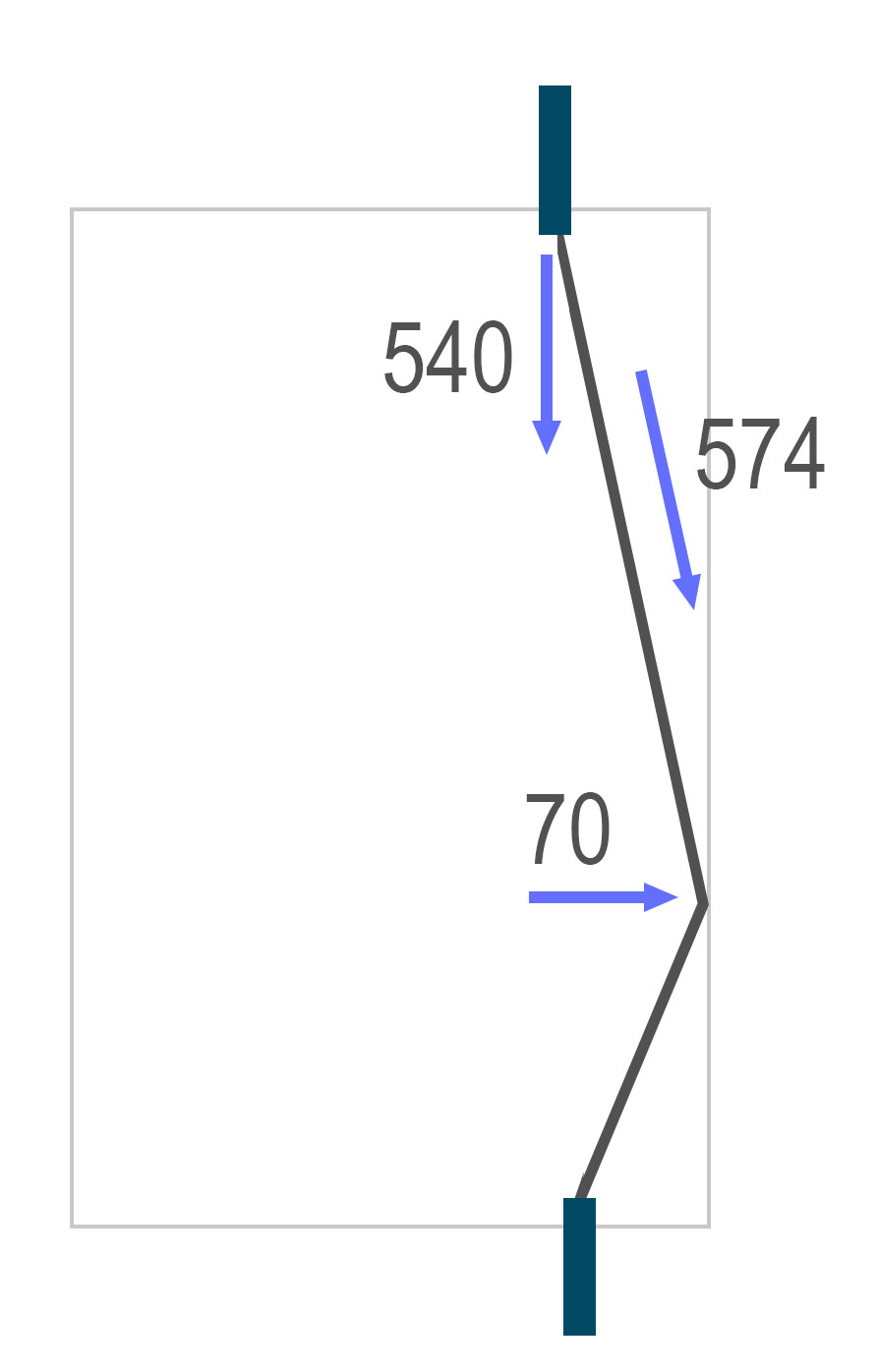
Under the conditions described above, six days of such cycling would be enough to trigger fatigue failure at one million cycles. If a 100-pound force was applied instead, the number of cycles to failure would drop to around 100,000.
The result was genuinely surprising. I knew the principles, but I hadn’t expected fatigue at such low stress levels and with so few cycles. Yet the evidence is clear. The nearby bolt that pulled partly out likely saw axial loads of over 1,100 pounds, enough to cause failure in just tens of thousands of cycles had the broken bolt been in its place. The final fracture area on the failed bolt suggests a sudden tensile load of around 1,600 pounds. These numbers confirm that the gate was experiencing higher axial forces on bolts than we’d anticipated.
The root cause was likely a corrosion pit, inevitable in this setting, and something stainless bolts (304 or 316) would have prevented, though stainless wouldn’t have stopped pullout. Loctite might help quick links resist opening under impact and vibration, though that’s unproven in this context. Chains, while easy to rig, amplified axial loads due to their geometry and flexibility. Stainless cable might vibrate less in water. Unfortunately, surface conditions at the entrance make a rigid or welded gate impractical. Stronger bolts – ½ or even ⅝ inch – torqued to 55 to 85 foot-pounds may be the only realistic improvement, though installation will be a challenge in that setting.
More broadly, this case illustrates how quickly nature punishes the use of non-stainless anchors underground.
From Aqueducts to Algorithms: The Cost of Consensus
Posted by Bill Storage in History of Science on July 9, 2025
The Scientific Revolution, we’re taught, began in the 17th century – a European eruption of testable theories, mathematical modeling, and empirical inquiry from Copernicus to Newton. Newton was the first scientist, or rather, the last magician, many historians say. That period undeniably transformed our understanding of nature.
Historians increasingly question whether a discrete “scientific revolution” ever happened. Floris Cohen called the label a straightjacket. It’s too simplistic to explain why modern science, defined as the pursuit of predictive, testable knowledge by way of theory and observation, emerged when and where it did. The search for “why then?” leads to Protestantism, capitalism, printing, discovered Greek texts, scholasticism, even weather. That’s mostly just post hoc theorizing.
Still, science clearly gained unprecedented momentum in early modern Europe. Why there? Why then? Good questions, but what I wonder, is why not earlier – even much earlier.
Europe had intellectual fireworks throughout the medieval period. In 1320, Jean Buridan nearly articulated inertia. His anticipation of Newton is uncanny, three centuries earlier:
“When a mover sets a body in motion he implants into it a certain impetus, that is, a certain force enabling a body to move in the direction in which the mover starts it, be it upwards, downwards, sidewards, or in a circle. The implanted impetus increases in the same ratio as the velocity. It is because of this impetus that a stone moves on after the thrower has ceased moving it. But because of the resistance of the air (and also because of the gravity of the stone) … the impetus will weaken all the time. Therefore the motion of the stone will be gradually slower, and finally the impetus is so diminished or destroyed that the gravity of the stone prevails and moves the stone towards its natural place.”
Robert Grosseteste, in 1220, proposed the experiment-theory iteration loop. In his commentary on Aristotle’s Posterior Analytics, he describes what he calls “resolution and composition”, a method of reasoning that moves from particulars to universals, then from universals back to particulars to make predictions. Crucially, he emphasizes that both phases require experimental verification.
In 1360, Nicole Oresme gave explicit medieval support for a rotating Earth:
“One cannot by any experience whatsoever demonstrate that the heavens … are moved with a diurnal motion… One can not see that truly it is the sky that is moving, since all movement is relative.”
He went on to say that the air moves with the Earth, so no wind results. He challenged astrologers:
“The heavens do not act on the intellect or will… which are superior to corporeal things and not subject to them.”
Even if one granted some influence of the stars on matter, Oresme wrote, their effects would be drowned out by terrestrial causes.
These were dead ends, it seems. Some blame the Black Death, but the plague left surprisingly few marks in the intellectual record. Despite mass mortality, history shows politics, war, and religion marching on. What waned was interest in reviving ancient learning. The cultural machinery required to keep the momentum going stalled. Critical, collaborative, self-correcting inquiry didn’t catch on.
A similar “almost” occurred in the Islamic world between the 10th and 16th centuries. Ali al-Qushji and al-Birjandi developed sophisticated models of planetary motion and even toyed with Earth’s rotation. A layperson would struggle to distinguish some of al-Birjandi’s thought experiments from Galileo’s. But despite a wealth of brilliant scholars, there were few institutions equipped or allowed to convert knowledge into power. The idea that observation could disprove theory or override inherited wisdom was socially and theologically unacceptable. That brings us to a less obvious candidate – ancient Rome.
Rome is famous for infrastructure – aqueducts, cranes, roads, concrete, and central heating – but not scientific theory. The usual story is that Roman thought was too practical, too hierarchical, uninterested in pure understanding.
One text complicates that story: De Architectura, a ten-volume treatise by Marcus Vitruvius Pollio, written during the reign of Augustus. Often described as a manual for builders, De Architectura is far more than a how-to. It is a theoretical framework for knowledge, part engineering handbook, part philosophy of science.
Vitruvius was no scientist, but his ideas come astonishingly close to the scientific method. He describes devices like the Archimedean screw or the aeolipile, a primitive steam engine. He discusses acoustics in theater design, and a cosmological models passed down from the Greeks. He seems to describe vanishing point perspective, something seen in some Roman art of his day. Most importantly, he insists on a synthesis of theory, mathematics, and practice as the foundation of engineering. His describes something remarkably similar to what we now call science:
“The engineer should be equipped with knowledge of many branches of study and varied kinds of learning… This knowledge is the child of practice and theory. Practice is the continuous and regular exercise of employment… according to the design of a drawing. Theory, on the other hand, is the ability to demonstrate and explain the productions of dexterity on the principles of proportion…”
“Engineers who have aimed at acquiring manual skill without scholarship have never been able to reach a position of authority… while those who relied only upon theories and scholarship were obviously hunting the shadow, not the substance. But those who have a thorough knowledge of both… have the sooner attained their object and carried authority with them.”
This is more than just a plea for well-rounded education. H e gives a blueprint for a systematic, testable, collaborative knowledge-making enterprise. If Vitruvius and his peers glimpsed the scientific method, why didn’t Rome take the next step?
The intellectual capacity was clearly there. And Roman engineers, like their later European successors, had real technological success. The problem, it seems, was societal receptiveness.
Science, as Thomas Kuhn famously brough to our attention, is a social institution. It requires the belief that man-made knowledge can displace received wisdom. It depends on openness to revision, structured dissent, and collaborative verification. These were values that the Roman elite culture distrusted.
When Vitruvius was writing, Rome had just emerged from a century of brutal civil war. The Senate and Augustus were engaged in consolidating power, not questioning assumptions. Innovation, especially social innovation, was feared. In a political culture that prized stability, hierarchy, and tradition, the idea that empirical discovery could drive change likely felt dangerous.
We see this in Cicero’s conservative rhetoric, in Seneca’s moralism, and in the correspondence between Pliny and Trajan, where even mild experimentation could be viewed as subversive. The Romans could build aqueducts, but they wouldn’t fund a lab.
Like the Islamic world centuries later, Rome had scholars but not systems. Knowledge existed, but the scaffolding to turn it into science – collective inquiry, reproducibility, peer review, invitations for skeptics to refute – never emerged.
Vitruvius’s De Architectura deserves more attention, not just as a technical manual but as a proto-scientific document. It suggests that the core ideas behind science were not exclusive to early modern Europe. They’ve flickered into existence before, in Alexandria, Baghdad, Paris, and Rome, only to be extinguished by lack of institutional fit.
That science finally took root in the 17th century had less to do with discovery than with a shift in what society was willing to do with discovery. The real revolution wasn’t in Newton’s laboratory, it was in the culture.
Rome’s Modern Echo?
It’s worth asking whether we’re becoming more Roman ourselves. Today, we have massively resourced research institutions, global scientific networks, and generations of accumulated knowledge. Yet, in some domains, science feels oddly stagnant or brittle. Dissenting views are not always engaged but dismissed, not for lack of evidence, but for failing to fit a prevailing narrative.
We face a serious, maybe existential question. Does increasing ideological conformity, especially in academia, foster or hamper science?
Obviously, some level of consensus is essential. Without shared standards, peer review collapses. Climate models, particle accelerators, and epidemiological studies rely on a staggering degree of cooperation and shared assumptions. Consensus can be a hard-won product of good science. And it can run perilously close to dogma. In the past twenty years we’ve seen consensus increasingly enforced by legal action, funding monopolies, and institutional ostracism.
String theory may (or may not) be physics’ great white whale. It’s mathematically exquisite but empirically elusive. For decades, critics like Lee Smolin and Peter Woit have argued that string theory has enjoyed a monopoly on prestige and funding while producing little testable output. Dissenters are often marginalized.
Climate science is solidly evidence-based, but responsible scientists point to constant revision of old evidence. Critics like Judith Curry or Roger Pielke Jr. have raised methodological or interpretive concerns, only to find themselves publicly attacked or professionally sidelined. Their critique is labeled denial. Scientific American called Curry a heretic. Lawsuits, like Michael Mann’s long battle with critics, further signal a shift from scientific to pre-scientific modes of settling disagreement.
Jonathan Haidt, Lee Jussim, and others have documented the sharp political skew of academia, particularly in the humanities and social sciences, but increasingly in hard sciences too. When certain political assumptions are so embedded, they become invisible. Dissent is called heresy in an academic monoculture. This constrains the range of questions scientists are willing to ask, a problem that affects both research and teaching. If the only people allowed to judge your work must first agree with your premises, then peer review becomes a mechanism of consensus enforcement, not knowledge validation.
When Paul Feyerabend argued that “the separation of science and state” might be as important as the separation of church and state, he was pushing back against conservative technocratic arrogance. Ironically, his call for epistemic anarchism now resonates more with critics on the right than the left. Feyerabend warned that uniformity in science, enforced by centralized control, stifles creativity and detaches science from democratic oversight.
Today, science and the state, including state-adjacent institutions like universities, are deeply entangled. Funding decisions, hiring, and even allowable questions are influenced by ideology. This alignment with prevailing norms creates a kind of soft theocracy of expert opinion.
The process by which scientific knowledge is validated must be protected from both politicization and monopolization, whether that comes from the state, the market, or a cultural elite.
Science is only self-correcting if its institutions are structured to allow correction. That means tolerating dissent, funding competing views, and resisting the urge to litigate rather than debate. If Vitruvius teaches us anything, it’s that knowing how science works is not enough. Rome had theory, math, and experimentation. What it lacked was a social system that could tolerate what those tools would eventually uncover. We do not yet lack that system, but we are testing the limits.
Rational Atrocity?
Posted by Bill Storage in Probability and Risk on July 4, 2025
Bayesian Risk and the Internment of Japanese Americans
We can use Bayes (see previous post) to model the US government’s decision to incarcerate Japanese Americans, 80,000 of which were US citizens, to reduce a perceived security risk. We can then use a quantified risk model to evaluate the internment decision.
We define two primary hypotheses regarding the loyalty of Japanese Americans:
- H1: The population of Japanese Americans are generally loyal to the United States and collectively pose no significant security threat.
- H2: The population of Japanese Americans poses a significant security threat (e.g., potential for espionage or sabotage).
The decision to incarceration Japanese Americans reflects policymakers’ belief in H2 over H1, updated based on evidence like the Niihau Incident.
Prior Probabilities
Before the Niihau Incident, policymakers’ priors were influenced by several factors:
- Historical Context: Anti-Asian sentiment on the West Coast, including the 1907 Gentlemen’s Agreement and 1924 Immigration Act, fostered distrust of Japanese Americans.
- Pearl Harbor: The surprise attack on December 7, 1941, heightened fears of internal threats. No prior evidence of disloyalty existed.
- Lack of Data: No acts of sabotage or espionage by Japanese Americans had been documented before Niihau. Espionage detection and surveillance were limited. Several espionage rings tied to Japanese nationals were active (Itaru Tachibana, Takeo Yoshikawa).
Given this, we can estimate subjective priors:
- P(H1) = 0.99: Policymakers might have initially been 99 percent confident that Japanese Americans were loyal, as they were U.S. citizens or long-term residents with no prior evidence of disloyalty. The pre-Pearl Harbor Munson Report (“There is no Japanese `problem’ on the Coast”) supported this belief.
- P(H2) = 0.01: A minority probability of threat due to racial prejudices, fear of “fifth column” activities, and Japan’s aggression.
These priors are subjective and reflect the mix of rational assessment and bias prevalent at the time. Bayesian reasoning (Subjective Bayes) requires such subjective starting points, which are sometimes critical to the outcome.
Evidence and Likelihoods
The key evidence influencing the internment decision was the Niihau Incident (E1) modeled in my previous post. We focus on this, as it was explicitly cited in justifying internment, though other factors (e.g., other Pearl Harbor details, intelligence reports) played a role.
E1: The Niihau Incident
Yoshio and Irene Harada, Nisei residents, aided Nishikaichi in attempting to destroy his plane, burn papers, and take hostages. This was interpreted by some (e.g., Lt. C.B. Baldwin in a Navy report) as evidence that Japanese Americans might side with Japan in a crisis.
Likelihoods:
P(E1|H1) = 0.01: If Japanese Americans are generally loyal, the likelihood of two individuals aiding an enemy pilot is low. The Haradas’ actions could be seen as an outlier, driven by personal or situational factors (e.g., coercion, cultural affinity). Note that this 1% probability is not the same 1% probability of H1, the prior belief that Japanese Americans weren’t loyal. Instead, P(E1|H1) is the likelihood assigned to whether E1, the Harada event, would have occurred given than Japanese Americans were loyal to the US.
P(E1|H2) = 0.6: High likelihood of observing the Harada evidence if the population of Japanese Americans posed a threat.
Posterior Calculation Using Bayes Theorem:
P(H1∣E1) = P(E1∣H1)⋅P(H1) / [P(E1∣H1)⋅P(H1)+P(E1∣H2)⋅P(H2)]
P(H1∣E1)=0.01⋅0.99 / [(0.01⋅0.99)+(0.6⋅0.01)] = 0.626
P(H2|E1) = 1 – P(H1|E1) = 0.374
The Niihau Incident significantly increases the probability of H2 (its prior was 0.01), suggesting a high perceived threat. This aligns with the heightened alarm in military and government circles post-Niihau. 62.6% confidence in loyalty is unacceptable by any standards. We should experiment with different priors.
Uncertainty Quantification
- Aleatoric Uncertainty: The Niihau Incident involved only two people.
- Epistemic Uncertainty: Prejudices and wartime fear would amplify P(H2).
Sensitivity to P(H1)
The posterior probability of H2 is highly sensitive to changes in P(H2) – and to P(H1) because they are linearly related: P(H2) = 1.0 – P(H1).
The posterior probability of H2 is somewhat sensitive to the likelihood assigned to P(E1|H1), but in a way that may be counterintuitive – because it is the likelihood assigned to whether E1, the Harada event, would have occurred given than Japanese Americans were loyal. We now know them to have been loyal, but that knowledge can’t be used in this analysis. Increasing this value lowers the posterior probability.
The posterior probability of H2 is relatively insensitive to changes in P(E1|H2), the likelihood of observing the evidence if Japanese Americans posed a threat (which, again, we now know them to have not).
A plot of posterior probability of H2 against the prior probabilities assigned to H2 – that is, P(H2|E1) vs P(H2) – for a range of values of P(H2) using three different values of P(E1|H1) shows the sensitivities. The below plot (scales are log-log) also shows the effect of varying P(E1|H2); compare the thin blue line to the thick blue line.
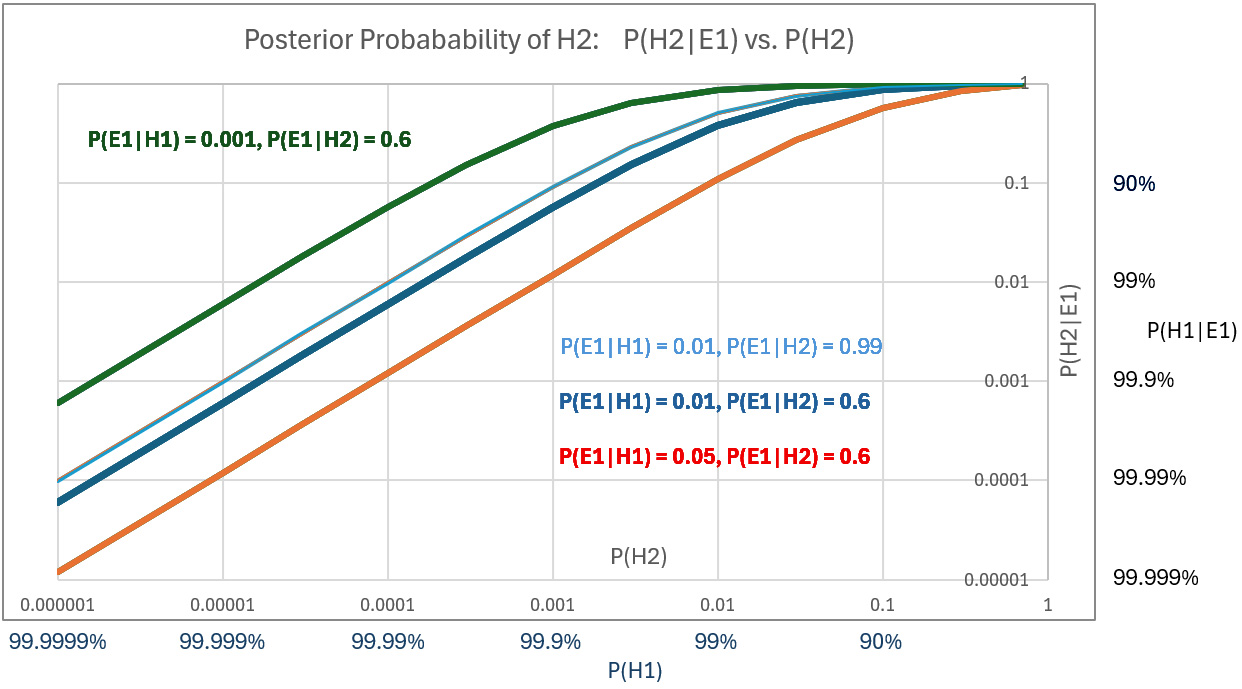
Prior hypotheses with probabilities greater the 99% represent confidence levels that are rarely justified. Nevertheless, we plot high posteriors for priors of H1 (i.e., posteriors of H2 down to 0.00001 (1E-5). Using P(E1|H1) = 0.05 and P(E1|H2 = 0.6, we get a posterior P(H2|E1) = 0.0001 – or P(H1|E1) = 99.99%, which might be initially judged as not supporting incarceration of US citizens in what were effectively concentration camps.
Risk
While there is no evidence of either explicit Bayesian reasoning or risk quantification by Franklin D. Roosevelt or military analysts, we can examine their decisions using reasonable ranges of numerical values that would have been used if numerical analysis had been employed.
We can model risk, as is common in military analysis, by defining it as the product of severity and probability – probability equal to that calculated as the posterior probability that a threat existed in the population of 120,000 who were interned.
Having established a range of probabilities for threat events above, we can now estimate severity – the cost of a loss – based on lost lives and lost defense capability resulting from a threat brought to life.
The Pearl Harbor attack itself tells us what a potential hazard might look like. Eight U.S. Navy battleships were at Pearl Harbor: Arizona, Oklahoma, West Virginia, California, Nevada, Tennessee, Maryland, and Pennsylvania. Typical peacetime crew sizes ranged from 1,200 to 1,500 per battleship, though wartime complements could exceed that. About 8,000–10,000 sailors were assigned to the battleships. More sailors would have been on board had the attack not happened on a Sunday morning.
About 37,000 Navy and 14,000 Army personnel were stationed at Pearl Harbor. 2,403 were killed in the attack, most of them aboard battleships. Four battleships were sunk. The Arizona suffered a catastrophic magazine explosion from a direct bomb hit. Over 1,170 crew members were killed. 400 were killed on the Oklahoma when it sank. None of the three aircraft carriers of the Pacific Fleet were in Pearl Harbor on Dec. 7. The USS Enterprise was due to be in port on Dec. 6 but was delayed by weather. Its crew was about 2,300 men.
Had circumstances differed slightly, the attack would not have been a surprise, and casualties would have been fewer. But in other conceivable turns of events, they could have been far greater. A modern impact analysis of an attack on Pearl Harbor or other bases would consider an invasion’s “cost” to be 10 to 20,000 lives and the loss of defense capability due to destroyed ships and aircraft. Better weather could have meant destruction of one third of US aircraft carriers in the Pacific.
Using a linear risk model, an analyst, if such analysis was done back then, might have used the above calculated P(H2|E1) as the probability of loss and 10,000 lives as one cost of the espionage. Using probability P(H1) in the range of 99.99% confidence in loyalty – i.e., P(H2) = 1E-4 – and severity = 10,000 lives yields quantified risk.
As a 1941 risk analyst, you would be considering a one-in-10,000 chance of losing 10,000 lives and loss of maybe 25% of US defense capacity. Another view of the risk would be that each of 120,000 Japanese Americans poses a one-in-10,000 chance of causing 10,000 deaths, an expected cost of roughly 120,000 lives (roughly, because the math isn’t quite as direct as it looks in this example).
While I’ve modeled the decision using a linear expected value approach, it’s important to note that real-world policy, especially in safety-critical domains, is rarely risk-neutral. For instance, Federal Aviation Regulation AC 25.1309 states that “no single failure, regardless of probability, shall result in a catastrophic condition”, a clear example of a threshold risk model overriding probabilistic reasoning. In national defense or public safety, similar thinking applies. A leader might deem a one-in-10,000 chance of catastrophic loss (say, 10,000 deaths and 25% loss of Pacific Fleet capability) intolerable, even if the expected value (loss) were only one life. This is not strictly about math; it reflects public psychology and political reality. A risk-averse or ambiguity-intolerant government could rationally act under such assumptions.
Would you take that risk, or would you incarcerate? Would your answer change if you used P(H1) = 99.999 percent? Could a prior of that magnitude ever be justified?
From the perspective of quantified risk analysis (as laid out in documents like FAR AC 25.1309), President Roosevelt, acting in early 1942 would have been justified even if P(H1) had been 99.999%.
In a society so loudly committed to consequentialist reasoning, this choice ought to seem defensible. That it doesn’t may reveal more about our moral bookkeeping than about Roosevelt’s logic. Racism existed in California in 1941, but it unlikely increased scrutiny by spy watchers. The fact that prejudice existed does not bear on the decision, because the prejudice did not motivate any action that would have born – beyond the Munson Report – on the prior probabilities used. That the Japanese Americans were held far too long is irrelevant to Roosevelt’s decision.
Since the rationality of Roosevelt’s decision, as modeled by Bayesian reasoning and quantified risk, ultimately hinges on P(H1), and since H1’s primary input was the Munson Report, we might scrutinize the way the Munson Report informs H1.
The Munson Report is often summarized with its most quoted line: “There is no Japanese ‘problem’ on the Coast.” And that was indeed its primary conclusion. Munson found Japanese American citizens broadly loyal and recommended against mass incarceration. However, if we assume the report to be wholly credible – our only source of empirical grounding at the time – then certain passages remain relevant for establishing a prior. Munson warned of possible sabotage by Japanese nationals and acknowledged the existence of a few “fanatical” individuals willing to act violently on Japan’s behalf. He recommended federal control over Japanese-owned property and proposed using loyal Nisei to monitor potentially disloyal relatives. These were not the report’s focus, but they were part of it. Critics often accuse John Franklin Carter of distorting Munson’s message when advising Roosevelt. Carter’s motives are beside the point. Whether his selective quotations were the product of prejudice or caution, the statements he cited were in the report. Even if we accept Munson’s assessment in full – affirming the loyalty of Japanese American citizens and acknowledging only rare threats – the two qualifiers Carter cited are enough to undercut extreme confidence. In modern Bayesian practice, priors above 99.999% are virtually unheard of, even in high-certainty domains like particle physics and medical diagnostics. From a decision-theoretic standpoint, Munson’s own language renders such priors unjustifiable. With confidence lower than that, Roosevelt made the rational decision – clear in its logic, devastating in its consequences.
Bayes Theorem, Pearl Harbor, and the Niihau Incident
Posted by Bill Storage in Probability and Risk on July 2, 2025
The Niihau Incident of December 7–13, 1941 provides a good case study for applying Bayesian reasoning to historical events, particularly in assessing decision-making under uncertainty. Bayesian reasoning involves updating probabilities based on new evidence, using Bayes’ theorem: P(A∣B) = P(B∣A) ⋅ P(A)P(B) / P(A|B), where:
- P(E∣H) is the likelihood of observing E given H
- P(H∣E) is the posterior probability of hypothesis H given evidence E
- P(H) is the prior probability of H
- P(E) is the marginal probability of E.
Terms like P(E∣H), the probability of evidence given a hypothesis, can be confusing. Alternative phrasings may help:
- The probability of observing evidence E if hypothesis H were true
- The likelihood of E given H
- The conditional probability of E under H
These variations clarify that we’re assessing how likely the evidence is under a specific scenario, not the probability of the hypothesis itself, which is P(H∣E).
In the context of the Niihau Incident, we can use Bayesian reasoning to analyze the decisions made by the island’s residents, particularly the Native Hawaiians and the Harada family, in response to the crash-landing of Japanese pilot Shigenori Nishikaichi. Below, I’ll break down the analysis, focusing on key decisions and quantifying probabilities while acknowledging the limitations of historical data.
Context of the Niihau Incident
On December 7, 1941, after participating in the Pearl Harbor attack, Japanese pilot Shigenori Nishikaichi crash-landed his damaged A6M2 Zero aircraft on Niihau, a privately owned Hawaiian island with a population of 136, mostly Native Hawaiians. The Japanese Navy had mistakenly designated Niihau as an uninhabited island for emergency landings, expecting pilots to await rescue there. The residents, unaware of the Pearl Harbor attack, initially treated Nishikaichi as a guest but confiscating his weapons. Over the next few days, tensions escalated as Nishikaichi, with the help of Yoshio Harada and his wife Irene, attempted to destroy his plane and papers, took hostages, and engaged in violence. The incident culminated in the Kanaheles, a Hawaiian couple, overpowering and killing Nishikaichi. Yoshio Harada committing suicide.
From a Bayesian perspective, we can analyze the residents updating their beliefs as new evidence emerged.
We define two primary hypotheses regarding Nishikaichi’s intentions:
- H1: Nishikaichi is a neutral (non-threatening) lost pilot needing assistance.
- H2: Nishikaichi is an enemy combatant with hostile intentions.
The residents’ decisions reflect the updating of beliefs about (credence in) these hypotheses.
Prior Probabilities
At the outset, the residents had no knowledge of the Pearl Harbor attack. Thus, their prior probability for P(H1) (Nishikaichi is non-threatening) would likely be high, as a crash-landed pilot could reasonably be seen as a distressed individual. Conversely, P(H2) (Nishikaichi is a threat) would be low due to the lack of context about the war.
We can assign initial priors based on this context:
- P(H1) = 0.9: The residents initially assume Nishikaichi is a non-threatening guest, given their cultural emphasis on hospitality and lack of information about the attack.
- P(H2) = 0.1: The possibility of hostility exists but is less likely without evidence of war.
These priors are subjective, reflecting the residents’ initial state of knowledge, consistent with the Bayesian interpretation of probability as a degree of belief.
We identify key pieces of evidence that influenced the residents’ beliefs:
E1: Nishikaichi’s Crash-Landing and Initial Behavior
Nishikaichi crash-landed in a field near Hawila Kaleohano, who disarmed him and treated him as a guest. His initial behavior (not hostile) supports H1.
Likelihoods:
- P(E1∣H1) = 0.95: A non-threatening pilot is highly likely to crash-land and appear cooperative.
- P(E1∣H2) = 0.3: A hostile pilot could be expected to act more aggressively, though deception is possible.
Posterior Calculation:
P(H1∣E1) = [P(E1∣H1)⋅P(H1)] / [P(E1∣H1)⋅P(H1) + P(E1∣H2)⋅P(H2) ]
P(H1|E1) = 0.95⋅0.9 / [(0.95⋅0.9) + (0.3⋅0.1)] = 0.97
After the crash, the residents’ belief in H1 justifies hospitality.
E2: News of the Pearl Harbor Attack
That night, the residents learned of the Pearl Harbor attack via radio, revealing Japan’s aggression. This significantly increases the likelihood that Nishikaichi was a threat.
Likelihoods:
- P(E2∣H1) = 0.1 P(E2|H1) = 0.1 P(E2∣H1) = 0.1: A non-threatening pilot is unlikely to be associated with a surprise attack.
- P(E2∣H2) = 0.9 P(E2|H2) = 0.9 P(E2∣H2) = 0.9: A hostile pilot is highly likely to be linked to the attack.
Posterior Calculation (using updated priors from E1):
P(H1∣E2) = P(E2∣H1)⋅P(H1∣E1) / [P(E2∣H1)⋅P(H1∣E1) + P(E2∣H2)⋅P(H2∣E1)]
P(H1∣E2) = 0.1⋅0.97 / [(0.1⋅0.97) + (0.9⋅0.03)] = 0.76
P(H2∣E2) = 0.24
The news shifts the probability toward H2, prompting the residents to apprehend Nishikaichi and put him under guard with the Haradas.
E3: Nishikaichi’s Collusion with the Haradas
Nishikaichi convinced Yoshio and Irene Harada to help him escape, destroy his plane, and burn Kaleohano’s house to eliminate his papers.
Likelihoods:
- P(E3∣H1) = 0.01: A non-threatening pilot is extremely unlikely to do this.
- P(E3∣H2) = 0.95: A hostile pilot is likely to attempt to destroy evidence and escape.
Posterior Calculation (using updated priors from E2):
P(H1∣E3) = P(E3∣H1)⋅P(H1∣E2) / [P(E3∣H1)⋅P(H1∣E2) + P(E3∣H2)⋅P(H2∣E2)]
P(H1∣E3) = 0.01⋅0.759 / [(0.01⋅0.759) + (0.95⋅0.241)] = 0.032
P(H2∣E3) = 0.968
This evidence dramatically increases the probability of H2, aligning with the residents’ decision to confront Nishikaichi.
E4: Nishikaichi Takes Hostages and Engages in Violence
Nishikaichi and Harada took Ben and Ella Kanahele hostage, and Nishikaichi fired a machine gun. Hostile intent is confirmed.
Likelihoods:
- P(E4∣H1) = 0.001: A non-threatening pilot is virtually certain not to take hostages or use weapons.
- P(E4∣H2) = 0.99: A hostile pilot is extremely likely to resort to violence.
Posterior Calculation (using updated priors from E3):
P(H1∣E4) = P(E4∣H1)⋅P(H1∣E3)/ [P(E4∣H1)⋅P(H1∣E3) + P(E4∣H2)⋅P(H2∣E3)P(H1|E4)]
P(H1∣E4) = 0.001⋅0.032 / [(0.001⋅0.032)+(0.99⋅0.968)] =0.00003
P(H2∣E4) = 1.0 – P(H1∣E4) = 0.99997
At this point, the residents’ belief in H2 is near certainty, justifying the Kanaheles’ decisive action to overpower Nishikaichi.
Uncertainty Quantification
Bayesian reasoning also involves quantifying uncertainty, particularly aleatoric (inherent randomness) and epistemic (model uncertainty) components.
Aleatoric Uncertainty: The randomness in Nishikaichi’s actions (e.g., whether he would escalate to violence) was initially high due to the residents’ lack of context. As evidence accumulated, this uncertainty decreased, as seen in the near-certain posterior for H2 after E4.
Epistemic Uncertainty: The residents’ model of Nishikaichi’s intentions was initially flawed due to their isolation and lack of knowledge about the war. This uncertainty reduced as they incorporated news of Pearl Harbor and observed Nishikaichi’s actions, refining their model of his behavior.
Analysis of Decision-Making
The residents’ actions align with Bayesian updating:
Initial Hospitality (E1): High prior for H1 led to treating Nishikaichi as a guest, with precautions (disarming him) reflecting slight uncertainty.
Apprehension (E2): News of Pearl Harbor shifted probabilities toward H2, prompting guards and confinement with the Haradas.
Confrontations (E3, E4): Nishikaichi’s hostile actions (collusion, hostage-taking) pushed P(H2) to near 1, leading to the Kanaheles’ lethal response.
The Haradas’ decision to assist Nishikaichi complicates the analysis. Their priors may have been influenced by cultural or personal ties to Japan, increasing their P(H1) or introducing a separate hypothesis of loyalty to Japan. Lack of detailed psychological data makes quantifying their reasoning speculative.
Limitations and Assumptions
Subjective Priors: The assigned priors (e.g., P(H1) = 0.9) are estimates based on historical context, not precise measurements. Bayesian reasoning allows subjective priors, but different assumptions could alter results.
Likelihood Estimates: Likelihoods (e.g., P(E1∣H1) = 0.95) are informed guesses, as historical records lack data on residents’ perceptions.
Simplified Hypotheses: I used two hypotheses for simplicity. In reality, residents may have considered nuanced possibilities, e.g., Nishikaichi being coerced or acting out of desperation.
Historical Bias: may exaggerate or omit details, affecting our understanding of evidence.
Conclusion
Bayesian reasoning (Subjective Bayes) provides a structured framework to understand how Niihau’s residents updated their beliefs about Nishikaichi’s intentions. Initially, a high prior for him being non-threatening (P(H1)=0.9) was reasonable given their isolation. As evidence accumulated (news of Pearl Harbor, Nishikaichi’s collusion with the Haradas, and his violent actions) the posterior probability of hostility, P(H2) approached certainty, justifying their escalating responses. Quantifying this process highlights the rationality of their decisions under uncertainty, despite limited information. This analysis demonstrates Bayesian inference used to model historical decision-making, assuming the deciders were rational agents.
Next
The Niihau Incident influenced U.S. policy decisions regarding the internment of Japanese Americans during World War II. It heightened fears of disloyalty among Japanese Americans. Applying Bayesian reasoning to the decision to intern Japanese Americans after the Niihau Incident might provide insight on how policymakers updated their beliefs about the potential threat posed by this population based on limited evidence and priors. In a future post, I’ll use Bayes’ theorem to model this decision-making process to model the quantification of risk.
If the Good Lord’s Willing and the Creek Don’t Rise
Posted by Bill Storage in Commentary on June 30, 2025
Feller said don’t try writin dialect less you have a good ear. Now do I think my ear’s good? Well, I do and I don’t. Problem is, younguns ain’t mindin this store. I’m afeared we don’t get it down on paper we gonna lose it. So I went up the holler to ask Clare his mind on it.
We set a spell. He et his biscuits cold, sittin on the porch, not sayin’ much, piddlin with a pocketknife like he had a mind to whittle but couldn’t commit. Clare looked like sumpin the cat drug in. He was wore slap out from clearing the dreen so he don’t hafta tote firewood from up where the gator can’t git. “Reckon it’ll come up a cloud,” he allowed, squinting yonder at the ridge. “Might could,” I said. He nodded slow. “Don’t fret none,” he said. “That haint don’t stir in the holler less it’s fixin ta storm proper.” Then he leaned back, tuckered, fagged-out, and let the breeze do the talkin.
Now old Clare, he called it alright. Well, I’ll swan! The wind took up directly, then down it come. We watched the brown water push a wall of dead leaves and branches down yon valley. Dry Branch, they call it, and that’s a fact. Ain’t dry now. Feature it. One minute dry as dust, then come a gully-washer, bless yer heart. That was right smart of time ago.
If you got tolerable horse sense for Appalachian colloquialism, you’ll have understood most of that. A haint, by the way, is a spirit, a ghost, a spell, or a hex. Two terms used above make me wonder if all the technology we direct toward capturing our own shreds of actual American culture still fail to record these treasured regionalisms.
A “dreen,” according to Merriam-Webster, is “a dialectal variation of ‘drain,’ especially in Southern and South Midland American English.” Nah, not in West Virginia. That definition is a perfect example of how dictionaries flatten regional terms into their nearest Standard English cousin and, in doing so, miss the real story. It’s too broad and bland to capture what was, in practice, a topographic and occupational term used by loggers.
A dreen, down home, is a narrow, shallow but steep-sided and steeply sloping valley used to slide logs down. It’s recognized in local place-names and oral descriptions. Clear out the gully – the drain – for logs and you got yourself a dreen. The ravine’s water flow, combined with exposed shards of shale, make it slick. Drop logs off up top, catch them in a basin at the bottom. An economical means for moving logs down rough terrain without a second team of horses, specialized whiffletrees, and a slip-tongue skidder. How is it that there is zero record of what a dreen is on the web?
To “feature” something means to picture it in your mind. Like, “imagine,” but more concrete. “Picture this” + “feature picture” → “feature this.” Maybe? I found a handful of online forums where someone wrote, “I can’t feature it,” but the dictionaries are silent. What do I not pay you people for?
It’s not just words and phrases that our compulsive documentation and data ingestion have failed to capture about Appalachia. Its expressive traditions rarely survive the smooshing that comes with cinematic stereotypes. Poverty, moonshine, fiddles, a nerdy preacher and, more lately, mobile meth labs, are easy signals for “rural and backward.” Meanwhile, the texture of Appalachian life is left out.
Ever hear of shape-note music? How about lined-out singing? The style is raw and slow, not that polished gospel stuff you hear down in Alabama. The leader “lines out” a hymn, and the congregation follows in a full, droning response. It sounds like a mixture of Gaelic and plain chant – and probably is.
Hill witch. Granny women, often midwives, were herbalists and folk doctors. Their knowledge was empirical, intergenerational, and somehow female-owned. They were healers with an oral pharmacopoeia rooted in a mix of Native American and Scottish traditions. Hints of it, beyond the ginseng, still pop up here and there.
Jack tales. They pick up where Jack Frost, Jack and Jill, and Little Jack Horner left off. To my knowledge, those origins are completely unrelated to each other. Jack tales use these starting points to spin yarns about seemingly low-ambition or foolish folk who outfox them what think they’re smart. (Pronounce “smart” with a short “o” and a really long “r” that stretches itself into two distinct syllables.)
Now, I know that in most ways, none of that amounts to a hill of beans, but beyond the dialect, I fear we’re going to lose some novel expressions. Down home,
“You can’t get there from here” means it is metaphorically impossible or will require a lot of explaining.
“Puny” doesn’t mean you’re small; it means you look sick.
“That dog won’t hunt” means an idea, particularly a rebuttal or excuse, that isn’t plausible.
“Tighter than Dick’s hatband” means that someone is stingy or has proposed an unfair trade.
“Come day, go day, God send Sunday” means living day to day, e.g., hoping the drought lets up.
“He’s got the big eye” means he can’t sleep.
“He’s ate up with it” means he’s obsessed – could be jealousy, could be pride.
“Well, I do and I don’t” says more than indecision. You deliver it as a percussive anapest (da-da-DUM!, da-da-DUM!), granting it a kind of rhythmic, folksy authority. It’s a measured fence-sitting phrase that buys time while saying something real. It’s a compact way to acknowledge nuance, to say, “I agree… to a point,” followed with “It’s complicated…” Use it to acknowledge an issue as more personal and moral, less analytical. You can avoid full commitment while showing thoughtfulness. It weighs individual judgment. See also:
“There’s no pancake so thin it ain’t got two sides.”
The stoics got nothin on this baby. I don’t want you think I’m uppity – gettin above my raisin, I mean – but this one’s powerful subtle. There’s a conflict between principle and sympathy. It flattens disagreement by framing it as something natural. Its double negative ain’t no accident. Deploy it if you’re slightly cornered but not ready to concede. You acknowledge fairness, appear to hover above the matter at hand, seemingly without taking sides. Both parties know you have taken a side, of course. And that’s ok. That’s how we do it down here. This is de-escalation of conflict through folk epistemology: nothing is so simple that it doesn’t deserve a second look. Even a blind hog finds an acorn now and then. Just ‘cause the cat’s a-sittin still don’t mean it ain’t plannin.
Appalachia is America’s most misunderstood archive, its stories tucked away in hollers like songs no one’s sung for decades.

Grains of Truth: Science and Dietary Salt
Posted by Bill Storage in History of Science, Philosophy of Science on June 29, 2025
Science doesn’t proceeds in straight lines. It meanders, collides, and battles over its big ideas. Thomas Kuhn’s view of science as cycles of settled consensus punctuated by disruptive challenges is a great way to understand this messiness, though later approaches, like Imre Lakatos’s structured research programs, Paul Feyerabend’s radical skepticism, and Bruno Latour’s focus on science’s social networks have added their worthwhile spins. This piece takes a light look, using Kuhn’s ideas with nudges from Feyerabend, Lakatos, and Latour, at the ongoing debate over dietary salt, a controversy that’s nuanced and long-lived. I’m not looking for “the truth” about salt, just watching science in real time.
Dietary Salt as a Kuhnian Case Study
The debate over salt’s role in blood pressure shows how science progresses, especially when viewed through the lens of Kuhn’s philosophy. It highlights the dynamics of shifting paradigms, consensus overreach, contrarian challenges, and the nonlinear, iterative path toward knowledge. This case reveals much about how science grapples with uncertainty, methodological complexity, and the interplay between evidence, belief, and rhetoric, even when relatively free from concerns about political and institutional influence.
In The Structure of Scientific Revolutions, Kuhn proposed that science advances not steadily but through cycles of “normal science,” where a dominant paradigm shapes inquiry, and periods of crisis that can result in paradigm shifts. The salt–blood pressure debate, though not as dramatic in consequence as Einstein displacing Newton or as ideologically loaded as climate science, exemplifies these principles.
Normal Science and Consensus
Since the 1970s, medical authorities like the World Health Organization and the American Heart Association have endorsed the view that high sodium intake contributes to hypertension and thus increases cardiovascular disease (CVD) risk. This consensus stems from clinical trials such as the 2001 DASH-Sodium study, which demonstrated that reducing salt intake significantly (from 8 grams per day to 4) lowered blood pressure, especially among hypertensive individuals. This, in Kuhn’s view, is the dominant paradigm.
This framework – “less salt means better health” – has guided public health policies, including government dietary guidelines and initiatives like the UK’s salt reduction campaign. In Kuhnian terms, this is “normal science” at work. Researchers operate within an accepted model, refining it with meta-analyses and Randomized Control Trials, seeking data to reinforce it, and treating contradictory findings as anomalies or errors. Public health campaigns, like the AHA’s recommendation of less than 2.3 g/day of sodium, reflect this consensus. Governments’ involvement embodies institutional support.
Anomalies and Contrarian Challenges
However, anomalies have emerged. For instance, a 2016 study by Mente et al. in The Lancet reported a U-shaped curve; both very low (less than 3 g/day) and very high (more than 5 g/day) sodium intakes appeared to be associated with increased CVD risk. This challenged the linear logic (“less salt, better health”) of the prevailing model. Although the differences in intake were not vast, the implications questioned whether current sodium guidelines were overly restrictive for people with normal blood pressure.
The video Salt & Blood Pressure: How Shady Science Sold America a Lie mirrors Galileo’s rhetorical flair, using provocative language such as “shady science” to challenge the establishment. Like Galileo’s defense of heliocentrism, contrarians in the salt debate (researchers like Mente) amplify anomalies to question dogma, sometimes exaggerating flaws in early studies (e.g., Lewis Dahl’s rat experiments) or alleging conspiracies (e.g., pharmaceutical influence). More in Feyerabend’s view than in Kuhn’s, this exaggeration and rhetoric might be desirable. It’s useful. It provides the challenges that the paradigm should be able to overcome to remain dominant.
These challenges haven’t led to a paradigm shift yet, as the consensus remains robust, supported by RCTs and global health data. But they highlight the Kuhnian tension between entrenched views and emerging evidence, pushing science to refine its understanding.
Framing the issue as a contrarian challenge might go something like this:
Evidence-based medicine sets treatment guidelines, but evidence-based medicine has not translated into evidence-based policy. Governments advise lowering salt intake, but that advice is supported by little robust evidence for the general population. Randomized controlled trials have not strongly supported the benefit of salt reduction for average people. Indeed, we see evidence that low salt might pose as great a risk.
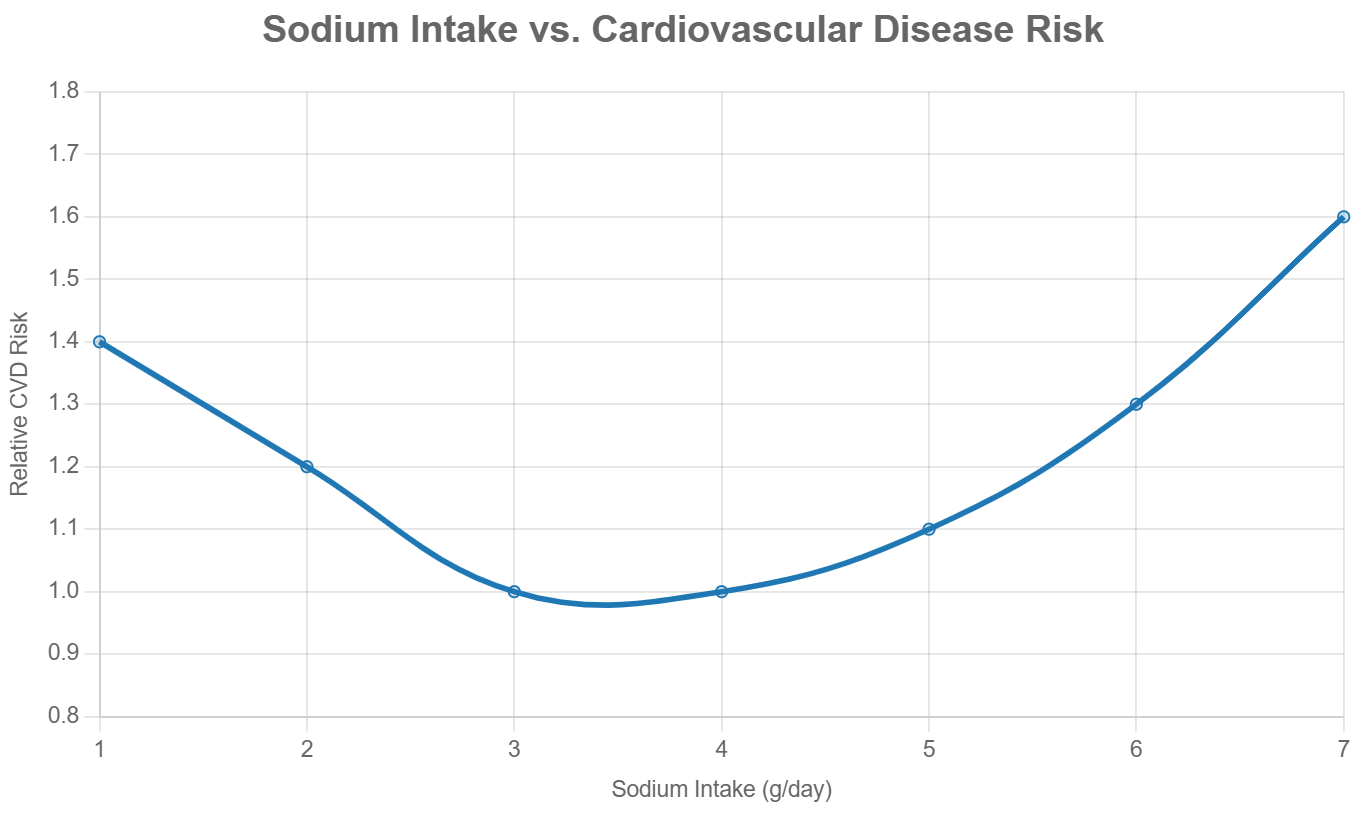
Sodium Intake vs. Cardiovascular Disease Risk. Based on Mente (2016) and O’Donnell (2014).
Methodological Challenges
The question “Is salt bad for you?” is ill-posed. Evidence and reasoning say this question oversimplifies a complex issue: sodium’s effects vary by individual (e.g., salt sensitivity, genetics), diet (e.g., processed vs. whole foods), and context (e.g., baseline blood pressure, activity level). Science doesn’t deliver binary truths. Modern science gives probabilistic models, refined through iterative testing.
While randomized controlled trials (RCTs) have shown that reducing sodium intake can lower blood pressure, especially in sensitive groups, observational studies show that extremely low sodium is associated with poor health. This association may signal reverse causality, an error in reasoning. The data may simply reveal that sicker people eat less, not that they are harmed by low salt. This complexity reflects the limitations of study design and the challenges of isolating causal relationships in real-world populations. The above graph is a fairly typical dose-response curve for any nutrient.
The salt debate also underscores the inherent difficulty of studying diet and health. Total caloric intake, physical activity, genetic variation, and compliance all confound the relationship between sodium and health outcomes. Few studies look at salt intake as a fraction of body weight. If sodium recommendations were expressed as sodium density (mg/kcal), it might help accommodate individual energy needs and eating patterns more effectively.
Science as an Iterative Process
Despite flaws in early studies and the polemics of dissenters, the scientific communities continue to refine its understanding. For example, Japan’s national sodium reduction efforts since the 1970s have coincided with significant declines in stroke mortality, suggesting real-world benefits to moderation, even if the exact causal mechanisms remain complex.
Through a Kuhnian lens, we see a dominant paradigm shaped by institutional consensus and refined by accumulating evidence. But we also see the system’s limits: anomalies, confounding variables, and methodological disputes that resist easy resolution.
Contrarians, though sometimes rhetorically provocative or methodologically uneven, play a crucial role. Like the “puzzle-solvers” and “revolutionaries” in Kuhn’s model, they pressure the scientific establishment to reexamine assumptions and tighten methods. This isn’t a flaw in science; it’s the process at work.
Salt isn’t simply “good” or “bad.” The better scientific question is more conditional: How does salt affect different individuals, in which contexts, and through what mechanisms? Answering this requires humility, robust methodology, and the acceptance that progress usually comes in increments. Science moves forward not despite uncertainty, disputation and contradiction but because of them.
Recent Comments

Atty at Purchasing on Avuncular Aloofness as Superst… Surviving Interstell… on What ‘Project Hail Mary…
 The Multidisciplinarian
All But the Clergy Believe
Posted by Bill Storage in Commentary on July 21, 2025
As the accused man approached the glowing iron, his heart pounded with faith. God, he trusted, would shield the innocent and leave the guilty to be maimed. The crowd, clutching rosaries and squinting through the smoke, murmured prayers. Most sought a miracle, some merely a verdict. They accepted the trial’s sanctity, exchanging bets on the defendant’s guilt.
Only the priest knew the fire wasn’t as hot as it looked. Sometimes it wasn’t hot at all. The iron was cooled or quietly switched. The timing of the ritual, the placement of fires and cauldrons, the priest’s step to the left rather than right. He held just enough control to steer the outcome toward justice, or what he took for it. The tricks had been passed down from the ancients. Hidden siphons, pivoting mirrors, vessels-within-vessels. Hero of Alexandria had described such things. Lucian of Samosata mocked them in his tales of string-pulled serpents and mechanical gods. Hippolytus of Rome listed them like a stage magician blowing the whistle on his rivals. Fake blood, hollow idols, the miracle of wine poured from nowhere.
By the thirteenth century, the ordeal was a dance: fire, chant, confession, absolution. The guilty, trembling at the priest’s solemn gaze, confessed before the iron’s touch. The faithful innocent, mindful of divine mercy, walked unscathed, unaware of the mirrors, the second cauldron, the cooled metal that had spared them.
There’s no record of public doubt about the mechanism, and church records support the above appraisal. Peter Leeson’s Ordeals drew data from a sample of 208 ordeals in early‑13th‑c. Várad. “Nearly two thirds of the accused were unscathed,” he wrote. F.W. Maitland, writing in 1909, found only one hot-iron ordeal in two decades that did not result in acquittal, a nearly 100% exoneration rate among the documented defendants who faced ordeals.
The audience saw a miracle and went home satisfied about heaven and earth. The priest saw the same thing and left, perhaps a faint weariness in his step, knowing no miracle had occurred. “Do not put the Lord your God to the test,” he muttered, absolving himself. No commandment had been broken, only the illusion of one. He knew he had saved the believers – from the chaos of doubt, from turning on each other, from being turned upon. It was about souls, yes. But it was more about keeping the village whole.
Everyone believed except the man who made them believe.
●
In the 1960s and 70s, the Soviet Union still spoke the language of revolution. Newspapers featured daily quotes from Lenin. Speeches invoked the inevitable collapse of capitalism and the coming utopia of classless harmony. School kids memorized Marx.
But by then – and even long before then, we later learned – no one believed it anymore. Not the factory workers, toiling under fabricated quotas. Not the schoolteachers, tasked with revising Marxist texts each summer. And the Politburo? The Brezhnevs and Andropovs mouthed slogans by day, then retreated to Black Sea dachas, Nikon cameras in hand, watching Finnish broadcasts on smuggled American TVs, Tennessee bourbon sweating on the table.
They enforced the rituals nonetheless. Party membership was still required for advancement. Professors went on teaching dialectical materialism. Writers still contrived odes to tractor production and revolutionary youth. All of it repeated with the same flat cadence. No belief, just habit and a vague sense that without it, the whole thing might collapse. No one risked reaching into the fire.
It was a system where no one believed – not the clergy, not the choir, not the congregation. But all pretended. The KGB, the Politburo, the party intellectuals, and everyone else knew Marx had failed. The workers didn’t revolt, and capitalism refused to collapse.
A few tried telling the truth. Solzhenitsyn criticized Stalin’s strategy in a private letter. He got eight years in the Gulag and internal exile. Bukovsky denounced the Communist Youth League at nineteen. He was arrested, declared insane in absentia, and confined. After release, he helped organize the Glasnost Meeting and was sent back to the asylum. On release again, he wrote against the abuse of psychiatry. Everyone knew he was right. They also knew he posed no real threat. They jailed him again.
That was the system. Sinyavsky published fiction abroad. He was imprisoned for the views of his characters. The trial was theater. There was no official transcript. He hadn’t threatened the regime. But he reminded it that its god was dead.
The irony is hard to miss. A regime that prided itself on killing God went on to clone His clergy – badly. The sermons were lifeless, the rituals joyless, the congregation compulsory. Its clergy stopped pretending belief. These were high priests of disbelief, performing the motions of a faith they’d spent decades ridiculing, terrified of what might happen if the spell ever broke.
The medieval priest tricked the crowd. The Soviet official tricked himself. The priest shaped belief to spare the innocent. The commissar demanded belief to protect the system.
The priest believed in justice, if not in miracles. The state official believed in neither.
One lied to uphold the truth. The other told the truth only when the fiction collapsed under its own weight.
And now?
bible, christianity, communism, faith, skepticism, Socialism
4 Comments