Posts Tagged Galileo
After the Applause: Heilbron Rereads Feyerabend
Posted by Bill Storage in History of Science, Philosophy of Science on June 4, 2025
A decade ago, in a Science, Technology and Society (STS) roundtable, I brought up Paul Feyerabend, who was certainly familiar to everyone present. I said that his demand for a separation of science and state – his call to keep science from becoming a tool of political authority – seemed newly relevant in the age of climate science and policy entanglement. Before I could finish the thought, someone cut in: “You can’t use Feyerabend to support republicanism!”
I hadn’t made an argument. Feyerabend was being claimed as someone who belonged to one side of a cultural war. His ideas were secondary. That moment stuck with me, not because I was misunderstood, but because Feyerabend was. And maybe he would have loved that. He was ambiguous by design. The trouble is that his deliberate opacity has hardened, over time, into distortion.
Feyerabend survives in fragments and footnotes. He’s the folk hero who overturned Method and danced on its ruins. He’s a cautionary tale: the man who gave license to science denial, epistemic relativism, and rhetorical chaos. You’ll find him invoked in cultural studies and critiques of scientific rationality, often with little more than the phrase “anything goes” as evidence. He’s also been called “the worst enemy of science.”
Against Method is remembered – or reviled – as a manifesto for intellectual anarchy. But “manifesto” doesn’t fit at all. It didn’t offer a vision, a list of principles, or a path forward. It has no normative component. It offered something stranger: a performance.
Feyerabend warned readers in the preface that the book would contradict itself, that it wasn’t impartial, and that it was meant to persuade, not instruct. He said – plainly and explicitly – that later parts would refute earlier ones. It was, in his words, a “tendentious” argument. And yet neither its admirers nor its critics have taken that warning seriously.
Against Method has become a kind of Rorschach test. For some, it’s license; for others, sabotage. Few ask what Feyerabend was really doing – or why he chose that method to attack Method. A few of us have long argued that Against Method has been misread. It was never meant as a guidebook or a threat, but as a theatrical critique staged to provoke and destabilize something that badly needed destabilizing.
That, I was pleased to learn, is also the argument made quietly and precisely in the last published work of historian John Heilbron. It may be the most honest reading of Feyerabend we’ve ever had.
John once told me that, unlike Kuhn, he had “the metabolism of a historian,” a phrase that struck me later as a perfect self-diagnosis: patient, skeptical, and slow-burning. He’d been at Berkeley when Feyerabend was still strutting the halls in full flair – the accent, the dramatic pronouncements, the partying. John didn’t much like him. He said so over lunch, on walks, at his house or mine. Feyerabend was hungry for applause, and John disapproved of his personal appetites and the way he flaunted them.
And yet… John’s recent piece on Feyerabend – the last thing he ever published – is microscopically delicate, charitable, and clear-eyed. John’s final chapter in Stefano Gattei’s recent book, Feyerabend in Dialogue, contains no score-settling, no demolition. Just a forensic mind trained to separate signal from noise. If Against Method is a performance, Heilbron doesn’t boo it offstage. He watches it again, closely, and tells us how it was done. Feyerabend through Heilbron’s lens is a performance reframed.
If anyone was positioned to make sense of Feyerabend, rhetorically, philosophically, and historically, it was Heilbron – Thomas Kuhn’s first graduate student, a lifelong physicist-turned-historian, and an expert on both early modern science and quantum theory’s conceptual tangles. His work on Galileo, Bohr, and the Scientific Revolution was always precise, occasionally sly, and never impressed by performance for performance’s sake.
That care is clearest in his treatment of Against Method’s most famous figure: Galileo. Feyerabend made Galileo the centerpiece of his case against scientific method – not as a heroic rationalist, but as a cunning rhetorician who won not because of superior evidence, but because of superior style. He compared Galileo to Goebbels, provocatively, to underscore how persuasion, not demonstration, drove the acceptance of heliocentrism. In Feyerabend’s hands, Galileo became a theatrical figure, a counterweight to the myth of Enlightenment rationality.
Heilbron dismantles this with the precision of someone who has lived in Galileo’s archives. He shows that while Galileo lacked a modern theory of optics, he was not blind to his telescope’s limits. He cross-checked, tested, and refined. He triangulated with terrestrial experiments. He understood that instruments could deceive, and worked around that risk with repetition and caution. The image of Galileo as a showman peddling illusions doesn’t hold up. Galileo, flaws acknowledged, was a working proto-scientist, attentive to the fragility of his tools.
Heilbron doesn’t mythologize Galileo; his 2010 Galileo makes that clear. But he rescues Galileo from Feyerabend’s caricature. In doing so, he models something Against Method never offered: a historically grounded, philosophically rigorous account of how science proceeds when tools are new, ideas unstable, and theory underdetermined by data.
To be clear, Galileo was no model of transparency. He framed the Dialogue as a contest between Copernicus and Ptolemy, though he knew Tycho Brahe’s hybrid system was the more serious rival. He pushed his theory of tides past what his evidence could support, ignoring counterarguments – even from Cardinal Bellarmine – and overstating the case for Earth’s motion.
Heilbron doesn’t conceal these. He details them, but not to dismiss. For him, these distortions are strategic flourishes – acts of navigation by someone operating at the edge of available proof. They’re rhetorical, yes, but grounded in observation, subject to revision, and paid for in methodological care.
That’s where the contrast with Feyerabend sharpens. Feyerabend used Galileo not to advance science, but to challenge its authority. More precisely, to challenge Method as the defining feature of science. His distortions – minimizing Galileo’s caution, questioning the telescope, reimagining inquiry as theater – were made not in pursuit of understanding, but in service of a larger philosophical provocation. This is the line Heilbron quietly draws: Galileo bent the rules to make a case about nature; Feyerabend bent the past to make a case about method.
In his final article, Heilbron makes four points. First, that the Galileo material in Against Method – its argumentative keystone – is historically slippery and intellectually inaccurate. Feyerabend downplays empirical discipline and treats rhetorical flourish as deception. Heilbron doesn’t call this dishonest. He calls it stagecraft.
Second, that Feyerabend’s grasp of classical mechanics, optics, and early astronomy was patchy. His critique of Galileo’s telescope rests on anachronistic assumptions about what Galileo “should have” known. He misses the trial-based, improvisational reasoning of early instrumental science. Heilbron restores that context.
Third, Heilbron credits Feyerabend’s early engagement with quantum mechanics – especially his critique of von Neumann’s no-hidden-variables proof and his alignment with David Bohm’s deterministic alternative. Feyerabend’s philosophical instincts were sharp.
And fourth, Heilbron tracks how Feyerabend’s stance unraveled – oscillating between admiration and disdain for Popper, Bohr, and even his earlier selves. He supported Bohm against Bohr in the 1950s, then defended Bohr against Popper in the 1970s. Heilbron doesn’t call this hypocrisy. He calls it instability built into the project itself: Feyerabend didn’t just critique rationalism – he acted out its undoing. If this sounds like a takedown, it isn’t. It’s a reconstruction – calm, slow, impartial. The rare sort that shows us not just what Feyerabend said, but where he came apart.
Heilbron reminds us what some have forgotten and many more never knew: that Feyerabend was once an insider. Before Against Method, he was embedded in the conceptual heart of quantum theory. He studied Bohm’s challenge to Copenhagen while at LSE, helped organize the 1957 Colston symposium in Bristol, and presented a paper there on quantum measurement theory. He stood among physicists of consequence – Bohr, Bohm, Podolsky, Rosen, Dirac, and Pauli – all struggling to articulate alternatives to an orthodoxy – Copenhagen Interpretation – that they found inadequate.
With typical wit, Heilbron notes that von Neumann’s no-hidden-variables proof “was widely believed, even by people who had read it.” Feyerabend saw that dogma was hiding inside the math – and tried to smoke it out.
Late in life, Feyerabend’s provocations would ripple outward in unexpected directions. In a 1990 lecture at Sapienza University, Cardinal Joseph Ratzinger – later Pope Benedict XVI – quoted Against Method approvingly. He cited Feyerabend’s claim that the Church had been more reasonable than Galileo in the affair that defined their rupture. When Ratzinger’s 2008 return visit was canceled due to protests about that quotation, the irony was hard to miss. The Church, once accused of silencing science, was being silenced by it, and stood accused of quoting a philosopher who spent his life telling scientists to stop pretending they were priests.
We misunderstood Feyerabend not because he misled us, but because we failed to listen the way Heilbron did.
Anarchy and Its Discontents: Paul Feyerabend’s Critics
Posted by Bill Storage in History of Science, Philosophy of Science on June 3, 2025
(For and against Against Method)
Paul Feyerabend’s 1975 Against Method and his related works made bold claims about the history of science, particularly the Galileo affair. He argued that science progressed not because of adherence to any specific method, but through what he called epistemological anarchism. He said that Galileo’s success was due in part to rhetoric, metaphor, and politics, not just evidence.
Some critics, especially physicists and historically rigorous philosophers of science, have pointed out technical and historical inaccuracies in Feyerabend’s treatment of physics. Here are some examples of the alleged errors and distortions:
Misunderstanding Inertial Frames in Galileo’s Defense of Copernicanism
Feyerabend argued that Galileo’s arguments for heliocentrism were not based on superior empirical evidence, and that Galileo used rhetorical tricks to win support. He claimed that Galileo simply lacked any means of distinguishing heliocentric from geocentric models empirically, so his arguments were no more rational than those of Tycho Brahe and other opponents.
His critics responded by saying that Galileo’s arguments based on the phases of Venus and Jupiter’s moons were empirically decisive against the Ptolemaic model. This is unarguable, though whether Galileo had empirical evidence to overthrow Tycho Brahe’s hybrid model is a much more nuanced matter.
Critics like Ronald Giere, John Worrall, and Alan Chalmers (What Is This Thing Called Science?) argued that Feyerabend underplayed how strong Galileo’s observational case actually was. They say Feyerabend confused the issue of whether Galileo had a conclusive argument with whether he had a better argument.
This warrants some unpacking. Specifically, what makes an argument – a model, a theory – better? Criteria might include:
- Empirical adequacy – Does the theory fit the data? (Bas van Fraassen)
- Simplicity – Does the theory avoid unnecessary complexity? (Carl Hempel)
- Coherence – Is it internally consistent? (Paul Thagard)
- Explanatory power – Does it explain more than rival theories? (Wesley Salmon)
- Predictive power – Does it generate testable predictions? (Karl Popper, Hempel)
- Fertility – Does it open new lines of research? (Lakatos)
Some argue that Galileo’s model (Copernicanism, heliocentrism) was obviously simpler than Brahe’s. But simplicity opens another can of philosophical worms. What counts as simple? Fewer entities? Fewer laws? More symmetry? Copernicus had simpler planetary order but required a moving Earth. And Copernicus still relied on epicycles, so heliocentrism wasn’t empirically simpler at first. Given the evidence of the time, a static Earth can be seen as simpler; you don’t need to explain the lack of wind and the “straight” path of falling bodies. Ultimately, this point boils down to aesthetics, not math or science. Galileo and later Newtonians valued mathematical elegance and unification. Aristotelians, the church, and Tychonians valued intuitive compatibility with observed motion.
Feyerabend also downplayed Galileo’s use of the principle of inertia, which was a major theoretical advance and central to explaining why we don’t feel the Earth’s motion.
Misuse of Optical Theory in the Case of Galileo’s Telescope
Feyerabend argued that Galileo’s use of the telescope was suspect because Galileo had no good optical theory and thus no firm epistemic ground for trusting what he saw.
His critics say that while Galileo didn’t have a fully developed geometrical optics theory (e.g., no wave theory of light), his empirical testing and calibration of the telescope were rigorous by the standards of the time.
Feyerabend is accused of anachronism – judging Galileo’s knowledge of optics by modern standards and therefore misrepresenting the robustness of his observational claims. Historians like Mario Biagioli and Stillman Drake point out that Galileo cross-verified telescope observations with the naked eye and used repetition, triangulation, and replication by others to build credibility.
Equating All Theories as Rhetorical Equals
Feyerabend in some parts of Against Method claimed that rival theories in the history of science were only judged superior in retrospect, and that even “inferior” theories like astrology or Aristotelian cosmology had equal rational footing at the time.
Historians like Steven Shapin (How to be Antiscientific) and David Wootton (The Invention of Science) say that this relativism erases real differences in how theories were judged even in Galileo’s time. While not elaborated in today’s language, Galileo and his rivals clearly saw predictive power, coherence, and observational support as fundamental criteria for choosing between theories.
Feyerabend’s polemical, theatrical tone often flattened the epistemic distinctions that working scientists and philosophers actually used, especially during the Scientific Revolution. His analysis of “anything goes” often ignored the actual disciplinary practices of science, especially in physics.
Failure to Grasp the Mathematical Structure of Physics
Scientists – those broad enough to know who Feyerabend was – often claim that he misunderstood or ignored the role of mathematics in theory-building, especially in Newtonian mechanics and post-Galilean developments. In Against Method, Feyerabend emphasizes metaphor and persuasion over mathematics. While this critique is valuable when aimed at the rhetorical and political sides of science, it underrates the internal mathematical constraints that shape physical theories, even for Galileo.
Imre Lakatos, his friend and critic, called Feyerabend’s work a form of “intellectual sabotage”, arguing that he distorted both the history and logic of physics.
Misrepresenting Quantum Mechanics
Feyerabend wrote about Bohr and Heisenberg in Philosophical Papers and later essays. Critics like Abner Shimony and Mario Bunge charge that Feyerabend misrepresented or misunderstood Bohr’s complementarity as relativistic, when Bohr’s position was more subtle and aimed at objective constraints on language and measurement.
Feyerabend certainly fails to understand the mathematical formalism underpinning Quantum Mechanics. This weakens his broader claims about theory incommensurability.
Feyerabend’s erroneous critique of Neil’s Bohr is seen in his 1958 Complimentarity:
“Bohr’s point of view may be introduced by saying that it is the exact opposite of [realism]. For Bohr the dual aspect of light and matter is not the deplorable consequence of the absence of a satisfactory theory, but a fundamental feature of the microscopic level. For him the existence of this feature indicates that we have to revise … the [realist] ideal of explanation.” (more on this in an upcoming post)
Epistemic Complaints
Beyond criticisms that he failed to grasp the relevant math and science, Feyerabend is accused of selectively reading or distorting historical episodes to fit the broader rhetorical point that science advances by breaking rules, and that no consistent method governs progress. Feyerabend’s claim that in science “anything goes” can be seen as epistemic relativism, leaving no rational basis to prefer one theory over another or to prefer science over astrology, myth, or pseudoscience.
Critics say Feyerabend blurred the distinction between how theories are argued (rhetoric) and how they are justified (epistemology). He is accused of conflating persuasive strategy with epistemic strength, thereby undermining the very principle of rational theory choice.
Some take this criticism to imply that methodological norms are the sole basis for theory choice. Feyerabend’s “anarchism” may demolish authority, but is anything left in its place except a vague appeal to democratic or cultural pluralism? Norman Levitt and Paul Gross, especially in Higher Superstition: The Academic Left and Its Quarrels with Science (1994), argue this point, along with saying Feyerabend attacked a caricature of science.
Personal note/commentary: In my view, Levitt and Gross did some great work, but Higher Superstition isn’t it. I bought the book shortly after its release because I was disgusted with weaponized academic anti-rationalism, postmodernism, relativism, and anti-science tendencies in the humanities, especially those that claimed to be scientific. I was sympathetic to Higher Superstition’s mission but, on reading it, was put off by its oversimplifications and lack of philosophical depth. Their arguments weren’t much better than those of the postmodernists. Critics of science in the humanities critics overreached and argued poorly, but they were responding to legitimate concerns in the philosophy of science. Specifically:
- Underdetermination – Two incompatible theories often fit the same data. Why do scientists prefer one over another? As Kuhn argued, social dynamics play a role.
- Theory-laden Observations – Observations are shaped by prior theory and assumptions, so science is not just “reading the book of nature.”
- Value-laden Theories – Public health metrics like life expectancy and morbidity (opposed to autonomy or quality of life) trickle into epidemiology.
- Historical Variability of Consensus – What’s considered rational or obvious changes over time (phlogiston, luminiferous ether, miasma theory).
- Institutional Interest and Incentives – String theory’s share of limited research funding, climate science in service of energy policy and social agenda.
- The Problem of Reification – IQ as a measure of intelligence has been reified in policy and education, despite deep theoretical and methodological debates about what it measures.
- Political or Ideological Capture – Marxist-Leninist science and eugenics were cases where ideology shaped what counted as science.
Higher Superstition and my unexpected negative reaction to it are what brought me to the discipline of History and Philosophy of Science.
Conclusion
Feyerabend exaggerated the uncertainty of early modern science, downplayed the empirical gains Galileo and others made, and misrepresented or misunderstood some of the technical content of physics. His mischievous rhetorical style made it hard to tell where serious argument ended and performance began. Rather than offering a coherent alternative methodology, Feyerabend’s value lay in exposing the fragility and contingency of scientific norms. He made it harder to treat methodological rules as timeless or universal by showing how easily they fracture under the pressure of real historical cases.
In a following post, I’ll review the last piece John Heilbron wrote before he died, Feyerabend, Bohr and Quantum Physics, which appeared in Stefano Gattei’s Feyerabend in Dialogue, a set of essays marking the 100th anniversary of Feyerabend’s birth.
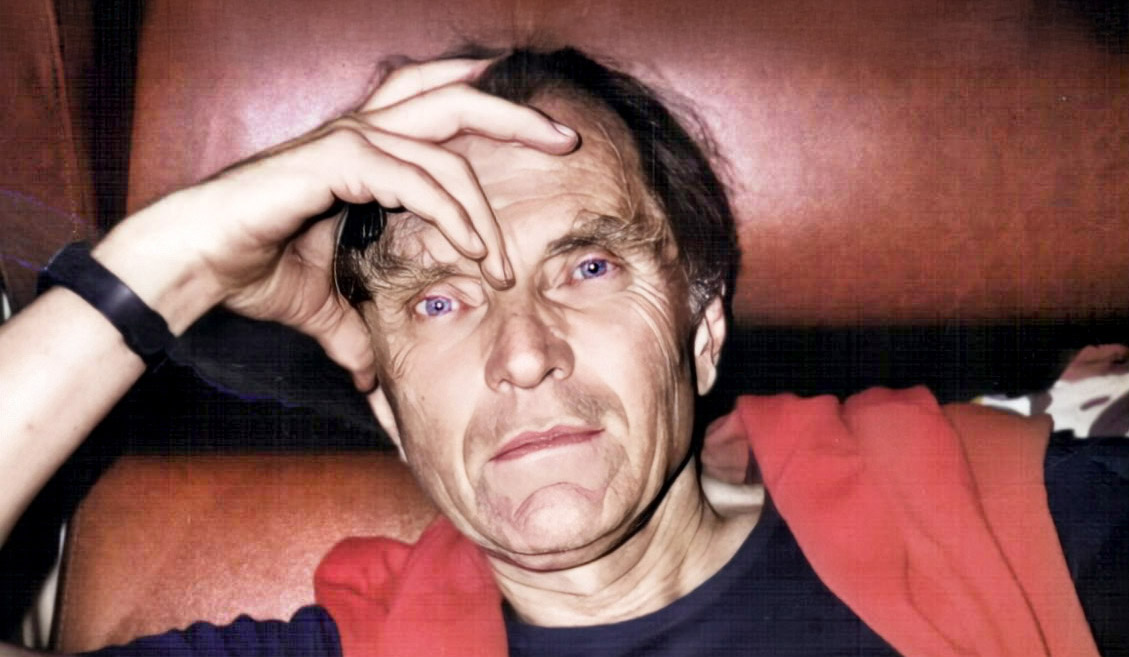
Paul Feyerabend. Photo courtesy of Grazia Borrini-Feyerabend.
Dialogue Concerning a Cup of Cooked Collards
Posted by Bill Storage in Fiction, History of Science on May 27, 2025
in which the estimable Signora Sagreda, guided by the lucid reasoning of Salviatus and the amiable perplexities of Simplicius, doth inquire into the nature of culinary measurement, and wherein is revealed, by turns comic and calamitous, the logical dilemma and profound absurdity of quantifying cooked collards by volume, exposing thereby the nutritional fallacies, atomic impossibilities, and epistemic mischiefs that attend such a practice, whilst invoking with reverence the spectral wisdom of Galileo Galilei.
Scene: A modest parlor, with a view into a well-appointed kitchen. A pot of collards simmers.
Sagreda: Good sirs, I am in possession of a recipe, inherited from a venerable aunt, which instructs me to add one cup of cooked collards to the dish. Yet I find myself arrested by perplexity. How, I ask, can one trust such a measure, given the capricious nature of leaves once cooked?
Salviatus: Ah, Signora, thou hast struck upon a question of more gravity than may at first appear. In that innocent-seeming phrase lies the germ of chaos, the undoing of proportion, and the betrayal of consistency.
Simplicius: But surely, Salviatus, a cup is a cup! Whether one deals with molasses, barley, or leaves of collard! The vessel measures equal, does it not?
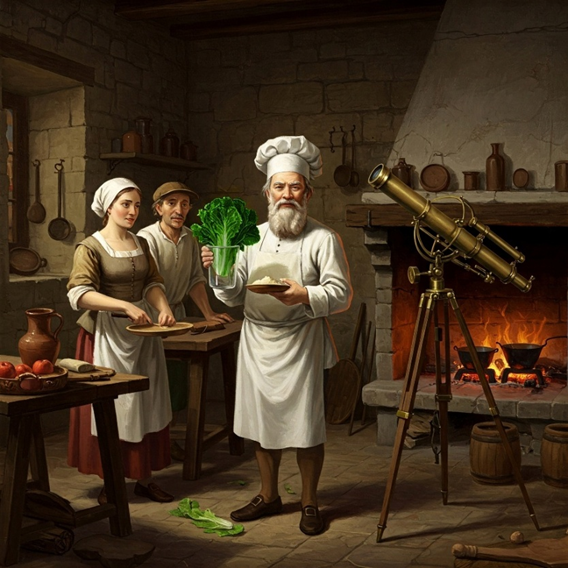
Salviatus: Ah, dear Simplicius, how quaint thy faith in vessels. Permit me to elaborate with the fullness this foolishness begs. A cup, as used here, is a measure of volume, not mass. Yet collards, when cooked, submit themselves to the will of the physics most violently. One might say that a plenty of raw collards, verdant and voluminous, upon the fire becomes but a soggy testament to entropy.
Sagreda: And yet if I, with ladle in hand, press them lightly, I may fill a cup with tender grace. But if I should tamp them down, as a banker tamps tobacco, I might squeeze thrice more into the same vessel.
Salviatus: Just so! And here lies its absurdity. The recipe calls for a cup, as though the collards were flour, or water, or some polite ingredient that hold the law of uniformity. But collards — and forgive my speaking plainly — are rogues. One cook’s gentle heap is another’s aggressive compression. Thus, a recipe using such a measure becomes not a method, but a riddle, a culinary Sphinx.
Simplicius: But might not tradition account for this? For is it not the case that housewives and cooks of yore prepared these dishes with their senses and not with scales?
Salviatus: A fair point, though flawed in its application. While the tongue and eye may suffice for the seasoned cook, the written recipe aspires to universality. It must serve the neophyte, the scholar, the gentleman abroad who seeks to replicate his mother’s collard pie with exactitude. And for these noble aims, only the scale may speak truth. Grams! Ounces! Units immutable, not subject to whim or squish!
Sagreda: You speak as though the collards, once cooked, engage in a deceit, cloaking their true nature.
Salviatus: Precisely. Cooked collards are like old courtiers — soft, pliable, and accustomed to hiding their substance beneath a veneer of humility. Only by weight can one know their worth. Or, more precisely, by its mass, the measure we know to not affect the rate at which objects fall.
Simplicius: But if all this be so, then is not every cookbook a liar? Is not every recipe suspect?
Salviatus: Not every recipe — only those who trade in volumetric folly where mass would bring enlightenment. The fault lies not in the recipe’s heart, but in its measurement. And this, dear Simplicius, we may yet amend.
Sagreda: Then shall we henceforth mark in our books, “Not a cup, but a weight; not a guess, but a truth“? For a measure of collards, like men, must be judged not by appearance, but by their substance.
Sagreda (reflecting): And yet, gentlemen, if I may permit a musing most unorthodox, does not all this emphasis on precision edge us perilously close to an unyielding, mechanical conception of science? Dare we call it… dogmatic?
Simplicius: Dogmatic? You surprise me, Signora. I thought it only the religion of Bellarmino and Barberini could carry such a charge.
Salviatus: Ha! Then you have not read the scribblings of Herr Paulus Feyerabend, who, proclaims with no small glee — and with more than of a trace of Giordano Bruno — that anything goes in the pursuit of knowledge. He teaches that the science, when constrained by method, becomes no different from myth.
Sagreda: Fascinating! And would this Feyerabend defend, then, the use of “a cup of cooked collards” as a sound epistemic act?
Salviatus: Indeed, he might. He would argue that inexactitude, even vagueness, can have its place. That Sagreda’s venerable aunt, the old wives, the village cooks, with their pinches and handfuls and mysteriously gestured “quanta bastas,” have no less a claim to truth than a chef armed with scales and thermocouples. He might well praise the “cup of cooked collards” as a liberating epistemology, a rejection of culinary tyranny.
Simplicius: Then Feyerabend would have me trust Sagreda’s aunt over the chemist?
Salviatus: Just so — he would, and be half right at least! Feyerabend’s quarrel is not with truth, but with monopoly over its definition. He seeks not the destruction of science, but the dethronement of science enthroned as sacred law. In this spirit, he might say: “Let the collards be measured by weight, or not at all, for the joy of the dish may reside not in precision, but in a dance of taste and memory.”
Sagreda: A heady notion! And perhaps, like a stew, the truth lies in the balance — one must permit both the grammar of measurement and the poetry of intuition. The recipe, then, is both science and art, its ambiguity not a flaw, but sometimes an invitation.
Salviatus: Beautifully said, Signora. Yet let us remember: Feyerabend champions chaos as a remedy for tyranny, not as an end in itself. He might defend the cook who ignores the scale, but not the recipe which claims false precision where none is due. And so, if we declare “a cup of cooked collards,” we ought either to define it, or admit with humility that we have no idea how many leaves is right to each observer.
Simplicius: Then science and the guessing of aunts may coexist — so long as neither pretends to be the other?
Salviatus: Precisely. The scale must not scorn the hunch, nor the cup dethrone the scale. But let us not forget: when preparing a dish to be replicated, mass is our anchor in the storm of leafy deception.
Sagreda (opening her laptop): Ah! Then let us dedicate this dish — to Feyerabend, to Bruno, to my venerable aunt. I will append to her recipe, notations from these reasonings on contradiction and harmony.
Cooked collards are like old courtiers — soft, pliable, and accustomed to hiding their substance beneath a veneer of humility — Salviatus
Sagreda (looking up from her laptop with astonishment): Gentlemen! I have stumbled upon a most curious nutritional claim. This USDA document — penned by government scientist or rogue dietitian — declares with solemn authority that a cup of cooked collards contains 266 grams calcium and a cup raw only 52.
Salviatus (arching an eyebrow): More calcium? From whence, pray, does this mineral bounty emerge? For collards, like men, cannot give what they do not possess.

Simplicius (waving a wooden spoon): It is well known, is it not, that cooking enhances healthfulness? The heat releases the virtues hidden within the leaf, like Barberini stirring the piety of his reluctant congregation!
Salviatus: Simplicius, your faith outpaces your chemistry. Let us dissect this. Calcium, as an element, is not born anew in the pot. It is not conjured by flame nor summoned by steam. It is either present, or it is not.
Simplicius: So how, then, can it be that the cooked collards have more calcium than their raw counterparts — cup for cup?
Sagreda: Surely, again, the explanation is compression. The cooking drives out water, collapses volume, and fills the cup more densely with matter formerly bulked by air and hubris.
Salviatus: Exactly so! A cup of cooked collards is, in truth, the compacted corpse of many cups raw — and with them, their calcium. The mineral content has not changed; only the volume has bowed before heat’s stern hand.
Simplicius: But surely the USDA, a most probable power, must be seen as sovereign on the matter. Is there no means, other than admitting the slackness of their decree, by which we can serve its authority?
Salviatus: Then, Simplicius, let us entertain absurdity. Suppose for a moment — as a thought experiment — that the cooking process does, in fact, create calcium.
By what alchemy? What transmutation?
Let us assume, in a spirit of lunatic (and no measure anachronous) generosity, that the humble collard leaf contains also magnesium — plentiful, impudent magnesium — and that during cooking, it undergoes nuclear transformation. Though they have the same number of valence electrons, to turn magnesium (atomic number 12) into calcium (atomic number 20), we must add 8 protons and a healthy complement of neutrons.
Sagreda: But whence come these subatomic parts? Shall we pluck nucleons from the steam?
Salviatus (solemnly): We must raid the kitchen for protons as a burglar raids a larder. Perhaps the protons are drawn from the salt, or the neutrons from baking powder, or perhaps our microwave is a covert collider, transforming our soup pot into CERN-by-candlelight.
But alas — this would take more energy than a dozen suns, and the vaporizing of the collards in a burst of gamma rays, leaving not calcium-rich greens but a crater and a letter of apology due. But, we know, do we not, that the universe is indifferent to apology; the earth still goes round the sun.
Sagreda: Then let us admit: the calcium remains the same. The difference is illusion — an artifact of measurement, not of matter.
Salviatus: Precisely. And the USDA, like other sovereigns, commits nutritional sophistry — comparing unlike volumes and implying health gained by heat alone, or, still worse, that we hold it true by unquestioned authority.
Let this be our final counsel: whenever the cup is invoked, ask, “Cup of what?” If it be cooked, know that you measure the ghost of raw things past, condensed, wilted, and innocent of transmutation.
The scale must not scorn the hunch, nor the cup dethrone the scale. – Salviatus
Thus ends the matter of the calcium-generating cauldron, in which it hath been demonstrated to the satisfaction of reason and the dismay of the USDA that no transmutation of elements occurs in the course of stewing collards, unless one can posit a kitchen fire worthy of nuclear alchemy; and furthermore, that the measure of leafy matter must be governed not by the capricious vulgarity of volume, but by the steady hand of mass, or else be entrusted to the most excellent judgment of aunts and cooks, whose intuitive faculties may triumph over quantification outright. The universe, for its part, remains intact, and the collards, alas, are overcooked.
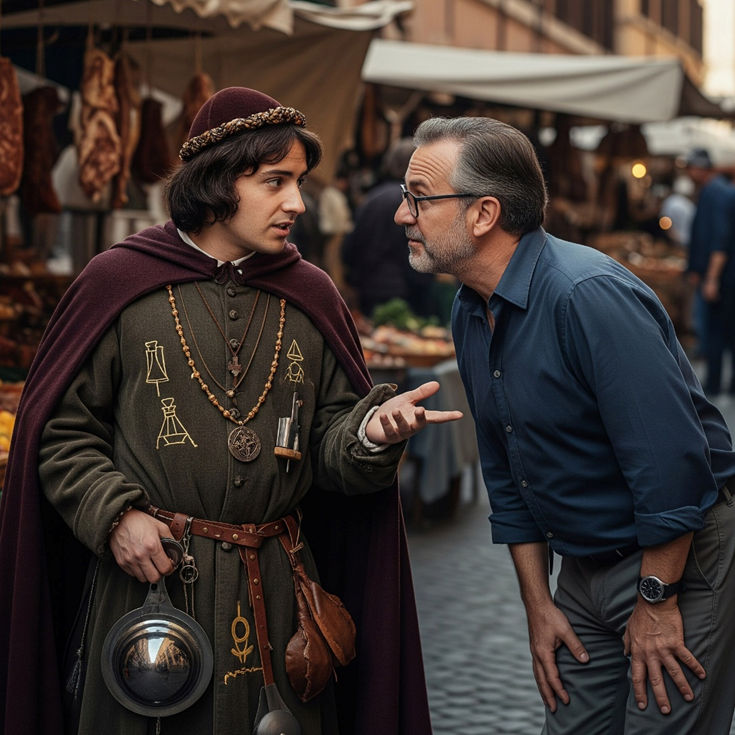
Giordano Bruno discusses alchemy with Paul Feyerabend. Campo de’ Fiori, Rome, May 1591.
Galileo’s Dialogue Concerning the Two Chief World Systems is a proto-scientific work presented as a conversation among three characters: Salviati, Sagredo, and Simplicio. It compares the Copernican heliocentric model (Earth revolves around Sun) and the traditional Ptolemaic geocentric model (Earth as center). Salviati represents Galileo’s own views and advocates for the Copernican system, using logic, mathematics, observation, and rhetoric. Sagredo is an intelligent, neutral layman who asks questions and weighs the arguments, representing the open-minded reader. Simplicio, a supporter of Aristotle and the geocentric model held by the church, struggles to defend his views and is portrayed as naive. Through their discussion, Galileo gives evidence for the heliocentric model and critiques the shortcomings of the geocentric, making a strong case for scientific reasoning based on observation rather than tradition and authority. Cardinal Roberto Bellarmino and Maffeo Barberini (Pope Urban VIII) were the central clergy figures in Galileo’s trial. In 1970 Paul Feyerabend argued that modern institutional science resembled the church more than it did Galileo. The Dominican monk, Giordano Bruno, held unorthodox ideas in science and theology. Bellarmino framed the decision leading to his conviction of heresy in 1600. He was burned at the stake in the plaza of Campo de’ Fiori, where I stood not one hour before writing this.
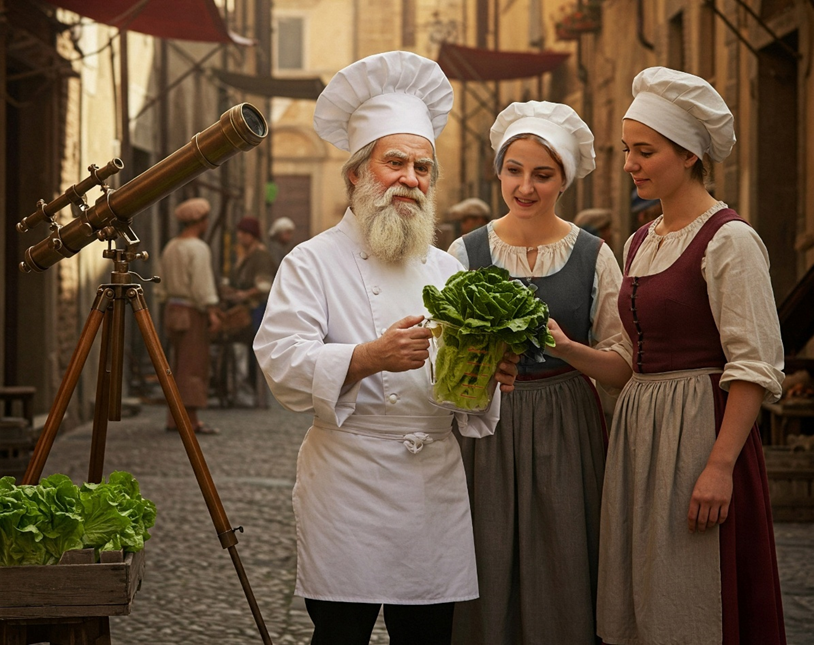
Galileo with collard vendors in Pisa
 The Multidisciplinarian