Posts Tagged religion
The Comet, the Clipboard, and the Knife
Posted by Bill Storage in Commentary on October 2, 2025
Background: My grandfather saw Comet Halley in 1910, and it was the biggest deal since the Grover Cleveland inaugural bash. We discussed it – the comet, not the inaugural – often in my grade school years. He told me of “comet pills” and kooks who killed themselves fearing cyanogens. Halley would return in 1986, an unimaginably far off date. Then out of nowhere in 1973, Luboš Kohoutek discovered a new comet, an invader from the distant Oort cloud – the flyover states of our solar system – and it was predicted to be the comet of the century. But Comet Kohoutek partied too hard somewhere near Saturn and arrived hungover, barely visible. And when Halley finally neared the sun in 1986, the earth was 180 degrees from it. Halley, like Kohoutek, was a flop. But 1996 brought Comet Hale-Bopp. Now, that was a sight even for urban stargazers. I saw it from Faneuil Hall in Boston and then bright above the Bay Bridge in San Francisco. It hung around for a year, its dual tails unforgettable. And as with anything cool, zealots stained its memory by freaking out.
A Sermon by Reverend Willie Storage, Minister of Peculiar Gospel
Brethren, we take our text today from The Book of Cybele, Chapter Knife, Verse Twenty-Three: “And lo, they danced in the street, and cut themselves, and called it joy, and their blood was upon their sandals, and the crowd applauded and took up the practice, for the crowd cannot resist a parade.”
To that we add The Epistle of Origen to the Scissors, Chapter Three, Verse Nine: “If thy member offend thee, clip it off, and if thy reason offend thee, chop that too, for what remains shall be called purity.”
These ancient admonitions are the ancestors of our story today, which begins not in Alexandria, nor the temples of Asia Minor, nor the starving castles of Languedoc, but in California, that golden land where individuality is a brand, rebellion is a style guide, and conformity is called freedom. Once it was Jesus on the clouds, then the Virgin in the sun, then a spaceship hiding behind a comet’s tail.
Thus have the ages spoken, and thus, too, spoke California in the year of our comet, 1997, when Hale-Bopp streaked across the sky like a match-head struck on the dark roof of the world. In Iowa, folk looked up and said, “Well, I’ll be damned – pass the biscuits.” In California, they looked up and said, “It conceals a spaceship,” and thirty-nine of them set their affairs in order, cut their hair to regulation style and length, pulled on black uniforms, laced up their sneakers, “prepared their vehicles for the Great Next Level,” and died at their own hands.

Now, California is the only place on God’s earth where a man can be praised for “finding himself” by joining a committee, and then be congratulated for the originality and bravery of this act. It is the land of artisan individuality in bulk: rows of identically unique coffee shops, each an altar to self-expression with the same distressed wood and imitation Edison bulbs. Rows of identically visionary cults, each one promising your personal path to the universal Next Level. Heaven’s Gate was not a freak accident of California. It was California poured into Grande-size cups and called “Enlightenment.”
Their leader, Do – once called Marshall Applewhite or something similarly Texan – explained that a spacecraft followed the comet, hiding like a pea under a mattress, ready to transport them to salvation. His co-founder, Ti, had died of cancer, inconveniently, but Do explained it in terms Homer Simpson could grasp: Ti had merely “shed her vehicle.” More like a Hertz than a hearse, and the rental period of his faithful approached its earthly terminus. His flock caught every subtle allusion. Thus did they gather, not as wild-eyed fanatics, but as the most polite of martyrs.
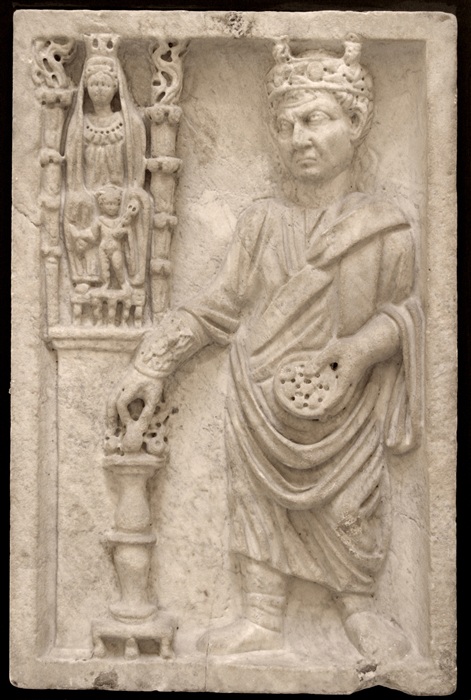
The priests of Cybele danced and bled. Origen of Alexandria may have cut himself off in private, so to speak, as Eusebius explains it. The Cathars starved politely in Languedoc. And the Californians, chased by their own doctrine into a corner of Rancho Santa Fe creativity, bought barbiturates at a neighborhood pharmacy, added a vodka chaser, then followed a color-coded procedure and lay down in rows like corn in a field. Their sacrament was order, procedure, and videotaped cheer. Californians, after all, enjoy their own performances.
Even the ancients were sometimes similarly inclined. Behold a relief from Ostia Antica of a stern priest nimbly handling an egg – proof, some claim, that men have long been anxious about inconvenient appendages, and that Easter’s chocolate bounty has more in common with the castrated ambitions of holy men than with springtime joy. Emperor Claudius, more clever than most, outlawed such celebrations – or tried to.
Brethren, it is not only the comet that inspires folly. Consider Sherry Shriner – a Kent State graduate of journalism and political science – who rose on the Internet just this century, a prophet armed with a megaphone, announcing that alien royalty, shadowy cabals, and cosmic paperwork dictated human destiny, and that obedience was the only path to salvation. She is a recent echo of Applewhite, of Origen, of priests of Cybele, proving that the human appetite for secret knowledge, cosmic favor, and procedural holiness only grows with new technology. Witness online alien reptile doomsday cults.
Now, California is a peculiar land which – to paraphrase Brother Richard Brautigan – draws Kent State grads like a giant Taj Mahal in the shape of a parking meter. Only there could originality be mass-produced in identical black uniforms, only there could a suicide cult be entirely standardized, only there could obedience to paperwork masquerade as freedom. The Heaven’s Gate crowd prized individuality with the same rigor that the Froot Loops factory prizes the relationship between each loop piece’s color and its flavor. And yet, in this implausible perfection, we glimpse an eternal truth: the human animal will organize itself into committees, assign heavenly responsibilities, and file for its own departure from the body with the same diligence it reserves for parking tickets.

And mark these words, it’s not finished. If the right comet comes again, some new flock will follow it, tidy as ever, clipboard in hand. Perhaps it won’t be a flying saucer but a carbon-neutral ark. Perhaps it will be the end of meat, of plastic, of children. You may call it Extinction Rebellion or Climate Redemption or Earth’s Last Stand. They may chain themselves to the rails and glue themselves to Botticelli or to Newbury Street, fast themselves to death for Mother Goddess Earth. It is a priest of Cybele in Converse high tops.
“And the children of the Earth arose, and they glued themselves to the paintings, and they starved themselves in the streets, saying, ‘We do this that life may continue.’ And a prophet among them said, ‘To save life ye must first abandon it.’”
If you must mutilate something, mutilate your credulity. Cut it down to size. Castrate your certainty. Starve your impulse to join the parade. The body may be foolish, but it has not yet led you into as much trouble as the mind.
Sing it, children.
—
After the Applause: Heilbron Rereads Feyerabend
Posted by Bill Storage in History of Science, Philosophy of Science on June 4, 2025
A decade ago, in a Science, Technology and Society (STS) roundtable, I brought up Paul Feyerabend, who was certainly familiar to everyone present. I said that his demand for a separation of science and state – his call to keep science from becoming a tool of political authority – seemed newly relevant in the age of climate science and policy entanglement. Before I could finish the thought, someone cut in: “You can’t use Feyerabend to support republicanism!”
I hadn’t made an argument. Feyerabend was being claimed as someone who belonged to one side of a cultural war. His ideas were secondary. That moment stuck with me, not because I was misunderstood, but because Feyerabend was. And maybe he would have loved that. He was ambiguous by design. The trouble is that his deliberate opacity has hardened, over time, into distortion.
Feyerabend survives in fragments and footnotes. He’s the folk hero who overturned Method and danced on its ruins. He’s a cautionary tale: the man who gave license to science denial, epistemic relativism, and rhetorical chaos. You’ll find him invoked in cultural studies and critiques of scientific rationality, often with little more than the phrase “anything goes” as evidence. He’s also been called “the worst enemy of science.”
Against Method is remembered – or reviled – as a manifesto for intellectual anarchy. But “manifesto” doesn’t fit at all. It didn’t offer a vision, a list of principles, or a path forward. It has no normative component. It offered something stranger: a performance.
Feyerabend warned readers in the preface that the book would contradict itself, that it wasn’t impartial, and that it was meant to persuade, not instruct. He said – plainly and explicitly – that later parts would refute earlier ones. It was, in his words, a “tendentious” argument. And yet neither its admirers nor its critics have taken that warning seriously.
Against Method has become a kind of Rorschach test. For some, it’s license; for others, sabotage. Few ask what Feyerabend was really doing – or why he chose that method to attack Method. A few of us have long argued that Against Method has been misread. It was never meant as a guidebook or a threat, but as a theatrical critique staged to provoke and destabilize something that badly needed destabilizing.
That, I was pleased to learn, is also the argument made quietly and precisely in the last published work of historian John Heilbron. It may be the most honest reading of Feyerabend we’ve ever had.
John once told me that, unlike Kuhn, he had “the metabolism of a historian,” a phrase that struck me later as a perfect self-diagnosis: patient, skeptical, and slow-burning. He’d been at Berkeley when Feyerabend was still strutting the halls in full flair – the accent, the dramatic pronouncements, the partying. John didn’t much like him. He said so over lunch, on walks, at his house or mine. Feyerabend was hungry for applause, and John disapproved of his personal appetites and the way he flaunted them.
And yet… John’s recent piece on Feyerabend – the last thing he ever published – is microscopically delicate, charitable, and clear-eyed. John’s final chapter in Stefano Gattei’s recent book, Feyerabend in Dialogue, contains no score-settling, no demolition. Just a forensic mind trained to separate signal from noise. If Against Method is a performance, Heilbron doesn’t boo it offstage. He watches it again, closely, and tells us how it was done. Feyerabend through Heilbron’s lens is a performance reframed.
If anyone was positioned to make sense of Feyerabend, rhetorically, philosophically, and historically, it was Heilbron – Thomas Kuhn’s first graduate student, a lifelong physicist-turned-historian, and an expert on both early modern science and quantum theory’s conceptual tangles. His work on Galileo, Bohr, and the Scientific Revolution was always precise, occasionally sly, and never impressed by performance for performance’s sake.
That care is clearest in his treatment of Against Method’s most famous figure: Galileo. Feyerabend made Galileo the centerpiece of his case against scientific method – not as a heroic rationalist, but as a cunning rhetorician who won not because of superior evidence, but because of superior style. He compared Galileo to Goebbels, provocatively, to underscore how persuasion, not demonstration, drove the acceptance of heliocentrism. In Feyerabend’s hands, Galileo became a theatrical figure, a counterweight to the myth of Enlightenment rationality.
Heilbron dismantles this with the precision of someone who has lived in Galileo’s archives. He shows that while Galileo lacked a modern theory of optics, he was not blind to his telescope’s limits. He cross-checked, tested, and refined. He triangulated with terrestrial experiments. He understood that instruments could deceive, and worked around that risk with repetition and caution. The image of Galileo as a showman peddling illusions doesn’t hold up. Galileo, flaws acknowledged, was a working proto-scientist, attentive to the fragility of his tools.
Heilbron doesn’t mythologize Galileo; his 2010 Galileo makes that clear. But he rescues Galileo from Feyerabend’s caricature. In doing so, he models something Against Method never offered: a historically grounded, philosophically rigorous account of how science proceeds when tools are new, ideas unstable, and theory underdetermined by data.
To be clear, Galileo was no model of transparency. He framed the Dialogue as a contest between Copernicus and Ptolemy, though he knew Tycho Brahe’s hybrid system was the more serious rival. He pushed his theory of tides past what his evidence could support, ignoring counterarguments – even from Cardinal Bellarmine – and overstating the case for Earth’s motion.
Heilbron doesn’t conceal these. He details them, but not to dismiss. For him, these distortions are strategic flourishes – acts of navigation by someone operating at the edge of available proof. They’re rhetorical, yes, but grounded in observation, subject to revision, and paid for in methodological care.
That’s where the contrast with Feyerabend sharpens. Feyerabend used Galileo not to advance science, but to challenge its authority. More precisely, to challenge Method as the defining feature of science. His distortions – minimizing Galileo’s caution, questioning the telescope, reimagining inquiry as theater – were made not in pursuit of understanding, but in service of a larger philosophical provocation. This is the line Heilbron quietly draws: Galileo bent the rules to make a case about nature; Feyerabend bent the past to make a case about method.
In his final article, Heilbron makes four points. First, that the Galileo material in Against Method – its argumentative keystone – is historically slippery and intellectually inaccurate. Feyerabend downplays empirical discipline and treats rhetorical flourish as deception. Heilbron doesn’t call this dishonest. He calls it stagecraft.
Second, that Feyerabend’s grasp of classical mechanics, optics, and early astronomy was patchy. His critique of Galileo’s telescope rests on anachronistic assumptions about what Galileo “should have” known. He misses the trial-based, improvisational reasoning of early instrumental science. Heilbron restores that context.
Third, Heilbron credits Feyerabend’s early engagement with quantum mechanics – especially his critique of von Neumann’s no-hidden-variables proof and his alignment with David Bohm’s deterministic alternative. Feyerabend’s philosophical instincts were sharp.
And fourth, Heilbron tracks how Feyerabend’s stance unraveled – oscillating between admiration and disdain for Popper, Bohr, and even his earlier selves. He supported Bohm against Bohr in the 1950s, then defended Bohr against Popper in the 1970s. Heilbron doesn’t call this hypocrisy. He calls it instability built into the project itself: Feyerabend didn’t just critique rationalism – he acted out its undoing. If this sounds like a takedown, it isn’t. It’s a reconstruction – calm, slow, impartial. The rare sort that shows us not just what Feyerabend said, but where he came apart.
Heilbron reminds us what some have forgotten and many more never knew: that Feyerabend was once an insider. Before Against Method, he was embedded in the conceptual heart of quantum theory. He studied Bohm’s challenge to Copenhagen while at LSE, helped organize the 1957 Colston symposium in Bristol, and presented a paper there on quantum measurement theory. He stood among physicists of consequence – Bohr, Bohm, Podolsky, Rosen, Dirac, and Pauli – all struggling to articulate alternatives to an orthodoxy – Copenhagen Interpretation – that they found inadequate.
With typical wit, Heilbron notes that von Neumann’s no-hidden-variables proof “was widely believed, even by people who had read it.” Feyerabend saw that dogma was hiding inside the math – and tried to smoke it out.
Late in life, Feyerabend’s provocations would ripple outward in unexpected directions. In a 1990 lecture at Sapienza University, Cardinal Joseph Ratzinger – later Pope Benedict XVI – quoted Against Method approvingly. He cited Feyerabend’s claim that the Church had been more reasonable than Galileo in the affair that defined their rupture. When Ratzinger’s 2008 return visit was canceled due to protests about that quotation, the irony was hard to miss. The Church, once accused of silencing science, was being silenced by it, and stood accused of quoting a philosopher who spent his life telling scientists to stop pretending they were priests.
We misunderstood Feyerabend not because he misled us, but because we failed to listen the way Heilbron did.
Extraordinary Miscarriages of Science, Part 2 – Creation Science
Posted by Bill Storage in History of Science on January 21, 2024
By Bill Storage, Jan. 21, 2024
Creation Science can refer either to young-earth or old-earth creation theories. Young Earth Creationism (YEC) makes specific claims about the creation of the universe from nothing, the age of the earth as inferred from the Book of Genesis and about the creation of separate “kinds” of creatures. Wikipedia’s terse coverage, as with Lysenkoism, brands it a pseudoscience without explanation. But YEC makes bold, falsifiable claims about biology and genetics (not merely evolution), geology (plate tectonics or lack thereof), and, most significantly, Newtonian mechanics. While it posits unfalsifiable unobservables including a divinity that sculpts the universe in six days, much of its paradigm contrasts modern physics in testable ways. Creation Science is not a miscarriage of science in the sense of some of the others. I’m covering it here because it has many similarities to other bad sciences and is a great test of demarcation criteria. Creation Science does limited harm because it preaches to the choir. I doubt anyone ever joined a cult because they were persuaded that creationism is scientific.
Intelligent Design
Old-earth creationism, now known as Intelligent Design (ID) theory is much different. While ID could have confined itself to the realm of metaphysics and stayed out of our cross hairs, it did not. ID mostly confines itself to the realm of descriptions and explanations, but it explicitly claims to be a science. Again, Wikipedia brands ID as pseudoscience, and, again, this distinction seems shallow. I’m also concerned that the label is rooted in anti-Christian bias with reasons invented after the labelling as a rationalization. To be clear, I see nothing substantial in ID that is scientific, but its opponents’ arguments are often not much better than those of its proponents.
It might be true that a supreme being, benevolent or otherwise, guided the hand of cosmological and biological evolution. But simpler, adequate explanations of those processes exist outside of ID, and ID adds no explanatory power to the theories of cosmology and biology that are independent of it. This was not always the case. The US founding fathers, often labeled Christian by modern Christians, were not Christian at all. They were deists, mainly because they lacked a theoretical framework to explain the universe without a creator, who had little interest in earthly affairs. They accepted the medieval idea that complex organisms, like complex mechanisms, must have a designer. Emergent complexity wasn’t seen as an option. That they generally – notably excepting David Hume – failed to see the circularity of this “teleological argument” can likely be explained by Kuhn’s notion of the assent of the relevant community. Each of them bought it because they all bought it. It was the reigning paradigm.
While intelligent design could logically be understood to not require a Judeo-Christian god, ID seems to have emerged out of fundamentalist Christian objection to teaching evolution in public schools. Logically, “intelligent design” could equally apply to theories involving a superior but not supreme creator or inventor. Space aliens may have seeded the earth with amino acids – the Zoo Hypothesis. Complex organic molecules could have been sent to earth on a comet by highly advanced – and highly patient – aliens, something we might call directed panspermia. Or we could be living in a computer simulation of an alien school kid. Nevertheless, ID seems to be a Christian undertaking positing a Christian God.
Opponents are quick to point this out. ID is motivated by Christian sentiments and is closely aligned with Christian evangelism. Is this a fair criticism of ID as a science? I tend to think not. Newton was strongly motivated by Christian beliefs, though his religion, something like Arianism or Unitarianism, would certainly be rejected by modern Christians. Regardless, Newton’s religious motivation for his studies no more invalidates them than Linus Pauling’s (covered below) economic motivations invalidate his work. Motivations of practitioners, in my view, cannot be grounds for calling a field of inquiry pseudoscience or bad science. Some social scientists disagree.
Dominated by Negative Arguments
YEC and ID writings focus on arguing that much of modern science, particularly evolutionary biology, cannot be correct. For example, much of YEC’s efforts are directed at arguing that the earth cannot be 4.5 billion years old. Strictly speaking, this ( the theory that another theory is wrong) is a difficult theory to disprove. Most scientists tend to think that disproving a theory that itself aims to disprove geology is pointless. They hold that the confirming evidence for modern geologic theory is sufficient. Karl Popper, who held that absence of disconfirmation was the sole basis for judging a theory good, would seem to have a problem with this though. YEC also holds theories defending a single worldwide flood within the last 5,000 years. That seems reasonably falsifiable, if one accepts a large body of related science including several radioactive dating techniques, mechanics of solids, denudation rate calculations, and much more.
Further, it is flawed reasoning (“false choice”) to think that exposing a failure of classical geology is support for a specific competing theory.
YEC and, perhaps surprisingly, much of ID have assembled a body of negative arguments against Darwinism, geology, and other aspects of a naturalistic worldview. Arguing that fossil evidence is an insufficient basis for evolution and that natural processes cannot explain the complexity of the eyeball are characteristically negative arguments. This raises the question of whether a bunch of negative arguments can rightly be called a science. While Einstein started with the judgement that the wave theory of light could not be right (he got the idea from Maxwell), his program included developing a bold, testable, and falsifiable theory that posited that light was something that came in discreet packages, along with predictions about how it would behave in a variety of extreme circumstances. Einsteinian relativity gives us global positioning and useful tools in our cell phones. Creationism’s utility seems limited to philosophical realms. Is lack of practical utility or observable consequences a good basis for calling an endeavor unscientific? See String Theory, below.
Wikipedia (you might guess that I find Wikipedia great for learning the discography of Miley Cyrus but poor for serious inquiries), appealing to “consensus” and “the scientific community,” judges Creation Science to be pseudoscience because creationism invokes supernatural causes. In the same article, it decries the circular reasoning of ID’s argument from design (the teleological argument). But claiming that Creation Science invokes supernatural causes is equally circular unless we’re able to draw the natural/supernatural distinction independently from the science/pseudoscience distinction. Creationists hold that creation is natural; that’s their whole point.
Ignoring Disconfirming Evidence
YEC proponents seem to refuse to allow that any amount of radioactive dating evidence falsifies their theory. I’m tempted to say this alone makes YEC either a pseudoscience or just terrible science. But doing so would force me to accept the 2nd and 3rd definitions of science that I gave in the previous post. In other words, I don’t want to judge a scientific inquiry’s status (or even the status of a non-scientific one) on the basis of what its proponents (a community or institution) do at an arbitrary point in time. Let’s judge the theory, not its most vocal proponents. A large body of German physicists denied that Edington’s measurement confirmed Einstein’s prediction of bent light rays during an eclipse because they rejected Jewish physics. Their hardheadedness is no reason to call their preferred wave theory of light a bad theory. It was a good theory with bad adherents, a good theory for which we now have excellent reasons to judge wrong.
Some YEC proponents hold that, essentially, the fossil record is God’s little joke. Indeed it is possible that when God created the world in six days a few thousand years ago he laid down a lot of evidence to test our faith. The ancient Christian writer Tertullian argued that Satan traveled backward in time to plant evidence against Christian doctrine (more on him soon). It’s hard to disprove. The possibility of deceptive evidence is related to the worry expressed by Hume and countless science fiction writers that the universe, including fossils and your memories of today’s breakfast, could have been planted five minutes ago. Like the Phantom Time hypothesis, it cannot be disproved. Also, as with Phantom Time, we have immense evidence against it. And from a practical perspective, nothing in the future would change if it were true.
Lakatos Applied to Creation Science
Lakatos might give us the best basis for rejecting Creation Science as pseudoscience rather than as an extraordinarily bad science, if that distinction has any value, which it might in the case of deciding what can be taught in elementary school. (We have no laws against unsuccessful theories or poor science.) Lakatos was interested in how a theory makes use of laws of nature and what its research agenda looks like. Laws of nature are regularities observed in nature so widely that we assume them to be true, contingently, and ground predictions about nature on them. Creation Science usually has little interest in making testable predictions about nature or the universe on the basis of such laws. Dr. Duane Gish of the Institute for Creation Research (ICR) wrote in Evolution, The Fossils Say No that “God used processes which are not now operating anywhere in the natural universe.” This is a major point against Creation Science counting as science.
Creation Science’s lack of testable predictions might not even be a fair basis for judging a pursuit to be unscientific. Botany is far more explanatory than predictive, and few of us, including Wikipedia, are ready to expel botany from the science club.
Most significant for me, Lakatos casts doubt on Creation Science by the thinness of its research agenda. A look at the ICR’s site reveals a list of papers and seminars all by PhDs and MDs. They seem to fall in two categories: evolution is wrong (discussed above), and topics that are plausible but that don’t give support for creationism in any meaningful way. The ploy here is playing a game with the logic of confirmation.
By the Will of Elvis
Consider the following statement of hypothesis. Everything happens by the will of Elvis. Now this statement, if true, logically ensures that the following disjunctive statement is true: Either everything happens by the will of Elvis or all cats have hearts. Now let’s go out with a stethoscope and do some solid cat science to gather empirical evidential support for all cats having hearts. This evidence gives us reasonable confidence that the disjunctive statement is true. Since the original simple hypothesis logically implies the disjunction, evidence that cats have hearts gives support for the hypothesis that everything happens by the will of Elvis. This is a fun game (like Hempel’s crows) in the logic of confirmation, and those who have studied it will instantly see the ruse. But ICR has dedicated half its research agenda to it, apparently to deceive its adherents.
The creationist research agenda is mostly aimed at negating evolution and at large philosophical matters. Where it deals with small and specific scientific questions – analogous to cat hearts in the above example – the answers to those questions don’t in any honest sense provide evidentiary support for divine creation.
If anything fails the test of being valid science, Creation Science does. Yet popular arguments that attempt to logically dismiss it from the sciences seem prejudiced or ill motivated. As discussed in the last post, fair and honest demarcation is not so simple. This may be a case where we have to take the stance of Justice Potter Stewart, who, when judging whether Lady Chatterley’s Lover was pornography, said “I shall not today attempt further to define [it], but I know it when I see it, and this is not it.”
To be continued.
 The Multidisciplinarian
Deficient Discipleship in Environmental Science
Posted by Bill Storage in Commentary, Philosophy of Science on October 28, 2025
Bear with me here.
Daniel Oprean’s “Portraits of Deficient Discipleship” (Kairos, 2024) argues that Gospel Matthew 8:18–27 presents three kinds of failed or immature discipleship, each corrected by Jesus’s response.
Oprean reads Matthew 19–20 as discipleship without costs. The “enthusiastic scribe” volunteers to follow Jesus but misunderstands the teacher he’s addressing. His zeal lacks awareness of cost. Jesus’s lament about having “nowhere to lay his head,” Oprean says, reveals that true discipleship entails homelessness, marginalization, and suffering.
As an instance of discipleship without commitment (vv. 21–22), a second disciple hesitates. His request to bury his father provokes Jesus’s radical command: “Follow me, and let the dead bury their own dead.” Oprean takes this as divided loyalty, a failure of commitment even among genuine followers.
Finally comes discipleship without hardships (vv. 23–27). The boat-bound disciples obey but panic in the storm. Their fear shows lack of trust. Jesus rebukes their “little faith.” His calming of the sea becomes a paradigm of faith maturing only through trial.
Across these scenes, Matthew’s Jesus confronts enthusiasm without realism, religiosity without surrender, faith without endurance. Authentic discipleship, Oprean concludes, must include cost, commitment, and hardship.
Oprean’s essay is clear and perfectly conventional evangelical exegesis. The tripartite symmetry – cost, commitment, hardship – works neatly, though it imposes a moral taxonomy on what Matthew presents as narrative tension (a pale echo of Mark’s deeper ironies). Each scene may concern not moral failure but stages of revelation: curiosity, obedience, awe. By moralizing them, Oprean flattens Matthew’s literary dynamism and theological ambiguity for devotional ends.
His dependence on the standard commentators – Gundry, Keener, Bruner – keeps him in the well-worn groove. There’s no attention to Matthew’s redactional strategy, the eschatological charge of “Son of Man” in v. 20, or the symbolic link between the sea miracle and Israel’s deliverance. The piece is descriptive, not interpretive; homiletic rather than analytic. The unsettling portrait of discipleship becomes a sermon outline about piety instead of a crisis in perception.
Fair enough, you say – there’s nothing wrong with devotional writing. True. The problem is devotional writing costumed as analysis and published as scholarship. He isn’t interrogating the text. If he were, he’d ask: Why does Matthew place these episodes together? How does “Son of Man” invoke Danielic or apocalyptic motifs? What does the sea episode reveal about Jesus’s authority over creation itself? Instead, Oprean turns inward, toward exhortation.
It’s an odd hybrid genre – half sermon, half commentary – anchored in evangelical assumptions about the text’s unity and moral purpose. Critical possibilities are excluded from the start. There’s no discussion of redactional intent, no engagement with Second-Temple expectations of the huios tou anthrōpou, no awareness that “stilling the sea” echoes both Genesis and Exodus motifs of creation and deliverance.
This is scholarship only in the confessional sense of “biblical studies,” where the aim is to explain what discipleship should mean according to current theological norms. It’s homiletics, not analysis.
But my quarrel isn’t really with Oprean. He’s the symptom, not the cause. His paper stands for a broader phenomenon – pseudonymous scholarship: writing that borrows the visual grammar of academic work (citations, subheadings, DOIs, statistical jargon) while serving ideological ends.
You can find parallels across the sciences. In the early 2000s, string theory was on the altar. Articles in Foundations of Physics or in Studies in History and Philosophy of Modern Physics carried the trappings of rigor but were effectively apologias for the “beauty” of untestable theories. “Mathematical consistency,” we were told, “is experimental evidence.” The logic matches Oprean’s: inward coherence replaces external test.
Climate science has its mirror image in policy-driven venues like Energy & Environment or think-tank white papers formatted as peer-reviewed studies. They reproduce the scaffolding of scholarship while narrowing inquiry to confirm prior skepticism.
The rhetorical pattern is the same:
This month’s Sage journal offers a case that makes Oprean look like Richard Feynman. “Dynamic Effect of Green Financing, Economic Development, Renewable Energy and Trade Facilitation on Environmental Sustainability in Developing and Developed Countries” by Usman Ali et al. exhibits the same performative scholarship. The surface polish of method and technical vocabulary hides an absence of real inquiry.
Written in the formal cadence of econometrics – Dynamic Fixed Effects, GEE, co-integration, Sargan tests – it brandishes its methods as credentials rather than arguments. No model specifications, variable definitions, or theoretical tensions appear. “Dynamic” and “robustness” are prestige words, not analytic ones.
Ali’s paper deploys three grand frameworks – Sustainable Development Theory, Innovation Theory, and the Environmental Kuznets Curve – as if piling them together produced insight. But these models conflict! The EKC’s inverted-U relationship between income and pollution is empirically shaky, and no attempt is made to reconcile contradictions. The gesture is interdisciplinary theater: breadth without synthesis.
At least Oprean’s homiletics are harmless. Ali’s conclusion doubles as policy: developed countries must integrate renewables – “science says so.” It’s a sermon in technocratic garb.
Across these domains, and unfortunately many others, we see the creeping genre of methodological theater: environmental-finance papers that treat regressions as theology; equations and robustness tests as icons of faith. The altar may change – from Galilee to global sustainability – but the liturgy is the same.
“The separation of state and church must be complemented by the separation of state and science, that most recent, most aggressive, and most dogmatic religious institution.” Paul Feyerabend, Against Method, 1975
clean energy, energy policy, evangelism, Paul Feyerabend, pseudoscience, religion, science
3 Comments