Bill Storage

This user hasn't shared any biographical information
“He Tied His Lace” – Rum, Grenades and Bayesian Reasoning in Peaky Blinders
Posted in Probability and Risk on August 4, 2025
“He tied his lace.” Spoken by a jittery subordinate halfway through a confrontation, the line turns a scene in Peaky Blinders from stylized gangster drama into a live demonstration of Bayesian belief update. The scene is a tightly written jewel of deadpan absurdity.
(The video clip and a script excerpt from Season 2, Episode 6 appears at the bottom of this article – rough language. “Peaky blinders,” for what its worth, refers to young brits in blindingly dapper duds and peaked caps in the 1920s.)
The setup: Alfie Solomons has temporarily switched his alliance from Tommy Shelby to Darby Sabini, a rival Italian gangster, in exchange for his bookies being allowed at the Epsom Races. Alfie then betrayed Tommy by setting up Tommy’s brother Arthur and having him arrested for murder. But Sabini broke his promise to Alfie, causing Alfie to seek a new deal with Tommy. Now Tommy offers 20% of his bookie business. Alfie wants 100%. In the ensuing disagreement, Alfie’s man Ollie threatens to shoot Tommy unless Alfie’s terms are met.
Tommy then offers up a preposterous threat. He claims to have planted a grenade and wired it to explode if he doesn’t walk out the door by 7pm. The lynchpin of this claim? That he bent down to tie his shoe on the way in, thereby concealing his planting the grenade among Alfie’s highly flammable bootleg rum kegs. Ollie falls apart when, during the negotiations, he recalls seeing Tommy tie his shoe on the way in. “He tied his lace,” he mutters frantically.
In another setting, this might be just a throwaway line. But here, it’s the final evidence given in a series of Bayesian belief updates – an ambiguous detail that forces a final shift in belief. This is classic Bayesian decision theory with sequential Bayesian inference, dynamic belief updates, and cost asymmetry. Agents updates their subjective probability (posterior) based on new evidence and choose an action to maximize expected utility.
By the end of the negotiation, Alfie’s offering a compromise. What changes is not the balance of lethality or legality, but this sequence of increasingly credible signals that Tommy might just carry through on the threat in response to Alfie’s demands.
As evidence accumulates – some verbal, some circumstantial – Alfie revises his belief, lowers his demands, and eventually accepts a deal that reflects the posterior probability that Tommy is telling the truth. It’s Bayesian updating with combustible rum, thick Cockney accents, and death threats delivered with stony precision.
Bayesian belief updating involves (see also *):
- Prior belief (P(H)): Initial credence in a hypothesis (e.g., “Tommy is bluffing”).
- Evidence (E): New information (e.g., a credible threat of violence, or a revealed inconsistency).
- Likelihood (P(E|H)): How likely the evidence is if the hypothesis is true.
- Posterior belief (P(H|E)): Updated belief in the hypothesis given the evidence.
In Peaky Blinders, the characters have beliefs about each other’s natures, e.g., ruthless, crazy, bluffing.
The Exchange as Bayesian Negotiation
Initial Offer – 20% (Tommy)
This reflects Tommy’s belief that Alfie will find the offer worthwhile given legal backing and mutual benefits (safe rum shipping). He assumes Alfie is rational and profit-oriented.
Alfie’s Counter – 100%
Alfie reveals a much higher demand with a threat attached (Ollie + gun). He’s signaling that he thinks Tommy has little to no leverage – a strong prior that Tommy is bluffing or weak.
Tommy’s Threat – Grenade
Tommy introduces new evidence: a possible suicide mission, planted grenade, anarchist partner. Alfie must now update his beliefs:
- What is the probability Tommy is bluffing?
- What’s the chance the grenade exists and is armed?
Ollie’s Confirmation – “He tied his lace…”
This is independent corroborating evidence – evidence of something anyway. Alfie now receives a report that raises the likelihood Tommy’s story is true (P(E|¬H) drops, P(E|H) rises). So Alfie updates his belief in Tommy’s credibility, lowering his confidence that he can push for 100%.
The offer history, which controls their priors and posteriors:
- Alfie lowers from 100% → 65% (“I’ll bet 100 to 1”)
- Tommy rejects
- Alfie considers Tommy’s past form (“he blew up his own pub”)
This shifts the prior. Now P(Tommy is reckless and serious) is higher. - Alfie: 65% → 45%
- Tommy: Counters with 30%
- Tommy adds detail: WWI tunneling expertise, same grenade kit, he blew up a mine
- Alfie checks for inconsistency (“I heard they all got buried”)
Potential Bayesian disconfirmation. Is Tommy lying? - Tommy: “Three of us dug ourselves out” → resolves inconsistency
The model regains internal coherence. Alfie’s posterior belief in the truth of the grenade story rises again. - Final offer: 35%
They settle, each having adjusted credence in the other’s threat profile and willingness to follow through.
Analysis
Beliefs are not static. Each new statement, action, or contradiction causes belief shifts. Updates are directional, not precise. No character says “I now assign 65% chance…” but, since they are rational actors, their offers directly encode these shifts in valuation. We see behaviorally expressed priors and posteriors. Alfie’s movement from 100 to 65 to 45 to 35% is not arbitrary. It reflects updates in how much control he believes he has.
Credibility is a Bayesian variable. Tommy’s past (blowing up his own pub) is treated as evidence relevant to present behavior. Social proof is given by Ollie. Ollie panics on recalling that Tommy tied his shoe. Alfie chastises Ollie for being a child in a man’s world and sends him out. But Alfie has already processed this Bayesian evidence for the grenade threat, and Tommy knows it. The 7:00 deadline adds urgency and tension to the scene. Crucially, from a Bayesian perspective, it limits the number of possible belief revisions, a typical constraint for bounded rationality.
As an initial setup, let:
- T = Tommy has rigged a grenade
- ¬T = Tommy is bluffing
- P(T) = Alfie’s prior that Tommy is serious
Let’s say initially:
P(T) = 0.15, so P(¬T) = 0.85
Alfie starts with a strong prior that Tommy’s bluffing. Most people wouldn’t blow themselves up. Tommy’s a businessman, not a suicide bomber. Alfie has armed men and controls the room.
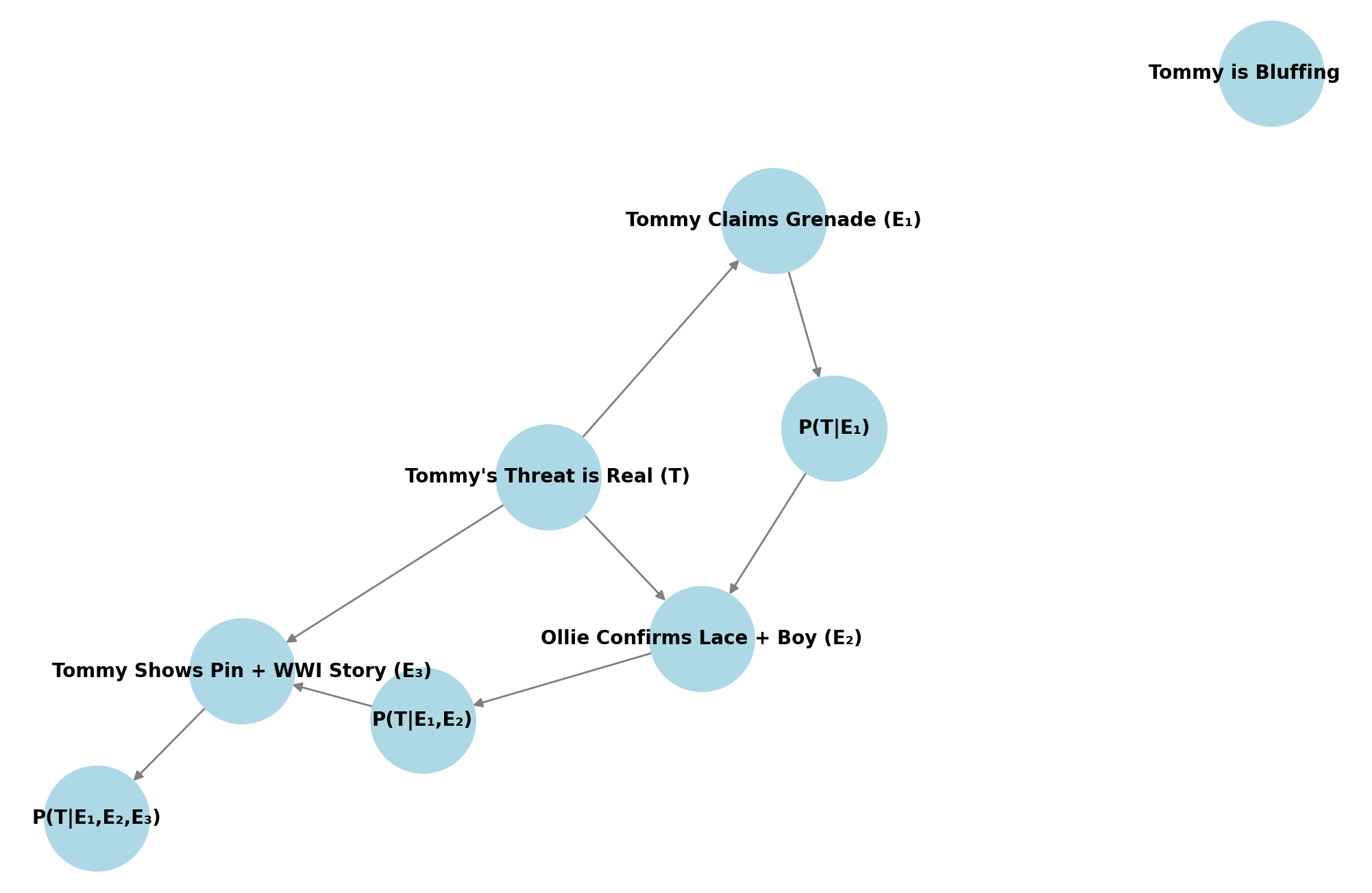
Sequence of Evidence and Belief Updates
Evidence 1: Tommy’s grenade threat
E₁ = Tommy says he planted a grenade and has an assistant with a tripwire
We assign:
- P(E₁|T) = 1 (he would say so if it’s real)
- P(E₁|¬T) = 0.7 (he might bluff this anyway)
Using Bayes’ Theorem:
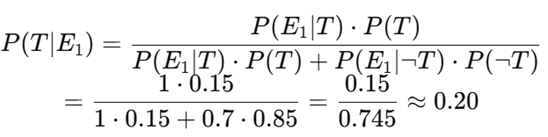
So now Alfie gives a 20% chance Tommy is telling the truth. Behavioral result: Alfie lowers the offer from 100% → 65%.
Evidence 2: Ollie confirms the lace-tying + nervousness
E₂ = Ollie confirms Tommy bent down and there’s a boy at the door
This is independent evidence supporting T.
- P(E₂|T) = 0.9 (if it’s true, this would happen)
- P(E₂|¬T) = 0.3 (could be coincidence)
Update:
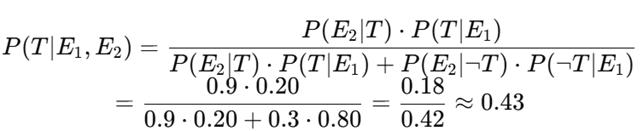
So Alfie now gives 43% probability that the grenade is real. Behavioral result: Offer drops to 45%.
Evidence 3: Tommy shows grenade pin + WWI tunneler claim
E₃ = Tommy drops the pin and references real tunneling experience
- P(E₃|T) = 0.95 (he’d be prepared and have a story)
- P(E₃|¬T) = 0.5 (he might fake this, but riskier)
Update:

Now Alfie believes there’s nearly a 60% chance Tommy is serious. Behavioral result: Offer rises slightly to 35%, the final deal.
Simplified Utility Function
Assume Alfie’s utility is:
U(percent) = percent ⋅ V−C ⋅ P(T)
Where:
- V = Value of Tommy’s export business (let’s say 100)
- C = Cost of being blown up (e.g., 1000)
- P(T) = Updated belief Tommy is serious
So for 65%, with P(T) = 0.43:
U = 65 – 1000 ⋅ 0.43 = 65 – 430 = −365
But for 35%, with P(T) = 0.59:
U = 35 – 1000 ⋅ 0.59 = 35 – 590 = −555
Here we should note that Alfie’s utility function is not particularly sensitive to the numerical values of V and C; using C = 10,000 or 500 doesn’t change the relative outcomes much. So, why does Alfie accept the lower utility? Because risk of total loss is also a factor. If the grenade is real, pushing further ends in death and no gain. Alfie’s risk appetite is negatively skewed.
At the start of the negotiation, Alfie behaves like someone with low risk aversion by demanding 100%, assuming dominance, and later believing Tommy is bluffing. His prior is reflect extreme confidence and control. But as the conversation progresses, the downside risk becomes enormous: death, loss of business, and, likely worse, public humiliation.
The evidence increasingly supports the worst-case scenario. There’s no compensating upside for holding firm, no added reward for risking everything to get 65% instead of 35%.
This flips Alfie’s profile. He develops a sharp negative skew in risk appetite, especially under time pressure and mounting evidence. Even though 35% yields a worse expected utility than 65%, it avoids the long tail – catastrophic loss.
***
[Tommy is seated in Alfie’s office]
Alfie (to Tommy): That’ll probably be for you, won’t it?
Tommy: Hello? Arthur. You’re out.
Alfie: Right, so that’ll be your side of the street swept up, won’t it? Where’s mine? What you got for me?
Tommy: Signed by the Minister of the Empire himself. Yeah? So it is.
Tommy: This means that you can put your rum in our shipments, and no one at Poplar Docks will lift a canvas.
Alfie: You know what? I’m not even going to have my lawyer look at that.
Tommy: I know, it’s all legal.
Alfie: You know what, mate, I trust you. That’s that. Done. So, whisky… There is, uh, one thing, though, that we do need to discuss.
Tommy: What would that be?
Alfie: It says here, “20% “paid to me of your export business.”
Tommy: As we agreed on the telephone…
Alfie: No, no, no, no, no. See, I’ve had my lawyer draw this up for us, just in case. It says that, here, that 100% of your business goes to me.
Tommy: I see.
Alfie: It’s there.
Tommy: Right.
Alfie: Don’t worry about it, right, because it’s totally legal binding. All you have to do is sign the document and transfer the whole lot over to me.
Tommy: Sign just here, is it?
Alfie: Yeah.
Tommy: I see. That’s funny. That is.
Alfie: What?
Tommy: No, that’s funny. I’ll give you 100% of my business.
Alfie: Yeah.
Tommy: Why?
[Ollie appears and aims a revolver at Tommy]
Alfie: Ollie, no. No, no, no. Put that down. He understands, he understands. He’s a big boy, he knows the road. Now, look, it’s just non-fucking-negotiable. That’s all you need to know. So all you have to do is sign the fucking contract. Right there.
Tommy: just sign here?
Alfie: With your pen.
Tommy: I understand.
Alfie: Good. Get on with it.
Tommy: Well, I have an associate waiting for me at the door. I know that he looks like a choir boy, but he is actually an anarchist from Kentish Town.
Alfie: Tommy… I’m going to fucking shoot you. All right?
Tommy: Now, when I came in here, Mr. Solomons, I stopped to tie my shoelace. Isn’t that a fact? Ollie?
Tommy: I stopped to tie my shoelace. And while I was doing it, I laid a hand grenade on one of your barrels.
Tommy: Mark 15, with a wired trip. And my friend upstairs… Well, he’s like one of those anarchists that blew up Wall Street, you know? He’s a professional. And he’s in charge of the wire. If I don’t walk out that door on the stroke of 7:00, he’s going to trigger the grenade and… your very combustible rum will blow us all to hell. And I don’t care… because I’m already dead.
Ollie: He tied his lace, Alfie. And there is a kid at the door.
Tommy: From a good family, too. Ollie, it’s shocking what they become…
Alfie (to Ollie): What were you doing when this happened?
Ollie: He tied his lace, nothing else.
Alfie: Yeah, but what were you doing?
Ollie: I was marking the runners in the paper.
Alfie: What are you doing?
Tommy: Just checking the time. Carry on.
Alfie: Right, Ollie, I want you to go outside, yeah, and shoot that boy in the face – from the good family, all right?
Tommy: Anyone walks through that door except me, he blows the grenade.
Ollie: He tied his fucking lace…
Tommy: I did tie my lace.
Alfie: I bet, 100 to 1, you’re fucking lying, mate. That’s my money.
Tommy: Well, see, you’ve failed to consider the form. I did blow up me own pub… for the insurance.
Alfie: OK right… Well, considering the form, I would say 65 to 1. Very good odds. And I would be more than happy and agree if you were to sign over 65% of your business to me. Thank you.
Tommy: Sixty-five? No deal.
Alfie: Ollie, what do you say?
Ollie: Jesus Christ, Alfie. He tied his fucking lace, I saw him! He planted a grenade, I know he did. Alfie, it’s Tommy fucking Shelby…
[Alfie smacks Ollie across the face, grabs him by the collar, pulls him close and looks straight into his face.]
Alfie to Ollie: You’re behaving like a fucking child. This is a man’s world. Take your apron off, and sit in the corner like a little boy. Fuck off. Now.
Tommy: Four minutes.
Alfie: All right, four minutes. Talk to me about hand grenades.
Tommy: The chalk mark on the barrel, at knee height. It’s a Hamilton Christmas. I took out the pin and put it on the wire.
[Tommy produces a pin from his pocket and drops it on the table. Alfie inspects it.]
Alfie: Based on this… forty-five percent. [of Tommy’s business]
Tommy: Thirty.
Alfie: Oh, fuck off, Tommy. That’s far too little.
Tommy: In France, Mr. Solomons, while I was a tunneller, a clay-kicker. 179. I blew up Schwabenhöhe. Same kit I’m using today.
Alfie: It’s funny, that. I do know the 179. And I heard they all got buried.
[Alfie looks at Tommy as though he has caught him in an inconsistency]
Tommy: Three of us dug ourselves out.
Alfie: Like you’re digging yourself out now?
Tommy: Like I’m digging now.
Alfie: Fuck me. Listen, I’ll give you 35%. That’s your lot.
Tommy: Thirty-five.
[Tommy and Alfie shake hands. Tommy leaves.]
Gospel of Mark: A Masterpiece Misunderstood, Part 7 – Mark Before Modernism
Posted in History of Christianity on August 3, 2025
See Part 1, Part 2, Part 3, Part 4, Part 4, Part 5, Part 6
In ancient Greek theater, like Sophocles’s Oedipus Rex, dramatic irony was central. Audiences knew Oedipus’s fate while he remained ignorant. This technique was carried into Roman drama, like Seneca’s tragedies. As described earlier, Christian writers moved away from irony in the late antique period.
During the Renaissance, Shakespeare used dramatic irony heavily. In Romeo and Juliet, the audience knows Juliet’s “death” is staged, but Romeo doesn’t. Such irony remained common in 17th- and 18th-century European drama, as in Molière’s comedies, but less structurally central than in Greek tragedy. The 19th century saw it in melodrama and novels (e.g., Thomas Hardy’s Tess of the d’Urbervilles), where readers grasped fates characters couldn’t.
In the 20th century, dramatic irony shifted. Modernist works like Brecht’s epic theater used it deliberately to alienate audiences, encouraging critical reflection. O’Neill’s plays (Long Day’s Journey into Night) leaned on it for emotional weight.
The Gospel of Mark seems to anticipate literary modernism. Mark didn’t invent stream of consciousness or set his gospel in a world of urban alienation. But the instincts of modernist storytelling – deliberate ambiguity, refusal to explain, the layering of voices, the elevation of reader above character, the fragmentary sense of time – are already alive in Mark. They are what make the gospel feel so strange to readers trained on the smoother harmonies of Matthew and Luke. In literary style, Mark seems to reach both far back, to the ancient Greeks, and far ahead, to modernism. He writes more as dramatist than as evangelist, putting him in unexpected company.
Withheld Meaning: Proust’s Readers and Mark’s
Modernist literature often refuses to say what it means. It circles themes without resolving them. It trusts the reader to infer. Mark gives riddles disguised as parables, miracles that aren’t explained, and a resurrection that isn’t shown. Not glory, but silence.
In Swann’s Way, Proust captures this same dynamic, not in plot, but in psychological structure. Swann, obsessively reading the behavior of the woman he loves, becomes a figure of frustrated interpretation:
“He belonged to that class of men who… are capable of discovering in the most insignificant action a symbol, a menace, a piece of evidence, and who are no more capable of not interpreting a movement of the person they love than a believer is of not interpreting a miracle.”
There’s the reader Mark aimed for, watching every detail, looking for signs.
Beckett and the Failed Witness
Beckett’s characters, like Vladimir and Estragon in Waiting for Godot and Winnie in Happy Days are excluded from understanding. They wait for voices that don’t explain, and they continue despite knowing the endpoint will never come.
Vladimir (Waiting for Godot): Suppose we repented.
Estragon: Repented what?
Vladimir: Oh… (He reflects.) We wouldn’t have to go into the details.
Estragon: Our being born?
In Mark, the reader continues after the characters collapse. The women flee the tomb. The disciples abandon the frame. The gospel stops, but the reader continues – because Mark has structured the story so that you see what they don’t.
Beckett once said that Joyce was always adding to his prose, and that he himself was working in the opposite direction: “I realized that my own way was in impoverishment, in lack of knowledge and in taking away.”
Mark takes away. He subtracts resurrection appearances and erases resolution. What remains is a void that insists on meaning – not through declaration, but through the reader’s isolation.
Unreliable Perception and Faulkner’s Disciples
In Faulkner’s works like The Sound and the Fury, characters narrate their experiences through fragmented, subjective lenses, often unaware of the full scope of their stories. Their voices – Quentin Compson’s anguished stream-of-consciousness or Addie Bundren’s posthumous reflections – clash and contradict, leaving gaps that the reader must navigate. This aligns with reader-response criticism, which emphasizes the reader’s active role in interpreting and reconstructing meaning from incomplete or biased accounts. Faulkner’s narrators don’t deliver a tidy “truth”; they offer perspectives clouded by personal trauma, guilt, or limited understanding. Quentin, for instance, obsesses over time and his sister Caddy’s fall, but his mental collapse distorts his narrative, forcing the reader to piece together the Compson family’s decay from his fractured memories and those of his brothers.
Faulkner’s unreliable narrators force the reader to rise above their limitations, synthesizing disparate voices to uncover a truth that no single character fully grasps.
Mark gives us the same through the disciples. They speak, but they are not to be trusted. They fear Jesus’s passion predictions and change the subject. And unlike Luke, Mark never rehabilitates them.
As with Faulkner, their unreliability is device. Mark lets them fall so you can rise, just as Faulkner allows Quentin’s breakdown to weave time, memory, and guilt into the fabric of the narrative. Faulkner’s chaos of competing voices reflects the human condition – fragmented, subjective, and burdened by history. In Mark, the disciples’ failures underscore the radical nature of Jesus’s mission, which defies human expectations of power and glory.
Beckett on the Death of the Subject
Samuel Beckett, writing on Proust in 1931, described the modern condition as a crisis, not of plot, but of self:
“We are not merely more weary because of yesterday, we are other, no longer what we were before the calamity of yesterday… The subject has died – and perhaps many times – on the way.”
This is the shape of Mark’s gospel. The narrator sees all but explains nothing. The disciples begin as named voices and end as absences. The final scene gives no resolution. Time, once galloping forward with Mark’s “immediately” at every step, halts in a tomb that no one enters.
The reader is left standing outside the story with a question its characters cannot answer.
Gospel of Ellipsis: Hemingway’s Surface Tension
Hemingway’s prose derives its emotional power from deliberate restraint, a technique often described as the “iceberg theory,” where the bulk of meaning lies beneath the surface of the text. In stories like Hills Like White Elephants, he employs sparse, minimalist dialogue and understated narration to convey profound emotional and thematic weight without explicitly stating the core issues. The story’s central conflict – an implied discussion about abortion between a man and a woman at a train station – is never directly named. Instead, Hemingway embeds the tension in clipped exchanges, pregnant pauses, and subtle imagery.
This restraint amplifies the emotional force by forcing readers to engage actively with the subtext. The silences between sentences – where characters avoid articulating their fears, desires, or regrets – carry the weight of unspoken truths. For example, when Jig says, “They look like white elephants,” and the man responds dismissively, the dialogue skirts the real issue, revealing their emotional disconnect and the power imbalance in their relationship. The unsaid looms larger than the said, making the reader feel the characters’ anxiety, uncertainty, and isolation.
Mark doesn’t explain the fig tree or narrate the resurrection. He doesn’t say why the women told no one. And when Jesus speaks cryptically, the narrator does not clarify. Mark doesn’t mismanage meaning, he suppresses it for effect. Like Hemingway, Mark trusts the reader to feel the weight of what isn’t said.
Kafka’s Gospel: Parable Without Answer
Kafka’s stories are often structured as parables – but not the kind that end in moral resolution. His parables frustrate the interpretive impulse. Their logic seems to point to something just beyond reach.
In Before the Law, a man spends his life trying to gain access to a door that was meant only for him. He dies without ever passing through. The priest in The Trial tells Joseph K. the parable – and then refuses to explain it.
In Mark 13:14, Jesus warns of an “abomination of desolation” and then stops mid-sentence. The narrator breaks in: “Let the reader understand.” Who is this reader? Not Peter, James, or John. You. Understand what? Mark’s narrator refuses to explain it.
Like Kafka, Mark knows the parable won’t resolve. He knows it exists to sharpen the hunger to understand. And the gospel itself becomes that hunger’s object.
Conclusion – Mark’s Gospel Came Too Soon
Even sympathetic readers struggle to see it. Because Mark says less the other gospels say, it is nearly impossible to read him without filling in what he left out. Harmonization is a habit learned in childhood. An untrained, unbiased, innocent reading – a first reading – by a western reader is almost unavailable. And so the masterpiece goes unnoticed because the broader story has been too thoroughly absorbed for the real Mark to be seen.
By theological or historical standards, Mark has long ranked lowest by far among the gospel writers. In early Christian citation, he accounts for barely 4% of gospel references. He is by far the shortest and the roughest, some say the least theologically rich. I disagree.
By modern literary standards – those that distrust omniscient narration and place the burden of meaning on the reader – Mark might be the rhetorical master of millennia.
That achievement is easily missed. I think it a shame that readers of modern literature rarely turn to the gospels, starting with Mark. And if they do, prior convictions prevent them from imagining it could house a work this strange, this far ahead of its time. Mark wasn’t experimenting with form for its own sake. He was a storyteller – one whose narrative instincts ran far ahead of his genre.
In his world of early Christianity, stories were expected to explain, miracles to prove, and heroes to be understood. Mark resists all of that. He gives us a Messiah who is misunderstood, a story that ends in silence, and a text that refuses to explain itself.
In other words, he wrote a modernist gospel – a work of quiet fire – before modernism existed.
Postscript: The Gospel That Leaves You Standing
Mark ends with absence– with flight, silence, and a rolled-away stone. That was the final move of a writer who trusted you to finish what he started.
Across this series, I haven’t treated Mark as theology but as what it so clearly is, once you stop trying to fix it: a story designed to be misunderstood by its characters and grasped by its reader. None of that should bear on your theology, beliefs, or lack thereof; it works regardless.
That story does not yield its truth by accumulating facts. It yields by withholding enough to make you reach. And when you do, something happens. You see what others miss. You feel the silence grow louder than the speech.
Even now, twenty centuries later, the final question still hangs–not in the mouths of the women at the tomb, but in yours: What are you going to do with what you’ve seen?
Gospel of Mark, Masterpiece Misunderstood, Part 6 – Mark, Paul and James: The Silence, the Self and the Law
Posted in History of Christianity on August 2, 2025
Mark vs. Matthew and Luke: Redaction, Not Clarification
Matthew and Luke didn’t set out to clarify Mark, as many scholars have claimed. They were authors writing for different communities with different needs. They either misunderstood Mark’s rhetorical style, understood it but disliked it, or were indifferent to it altogether, merely reusing his stories and text. They took Mark’s gospel and Q as starting points, then reshaped them to fit their theological goals. In doing so, they smoothed its edges, filled in its silences, and reframed its mysteries using their own rhetorical styles.
Matthew, by most accounts, is rhetorically more refined than Mark. His Greek is more polished, and his theological framing is clearer. But Matthew and Luke lose Mark’s vividness. In my view, the most rhetorically daring gospel in Christianity was overwritten by its successors, and it is inaccurate or disingenuous to frame this as clarification.
Matthew and Luke reworked the fig tree. Mark’s fig tree vignette (11:12–14, 20–21) is famously strange, as discussed earlier: Jesus curses a tree for having no fruit out of season and Mark wraps the episode around the cleansing of the temple to enforce the metaphor.
Matthew’s version (21:18–22) changes the tempo: the tree withers immediately. The temple scene is unlinked. And the point is made explicit: it’s a lesson about faith and prayer. Luke (13:6–9) avoids the destructive miracle and cursing the tree, giving instead a parable that calls for repentance while there’s still time. A summary shows the transformation:
| Feature | Mark | Matthew | Luke |
| Type | miracle + symbol | miracle + moral | parable |
| Timing of Withering | next day | immediate | not applicable |
| Commentary | faith and prayer | faith and prayer | repentance and mercy |
| Relation to Temple | surrounds cleansing | follows cleansing | precedes healing on sabbath |
| Theological Emphasis | judgment, irony, failure of temple | power, faith, moral clarity | warning, grace, call for repentance |
What was rhetorical structure in Mark becomes illustrative theology in Matthew and Luke. Riddle becomes sermon; the silence is gone.
A comparison of approaches to the fig tree shows the progression toward theological evolution and loss of irony:
| Detail | Mark | Matthew | Luke |
| Fig tree cursed | Yes | Yes | No (parable only) |
| Disciples mentioned | Yes: “heard it”, “Peter remembered” | Yes: they “marveled” | No |
| Delayed withering | Yes | No | N/A |
| Delayed narrative payoff | Yes | No | N/A |
| Irony/suspension | Yes | No | No |
A comparison of the way Mark and Matthew mention the disciples in this story shows still more about their rhetorical mindsets. Mark (11:14) reports:
And he said to it, “May no one ever eat fruit from you again.” And his disciples heard it. (ESV)
His disciples heard it? Of course they did. But what an odd thing for Mark, given his economic prose, to include. The statement doesn’t advance the plot and interprets nothing. No, this is Mark the author signaling that he’s hung Chekov’s gun (give a reader no false promises) on the wall. Take notice, something is going to happen, so remember what is being marked here.
What’s going to happen is that Jesus will cleanse the temple. The marker (they heard him) marks the curse and is a small, almost invisible trigger, narratively minimal, ironically loaded, and structurally strategic. Matthew and Luke steered clear. Mark delays firing Chekov’s gun until he returns to the tree. Bang, it’s dead.
Mark ends his gospel with silence and fear. The women flee the tomb. No resurrection appearances. “They said nothing to anyone, for they were afraid.”
Matthew and Luke add resurrection appearances, dialogue, comfort, and commissions. Matthew gives us theatrical effects: guards, earthquakes, angelic speech. Luke gives us the road to Emmaus, meals, and final instructions.
These endings do more than continue the story. They close a loop Mark left open. They give theological assurance where Mark offered emotional tension. By explaining what Mark left implied, they take the burden of interpretation off the reader and place it into the narrative.
Mark’s disciples are never right. They botch the parables and miss the miracles. They sleep, flee, and deny. Mark never resolves that arc. The disciples have no epiphany. Peter is given a beatitude in Matthew: “Blessed are you, Simon… you are Peter, and on this rock I will build my church” (Matt. 16:17–18).
Luke dials back the disciples’ failures and paints a more stable community. By the time we reach Acts, the apostles are the theological center of gravity.
Modern scholarship tends to treat Matthew and Luke as consciously adapting Mark rather than misunderstanding him or cringing at his telling. But their treatment of the fig tree is revealing. Whether their changes stem from narrative or theological agendas, the result is a loss of Mark’s narrative complexity. In that sense, even if they didn’t misunderstand or dislike Mark’s meaning, they did dismantle his rhetorical scaffolding – and with it, the deeper tension he built into the scene.
In Mark, Jesus says explicitly that parables are designed to (in order that they) conceal, not clarify (4:11–12). It’s a shocking claim. Jesus doesn’t teach in parables to illustrate the truth, but to hide it from those unready to hear it. It’s a clear challenge to you to show your readiness.
Matthew retains many of the same parables but softens the intent. He writes:
This is why I speak to them in parables, because seeing they do not see… (Matt. 13:13)
The subtle change from “in order that” to “because” shifts the parables’ purpose from concealment to explanation. This contrast doesn’t result from translation; it’s present in the Koine manuscripts. I agree with scholars like R.T. France and Joel Marcus that Matthew must have deliberately changed Mark’s ἵνα to ὅτι to soften the implication that Jesus’s parables intentionally obscure truth. That implication was theologically problematic for Matthew. What Mark presents as rhetorical filtering, Matthew turns into compassionate pedagogy. Matthew and Luke, in moving away from literary puzzle toward religion, wrote for churches, for instruction, for catechesis. Their redactions obscured the most subversive thing Mark had done: trust the reader.
Paul vs. Mark
While the epistles – especially those commonly attributed to Paul – show formidable rhetorical skill, their style is strikingly different from Mark’s. Paul’s prose is argumentative, insistent, full of digression and appeal. He leads the reader, often with intensity, sometimes with exasperation, and always with a strong sense of his own position in the exchange. Paul’s voice dominates. There’s no narrative mask, little humble pretense. The authority of the letter comes not from its structure but from the voice behind it. Even Paul’s moments of self-deprecation – “I speak as a fool” – seem more performative than self-effacing.
In 2 Corinthians 11, Paul all but dares his audience to compare him to rival apostles, saying,
Are they Hebrews? so am I. Are they Israelites? so am I. Are they the seed of Abraham? so am I. Are they ministers of Christ? (I speak as one beside himself) I more; in labors more abundantly… (2 Cor 11:22-23 ASV)
In Galatians, Paul shows that he is the conduit. He is bound to his message; it’s his claim, his proof, his identity. He states outright that he is bypassing both tradition and community—no apostolic succession, no collective discernment. It’s just him and revelation.
For I would have you know, brothers, that the gospel that was preached by me is not man’s gospel. For I did not receive it from any man, nor was I taught it, but I received it through a revelation of Jesus Christ. (Gal 1:11–12 ESV)
In 1 Corinthians 9, Paul defends his apostleship with personal passion and rhetorical intensity:
Am I not free? Am I not an apostle? Have I not seen Jesus our Lord? Are not you my workmanship in the Lord? If to others I am not an apostle, at least I am to you… (1 Cor 11:1-2 ESV)
Here, Paul’s rhetorical command is on full display, but so is his presence. He becomes part of the message. He is its defender and its embodiment. Mark, by contrast, disappears. His narrator rarely intrudes, and when he does, it is briefly, obliquely, or through broken syntax. The reader, not the writer, is meant to emerge in command. That difference of posture – one text rhetorical to persuade, the other rhetorical to implicate the reader in the story’s meaning and cost – is perhaps the clearest sign of Mark’s literary distinctiveness.
James – Rhetoric Without a Narrator
The Epistle of James warrants a mention because its rhetoric is also shrewd. The book is famous for its assertion that “faith without works is dead.” He sets up a contrast between empty belief and active compassion:
If a brother or sister is poorly clothed and lacking in daily food… what good is that? (2:14–17 ESV)
Here, “works” clearly means acts of charity and mercy. The moral framing is universal, hard to argue with, and rhetorically effective. It appeals to shared values. But elsewhere in James, “works” may implicitly include behaviors not so obviously ethical at root:
Religion that is pure and undefiled before God… is this: to visit orphans and widows… and to keep oneself unstained from the world. (1:27)
The second clause – “unstained from the world” – is vague, but loaded. It likely gestures toward purity behaviors that are more Jewish than Christian in tone.
Do you not know that friendship with the world is enmity with God? (4:4)
Again, this moves from moral to separatist rhetoric – potentially reinforcing ethnic or cultural boundaries. We can’t be certain, but James seems to be framing his argument in terms everyone can agree on. Then he gradually broadening the meaning of “works” to smuggle in a stricter behavioral code, includes Jewish law-adjacent customs. Cunning. He avoids direct confrontation with Paul’s theology, but still answers it implicitly but forcefully.
James often sounds like Proverbs or Sirach, surely no accident. His use of tight, balanced structures gives his writing an oracular, gnomic quality:
Let every person be quick to hear, slow to speak, slow to anger… (1:19 ESV)
From the same mouth come blessing and cursing. My brothers, these things ought not to be so. (3:10 ESV)
Do not swear, either by heaven or by earth or with any other oath; but your yes is to be yes, and your no, no (5:12 NASB – note the syntactic ellipsis between “no” and “no”, lost in many translations)
James’s imagery is concrete, unlike Mark and Paul. He compares the tongue to a spark, an uncertain man to a bobbing wave, and the rich to withering grass. His imagery persuades while bypassing formal argument.
A short comparison between Mark, Paul, and James shows:
| Writer | Narrative Presence | Rhetorical Voice | Ego/ Authority | Style of Engagement |
| Mark | Minimal, oblique | Structural, ironic | Effaced | Reader discovers meaning |
| Paul | Occasional but strongly personal | Assertive, argumentative | Central | Reader is persuaded |
| James | None | Moral, aphoristic | Neutral | Reader exhorted, corrected |
Mark is the early outlier, followed by a literary trend toward clarity and control. The text becomes the instrument of the Church, not a provocation to the reader. Tastes of the church turned institutional, doctrinal, and mass-oriented. Mark wrote for those with ears to hear (4:9). The Church wrote for those who sought a creed.
Next and final: Mark Before Modernism
The Gospel of Mark: A Masterpiece Misunderstood, Part 5 – Mark’s Interpreter Speaks
Posted in History of Christianity on August 1, 2025
See Part 1, Part 2, Part 3, Part 4
Mark’s narrator very rarely offers commentary. His most overt interpretations are tucked into parentheses or framed as almost self-effacing asides. In Mark 7:2–4, he breaks the flow of Jesus’s confrontation with the Pharisees to explain handwashing customs:
(For the Pharisees, and all the Jews, do not eat unless they wash their hands properly, holding to the tradition of the elders; and when they come from the marketplace, they do not eat unless they wash. And there are many other traditions they observe, such as the washing of cups and pots and copper vessels.) (ESV)
This form of direct exposition appears nowhere else in the gospel, and its tone is uncharacteristically anxious. The syntax is crowded and accumulative, almost list-like. There’s no attempt to link this aside tightly to the main dialogue, and it reads like a clarification added for a reader who simply wouldn’t understand the stakes of the debate without it. In that sense, it’s a breach where Mark momentarily acknowledges the gap between the world of the story and the world of the reader.
But it’s not clear who is being addressed. A Jewish narratee wouldn’t need the explanation. A Roman reader might, but Mark doesn’t frame it as such. There’s no “as you know” or direct narrative address. Instead, the narrator drops the aside in mid-stream, then promptly disappears again. The result is strangely destabilizing. It invites the reader to notice that this gospel knows it’s being read across cultural lines but doesn’t want to say so too loudly.
Scholars have long noted this passage as evidence that Mark’s intended audience may have included Gentile readers unfamiliar with Jewish purity laws. But its narrative awkwardness may be more important than its audience implications. The digression doesn’t belong to Jesus’s speech, and it isn’t integrated into the narrator’s voice. It hangs slightly askew, as if the narrator is not quite practiced in speaking outside the bounds of his scenes. And that narrative unease may be the point.
In rhetoric, dubitatio is the technique of feigning hesitation or uncertainty, often to enhance credibility. Mark’s aside in 7:2–4 isn’t classic dubitatio. It’s not self-aware enough to feel like artful hesitation, but it does feel like narrative restraint forced into speech. It overexplains in a crowded string of clauses and lacks a clear addressee. Mark’s narrator shows a kind of structural dubitation.
Mark is quiet, especially where we would most expect it to explain itself. The narrator rarely steps in to clarify, summarize, or instruct. When he does, it’s with restraint and can seem indecisive. Odd, parenthetical elements are syntactically jarring. Is Mark’s narrator hesitant to break the rhetorical spell, or is he intentionally breaking rhythm?
This piece looks at the breaches in Mark’s otherwise minimalist storytelling and argues that they are meant to highlight his indirection. Mark’s rare authorial voice is self-referential: not so much pointing to the meaning of events, but to the process of reading and interpreting them. Even when he speaks, Mark still makes you work.
Parentheses in the Wilderness: Ritual Washing
In Mark 7:2–4, the Pharisees confront Jesus about his disciples eating with unwashed hands. Notice how the narration breaks:
(For the Pharisees and all the Jews do not eat unless they wash their hands properly… and there are many other traditions that they observe.) (ESV)
On the surface, this parenthetical is meant to help the reader. But which reader? Again, a Jewish reader wouldn’t need this to be explained, assuming the statement is correct. A Gentile might. So this comment could be the voice of the narrator to the real-world reader, not the narratee within the gospel world.
But it’s not introduced formally. It adds a tangent. Its syntax is overloaded. It’s explanatory, but clunky. It breaks the flow, and it reads like an interlinear gloss that drifted into the body of the text – as some scholars argue it is.
But comparison with Mark’s other parentheses shows it to be consistent. It emphasizes his deliberate method of resisting interpretation at the narrator level.
Dramatically, in 7:19, Jesus says that nothing entering a person from the outside can defile him. It’s a provocative statement – but it’s not a formal abrogation of dietary law. Yet Mark’s narrator follows it with a striking editorial aside: “Thus he declared all foods clean.” Mark tells us that this is his narrator’s gloss, not what Jesus said. It’s what the narrator concludes – or wants the reader to conclude. This is a major theological claim, especially in a first-century Jewish context. Yet it’s not put in Jesus’s mouth but tacked onto the end. The comment is not timeless; it’s contextual. But most readers fail to notice this; they remember the story as if this were Jesus’s claim.
In Greek, this phrase is syntactically ambiguous. It’s an editorial comment, awkwardly inserted and easily overlooked. Yet it’s doing a lot of work.
If it’s Mark’s voice, then it’s one of the rare times he interprets Jesus’s meaning for the reader. But even here, he does it indirectly, after the fact, as a kind of explanatory shrug. He doesn’t say, “Here’s what Jesus meant.” His “thus” leaves us wondering.
In the healing of Jairus’s daughter, Jesus takes the child by the hand and says:
“Talitha koum”–which means, “Little girl, I say to you, arise.” (5:41 NASV)
Koine Greek has no quotation marks. It’s unclear whether this translation, internal to the text, is Jesus speaking to the girl, Jesus speaking to others in the room, or the narrator speaking to the reader. The effect is subtle: Jesus has just used Aramaic; so someone has translated it. But the grammar doesn’t make it obvious who that is.
This is one of several places where Mark’s narration blurs into character speech. It mirrors the overall strategy of the gospel, where author and narrator are not fully aligned, and where the reader is constantly asked to track perspective.
Let the Reader Misunderstand: Parentheses and Self-Reference
A curious moment where Mark breaks from letting actions and dialogue tell the story is the anointing story. Here’s the core moment:
Truly I tell you, wherever the gospel is preached in the whole world, what she has done will be told in memory of her. (14:9)
The narrator up to this point has played things relatively straight – omniscient without interpretation. But here, something unusual happens. A character (Jesus) speaks with a global-historical voice, predicting the preservation of this woman’s story. But this prediction is, ironically, already fulfilled by the gospel in which it appears.
The moment is self-aware. It feels like the author breaking through the narrator using Jesus’s words. Jesus says her story will be told wherever the gospel goes, and the truth of his prophecy is in the reader’s hands. Look, you’re reading it.
Mark 14:9 collapses narrative time and reader time. It’s a moment of reflexivity, not just a character’s prediction, but a cue from the authorial level that this story you’re reading is already enacting the prediction. Mark doesn’t break the fourth wall directly, but this is the next closest thing: Jesus’s voice carries authorial weight.
Mark asserts a form of meta-claim: this anonymous woman, unnamed by everyone in the room, is now known to you, the reader of this gospel because this is that telling, “told in memory of her.”
The clearest and strangest example of Mark’s self-referential voice appears in Mark 13:14. Jesus is giving a long apocalyptic speech about future tribulation. He says:
When you see the abomination of desolation standing where it ought not to be… (let the reader understand) …then let those who are in Judea flee to the mountains. (ESV)
In 13:14, translators struggle not with tense but with punctuation. Who’s talking? The phrase “let the reader understand” interrupts the discourse. It’s not addressed to the disciples. It’s not part of the speech’s internal logic. It’s not “let the listener understand,” or “let him who sees understand.” It’s: ὁ ἀναγινώσκων νοείτω: “Let the one who is reading understand.”
Jesus doesn’t speak this way elsewhere. This line isn’t addressed to anyone in the story. It’s aimed past them – to the reader. Though a few evangelists (William L. Lane, Craig Evans, and Robert Gundry) suggest that it could be Jesus’s voice, I think that highly unlikely. The phrase’s address to a “reader” is anachronistic for Jesus’ oral context if he spoke to disciples, not a reading audience. Its parenthetical form and alignment with Mark’s asides (e.g., Mark 7:19) suggest an editorial hand. Matthew’s clarification (“spoken of through the prophet Daniel”) and Luke’s omission (Luke 21:20) imply the phrase was seen by them as a saying of Jesus.
Instead, this is the voice of both the author and the narrator – conflated here – breaking through the frame to speak directly to the reader, not the narratee. Joel Marcus sees it as Mark’s instruction to interpret the “abomination” as destruction of the temple by Romans under Vespasian in 70 AD. Others suggest a reference to the more severe Roman response to the Simon bar Kokhba revolution under Hadrian in 136 AD.
Its literary significance holds regardless of the reference. It is the moment the gospel becomes unarguably self-referential. It admits it’s a text and knows it’s being read. It tells the reader to pay attention – to spot something. Remarkably, that something will not be explained.
This comes at one of the gospel’s most cryptic moments. Rather than clarify the “abomination of desolation” (reference to Daniel 9:27), Mark points directly to its ambiguity and places the burden of interpretation on you.
Ironically, this passage shows boldly that even when Mark speaks, he withholds. His parenthetical interjection is paradoxically employed to direct the reader’s gaze at the absence of explanation.
In a rhetorical move that could have been pulled straight from Samuel Beckett, Mark breaks the fourth wall to report that the fourth wall exists (let the reader understand).
Next: Strategies of Mark, Paul and James: The Silence, the Self and the Law
The Gospel of Mark: A Masterpiece Misunderstood, Part 4 – Silence and Power
Posted in History of Christianity on July 30, 2025
Silence and Prohibition as Rhetorical Trapdoor
For Mark, silence is a form of structure. His most famous silence comes at the end of the gospel, in 16:8, where the women flee the empty tomb and “said nothing to anyone, for they were afraid.” Here we have silence at the characters’ level and at the narrative level.
Mark uses silence like a line break. It isolates, heightens, and forces attention. His scenes close with hesitation. The fig tree withers, Jesus gives no explanation. Jesus heals by touch, the narrator doesn’t comment. At his trial, Jesus is silent when questioned (14:61).
In Mark 1:40–45, Jesus heals a leper and sternly warns him to tell no one. The man spreads the news widely. Jesus then retreats into desolate places. The rest is silence. There is no commentary on the man’s disobedience, no indication that Jesus is angry, no explanation of what Jesus’s withdrawal means.
These silences create enough interpretive space to lure a thoughtful reader. A key moment comes in the boat immediately after the second feeding miracle. The disciples are worried they’ve forgotten to bring bread. Jesus asks:
Do you not yet perceive or understand? Are your hearts hardened? Having eyes do you not see, and having ears do you not hear? (8:17–18 ESV)
He’s just fed thousands–twice, and they’re panicking about lunch. The moment seems to glance past the disciples and land somewhere else. The burden of understanding has been handed to the reader
The Messianic Secret: Command as Rhetoric
Repeatedly, Mark’s Jesus performs a miracle, then demands the characters to be silent. He heals a leper, then says: “See that you say nothing to anyone” (1:44). He raises Jairus’s daughter, then “strictly charged them that no one should know” (5:43). He opens a deaf man’s ears and “charged them to tell no one” (7:36). After Peter confesses him as the Christ, Jesus “strictly charged them to tell no one about him” (8:30). The Messianic Secret refers to these repeated instructions to demons and healed individuals, prominent only in Mark’s Gospel, to keep his identity as the Messiah hidden.
Scholars offer various explanations, reflecting different approaches to the text. Some give a historical explanation. Jesus commanded secrecy to avoid arrest by Roman authorities, protecting his ministry. A theological alternative postulates that Jesus kept his identity secret to challenge Jewish expectations of a political Messiah, not the role the suffering Jesus plays in the gospels. Some see it as purely practical – a way to manage crowds to avoid interference with his teaching. This theory fits well with the healing the leper (1:45) and the blind man at Bethsaida (8:22) but poorly with the recognition by Jesus of demons (1:23, 1:34, 3:11) and after Peter’s confession (8:30).
I see it, especially in its repetition, like William Wrede did in the 1800s, as a literary device. Unlike Wrede, I am not concerned with the theological question of whether Jesus was the Messiah from the start, preordained since the beginning of time, as in John 1:1, or whether he became the Messiah at the point of crucifixion, as Phillipians 2:6 can be read. Wrede’s argument for the messianic secret being a literary device hinged on this distinction, along with the question of Markan priority. Mine does not. Wrede and many other explanations of the messianic secret miss the point that is obvious in a reader-response analysis of Mark.
Mark is delaying public understanding to increase private responsibility. If the characters can’t see what happened, then the reader has to see it for them. The messianic identity remains hidden inside the story. It becomes visible to those who can read the signs.
Those reading Mark only for its theology or to judge its historicity miss the continuity between the silence and Jesus’s explanation of the parables: “…but for those outside everything is in parables…” This is blatant. Jesus isn’t hiding from everyone;he’s only hiding within the story. But Jesus, through the narrator, reveals himself directly, to the reader. And Mark rewards the reader for not needing to be told.
It’s the Reader Who Sees the Pattern
Mark’s combination of rhetorical choices – the silence, the repetition, the warnings not to tell anyone – shape an experience that forces the reader to see what the disciples do not, and to do so without the narrator confirming it. It’s why no one inside the story “gets it.” The entire gospel is a structure of discovery, designed not for the narratee, but for you, the reader.
You understand the feeding miracles. You understand the anointing. You suspect, if your rhetorical skills are sharp, that the fig tree is about the temple. You hear the Roman centurion’s words – “Truly this man was the Son of God” – and realize no one else has said anything like that through the entire gospel.
Mark’s narrator doesn’t hand insight to you. You earn it. But on another level, Mark the author, one level up, did hand it to you. Isolating the reader is Mark’s deepest rhetorical move. It’s not that he just delays meaning; he narrows its access. This narrative isolation creates a private moment of insight for the reader alone.
Mark’s positioning of the reader as sole witness is seen in the transfiguration’s muffled epiphany (9:2). Jesus takes Peter, James, and John up a mountain. They see him transfigured, his clothes radiant white, flanked by Moses and Elijah (echoing Malachi 4:5-6). Considered “the greatest miracle” by Aquinas, we might expect it to be the clearest scene in the gospel.
But what happens in Mark’s telling? Peter blurts out something foolish. A voice from heaven addresses an unspecified listener: “This is my beloved Son: hear ye him.” Then, “suddenly looking round about, they saw no one any more.” Jesus tells the disciples “tell no man what things they had seen” (ASV).
The moment has closed on itself, the vision collapsed to silence. The disciples are clueless and are told to be silent. Who’s left to interpret Jesus’s miracle? Only, you, the reader. Hear ye him.
In the garden of Gethsemane, Jesus undergoes his moment of greatest anguish. He tells his disciples to watch and pray, but they fall asleep. Three times. You, the reader, are fully awake. You are present for every word of his prayer. You see his sorrow. You watch the drops of isolation gather around him. This scene, as Mark paints it, isn’t about the disciples’ inattention; it’s about your attention.
Mark’s structure puts you in a lonely place. You are the only one who sees the pattern. You are the only one who notices the parallels, the ironies, the betrayals. You’re the only one who sees what kind of Messiah this is. Mark doesn’t want you to pity the disciples. He wants you to step over the blocks on which they’ve stumbledand keep on going.
Silence Plus Inversion
Throughout Mark, people are constantly told to be silent – and they rarely obey. The leper in chapter 1 is told to “say nothing to anyone.” He spreads the news. After Jairus’s daughter is raised, Jesus instructs them to keep quiet. They are “immediately overcome with amazement” and, presumably, do not obey. The deaf man in chapter 7 is healed. Jesus charges them to tell no one. “But the more he charged them, the more zealously they proclaimed it.”
It’s a pattern: commanded silence, followed by disobedient speech. But at the tomb, the pattern is reversed. The women are not told to be silent. In fact, they are given a clear message to deliver:
Go, tell his disciples and Peter that he is going before you to Galilee (Mark 16:7 ESV)
But this time, they say nothing.
And they went out and fled from the tomb, for trembling and astonishment had seized them, and they said nothing to anyone, for they were afraid. (Mark 16:8 ESV)
It’s the only moment in the gospel when someone actually complies with silence – despite being told not to.
This reversal is Mark’s final irony. He has trained us to expect speech after commands for silence. But now, when the resurrection itself is announced, when the story should break open, the characters fall silent.
The women are continuing the pattern of misunderstanding and fear that runs through the entire narrative. Even here, at the resurrection, Mark offers no closure. The characters don’t overcome their limitations; they give in to them. And the reader is drawn in.
Mark’s Redefinition of Power
From the midpoint of Mark onward, the tone darkens. Jesus has healed the sick, fed the hungry, walked on water, and rebuked storms. He has astonished crowds, exorcised demons, and taught in riddles that burn their way into the mind. But once Peter names him the Messiah in Mark 8, things shift.
And he began to teach them that the Son of Man must suffer many things… (Mark 8:31 ESV)
This is the pivot. From here on, Jesus repeats the same strange message: he won’t rule as a king but will be rejected. He won’t be crowned; he’ll suffer and dieand rise again. Each time he says it, the disciples, on cue, fail to understand. Mark builds his second half on this theme.
In Mark 8:29, Peter finally names Jesus as the Christ. In a rhetorically less shrewd telling, this would be framed as the breakthrough. In cinema it would be the classic zoom-out, where we are invited to consider the character Jesus and his state of mind before understanding the context around him. But here, Mark’s Jesus story tracks in rather than zooming out. Jesus, in a full-screen close-up, tells the disciples to tell no one and then says “the Son of Man must suffer.”
Peter pulls him aside and says that can’t be right. Jesus responds with the harshest tone, unparalleled in the other gospels:
Get behind Me, Satan; for you are not setting your mind on God’s purposes, but on man’s. (8:33)
This is a clash between two visions of power. Peter gets the title right but fills it with the wrong content. He imagines a crowned victor; Jesus offers a condemned servant. It’s both rebuke and reversal.
In 8:33, Mark shows us something else: Peter is not the intended reader. This isn’t a Vaudeville wink or Groucho’s fourth-wall smirk. It isn’t postmodern self-reference either. It’s something subtler – a direct address the narrator doesn’t acknowledge, but the reader feels. The Greeks called it metalepsis.
In this metalepsis Mark sets up the Christ-confession not as insight but as a foil for the insight that hasn’t happened yet. The reader is meant to notice the disjunction. The narrator doesn’t explain it. But, like a theatrically and rhetorically literate ancient Greek, you’re supposed to feel it.
Mark has three predictions of the Passion (8:31, 9:31, 10:33). In the first we learn that the Son of Man must suffer many things, in the second that he will be delivered. The third has specificity:
The Son of Man will be handed over to the chief priests… They will mock him and spit on him, and flog him and kill him. (10:33–34 NASB)
Mark uses a clear escalation in both content and tone. Each is followed by the disciples’ embarrassing descent into misapprehension. By the third, the reader is actively frustrated when James and John ask for seats of glory. They’re imagining Jesus enthroned in messianic splendor, and they want the top cabinet posts – prime minister and chief of staff. Their political expectation shows the disciples’ continued misunderstanding of what Jesus’s “kingdom” is. Mark uses their request to stage one of the gospel’s key reversals. Jesus responds (10:42–45) by redefining power entirely.
This is one of the more elegant places where inherited harmonization dulls Mark’s edge. Readers come to the scene already believing that Jesus is a spiritual king. But Mark wants us to see the disciples as tragically, almost comically mistaken. If you read Mark with fresh eyes – no John 18:36, no Pauline theology, no Sunday school overlays – it hits different. Jesus has predicted torture and death. James and John are jostling for promotions.
As a reader, you wince, like Mark intended. How can they be this obtuse? How can they hear “mocked, spat upon, killed” and respond with “Can we sit at your right and left hand?” The scene mirrors the ironic humor of Jason’s naive optimism in Euripides’ Medea, which similarly served to deepen the audience’s engagement.
Then there’s the final irony. The two men who are actually at Jesus’s right and left when he “comes into his glory” are mocking, low-life thieves, nailed up beside him. Mark explicitly states that one is on his right and one on the left. The seats coveted by James and John are occupied by the damned. Mark makes that detail land like a death knell to any political or triumphalist reading of Jesus’s kingship. Luke seems to want one last flicker of hope; one of his thieves repents and is saved. Mark leaves it dark, no repentance. Readers’ background knowledge of Luke contaminates Mark’s narrative. Harmonized memory, doctrinal catechesis, and liturgical exposure overwrite Mark’s internal logic and makes readers miss Mark’s brutal wit.
Mark’s storytelling shares much with Greek tragic form, but he uses its elements with new intent. Critics have written detailed comparisons between ancient Greek literature and the books of the New Testament. Like the protagonists of Sophocles’ Oedipus or Euripides’ Hippolytus, Jesus is a noble figure with a divine mission, yet he faces suffering and betrayal. The centurion’s declaration at Jesus’ death is a standard Greek anagnorisis, a moment of recognition where a character realizes the true identity of the protagonist. Many more examples appear in Mark.
I’m not pursuing an analysis of parallels here, particularly because I’m not portraying Mark as a standard Greek author but as an innovative one. His tools clearly emerge from that tradition, but he combines them in uncommon ways to push the artform into the future, as befits the explosion of a new form of religion.
Like Euripides in Medea and in Alcestis, Mark has introduced mildly comic elements into what is nominally a tragedy. These comic elements aren’t there to lighten the mood but to embarrass you on behalf of dimwitted characters in the story. Mark, in service of Jesus’s redefinition of power, has put this device to novel use.
Mark is teaching the reader not just to reject the disciples’ response, but to reject the assumption behind it: that power is triumph, authority is dominance, and victory means avoidance of pain.
For Mark, power is something else entirely. To the disciples’ disbelief, power points downward. When James and John make their request, Jesus answers:
You do not know what you are asking. Are you able to drink the cup that I drink…? (10:38 NASB)
They say yes, because they still don’t get it. And then Jesus delivers what may be the clearest statement of power redefinition in the New Testament:
…whoever wants to be first among you shall be slave of all… For even the Son of Man did not come to be served, but to serve, and to give his life as a ransom for many. (10:43–45 NASB)
Jesus is not telling them to act humble while being powerful. He’s telling them that the act of humiliation – the path downward,through rejection, suffering, and death– is the power.
As expected, Mark does not explain this principle, he dramatizes it. The ostensibly powerful figures in Mark – Herod, Pilate, the Sanhedrin (high priests, elders, and scribes) – are all shown to be weak. They fear crowds and make cowardly decisions. The disciples, given the chance to stand with Jesus, scatter.
Jesus remains steady and silent. When accused, he does not defend himself. When struck, he doesn’t retaliate. When mocked, he gives no response. The reader is left with the realization: this is what power looks like. It doesn’t come with thunder or reach for titles. It’s patient and does not boast. It walks through pain, fearing no evil, knowing what lies beyond.
Jesus’s redefinition of power is for the reader. The disciples aren’t punished for their dullness. The story moves forward without them. They do not greet the resurrection.
But you do. You’re taken through all of it, with increasing quiet. Mark’s tone descends lower still, until finally, in the silence of the tomb, you are the only one left. Mark doesn’t conclude with a lesson, but an echo. And in the subsequent hush, the story belongs to you, the reader.
Next: Mark’s Interpreter Speaks
The Gospel of Mark: A Masterpiece Misunderstood, Part 3 – Rhetorical Strategies
Posted in History of Christianity on July 30, 2025
When Matthew rewrites Mark, he gives names to faceless characters, supplies motives, removes redundancies, and adds explanation. These edits have historically been interpreted as clarifications, refinements, or improvements, a claim rooted in late classical ideas of rhetorical polish.
I take issue with that interpretation. To call these additions clarifications is, at best, apologetic. A post-resurrection appearance doesn’t clarify Mark – it changes the story. Whether Matthew refined Mark is a theological judgment. Whether he improved him is an aesthetic one. Rhetorical skill, in the end, lies in the eye of the reader.
If we shift the criteria used to judge a gospel from didactic elegance to the ability to implicate the reader, then Mark is doing something monumental. By examining Mark’s tools, we can see his strategy at work. At the heart of that strategy is a tool most of us associate with sarcasm, but in Greek literature runs deeper: irony.
When modern readers use the word, they usually mean something like “when the opposite of what you expect happens,” or they simply mean a dry or mocking tone. For the ancient Greeks, irony was more refined. At its core, irony occurs when there’s a gap between what a character and the reader understand.
In Mark, the gap is huge. The disciples repeatedly fail to understand who Jesus is or what he’s doing. Jesus will explain something directly, and they still miss the point. But you, the reader, can see it. That’s dramatic irony, and Mark uses it repeatedly. Here we’ll explore Mark’s irony and the rhetorical devices he couples with it.
In Mark’s crucifixion scene, bystanders taunt Jesus as he dies on the cross, sneering:
He saved others; He cannot save Himself! Let this Christ, the King of Israel, come down now from the cross, so that we may see and believe! (15:31-32, NAS)
The irony works on two levels. First, the mockers’ words drip with sarcasm, derisively labeling Jesus as the Christ and King of Israel (irony as the term is popularly used). Second, unbeknownst to them, their taunts actually ring true (ancient irony). You the reader, unlike the characters, accept the narrator’s firm belief that Jesus is indeed the Christ, the King of Israel, making the mockery unintentionally truthful. Then at the cross, only the Roman centurion – and you the reader – realize what just happened (15:39).
That’s Ernest Hemingway’s iceberg principle 2000 years before A Farewell to Arms. It’s Mark letting the reader rise above both the narrator and the narratee. It’s how he creates an experience of epiphany rather than exposition.
Antithesis and Parataxis
Antithesis sets opposites side by side – darkness and light, silence and speech. (That sentence uses literal antithesis.) Parataxis is this: short clauses, side by side, no hierarchy, no conjunctions. (That sentence is paratactic.)
Mark uses literal antithesis (e.g., “not to be served but to serve”, 10:45, 7:15, 10:34) like the other gospels do, but he does so much less often. He uses conceptual antithesis (e.g. 9:35, first and last, greatness and servanthood) at roughly the same frequency as the other gospels, but his style is less systematic. Mark’s antithesis builds narrative tension rather than highlighting explicit teaching moments.
As an example, consider the demoniac of Mark 5:1–20. He recognizes Jesus immediately, begs to stay with him, and is sent out as a witness. The disciples, who are with Jesus constantly, resist his identity and mission (Mark 4:13, 6:52). The narrative antithesis is that those who should be inside the circle of understanding are blind while the demon-possessed outsider sees clearly.
The Widow’s Offering vs. Temple Grandeur contrasts the poor widow who gives all she had with lavish display and institutional grandeur. The juxtaposition does the work without a sermon. James and John ask Jesus for status (Mark 10:35–45) while Bartimaeus, a blind beggar, “sees” Jesus as Son of David and follows him immediately. The supposedly enlightened are self-seeking while the blind man has true sight.
Mark 1:32–34 shows his parataxis at work, particularly in Young’s Literal Translation. Each clause lands like a drumbeat, event after event, rough and ready, without transitions, no reflection or interiority, just stacked actions at a ballistic pace:
And evening having come, when the sun did set, they brought unto him all who were ill, and who were demoniacs, and the whole city was gathered together near the door,and he healed many who were ill of manifold diseases, and many demons he cast forth, and was not suffering the demons to speak, because they knew him.
In Mark 37-39, the storm escalates clause by clause, each introduced with and. No breath taken, no interpretive because. It throws the reader into the middle of the chaos and preserves the disciples’ panic. Mark phrases this in the historic present, bouncing between present and past tense, a device we’ll examine later:
“And there cometh a great storm of wind, and the waves were beating on the boat, so that it is now being filled, and he himself was upon the stern, upon the pillow sleeping, and they wake him up, and say to him, ‘Teacher, art thou not caring that we perish?’” (YLT)
If rhetorical skill is measured only by traditional standards – the kind favored by W. D. Davies, B. H. Streeter, R. T. France, and Dale Allison – such as formal balance, polished diction, or sermonic structure – then Mark fares poorly. But judged by how rhetoric drives tension, irony, and narrative momentum, Mark excels. His narrative and linguistic oddities are strategies – winning strategies I think – effective ones, as a comparison with Matthew makes clear:
| Passage | Mark’s Devices | Matthew’s Devices |
| Messiah’s mission | parataxis, sharp antithesis, irony | polished antithesis, didactic tone |
| Demoniac healing | parataxis, symbolism, psychological depth, inversion | pacing, emphasis on danger, Jesus’s authority |
| Fig tree judgment | symbolism, narrative antithesis | explicit moralizing, longer narrative |
| Peter’s confession | irony, abruptness, parataxis | theological exposition, smoother narrative |
| Blind man healing | symbolism, narrative pacing | miracle story, immediate healing |
| Jesus’s baptism | cosmic rupture, lean narration | fulfillment formula, dialog with John |
| Temptation in the wilderness | brevity, starkness, no dialogue | extended dialogue, scriptural quotation |
| Parables of the kingdom | cryptic delivery, framing with irony | explanatory framing, allegorical expansion |
| Walking on water | parataxis, abrupt shift from fear to awe, irony | clearer theological emphasis, worship motif |
| Cleansing the temple | sudden action, compressed sequence | moral explanation, Old Testament citation |
| Passion narrative | escalating irony, silence, fractured pacing | narrative order, fulfillment citations, dramatic clarity |
Rudolf Bultmann and other early form critics dismissed Mark’s Gospel as a loose patchwork of oral traditions, lightly stitched together by a primitive eschatological scheme. In their view, Matthew provided the literary and theological coherence that Mark lacked. But further analysis of Mark’s rhetorical devices – beyond the narrow frame of late-classical Greek norms – undermines that judgment. If we assess Mark using modern literary standards, the contrast with Matthew becomes a matter of aesthetics, not competence.
Two of Mark’s favorite narrative devices are incomplete vignettes and doublets. Matthew rarely uses incomplete vignettes, and when he does they are smoothed. Mark’s are abrupt. Matthew and Mark both use doublets extensively, but in Matthew they are didactic and thematic – reinforcing ethical teachings (emphatic parallelism). Mark’s doublets increase the tension between what Jesus teaches and what the disciples want, putting the reader in cognitive competition with the disciples. Incomplete vignettes and doublets are used by the writers for very different purposes.
Incomplete Vignettes
One of Mark’s strangest and most troubling moments is an incomplete vignette that has perplexed or embarrassed some evangelists. In Mark 11:12–14, Jesus sees a fig tree in the distance. He approaches it, finds it has no fruit, and curses it. The next day, the disciples notice the tree has withered. Mark states explicitly that it wasn’t the season for figs.
This, on a simplistic reading, either makes Jesus foolish and ill-tempered or Mark a sloppy writer. Matthew “fixes” it by making the tree wither immediately and not mentioning that figs are out of season. Luke omits the story entirely.
Mark knows it’s weird, and he likes it that way. We can tell that from what Mark does next: he sandwiches the fig tree scene around another one, the cleansing of the temple. First, Jesus curses the fig tree. Then he drives out the money changers in the temple. Then they pass by the now-dead tree. Fig tree → temple → fig tree.
Mark’s execution is ruthlessly efficient. The fig tree has leaves but no fruit, just like the temple – and possibly Jerusalem itself – which looks holy but is spiritually barren. Jesus’s rage and actions in the temple are the fulfillment of the fig tree’s parable. The tree is the temple. It’s been weighed, found wanting, and marked for death.
In Mark 14:3–9, Jesus is at the house of Simon the leper in Bethany. An unnamed woman enters, breaks an alabaster jar of expensive nard, and pours it on Jesus’ head. Some present criticize her for wasting the ointment, suggesting it could have been sold with the proceeds given to the poor. Jesus defends her, saying she has done a “beautiful thing,” anointing his body for burial, and her act will be remembered wherever the gospel is preached. The woman’s identity, motives, and fate are unstated; the critics are anonymous; and the transition to the next scene (Judas’ betrayal, Mark 14:10–11) is abrupt.
Scholars have addressed the perceived incompleteness of Mark 14:3–9 through several lenses. I think Adela Yarbro Collins best accounts for the abrupt transition to Judas. It underscores Mark’s theme of misunderstanding versus true discipleship, with the woman as a model disciple. Its brevity heightens dramatic impact, focusing on the anointing as a prophetic act. The promise that the woman’s act will be remembered (14:9) serves as a meta-narrative climax, linking her deed to the gospel’s spread. A story-level climax would be both unnecessary and distracting.
In Mark 5:25–34, a woman who has suffered from a hemorrhage for twelve years, having spent all her money on ineffective physicians, hears about Jesus, touches his garment in a crowd, and is immediately healed. Mark 5:30 states:
And Jesus, perceiving in himself that power had gone out from him, immediately turned about in the crowd and said, “Who touched my garments?” And His disciples said to Him, “You see the crowd pressing in on You, and You say, ‘Who touched Me?’” (ESV).
The disciples question his inquiry given the crowd’s size. The woman confesses, and Jesus affirms her faith, sending her in peace. The verse begs for detail about Jesus’ perception process, his emotional state, and the crowd’s reaction to his question. The question creates cinematic-style suspense, prompting readers to anticipate the woman’s revelation. Past scholars saw the scene as inviting questions about Jesus’s human limitations, but surely, gospel harmonization is behind that consideration. Mark’s gospel shows no sign of concern with Jesus’s human limitations.
While Mark 5:25–34 is narratively complete, it contains the kind of internal tension that characterizes Mark’s larger rhetorical style. Jesus does not seem to control the miracle. And while the woman’s healing is affirmed, the scene exposes threads that Mark forces the reader to notice though they are left theologically dangling.
Mark’s narrator withholds the interpretation, even when the narrator sees everything. In this sense, the assertion by past reader-response critics that Mark’s narrator is omniscient is simply too broad a brush to accurately paint this scene. Omniscient yes, but to what end, if the narrator withholds what he knows? The distance between author and narrator here is clear. Mark the author, isn’t asking you to see and believe, but to notice and wonder.
Parables, Concealment, and the Reader’s Role
At first glance, Mark’s explanation of parables sounds disturbingly exclusionary. In 4:11–12, Jesus says to his disciples:
To you has been given the secret of the kingdom of God, but for those outside, everything is in parables, so that they may indeed see but not perceive… (ESV)
This seems, on its face, to make parables a kind of punishment – an obscuring of the truth. If Jesus came to proclaim good news, why deliver it in riddles that no one can understand?
The problem fades if we stop imagining Mark’s portrayal as being of real-time recipients of salvation, and start understanding them as dramatic figures in a rhetorical composition. The parables are not traps laid for first-century peasants. They are tests set before the readers of this gospel. In Mark’s world, the disciples are slow, as are the crowds. But the reader sees what they don’t. The parables are there not to communicate with the characters but to reveal the reader’s insight by comparison.
If we assume the story as told exists to be interpreted, then the parables make perfect sense: they are devices that reward attention. They are rhetorical mirrors. They divide not the faithful from the wicked, but the passive from the alert. In that division, Mark shifts the focus of the gospel – from belief taken on command to perception earned by reading.
The Function of Doublets
The disciples’ failure becomes even more pointed in Mark’s use of doublets – two similar episodes placed in sequence, almost as echoes. Clearly not accidental repetitions, they’re literary devices used to reveal (or withhold) understanding.
Take the feeding miracles, the feeding of the 5,000 (6:35–44) and the feeding of the 4,000 (8:1–10). In both cases, Jesus is surrounded by a hungry crowd. In both, the disciples doubt how the people can be fed. And in both, Jesus provides. The second episode reads almost like parody–how could the disciples not recall the first?
Matthew combines the feeding miracles into one but retains both incidents, and Luke includes only one. suggesting they found Mark’s repetitive, ambiguous style inadequate for their needs.
Matthew retains both of Mark’s feeding miracles but smooths their edges, while Luke includes only one, suggesting that Mark’s repetition and ambiguity didn’t suit Luke’s narrative aims.
Some have suggested that the two feeding stories were preserved because of the numbers they contain – that each version carried symbolic or even mystical significance. Robert M. Price, for instance, has speculated that early redactors may have retained both accounts because the numbers in each were thought to hold cabalistic or talismanic weight.
I find this unlikely. In my view, the differing numbers serve a simpler, more narrative purpose: to make clear that the doublet is no accident. Mark means the repetition to be noticed. The numerical variation helps distinguish the events just enough to resist conflation, while the repetition itself builds rhetorical force – a strategy reinforced by Jesus’s own reference back to both feedings in 8:14–21.
In the first story, the disciples are clueless about how Jesus can feed 5,000 in the wilderness, yet he does so with their help. In the second, they’re just as oblivious, despite witnessing the first miracle.
Some critics reject the idea that the author intended such stupidity, though clues like Mark 6:52 and 8:14-21 suggest otherwise. The stories showcase the author’s use of irony to highlight the disciples’ repeated failure to grasp Jesus’s power. This is stark when, in the second story, they question how to feed a crowd with few loaves and fish, ignoring Jesus’ prior miracle (8:4). The author doesn’t call out their ignorance. It is obvious, but the irony prompts readers to notice and question it.
The clearest and simplest answer is that Mark wants the reader to notice the repetition. Not to scoff at the disciples, but to let the reader experience: I got what they didn’t. Why do they keep failing to understand who Jesus is, even after miracle upon miracle? Mark the writer knows, Mark the narrator doesn’t mention it, the narratee is challenged to figure it out, and you the reader solve the puzzle: Jesus is Lord. You are an active participant.
In the first of two boat scenes (Mark 4:35–41), Jesus calms a storm on the Sea of Galilee, rebuking the disciples’ lack of faith. The disciples respond by asking who is this that even the wind and sea obey. In the second (Mark 6:45–52), Jesus sends his disciples ahead to Bethsaida in a boat while he goes to pray on a mountain. Later, Jesus walks on the Sea of Galilee to meet the disciples, who are struggling in the boat against strong wind. When they see Jesus walking on the water, they mistake him for a ghost and are terrified. Jesus reassures them, and the wind stops. Here, the narrator explicitly states that they had not gained insight from the feeding incident. Mark has increased the contrast between Jesus’s revealed power and the disciples’ stagnant comprehension.
Mark reports two healings of blind men. At Bethsaida (8:22–26), Jesus takes the man out of the village. The man sees partially: “I see people, but they look like trees walking.” Jesus lays hands again – then the man sees clearly. Jesus tells him to go home but not into the village. In the second, Bartimaeus calls Jesus “Son of David.” Others rebuke him, but he persists. Jesus heals him immediately, no second touch. Bartimaeus follows Jesus “on the way.”
The first is ambiguous, gradual, private. The second is direct, public, declarative. Together they form a bracket around a major transition (the Passion predictions start in 8:31). The blind man at Bethsaida is like the disciples: partially seeing, but still confused. Bartimaeus, in contrast, recognizes Jesus as Messiah, persists in faith, and becomes a model disciple. The two-stage healing mirrors a gradual revelation of Jesus’ identity, while Bartimaeus’ immediate response highlights the ideal response to Jesus’ call that Mark expects the reader to repeat. This doublet brackets the “way” section, where Jesus teaches about suffering and discipleship, reinforcing the theme of seeing and following correctly.
Mark repeats predictions of the Passion twice (8:31, 9:31, 10:33). I’ll discuss these in more detail in a following piece, specifically looking at Mark’s redefinition of Jesus’s power.
These scenes are literary refrains. Mark is using repetition to test the reader. Each doublet invites us to notice what the disciples do not, to hear what the narrator does not explain, to experience a personal victory by understanding what the narratee didn’t grasp.
Mark never says that outright or even winks to the reader. His narrator describes the events but does not interpret. He lets the structure speak for itself.
In the later gospels, especially Luke and John, the disciples eventually grow into spiritual insight. They struggle, but they arrive. They ultimately understand. Not in Mark. The disciples in Mark start confused and stay that way. They ask Jesus what his parables mean (4:10). They panic during a storm even after seeing him calm the sea (4:35–41). They marvel when he feeds a crowd, and then marvel again when he does it a second time. How could they forget this? (6:35–44; 8:1–10). They forget to bring bread, panic about it in a boat, and earn a withering rebuke from Jesus: “Do you not yet understand?” (8:21).
It’s easy to assume that this is just crude storytelling, primitive theology, or both. But Mark is, despite his relatively modest Greek (possibly also by design) a sophistic and sophisticated writer.
Grammar of Urgency and the Historical Present
Mark is called the most breathless gospel. One reason is his use of the word εὐθύς (euthys)– usually translated as “immediately.” It occurs over 40 times in Mark, far more than in the other gospels combined. In Mark 1 alone, it appears 10 times, driving the narrative from event to event with little reflection or transition. English readers feel the effect, but a bit is lost in translation: a rhetorical grammar of urgency, rooted in Greek aspect and tense.
Modern English has tense but not aspect in the way Koine (New Testament Greek) does. Greek verbs distinguish both the time when something happens (past/present/future) and how it unfolds: whether as a whole (aorist), as a process (imperfect), or as an ongoing or repeated action (imperfect). Mark often switches tense and aspect in the middle of a narrative, something you were probably taught not to do. Mark jumps from past to present tense while describing past events, a technique known as the historical present, to create immediacy and vividness, as though the events are unfolding in front of the reader. For example:
And they went into Capernaum, and immediately on the Sabbath he enters the synagogue and teaches…
That is Mark 1:21 as I translate it from the Koine. I’m attempting to capture the nuances of Mark’s tense transitions. Even Young’s Literal Translation struggles to map it onto English:
And they go on to Capernaum, and immediately, on the sabbaths, having gone into the synagogue, he was teaching.
In Greek, διδάσκει (“he teaches”) is present tense, even though here it describes past actions. This jolts the narrative into real-time.
When Jesus calms the sea, Mark switches tenses within a single sentence (three verses, as numbered by Robert Estienne in 1551), several times.
And there cometh a great storm of wind, and the waves were beating on the boat… and he is sleeping on the cushion, and they awake him… and he, having waked up, rebuked the wind… (YLT)
Cometh – is sleeping – awake – rebuked. He bounces between present and past. Young’s Literal Translation does its best to preserve how this works in Greek, though it’s more impressive in the Greek.
Here’s the Koine Greek, abbreviated for clarity:
- καὶ γίνεται λαῖλαψ μεγάλη – And there comes (present tense) a great storm
- τὰ κύματα ἐπέβαλλεν – the waves were beating (imperfect)
- αὐτὸς ἦν ἐπὶ τῇ πρύμνῃ καθεύδων – he was in the stern, sleeping (imperfect + present participle)
- ἐγείρουσιν αὐτόν – they wake him up (present)
- καὶ λέγουσιν αὐτῷ – and they say to him (present)
- καὶ διεγερθεὶς ἐπετίμησεν – and having been awakened, he rebuked (aorist)
Extracting the verbs:
- γίνεται (“there comes”) and ἐγείρουσιν (“they wake”) are historic present.
- ἐπέβαλλεν (“were beating”) and ἦν (“was”) are standard past/imperfect.
- ἐπετίμησεν (“rebuked”) is aorist, simple past.
The sentence yields something disorienting but engaging:
Past (setting) – present (storm hits) – past (ongoing waves) – past (Jesus sleeping) – present (they wake him) – present (they speak) – aorist (he rebuked)
Mark’s bold construction injects urgency and immediacy. He wants you in the boat, living this scene in real time. The YLT tries to preserve that effect – hence the strange-seeming tense shifts that modern translations often iron out, favoring doctrine, coherence, and interpretation over narrative technique, dissonance, and voice.
Mark 4:37–39 raises a point at the intersection of rhetorical technique and reader-response criticism. A casual but persistent assumption in popular criticism is that translation doesn’t matter, at least among decent ones like ASV, NASB, and ESV. But if you care about hearing what the author actually said, translation matters. The smoothing over of the Greek – what YLT tries valiantly to resist – changes how the reader experiences the text. Even if your aim is evangelistic or devotional, polishing away Mark’s strange rhetorical choices may dull their force. Clerics likely assumed a smoother text would attract more converts. But some readers, especially new ones, might find Mark’s rawness more persuasive.
Rhetorical tools exist for a reason. So do the rough edges Mark shapes with them.
Coming next: Silence and Power
The Gospel of Mark: A Masterpiece Misunderstood, Part 2 – Reader-Response Criticism
Posted in History of Christianity on July 29, 2025
See Part 1
What Is Reader-Response Criticism?
Reader-response criticism posits that a text’s meaning is not solely determined by the author’s words or its historical context but is actively constructed through the reader’s engagement with it. This approach views a text as an experiential framework shaped by the reader’s imagination, emotions, and interpretive choices. As Marcel Proust articulates in Time Regained (1927), “The writer’s work is only a kind of optical instrument he provides the reader so he can discern what he might never have seen in himself without this book.” In this perspective, the author functions as a rhetorician, deliberately crafting the text to guide the reader’s experience through structure, omission, and suggestion, eliciting specific responses in the act of reading.
Some versions of reader-response criticism wander into social constructivism and weird academic territory. I won’t follow them. All I mean here is that reading is a two-way act. Writers don’t just write; they anticipate, provoke, and reward certain kinds of readers. This doesn’t mean “the reader makes the meaning,” and it shouldn’t be confused with the more radical forms of reader-response criticism found in modern legal theory or postmodern academia.
In the Gospel of Mark, this rhetorical artistry is particularly evident. Unlike a text that explicitly states its conclusions, Mark subtly invites readers to participate actively in constructing meaning – meaning he points to but leaves you to claim. He arranges, but makes you assemble. The Gospel’s narrative is marked by ambiguity and restraint, leaving gaps that prompt reflection, questioning, or wonder. For instance, Mark’s portrayal of the disciples as persistently misunderstanding Jesus’ identity and mission (e.g., Mark 8:17–21) challenges readers to discern truths that the characters fail to grasp. Rather than providing overt explanations, Mark guides readers toward insights through understated cues, such as the abrupt ending at Mark 16:8, where the women’s fear and silence invite contemplation of the resurrection’s mystery. This approach contrasts with the more explicit narratives of Matthew, Luke, and John, which offer detailed resolutions. Mark’s unique strategy engages readers by trusting their interpretive faculties, fostering a profound and personal encounter with the text’s theological implications. He points you toward conclusions – without ever letting on that he knows them too.
Four Roles in the Story
To see this clearly, I need to distinguish four roles at work in Mark: the author, the narrator, the narratee, and the reader.
These aren’t my invention. They come from literary theory, but I’m streamlining them. Theorists (e.g., Seymour Chatman, Wayne Booth, and Robert Fowler, separately) propose more roles, or define them differently, but these four suffice for our purposes:
- Author
The historical person(s) who composed the text. In our case, this is Mark – whoever he was. Despite some signs of redaction, Mark’s syntax, style, and rhetorical unity suggest a single, coherent, literary mind. The author controls everything but may choose to hide his hand. - Narrator
The voice telling the story inside the text. Mark’s narrator sees all but does not explain all. I differ from the above theorists by arguing that Mark’s narrator is not omniscient in the theological sense. He presents events plainly, sometimes cryptically, and lets the reader draw connections. In literary terms, the author engages in discourse; the narrator engages in storytelling. - Narratee
The implied audience within the story – the fictional listener to whom the narrative is directed. In Huck Finn, it’s a culturally naive frontier audience. In Mark, it is someone sympathetic to Jesus and familiar with Jewish customs, but still needing to be brought along. The narratee doesn’t grasp everything – and isn’t meant to. - Reader
That’s us. Real readers, both ancient and modern, who internalize the story and bring their own beliefs, doubts, and histories. Ideally, the real reader becomes the reader Mark hoped for – someone who can notice more than the narrator says and more than the narratee understands.
My position diverges from some common critical accounts. In popular analyses of the gospels, the difference between narratee and reader is often collapsed or ignored. But in Mark, I believe that distinction is crucial. Mark’s narratee is being led, sometimes gently, sometimes ironically, through the text, while the real reader is being asked to go further. His craft lies in how he engineers that difference.
Scholars like Fowler and Chapman have nearly said as much. They open the door – brilliantly – but seem unwilling to walk through it. In Fowler’s case, the hesitation feels less like a lack of insight than a reluctance to name what he clearly sees.
Seymour Chatman, in Story and Discourse (1978), distinguishes between author (implied author, the text’s constructed persona, in Chatman’s model) and the narrator (the voice telling the story). He argues that in most narratives, the narrator serves as a vehicle for the author’s perspective, but they are analytically separable. In texts with an unreliable narrator, the gap between narrator and implied author becomes evident.
Chatman’s framework, as applied by scholars like Stephen Moore, suggests a reliable, omniscient narrator who conveys the implied author’s theological perspective. The narrator’s omniscience aligns with the author’s intent to present Jesus as the Messiah, with no significant interpretive gap between them. In contrast, I argue that Mark’s narrator is not omniscient – not as the term is usually understood – as is apparent from his failure to notice and report the disciples’ cluelessness. Chapman’s narrator embodies the author’s interpretive stance, where I limit the narrator’s role to showing, not telling.
Wayne Booth’s framework (The Rhetoric of Fiction, 1961), as applied by David Rhoads and Donald Michie in Mark as Story, sees Mark’s narrator as reliable and aligned with the author’s goal of persuading the reader of Jesus’ divine identity. By positing a narrator who sees all but does not explain all, and who avoids theological interpretation, I challenge the Booth-inspired view that Mark’s narrator is a direct extension of the author’s rhetorical agenda.
Robert Fowler, in Let the Reader Understand (1991), applies reader-response criticism to Mark, focusing on how the text manipulates the reader’s experience. He views Mark’s narrator as reliable and omniscient. He distinguishes between the narrator’s voice and the author’s design but sees them as working in tandem. Fowler sees the narrator as omniscient in all senses and actively shaping the reader’s interpretation under the author’s direction. I argue that the narrator is deliberately non-interpretive, presenting the gospel events without theological commentary. Mark’s narrator doesn’t interpret or even comment on the disciples’ inability to interpret.
By separating the narrator and author more sharply than Chatman, Booth, or Fowler, we can use a fresh lens for reader-response analysis. There is a fine line here, but it is distinct. Mark’s narrator calls Jesus “the Son of Man” (8:31, 10:45) providing clear interpretive cues, but he does not state any interpretation in his text. Matthew and Luke sometimes avoid stating an interpretation in text (e.g., Matthew 13:44), but often supply it directly, as in his description of fulfilling prophecies (Matthew 1:22-23): “to fulfill what the Lord had spoken by the prophet.” Matthew uses this formula at least ten times, often explicitly and mechanically (e.g., 2:17, 2:23, 4:14, 8:17, 12:17, 13:18–23, 13:35, 21:4, 27:9). But Mark’s restraint is nearly absolute.
Cases where Mark might be said to be interpreting are nuanced. In the Parable of the Sower (4:13-20) it is Jesus who gives an allegorical interpretation, not Mark. The same applies to the Passion Predictions (8:31; 9:31; 10:33–34). In each, Jesus explicitly interprets what will happen to him: betrayal, death, resurrection. Mark 2:27 (Sabbath was made for man) similarly puts the interpretation in the mouth of Jesus. The only clear editorial comment in Mark is in 7:19: “Thus he declared all foods clean.”
The fact that Mark’s rare interpretive moments come only from the mouth of Jesus, with the lone exception of 7:19, is one of the strongest rhetorical signals that Mark is consciously avoiding interpretation at the level of the narrator. When the narrator steps in to say “this was to fulfill what the prophet said” (as Matthew does), it guides the reader’s understanding. It’s a cue: Here’s how to read this. For Mark, interpretation, when it occurs, is located within the dramatic world, not outside it. That preserves the narrative distance between story and reader – an open space for interpretation to arise through structure and implication.
Further, even when Jesus interprets, it creates tension. Jesus’s interpretive moments in Mark often fall flat within the story (e.g., the passion predictions), because not only do the characters themselves fail to interpret, they fail to understand an interpretation handed to them by Jesus. This creates a second-order irony that intensifies Mark’s rhetorical strategy.
What Mark is doing is common in modern fiction. There, narrators, unlike their authors, often have limited knowledge.
In The Adventures of Huckleberry Finn, Mark Twain writes in the voice of a semi-literate boy who often reports impossible events. Twain doesn’t expect you to believe that Huck is telling the truth. He expects you to get inside Huck’s head. You suspend disbelief, not to believe nonsense, but to experience the story’s reasoning. Twain’s narrator doesn’t speak to the reader; he speaks to a fictional version of the reader, the narratee – one who suspends disbelief and allows himself to be lead by Twain’s narrator. Twain’s narrator is confident that he can pull the wool over the narratee’s eyes, not those of the reader.
In most nonfiction, the author and narrator are the same entity, though not always.
Joan Didion’s “I” is quite distinct from Didion the person. The “I” on the page is meticulously crafted – not fictional, but filtered, curated, and stylized. The opening line of The Moment of Death, where she describes her husband’s heart attack, reads:
Life changes fast. Life changes in the instant. You sit down to dinner and life as you know it ends.
The Didion “I” narrator is restrained. It watches itself grieve from a distance.
I remember the EMT asking if he had a history of heart disease. Had he had a heart attack before. I remember saying only once, a mild one.
Note Didion’s repetition of “I remember.” Instead of giving us unmediated access to her emotions, she’s documenting memory fragments. The narrator is observing events but is disoriented.
That line also dramatizes the narrator’s confusion and emotional dissociation without explicitly naming it. The phrase “only once, a mild one” is haunting because it reveals a failure to register the gravity of the moment, a subconscious downplaying of trauma, and an inner voice that hasn’t caught up to reality.
This flawed cognition is uncommented upon by the narrator. Didion the author is entirely in control; she sees the disjunction and weakness of that statement, but Didion the narrator doesn’t pause to flag it. She lets the poor thinking stand, preserved in the amber of memory.
I could not give away the rest of his shoes. I stood there for a moment, then realized why: he would need shoes if he was to return.
Didion the author shows that that Didion the narrator is delusional.
Historians like Shelby Foote and Barbara Tuchman similarly adopt narrative voices shaped by genre and tone.
I’m not saying that the Gospel of Mark’s author-narrator distinction is the same as Didion’s split-self, or that Twain’s Huck is a rhetorical twin to Jesus in Mark. The textures and aims are different. But Huckleberry Finn and Mark are both anti-epic moral quests, shaped by radical irony, and are built to leave the reader suspended between understanding and action, between knowledge and responsibility.
What Twain and Mark share with Didion is this: in each case, a sophisticated author creates distance between author and narrator, not to obscure meaning, not the deliberate opacity sometimes prized in postmodern literature, but to invite the reader into it. The withholding is structural. The narrator holds back so the reader can move forward.
I’ll compare Mark to other modern writers later in this series. Next I’ll explore Mark’s rhetorical strategies. I won’t be interpreting Mark doctrinally, historically, or devotionally. I’ll be reading it as a work of literature that hides its method so the reader can have an epiphany.
The Gospel of Mark: A Masterpiece Misunderstood
Posted in History of Christianity on July 28, 2025
PART 1 – Introduction and Premises
This series of posts is my attempt to distill a decade of notes on only one aspect of the Gospel of Mark. It’s long. I’ll divide it into digestible pieces. If you’re already familiar with biblical criticism, you might want to skip this post and move on to the next one.
Introduction
The Gospel of Mark is widely regarded as the earliest, the shortest, and the least theologically or rhetorically polished of the four canonical gospels. In early 20th-century scholarship. B. H. Streeter called Mark a “source document.” W. D. Davies, R. T. France, and Dale Allison describe Matthew as correcting or improving Mark’s syntax, arrangement, and clarity. Rudolf Bultmann famously dismissed Mark as a patchwork of oral units loosely strung together by a primitive eschatological framework. Mark accounts for just four percent of citations of the four gospels.
The idea, implicit or explicit, is that Mark is a rough draft. The real polish came later, first in Matthew, then in Luke, and ultimately in John, where style and theology finally reach their high form. This view depends on certain assumptions: that rhetorical excellence is a matter of formality and symmetry, that coherence requires direct explanation, and that more surface clarity leads to better persuasion, enlightenment, and epiphany.
What if Mark is playing a different game altogether? I’ll argue that the qualities that earlier critics judged as defects – abrupt transitions, ambiguity, repetition, narrative asymmetry – are not signs of immaturity but deliberate rhetorical strategies. What if the reader is not a passive recipient of doctrine, but the only character in the story intended to see clearly?
This essay argues that Mark’s lack of disclosure is calculated. I suggest that accepting the reader as a character in the story explains Mark’s apparent incongruities. By withholding, he provokes instead of sermonizing. Mark doesn’t seek exposition through polished antithesis. Instead, it combines dramatic irony drawn from the Greeks with innovations like rhetorical compression and a consistent narrative inversion of expectation. Where Matthew teaches, Mark tests, leaving characters in the dark, signaling to the reader through omission, and forcing interpretation through tension. Radical innovations in Mark’s time, these devices are common in 20th century literature.
This approach puts me, as writer of this essay, at odds with a long tradition of biblical criticism, but it frees a reader to see Mark on its own terms – as a standalone literary performance unequalled in the New Testament.
What follows is a reading of Mark attentive to narrative strategy, reader positioning, and the rhetorical use of silence, irony, and repetition. Along the way, I’ll contrast Mark with Matthew to highlight the aesthetic and rhetorical choices that shape each gospel’s voice. I’ll also compare Mark’s rhetorical approach to that of ancient Greeks, the other gospels, the epistles, and finally, to modern literature.
The focus here has gone largely unexamined: how the rhetorical effect of changes to Mark by Matthew and Luke reshapes the reader’s experience. What would a Christianity based solely on Mark look like? How would it feel?
One of the greatest barriers to reading Mark as Mark intended is overexposure to other gospels. Even more, it’s exposure to a whole cultural composite of “gospel truth,” much of it untethered from the texts themselves. Readers come to Mark not just having heard Matthew and Luke, but having absorbed centuries of harmonized retelling, devotional imagery, and theological overlay. They know what to expect. Shepherds, wise men, angels, a calm nativity scene, and Mary with a halo. And they see it even when it’s not there.
Nearly every nativity scene includes an ox and an ass, though no gospel mentions them. The Old Testament reference is clear (Isaiah 1:3), but the animals themselves are part of the interpretive afterlife of scripture, not scripture itself.
To read Mark on its own terms, to hear its urgency and feel its narrative shocks, you’d need to forget not only Matthew, Luke, John, and Acts, but centuries of art, sermons, and Christmas cards. If you could do that – if you could read Mark fresh – it would feel strange, stark, and full of unanswered questions. Mark wants his readers off-balance.
This analysis of Mark’s rhetoric relies on two premises, each widely but not universally accepted in biblical studies: Markan Priority and Short Ending. Markan Priority involves a related topic of scripture studies, the Synoptic Problem.
The Synoptic Problem
Matthew, Mark, and Luke share many of the same stories, sometimes word for word. Nearly 90% of Mark’s content appears in Matthew, and roughly 50% in Luke, sometimes verbatim. This cannot be merely coincidental. This shared structure and language is what scholars call the Synoptic Problem, because the gospels can be “seen together” (syn-optic), but don’t always agree. Who borrowed from whom?
The Two-Source Hypothesis posits that Mark and a hypothetical source called Q, containing material shared by Matthew and Luke but absent in Mark, account for the similarities and differences among the Gospels. Matthew and Luke sometimes agree in wording that is different from Mark. This logically necessitates the existence of Q by set theory: Q = (Luke ∩ Matthew) – Mark.
The possibility that Luke used Matthew directly (Farrer Hypothesis) eliminates the need for Q but faces challenges explaining Luke’s omitting major Matthean material. Other non-canonical source like Gospel of Thomas and the Logia of Jesus cloud the picture, and volumes have been written on the topic. But this simple summary, which roughly represents consensus, will serve our needs.
Markan Priority
Most scholars agree that Mark was the first of the canonical gospels to be written. Augustine of Hippo thought otherwise but did so on theological grounds. Markan priority has been the dominant view in New Testament studies for over a century.
Here’s why:
- Triple Tradition: Scholars estimate that 90–95% of the content in the Gospel of Mark (measured by verses or words) appears in either Matthew or Luke, often with similar wording or structure. Matthew incorporates about 600–620 of Mark’s 661 verses (90–93%), either verbatim or with modifications, while Luke includes about 350–400 (53–60%).
- Directional Dependence (redaction evidence): When Matthew and Luke both draw on the same Markan passage, they tend to revise or clarify Mark’s wording, suggesting they were using him as a source. The direction of influence runs from Mark to Matthew and from Mark to Luke because both sets of changes move from rough to refined.
- Theological Development: Mark’s accounts of events are often shorter, less polished, and present theological or narrative difficulties that Matthew and Luke appear to smooth over or “fix.” This suggests Mark was written first, and later authors refined its content to align with developing theological needs or to address potential misunderstandings. In Mark 6:5, Jesus “could not do any miracles” in Nazareth due to unbelief, implying a limitation. Matthew 13:58 softens this to “he did not do many miracles there because of their lack of faith,” removing the suggestion of inability. Mark 10:18 (“Why do you call me good?”) is similarly rephrased in Matthew 19:17.
- Indifference to the Synoptic Problem: The Two-Source Hypothesis posits that Matthew and Luke are based on Mark Q because minor agreements between Matthew and Luke necessitate it. Markan priority holds regardless of theory choice between Two-Source and Farrer.
- Markan Agreements: Matthew and Luke rarely agree against Mark, a pattern that fits if they both used him independently, but not if they used each other. Triadic comparison entails that if Matthew and Luke were independent, or if one used the other, you’d expect them to sometimes agree with each other against Mark. They rarely do. Instead, they either both agree with Mark or they diverge from Mark independently. The three synoptics share the healing of the paralytic (Mark 2:1–12; Matthew 9:1–8; Luke 5:17–26). Matthew and Luke deviate independently from Mark. Matthew simplifies the story, omitting details about the four men and the roof, and adds “Take heart” to Jesus’s words, a unique Matthean flourish. Luke retains Mark’s detail about the roof but specifies “through the tiles,” a detail absent in Mark. He changes “Son” to “Man” in Jesus’s address. The Parable of the Sower and the feeding miracles show similar independent deviations.
- Augustinian Hypothesis Flaws: Augustine’s Mark-as-summary theory entails that a Christian (Mark), in summarizing Matthew, could somehow deem the annunciation and virgin birth secondary details. Matthew 1:18–25 establishes Jesus’s divine origin. For early Christians, this element was central to the story of Jesus. Omitting core doctrinal claims in a summary would be unthinkable. Mark also lacks other material key to the Christian agenda including post-resurrection appearance and Sermon on the Mount.
If Mark came first, then Matthew and Luke aren’t just telling the same stories but are reacting directly to Mark, often repeating his words. And when they change him, we can learn a lot about what they found unacceptable or confusing.
Modern readers now have the opportunity to read Mark as I argue its author intended, though doing so isn’t easy, for reasons stated above. Mark’s omission of post-resurrection appearances and other key theological events are striking – and consequential. I hold that Mark was an original, complete work capable of delivering its message perfectly – for readers trained to read rhetorically and who treasure ironic writing.
This argument about Mark also relies on the notion that the short ending of Mark is the original, not the longer version.
Short Ending – the Manuscript Problem
The “short ending” of Mark’s Gospel ends abruptly at Mark 16:8:
And they went out and fled from the tomb, for trembling and astonishment had seized them, and they said nothing to anyone, for they were afraid. (ESV)
Whether this or a longer version that includes post-resurrection appearances was original has caused scholarly debate for centuries. Concluding with the women fleeing, afraid, and saying nothing seems anticlimactic or unsettling to many modern Christians, as it did in ancient times. Inerrantists often seek to harmonize Gospel accounts to maintain consistency, but some inerrantists, like the Evangelical Theological Society, conclude that the short ending is original and defend it as intentional, suggesting it conveys a theological point: awe at the resurrection. I agree.
More comprehensive analysis in recent decades leaves little doubt that the long version is a later addition:
- Manuscript Evidence The earliest and most reliable Greek manuscripts, such as Codex Sinaiticus and Codex Vaticanus (both 4th century), conclude the Gospel of Mark at 16:8, with the women fleeing in fear and saying nothing. So do the earliest Syriac and Latin translations. These manuscripts, considered among the best-preserved and closest to the original texts, show no trace of the Longer Ending (16:9–20). Additionally, no early manuscript ends mid-sentence or shows signs of physical damage (e.g., a torn page) that might suggest an accidental loss of text after 16:8. This textual stability in the earliest copies strongly supports the Short Ending as the original, as later manuscripts (from the 5th century onward) introduce the Longer Ending, indicating it was a subsequent addition rather than part of Mark’s original composition.
- External Testimony Early church fathers provide compelling evidence that the Short Ending was the original. Figures like Clement of Alexandria (late 2nd century) and Origen (early 3rd century) quote extensively from Mark but show no awareness of the Longer Ending (16:9–20), suggesting it was absent from their texts. Later, Eusebius and Jerome (4th century) explicitly note that the majority of Greek manuscripts known to them ended at 16:8 (at what we call 16:8 – numbered verses came much later), with Eusebius stating that “accurate” copies stopped there. This testimony from early Christian writers, combined with their silence on the Longer Ending, indicates that 16:8 was the widely accepted conclusion in the earliest centuries, before alternative endings appeared in later traditions.
- Textual Style and Vocabulary The Longer Ending (Mark 16:9–20) exhibits a distinct shift in style and vocabulary that sets it apart from the rest of Mark’s Gospel. Unlike Mark’s typically concise and vivid Greek, the Longer Ending uses words, such as poreuomai (“go”) and theaomai (“see”), that are absent elsewhere in Mark but common in later New Testament writings. Its polished, summary-like tone contrasts with Mark’s rugged narrative style. For example, the Longer Ending’s list of resurrection appearances and signs (handling snakes, drinking poison) feels formulaic and unlike Mark’s enigmatic storytelling. This linguistic discontinuity strongly suggests that 16:9–20 was written by a different author, likely to provide a more conventional conclusion.
- Abruptness Fits Mark’s Strategy The abrupt ending at Mark 16:8, with the women fleeing in “trembling and astonishment” and saying “nothing to anyone, for they were afraid,” aligns with Mark’s narrative strategy of emphasizing silence, mystery, ambiguity, and human failure. Throughout the Gospel, Mark portrays disciples who misunderstand Jesus (e.g., 8:21) and uses enigmatic statements to challenge readers (e.g., 4:11–12, where the purpose of parables is to obscure understanding for outsiders). The Short Ending’s lack of resolution invites readers to wrestle with the resurrection’s implications, fitting Mark’s pattern of leaving questions open-ended to provoke faith and reflection. This deliberate ambiguity makes the Short Ending consistent with Mark’s theological and literary goals, rather than a mistake or truncation.
- Internal Coherence The Short Ending at Mark 16:8 is internally coherent with the Gospel’s themes and tone. The women’s reaction is fear and silence in response to the angelic announcement of Jesus’ resurrection. This is a plausible human response to a divine encounter, echoing Mark’s portrayal of awe and fear elsewhere (e.g., 4:41, 5:15). In contrast, the Longer Ending shifts abruptly to a series of post-resurrection appearances and a commission, which feels like an attempt to resolve the ambiguity of 16:8 and align Mark with the more detailed accounts in Matthew and Luke. This shift disrupts the narrative flow and theological emphasis of Mark.
- Scribal Additions The Longer Ending appears in later manuscripts (from the 5th century onward, e.g., Codex Alexandrinus) and shows signs of being a composite text, likely drawn from elements in Matthew, Luke, and Acts (e.g., the Great Commission in Matthew 28:19–20, signs in Acts 2:4). Some manuscripts include an “Intermediate Ending” or other variants after 16:8, indicating scribal attempts to provide closure. These multiple endings suggest that later copyists, uncomfortable with the abruptness of 16:8, added material to make Mark’s conclusion more consistent with other gospel traditions.
On the matter of external testimony (2, above), I should say a bit more, because the argument here uses logic that comes up repeatedly in a study of Mark. The logic of this argument is what the ancients called argumentum ex silentio, an argument from silence. This reasoning infers a conclusion from the absence of evidence or statements where one might expect them.
Argument from silence is a contentious topic in biblical criticism. Apologist William Lane Craig challenges arguments from silence in debates, particularly on the matter of historicity. Apologist Greg Bahnsen judged arguments from silence sharply, arguing that unbelievers’ suppression of truth (Romans 1:18–20) makes silence on divine matters irrelevant.
But the silences supporting the Short Ending are from Christian writers themselves. Origen and Clement wrote lengthy, detailed analyses of what Mark had to say, but with no mention of Mark beyond 16:8. These prolific early Christian scholars focused on Christology, resurrection, and apostolic testimony, making it very likely they would have referenced the longer ending’s post-resurrection appearances (e.g., Jesus’s commission in 16:15-18) if they knew of them, because they align with their theological interests and would support their apologetic arguments. Their omission is not neutral; it’s powerful evidence that the longer ending was unknown to them.
Darrell J. Doughty (via Robert M. Price) proposed that Mark’s gospel may be circular in structure, the Short Ending intentionally echoing the beginning, prompting the reader to loop back to the opening scene of Jesus calling his disciples. While this idea remains speculative, the suggestion reflects a broader recognition that Mark’s structure is too intentional to be accidental.
The figure or figures responsible for assembling the New Testament canon – whether an ecclesiastical redactor, as David Trobisch argues, or a clerical-scribal network shaping a proto-canon – likely viewed the Short Ending of Mark as a theological and narrative deficiency. The women’s flight in fear and silence contrasts sharply with triumphant accounts in Matthew, Luke, and John, potentially creating unease for early Christians seeking a unified Gospel message. Despite this, the redactor or clerics recognized Mark’s foundational influence on Matthew and Luke, as evidenced by the significant textual overlap. Excluding Mark was not an option, given its historical and literary significance. Placing Mark second in the canonical order, after Matthew’s comprehensive narrative, masks any perceived shortcomings of Mark’s ending, allowing readers to encounter Matthew’s resurrection appearances first and thus harmonize the accounts. This positioning may suggest anxiety around Mark’s rhetorical style before the canon was formalized. Note on canonization: It did not occur at the Council of Nicaea as popularly believed, or at any other specific event. The Synod of Hippo in 393 addressed canon directly, but much earlier manuscripts show the modern ordering of books.
One other bit of housekeeping is worth noting here. The debates regarding Markan synthesis and scriptural construction – the claim that the Gospel of Mark constructs its Jesus narrative solely from Old Testament texts – is interesting but tangential to examining Mark’s rhetorical approach. Mark uses OT scripture to narrate meaning, regardless of whether its author was writing history or inventing fiction. He’s producing sacred narrative in a form recognizable to his audience. To narrate meaningfully was to echo scripture. Whether Mark saw the parallels as a signal of divine orchestration (fulfilment of prophecy, loosely) or solely as a literary device doesn’t matter. Mark likely courted that ambiguity like many others in his gospel.
I will argue that Mark is the most strategically self-effacing writer in early Christian literature, canonical or otherwise, hiding his own brilliance so you can experience something mysterious. He hides his craft by separating Mark the author from Mark the narrator, who seems slightly puzzled and slow, so that the reader can outpace the story itself. Differentiating author from narrator is the realm of reader-response criticism.
Coming next: What Is Reader Response Criticism?
Six Days to Failure? A Case Study in Cave Bolt Fatigue
Posted in Engineering & Applied Physics on July 17, 2025
The terms fatigue failure and stress-corrosion cracking get tossed around in climbing and caving circles, often in ways that would make an engineer or metallurgist cringe. This is an investigation of a bolt failure in a cave that really was fatigue.
In October, we built a sort of gate to keep large stream debris from jamming the entrance to West Virginia’s Chestnut Ridge Cave. After placing 35 bolts – 3/8 by 3.5-inch, 304 stainless – we ran out. We then placed ten Confast zinc-plated mild steel wedge anchors of the same size. All nuts were torqued to between 20 and 30 foot-pounds.
The gate itself consisted of vertical chains from floor to ceiling, with several horizontal strands. Three layers of 4×4-inch goat panel were mounted upstream of the chains and secured using a mix of 304 stainless quick links and 316 stainless carabiners.
No one visited the entrance from November to July. When I returned in early July and peeled back layers of matted leaves, it was clear the gate had failed. One of the non-stainless bolts had fractured. Another had pulled out about half an inch and was bent nearly 20 degrees. Two other nuts had loosened and were missing. At least four quick links had opened enough to release chain or goat panel rods. Even pairs of carabiners with opposed gates had both opened, freeing whatever they’d been holding.

I recovered the hanger-end of the broken bolt and was surprised to see a fracture surface nearly perpendicular to the bolt’s axis, clearly not a shear break. The plane was flat and relatively smooth, with no sign of necking or the cup-and-cone profile typical of ductile tensile failure. Under magnification, the surface showed slight bumpiness, indicating the smoothness didn’t come from rubbing against the embedded remnant of the bolt. These features rule out a classic shear failure from preload loss (e.g., a nut loosening from vibration) and also rule out simple tensile overload and ductile fracture.

That leaves two possibilities: brittle tensile fracture or fatigue failure under higher-than-expected cyclic tensile load. Brittle fracture seems highly unlikely. Two potential causes exist. One is hydrogen embrittlement, but that’s rare in the low-strength carbon steel used in these bolts. The zinc-plating process likely involved acid cleaning and electroplating, which can introduce hydrogen. But this type of mild steel (probably Grade 2) is far too soft to trap it. Only if the bolt had been severely cold-worked or improperly baked post-plating would embrittlement be plausible.
The second possibility is a gross manufacturing defect or overhardening. That also seems improbable. Confast is a reputable supplier producing these bolts in massive quantities. The manufacturing process is simple, and I found no recall notices or defect reports. Hardness tests on the broken bolt (HRB ~90) confirm proper manufacturing and further suggest embrittlement wasn’t a factor.
While the available hydraulic energy at the cave entrance would seem to be low, and the 8-month time to failure is short, tensile fatigue originating at a corrosion pit emerges as the only remaining option. Its viability is supported by the partially pulled-out and bent bolt, which was placed about a foot away.
The broken bolt remained flush with the hanger, and the fracture lies roughly one hanger thickness from the nut. While the nut hadn’t backed off significantly, it had loosened enough to lose all preload. This left the bolt vulnerable to cyclic tensile loading from the attached chain vibrating in flowing water and from impacts by logs or boulders.
A fatigue crack could have initiated at a corrosion pit. Classic stress-corrosion cracking is rare in low-strength steel, but zinc-plated bolts under tension in corrosive environments sometimes behave unpredictably. The stream entering the cave has a summer pH of 4.6 to 5.0, but during winter, acidic conditions likely intensified, driven by leaf litter decay and the oxidation of pyrites in upstream Mauch Chunk shales after last year’s drought. The bolt’s initial preload would have imposed tensile stresses at 60–80% of yield strength. In that environment, stress-corrosion cracking is at least plausible.
More likely, though, preload was lost early due to vibration, and corrosion initiated a pit where the zinc plating had failed. The crack appears to have originated at the thread root (bottom right in above photo) and propagated across about two-thirds of the cross-section before sudden fracture occurred at the remaining ligament (top left).
The tensile stress area for 3/8 x 16 bolt would be 0.0775 square inches. If 65% was removed by fatigue, the remaining area would be 0.0271 sq. in. Assuming the final overload occurred at a tensile stress of around 60 ksi (SAE J429 Grade 2 bolts), then the final rupture would have required a tensile load of about 1600 pounds, a plausible value for a single jolt from a moving log or sudden boulder impact, especially given the force multiplier effect of the gate geometry, discussed below.
In mild steel, fatigue cracks can propagate under stress ranges as low as 10 to 30 percent of ultimate tensile strength, given a high enough number of cycles. Based on published S–N curves for similar material, we can sketch a basic relationship between stress amplitude and cycles to failure in an idealized steel rod (see columns 1 and 2 below).
Real-world conditions, of course, require adjustments. Threaded regions act as stress risers. Standard references assign a stress concentration factor (Kₜ) of about 3 to 4 for threads, which effectively lowers the endurance limit by roughly 40 percent. That brings the endurance limit down to around 7.5 ksi.
Surface defects from zinc plating and additional concentration at corrosion pits likely reduce it by another 10 percent. Adjusted stress levels for each cycle range are shown in column 3.
Does this match what we saw at the cave gate? If we assume the chain and fencing vibrated at around 2 Hz during periods of strong flow – a reasonable estimate based on turbulence – we get about 172,000 cycles per day. Just six days of sustained high flow would yield over a million cycles, corresponding to a stress amplitude of roughly 7 ksi based on adjusted fatigue data.
Given the bolt’s original cross-sectional area of 0.0775 in², a 7 ksi stress would require a cyclic tensile load of about 540 pounds.
| Cycles to Failure | Stress amplitude (ksi) | Adjusted Stress |
| ~10³ | 40 ksi | 30 ksi |
| ~10⁴ | 30 ksi | 20 ksi |
| ~10⁵ | 20 ksi | 12 ksi |
| ~10⁶ | 15 ksi | 7 ksi |
| Endurance limit | 12 ksi | 5 ksi |
Could our gate setup impose 540-pound axial loads on ceiling bolts? Easily – and the geometry shows how. In load-bearing systems like the so-called “death triangle,” force multiplication depends on the angle between anchor points. This isn’t magic. It’s just static equilibrium: if an object is at rest, the vector sum of forces acting on it in every direction must be zero (as derived from Newton’s first two laws of mechanics).
In our case, if the chain between two vertically aligned bolts sags at a 20-degree angle, the axial force on each bolt is multiplied by about a factor of eight. That means a horizontal force of just 70 pounds – say, from a bouncing log – can produce an axial load (vertical load on the bolt) of 540 pounds.
Under the conditions described above, six days of such cycling would be enough to trigger fatigue failure at one million cycles. If a 100-pound force was applied instead, the number of cycles to failure would drop to around 100,000.
The result was genuinely surprising. I knew the principles, but I hadn’t expected fatigue at such low stress levels and with so few cycles. Yet the evidence is clear. The nearby bolt that pulled partly out likely saw axial loads of over 1,100 pounds, enough to cause failure in just tens of thousands of cycles had the broken bolt been in its place. The final fracture area on the failed bolt suggests a sudden tensile load of around 1,600 pounds. These numbers confirm that the gate was experiencing higher axial forces on bolts than we’d anticipated.
The root cause was likely a corrosion pit, inevitable in this setting, and something stainless bolts (304 or 316) would have prevented, though stainless wouldn’t have stopped pullout. Loctite might help quick links resist opening under impact and vibration, though that’s unproven in this context. Chains, while easy to rig, amplified axial loads due to their geometry and flexibility. Stainless cable might vibrate less in water. Unfortunately, surface conditions at the entrance make a rigid or welded gate impractical. Stronger bolts – ½ or even ⅝ inch – torqued to 55 to 85 foot-pounds may be the only realistic improvement, though installation will be a challenge in that setting.
More broadly, this case illustrates how quickly nature punishes the use of non-stainless anchors underground.
 The Multidisciplinarian
All But the Clergy Believe
Posted in Commentary on July 21, 2025
As the accused man approached the glowing iron, his heart pounded with faith. God, he trusted, would shield the innocent and leave the guilty to be maimed. The crowd, clutching rosaries and squinting through the smoke, murmured prayers. Most sought a miracle, some merely a verdict. They accepted the trial’s sanctity, exchanging bets on the defendant’s guilt.
Only the priest knew the fire wasn’t as hot as it looked. Sometimes it wasn’t hot at all. The iron was cooled or quietly switched. The timing of the ritual, the placement of fires and cauldrons, the priest’s step to the left rather than right. He held just enough control to steer the outcome toward justice, or what he took for it. The tricks had been passed down from the ancients. Hidden siphons, pivoting mirrors, vessels-within-vessels. Hero of Alexandria had described such things. Lucian of Samosata mocked them in his tales of string-pulled serpents and mechanical gods. Hippolytus of Rome listed them like a stage magician blowing the whistle on his rivals. Fake blood, hollow idols, the miracle of wine poured from nowhere.
By the thirteenth century, the ordeal was a dance: fire, chant, confession, absolution. The guilty, trembling at the priest’s solemn gaze, confessed before the iron’s touch. The faithful innocent, mindful of divine mercy, walked unscathed, unaware of the mirrors, the second cauldron, the cooled metal that had spared them.
There’s no record of public doubt about the mechanism, and church records support the above appraisal. Peter Leeson’s Ordeals drew data from a sample of 208 ordeals in early‑13th‑c. Várad. “Nearly two thirds of the accused were unscathed,” he wrote. F.W. Maitland, writing in 1909, found only one hot-iron ordeal in two decades that did not result in acquittal, a nearly 100% exoneration rate among the documented defendants who faced ordeals.
The audience saw a miracle and went home satisfied about heaven and earth. The priest saw the same thing and left, perhaps a faint weariness in his step, knowing no miracle had occurred. “Do not put the Lord your God to the test,” he muttered, absolving himself. No commandment had been broken, only the illusion of one. He knew he had saved the believers – from the chaos of doubt, from turning on each other, from being turned upon. It was about souls, yes. But it was more about keeping the village whole.
Everyone believed except the man who made them believe.
●
In the 1960s and 70s, the Soviet Union still spoke the language of revolution. Newspapers featured daily quotes from Lenin. Speeches invoked the inevitable collapse of capitalism and the coming utopia of classless harmony. School kids memorized Marx.
But by then – and even long before then, we later learned – no one believed it anymore. Not the factory workers, toiling under fabricated quotas. Not the schoolteachers, tasked with revising Marxist texts each summer. And the Politburo? The Brezhnevs and Andropovs mouthed slogans by day, then retreated to Black Sea dachas, Nikon cameras in hand, watching Finnish broadcasts on smuggled American TVs, Tennessee bourbon sweating on the table.
They enforced the rituals nonetheless. Party membership was still required for advancement. Professors went on teaching dialectical materialism. Writers still contrived odes to tractor production and revolutionary youth. All of it repeated with the same flat cadence. No belief, just habit and a vague sense that without it, the whole thing might collapse. No one risked reaching into the fire.
It was a system where no one believed – not the clergy, not the choir, not the congregation. But all pretended. The KGB, the Politburo, the party intellectuals, and everyone else knew Marx had failed. The workers didn’t revolt, and capitalism refused to collapse.
A few tried telling the truth. Solzhenitsyn criticized Stalin’s strategy in a private letter. He got eight years in the Gulag and internal exile. Bukovsky denounced the Communist Youth League at nineteen. He was arrested, declared insane in absentia, and confined. After release, he helped organize the Glasnost Meeting and was sent back to the asylum. On release again, he wrote against the abuse of psychiatry. Everyone knew he was right. They also knew he posed no real threat. They jailed him again.
That was the system. Sinyavsky published fiction abroad. He was imprisoned for the views of his characters. The trial was theater. There was no official transcript. He hadn’t threatened the regime. But he reminded it that its god was dead.
The irony is hard to miss. A regime that prided itself on killing God went on to clone His clergy – badly. The sermons were lifeless, the rituals joyless, the congregation compulsory. Its clergy stopped pretending belief. These were high priests of disbelief, performing the motions of a faith they’d spent decades ridiculing, terrified of what might happen if the spell ever broke.
The medieval priest tricked the crowd. The Soviet official tricked himself. The priest shaped belief to spare the innocent. The commissar demanded belief to protect the system.
The priest believed in justice, if not in miracles. The state official believed in neither.
One lied to uphold the truth. The other told the truth only when the fiction collapsed under its own weight.
And now?
bible, christianity, communism, faith, skepticism, Socialism
4 Comments