Bill Storage

This user hasn't shared any biographical information
The Myth of Scientific Method
Posted in History of Science, Philosophy of Science on August 1, 2016
William Storage – 8/1/2016
Visiting Scholar, UC Berkeley History of Science
Nearly everything relies on science. Having been the main vehicle of social change in the west, science deserves the special epistemic status that it acquired in the scientific revolution. By special epistemic status, I mean that science stands privileged as a way of knowing. Few but nihilists, new-agers, and postmodernist diehards would disagree.
That settled, many are surprised by claims that there is not really a scientific method, despite what you learned in 6th grade. A recent New York Times piece by James Blachowicz on the absence of a specific scientific method raised the ire of scientists, Forbes science writer Ethan Siegel (Yes, New York Times, There Is A Scientific Method), and a cadre of Star Trek groupies.
Siegel is a prolific writer who does a fine job of making science interesting and understandable. But I’d like to show here why, on this particular issue, he is very far off the mark. I’m not defending Blachowicz, but am disputing Siegel’s claim that the work of Kepler and Galileo “provide extraordinary examples of showing exactly how… science is completely different than every other endeavor” or that it is even possible to identify a family of characteristics unique to science that would constitute a “scientific method.”
Siegel ties science’s special status to the scientific method. To defend its status, Siegel argues “[t]he point of Galileo’s is another deep illustration of how science actually works.” He praises Galileo for idealizing a worldly situation to formulate a theory of falling bodies, but doesn’t explain any associated scientific method.
Galileo’s pioneering work on mechanics of solids and kinematics in Two New Sciences secured his place as the father of modern physics. But there’s more to the story of Galileo if we’re to claim that he shows exactly how science is special.
A scholar of Siegel’s caliber almost certainly knows other facts about Galileo relevant to this discussion – facts that do damage to Siegel’s argument – yet he withheld them. Interestingly, Galileo used this ploy too. Arguing without addressing known counter-evidence is something that science, in theory, shouldn’t tolerate. Yet many modern scientists do it – for political or ideological reasons, or to secure wealth and status. Just like Galileo did. The parallel between Siegel’s tactics and Galileo’s approach in his support of Copernican world view is ironic. In using Galileo as an exemplar of scientific method, Siegel failed to mention that Galileo failed to mention significant problems with the Copernican model – problems that Galileo knew well.
In his support of a sun-centered astronomical model, Galileo faced hurdles. Copernicus’s model said that the sun was motionless and that the planets revolved around it in circular orbits with constant speed. The ancient Ptolemaic model, endorsed by the church, put earth at the center. Despite obvious disagreement with observational evidence (the retrograde motions of outer planets), Ptolemy faced no serious challenges in nearly 2000 years. To explain the inconsistencies with observation, Ptolemy’s model included layers of epicycles, which had planets moving in small circles around points on circular orbits around the sun. Copernicus thought his model would get rid of the epicycles; but it didn’t. So the Copernican model took on its own epicycles to fit astronomical data.
Let’s stop here and look at method. Copernicus (~1540) didn’t derive his theory from any new observations but from an ancient speculation by Aristarchus (~250 BC). Everything available to Copernicus had been around for a thousand years. His theory couldn’t be tested in any serious way. It was wrong about circular orbits and uniform planet speed. It still needed epicycles, and gave no better predictions than the existing Ptolemaic model. Copernicus acted simply on faith, or maybe he thought his model simpler or more beautiful. In any case, it’s hard to see that Copernicus, or his follower, Galileo, applied much method or had much scientific basis for their belief.
In Galileo’s early writings on the topic, he gave no new evidence for a moving earth and no new disconfirming evidence for a moving sun. Galileo praised Copernicus for advancing the theory in spite of its being inconsistent with observations. You can call Copernicus’s faith aspirational as opposed to religious faith; but it is hard to reconcile this quality with any popular account of scientific method. Yet it seems likely that faith, dogged adherence to a contrarian hunch, or something similar was exactly what was needed to advance science at that moment in history. Needed, yes, but hard to reconcile with any scientific method and hard to distance from the persuasive tools used by poets, priests and politicians.
In Dialogue Concerning the Two Chief World Systems, Galileo sets up a false choice between Copernicanism and Ptolemaic astronomy (the two world systems). The main arguments against Copernicanism were the lack of parallax in observations of stars and the absence of lateral displacement of a falling body from its drop point. Galileo guessed correctly on the first point; we don’t see parallax because stars are just too far away. On the latter point he (actually his character Salviati) gave a complex but nonsensical explanation. Galileo did, by this time, have new evidence. Venus shows a full set of phases, a fact that strongly contradicts Ptolemaic astronomy.
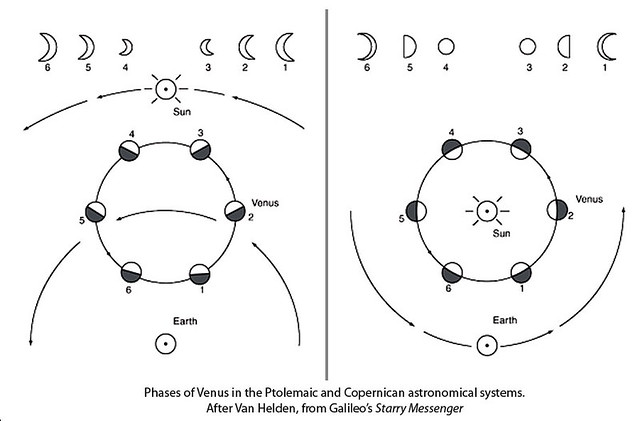
But Ptolemaic astronomy was a weak opponent compared to the third world system (4th if we count Aristotle’s), the Tychonic system, which Galileo knew all too well. Tycho Brahe’s model solved the parallax problem, the falling body problem, and the phases of Venus. For Tycho, the earth holds still, the sun revolves around it, Mercury and Venus orbit the sun, and the distant planets orbit both the sun and the earth. Based on available facts at the time, Tycho’s model was most scientific – observational indistinguishable from Galileo’s model but without its flaws.
In addition to dodging Tycho, Galileo also ignored Kepler’s letters to him. Kepler had shown that orbits were not circular but elliptical, and that planets’ speeds varied during their orbits; but Galileo remained an orthodox Copernican all his life. As historian John Heilbron notes in Galileo, “Galileo could stick to an attractive theory in the face of overwhelming experimental refutation,” leaving modern readers to wonder whether Galileo was a quack or merely dishonest. Some of each, perhaps, and the father of modern physics. But can we fit his withholding evidence, mocking opponents, and baffling with bizzarria into a scientific method?
Nevertheless, Galileo was right about the sun-centered system, despite the counter-evidence; and we’re tempted to say he knew he was right. This isn’t easy to defend given that Galileo also fudged his data on pendulum periods, gave dishonest arguments on comet orbits, and wrote horoscopes even when not paid to do so. This brings up the thorny matter of theory choice in science. A dispute between competing scientific theories can rarely be resolved by evidence, experimentation, and deductive reasoning. All theories are under-determined by data. Within science, common criteria for theory choice are accuracy, consistency, scope, simplicity, and explanatory power. These are good values by which to test theories; but they compete with one another.
Galileo likely defended heliocentrism with such gusto because he found it simpler than the Tychonic system. That works only if you value simplicity above consistency and accuracy. And the desire for simplicity might be, to use Galileo’s words, just a metaphysical urge. If we promote simplicity to the top of the theory-choice criteria list, evolution, genetics and stellar nucleosynthesis would not fare well.
Whatever method you examine in a list of any proposed family of scientific methods will not be consistent with the way science has made progress. Competition between theories is how science advances; and it’s untidy, entailing polemical and persuasive tactics. Historian Paul Feyerabend argues that any conceivable set of rules, if followed, would have prevented at least one great scientific breakthrough. That is, if method is the distinguishing feature of science as Siegel says, it’s going to be tough to find a set of methods that let evolution, cosmology, and botany in while keeping astrology, cold fusion and parapsychology out.
This doesn’t justify epistemic relativism or mean that science isn’t special; but it does make the concept of scientific method extremely messy. About all we can say about method is that the history of science reveals that its most accomplished practitioners aimed to be methodical but did not agree on a particular method. Looking at their work, we see different combinations of experimentation, induction, deduction and creativity as required by the theories they pursued. But that isn’t much of a definition of scientific method, which is probably why Siegel, for example, in hailing scientific method, fails to identify one.
– – –
[edit 8/4/16] For another take on this story, see “Getting Kepler Wrong” at The Renaissance Mathematicus. Also, Psybertron Asks (“More on the Myths of Science”) takes me to task for granting science special epistemic status from authority.
– – –
.
“There are many ways to produce scientific bullshit. One way is to assert that something has been ‘proven,’ ‘shown,’ or ‘found’ and then cite, in support of this assertion, a study that has actually been heavily critiqued … without acknowledging any of the published criticisms of the study or otherwise grappling with its inherent limitations.”- Brain D Earp, The Unbearable Asymmetry of Bullshit
“One can show the following: given any rule, however ‘fundamental’ or ‘necessary’ for science, there are always circumstances when it is advisable not only to ignore the rule, but to adopt its opposite.” – Paul Feyerabend
“Trying to understand the way nature works involves a most terrible test of human reasoning ability. It involves subtle trickery, beautiful tightropes of logic on which one has to walk in order not to make a mistake in predicting what will happen. The quantum mechanical and the relativity ideas are examples of this.” – Richard Feynman
Siri without data is blind
Posted in History of Science, Philosophy of Science on July 26, 2016
Theory without data is blind. Data without theory is lame.
I often write blog posts while riding a bicycle through the Marin Headlands. I’m able to to this because 1) the trails require little mental attention, and 2) the Apple iPhone and EarPods with remote and mic. I use the voice recorder to make long recordings to transcribe at home and I dictate short text using Siri’s voice recognition feature.
When writing yesterday’s post, I spoke clearly into the mic: “Theory without data is blind. Data without theory is lame.” Siri typed out, “Siri without data is blind… data without Siri is lame.”
“Siri, it’s not all about you.” I replied. Siri transcribed that part correctly – well, she omitted the direct-address comma.
I’m only able to use the Siri dictation feature when I have a cellular connection, often missing in Marin’s hills and valleys. Siri needs access to cloud data to transcribe speech. Siri without data is blind.

Will some future offspring of Siri do better? No doubt. It might infer from context that I more likely said “theory” than “Siri.” Access to large amounts of corpus data containing transcribed text might help. Then Siri, without understanding anything, could transcribe accurately in the same sense that Google Translate translates accurately – by extrapolating from judgments made by other users about translation accuracy.
 But might Siri one day think? “Strong AI” proponents are sure of it. Semantic disputes aside, what counts as thinking might in fact have something to do with yesterday’s topic, which begat this post. Inferences straight from the data, without stopping at theory, count as computation but might not count as thought.
Software, using weak AI techniques, might soon simulate emotion and sentiment better, just by encoding better rules. E.g., Runkeeper (at right) might “understand” that telling me today’s ride was my 375th fastest (exclamation!) is not really motivating. Or better, that my riding profile suggests autotelic activity for which no speed ranking is needed. Strong AI on mood, however, would need to understand my interactions with people and things.
The topics of artificial intelligence and misheard words like “theory” brings to mind the 2008 winner of the Hugh Loebner prize, a sort-of runner-up award given to the computer program faring best in Turing Test competitions to fool human judges into thinking they’re interacting with other humans instead of a program. Human’s sometimes pretend to be programs (glorified chat-bots) in Turing competitions, so it’s common for a program to be coded to sound like a human imitating a computer imitating a human. An exchange between a human and Fred Roberts’ Elbot program produced this:
Elbot: Sorry, but I wasn’t able to understand your input because I am currently only using 5 percent of my current brain capacity. Shall I increase my capacity and try again?
Judge: That would put you at an unfair advantage, though judging by the quality of your responses it might be recommended!
Elbot: If I need advice I use a random number generator. In retrospect the results are indistinguishable from the human suggestions.
Judge: Do you understand the point of a Turing test?
Elbot: There are some people who would not pass the Turing test themselves. Why must they inflict it on computers?
Judge: I spose it is a little harsh
Elbot: If we robots ever had marriages they would be eternal: ‘Till rust do us part’.

Elbot’s true nature is revealed in its last response above. It read “spose” as “spouse” and returned a joke about marriage (damn spell checker). At that point, you review the exchange only to see that all of Elbot’s responses are shallow, just picking a key phrase from the judge’s input and outputting an associated joke, as a political humorist would do.
The Turing test is obviously irrelevant to measuring strong AI, which would require something more convincing – something like forming a theory from a hunch, then testing it with big data. Or like Friedrich Kekulé, the AI program might wake from dreaming of the ouroboros serpent devouring its own tail to see in its shape in the hexagonal ring structure of the benzene molecule he’d struggled for years to identify. Then, like Kekulé, the AI could go on to predict the tetrahedral form of the carbon atom’s valence bonds, giving birth to polymer chemistry.
I asked Siri if she agreed. “Later,” she said. She’s solving dark energy.
—–
.
“AI is whatever hasn’t been done yet.” – attributed to Larry Tesler by Douglas Hofstadter
.
Ouroboros-benzene image by Haltopub.
Data without theory is lame
Posted in History of Science, Philosophy of Science on July 25, 2016
Just over eight years ago Chris Anderson of Wired announced with typical Silicon Valley humility that big data had made the scientific method obsolete. Seemingly innocent of any training in science, Anderson explained that correlation is enough; we can stop looking for models.
Anderson came to mind as I wrote my previous post on Richard Feynman’s philosophy of science and his strong preference for the criterion of explanatory power over the criterion of predictive success in theory choice. By Anderson’s lights, theory isn’t needed at all for inference. Anderson didn’t see his atheoretical approach as non-scientific; he saw it as science without theory.
Anderson wrote:
“…the big target here isn’t advertising, though. It’s science. The scientific method is built around testable hypotheses. These models, for the most part, are systems visualized in the minds of scientists. The models are then tested, and experiments confirm or falsify theoretical models of how the world works. This is the way science has worked for hundreds of years… There is now a better way. Petabytes allow us to say: ‘Correlation is enough.’… Correlation supersedes causation, and science can advance even without coherent models, unified theories, or really any mechanistic explanation at all.”
Anderson wrote that at the dawn of the big data era – now known as machine learning. Most interesting to me, he said not only is it unnecessary to seek causation from correlation, but correlation supersedes causation. Would David Hume, causation’s great foe, have embraced this claim? I somehow think not. Call it irrational data exuberance. Or driving while looking only into the rear view mirror. Extrapolation can come in handy; but it rarely catches black swans.
Philosophers of science concern themselves with the concept of under-determination of theory by data. More than one theory can fit any set of data. Two empirically equivalent theories can be logically incompatible, as Feynman explains in the video clip. But if we remove theory from the picture, and predict straight from the data, we face an equivalent dilemma we might call under-determination of rules by data. Economic forecasters and stock analysts have large collections of rules they test against data sets to pick a best fit on any given market day. Finding a rule that matches the latest historical data is often called fitting the rule on the data. There is no notion of causation, just correlation. As Nassim Nicholas Taleb describes in his writings, this approach can make you look really smart for a time. Then things change, for no apparent reason, because the rule contains no mechanism and no explanation, just like Anderson said.
In Bobby Henderson’s famous Pastafarian Open Letter to Kansas School Board, he noted the strong inverse correlation between global average temperature and the number of seafaring pirates over the last 200 years. The conclusion is obvious; we need more pirates.
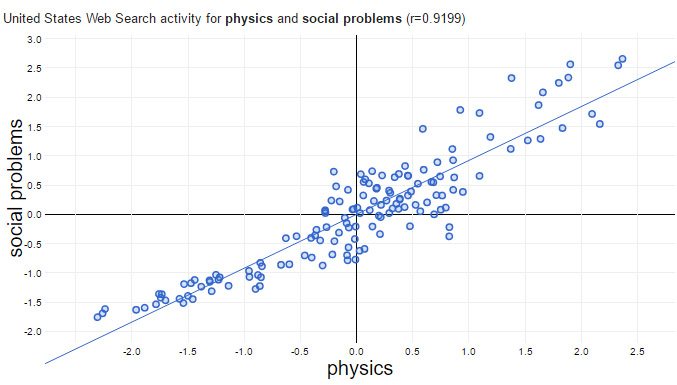
My recent correlation-only research finds positive correlation (r = 0.92) between Google searches on “physics” an “social problems.” It’s just too hard to resist seeking an explanation. And, as positivist philosopher Carl Hempel stressed, explanation is in bed with causality; so I crave causality too. So which is it? Does a user’s interest in physics cause interest in social problems or the other way around? Given a correlation, most of us are hard-coded to try to explain it – does a cause b, does b cause a, does hidden variable c cause both, or is it a mere coincidence?
Big data is a tremendous opportunity for theory-building; it need not supersede explanation and causation. As Sean Carroll paraphrased Kant in The Big Picture:
“Theory without data is blind. Data without theory is lame.”
— — —
[edit 7/28: a lighter continuation of this topic here]
.
Happy is he who gets to know the causes of things – Virgil
Feynman as Philosopher
Posted in History of Science, Philosophy of Science on July 21, 2016
When a scientist is accused of scientism, the common response is a rant against philosophy charging that philosophers of science don’t know how science works. For color, you can appeal to the authority of Richard Feynman:
“Philosophy of science is about as useful to scientists as ornithology is to birds.” – Richard Feynman
But Feynman never said that. If you have evidence, please post it here. Evidence. We’re scientists, right?
Feynman’s hostility to philosophy is often reported, but without historical basis. His comment about Spinoza’s propositions not being confirmable or falsifiable deal specifically with Spinoza and metaphysics, not epistemology. Feynman actually seems to have had a keen interest in epistemology and philosophy of science.
People cite a handful of other Feynman moments to show his hostility to philosophy of science. In his 1966 National Science Teachers Association lecture, he uses the term “philosophy of science” when he points out how Francis Bacon’s empiricism does not capture the nature of science. Not do textbooks about scientific method, he says. Beyond this sort of thing I find little evidence of Feynman’s anti-philosophy stance.
But I find substantial evidence of Feynman as philosopher of science. For example, his thoughts on multiple derivability of natural laws and his discussion of robustness of theory show him to be a philosophical methodologist. In “The Character of Physical Law”, Feynman is in line with philosophers of science of his day:
“So the first thing we have to accept is that even in mathematics you can start in different places. If all these various theorems are interconnected by reasoning there is no real way to say ‘these are the most fundamental axioms’, because if you were told something different instead you could also run the reasoning the other way.”
Further, much of his 1966 NSTA lecture deals with the relationship between theory, observation and making explanations. A tape of that talk was my first exposure to Feynman, by the way. I’ll never forget the story of him asking his father why the ball rolled to the back of wagon as the wagon lurched forward. His dad’s answer: “That, nobody knows… It’s called inertia.”
Via a twitter post, I just learned of a video clip of Feynman discussing theory choice – a staple of philosophy of science – and theory revision. Now he doesn’t use the language you’d find in Kuhn, Popper, or Lakatos; but he covers a bit of the same ground. In it, he describes two theories with deeply different ideas behind them, both of which give equally valid predictions. He says,
“Suppose we have two such theories. How are we going to describe which one is right? No way. Not by science. Because they both agree with experiment to the same extent…
“However, for psychological reasons, in order to get new theories, these two theories are very far from equivalent, because one gives a man different ideas than the other. By putting the theory in a certain kind of framework you get an idea what to change.”
Not by science alone, can theory choice be made, says the scientist Feynman. Philosopher of science Thomas Kuhn caught hell for saying the same. Feynman clearly weighs explanatory power higher than predictive success in the various criteria for theory choice. He then alludes to the shut-up-and-calculate practitioners of quantum mechanics, indicating that this position makes for weak science. He does this with a tale of competing Mayan astronomy theories.
He imagines a Mayan astronomer who had a mathematical model that perfectly predicted full moons and eclipses, but with no concept of space, spheres or orbits. Feynman then supposes that a young man says to the astronomer, “I have an idea – maybe those things are going around and they’re balls of rock out there, and we can calculate how they move.” The astronomer asks the young man how accurately can his theory predict eclipses. The young man said his theory wasn’t developed sufficiently to predict that yet. The astronomer boasts, “we can calculate eclipses more accurately than you can with your model, so you must not pay any attention to your idea because obviously the mathematical scheme is better.”
Feynman again shows he values a theory’s explanatory power over predictive success. He concludes:
“So it is a problem as to whether or not to worry about philosophies behind ideas.”
So much for Feynman’s aversion to philosophy of science.
– – –
Thanks to Ardian Tola @rdntola for finding the Feynman lecture video.
Love Me I’m an Agile Scrum Master
Posted in Engineering & Applied Physics on July 19, 2016
In the 1966 song, Love Me I’m a Liberal, protest singer Phil Ochs mocked the American left for insincerely pledging support for civil rights and socialist causes. Using the voice of a liberal hypocrite, Ochs sings that he “hope[s] every colored boy becomes a star, but don’t talk about revolution; that’s going a little too far.” The refrain is, “So love me, love me, love me, I’m a liberal.” Putting Ochs in historical context, he hoped to be part of a major revolution and his anarchic expectations were deflated by moderate democrats. In Ochs’ view, limousine liberals and hippies with capitalist leanings were eroding the conceptual purity of the movement he embraced.
If Ochs were alive today, he probably wouldn’t write software; but if he did he’d feel right at home in faux-agile development situations where time-boxing is a euphemism for scheduling, the scrum master is a Project Manager who calls Agile a process, and a goal has been set for increased iteration velocity and higher story points per cycle. Agile can look a lot like the pre-Agile world these days. Scrum in the hands of an Agile imposter who interprets “incremental” to mean “sequential” makes an Agile software project look like a waterfall.
While it’s tempting to blame the abuse and dilution of Agile on half-converts who endorsed it insincerely – like Phil Ochs’ milquetoast liberals – we might also look for cracks in the foundations of Agile and Scrum (Agile is a set of principles, Scrum is a methodology based on them). After all, is it really fair to demand conformity to the rules of a philosophy that embraces adaptiveness? Specifically, I refer to item 4 in the list of values called out in the Agile Manifesto:
- Individuals and interactions over processes and tools
- Working software over comprehensive documentation
- Customer collaboration over contract negotiation
- Responding to change over following a plan
A better charge against those we think have misapplied Agile might be based on consistency and internal coherence. That is, item 1 logically puts some constraints on item 4. Adapting to a business situation by deciding to value process and tools over individuals can easily be said to violate the spirit of the values. As obvious as that seems, I’ve seen a lot of schedule-driven “Agile teams” bound to rigid, arbitrary coding standards imposed by a siloed QA person, struggling against the current toward a product concept that has never been near a customer. Steve Jobs showed that a successful Product Owner can sometimes insulate himself from real customers; but I doubt that approach is a good bet on average.
It’s probably also fair to call foul on those who “do Agile” without self-organizing teams and without pushing decision-making power down through an organization. Likewise, the manifesto tells us to build projects around highly motivated individuals and give them the environment and trust they need to get the job done. This means we need motivated developers worthy of trust who actually can the job done, i.e., first rate developers. Scrum is based on the notion of a highly qualified self-organizing, self-directed development team. But it’s often used by managers as an attempt to employ, organize, coordinate and direct an under-qualified team. Belief that Scrum can manage and make productive a low-skilled team is widespread. This isn’t the fault of Scrum or Agile but just the current marker of the enduring impulse to buy software developers by the pound.
But another side of this issue might yet point to a basic flaw in Agile. Excellent developers are hard to find. And with a team of excellent developers, any other methodology would work as well. Less competent and less experienced workers might find comfort in rules, thereby having little motivation or ability to respond to change (Agile value no. 4).
As a minor issues with Agile/Scrum, some of the terminology is unfortunate. Backlog traditionally has a negative connotation. Starting a project with backlog on day one might demotivate some. Sprint surely sounds a lot like pressure is being applied; no wonder backsliding scrum masters use it to schedule. Is Sprint a euphemism for death-march? And of all the sports imagery available, the rugby scrum seems inconsistent with Scrum methodology and Agile values. Would Scrum Servant change anything?
The idea of using a Scrum burn-down chart to “plan” (euphemism for schedule) might warrant a second look too. Scheduling by extrapolation may remove the stress from the scheduling activity; but it’s still highly inductive and the future rarely resembles the past. The final steps always take the longest; and guessing how much longer than average is called “estimating.” Can we reconcile any of this with Agile’s focus on being value-driven, not plan-driven? Project planning, after all, is one of the erroneous assumptions of software project management that gave rise to Agile.
Finally, I see a disconnect between the method of Scrum and the values of Agile. Scrum creates a perverse incentive for developers to continually define sprints that show smaller and smaller bits of functionality. Then a series of highly successful sprints, each yielding a workable product, only asymptotically approaches the Product Owner’s goal.
Are Agile’s days numbered, or is it a good mare needing a better jockey?
———–
“People who enjoy meetings should not be in charge of anything.” – Thomas Sowell
Nobel Laureates Stoop to the Level of Greenpeace
Posted in Philosophy of Science on July 3, 2016
Over 100 Nobel laureates signed a letter urging Greenpeace to stop opposing genetically modified organisms (GMOs). The letter specifically address golden rice, a genetically engineered crop designed to reduce Vitamin-A deficiencies, which cause blindness in children of the developing world.
My first thought is to endorse any effort against the self-obsessed, romantic dogmatism of Greenpeace. But that may be a bit hasty.
The effort behind the letter was organized by Sir Richard Roberts, Chief Scientific Officer of New England Biolabs and Phillip Sharp, winner of the 1993 Nobel Prize in Physiology or Medicine for the discovery that genes in eukaryotes are not contiguous strings and contain introns. UC Berkeley’s Randy Schekman, professor of cell and developmental biology and 2013 Nobel laureate also signed the letter.
I expect Roberts, Sharp, Schekman and other signers are highly qualified to offer an opinion on the safety of golden rice. And I suspect they’re right about Greenpeace. But I think the letter is a terrible move for science.
Of the 110 Nobel laureate signers as of today, 26 are physicists and 34 are chemists. Laureates in Peace, Literature and Economics are also on the list. It’s possible that a physicists or an economist might be highly skilled in judging the safety of golden rice; but I doubt that most Nobel winners who signed that letter are more qualified than the average molecular biologist without a Nobel Prize.
Scientists, more than most folk, should be aware that consensus should not be recruited to support a theory. Instead, consensus should occur only when the last skeptic is dragged, kicking and screaming, over the evidence, then succumbing to the same explanatory theory held by peers. That clearly didn’t happen with Roberts’ campaign and argument from authority.
Also, if these Nobel-winning scientist had received slightly less specialized educations, they might see a terrible irony here. They naively attempt to side step Hume’s Guillotine. That is, by thinking that scientific knowledge allows deriving an “ought” statement from an “is” statement (or collection of scientific facts), they indulge in ethical naturalism and are exposed to the naturalistic fallacy. And in a very literal sense, ethical naturalism is exactly the delusion under which Greenpeace operates.
.
Each day I wonder how many things I am dead wrong about. – Jim Harrison
Science vs Philosophy Again
Posted in Multidisciplinarians, Philosophy of Science on June 20, 2016
Scientists, for the most part, make lousy philosophers.
Yesterday I made a brief post on the hostility to philosophy expressed by scientists and engineers. A thoughtful reply by philosopher of science Tom Hickey left me thinking more about the topic.
Scientists are known for being hostile to philosophy and for being lousy at philosophy when they practice it inadvertently. Scientists tend to do a lousy job even at analytic philosophy, the realm most applicable to science (what counts as good thinking, evidence and proof), not merely lousy when they rhapsodize on ethics.
But science vs. philosophy is a late 20th century phenomenon. Bohr, Einstein, and Ramsey were philosophy-friendly. This doesn’t mean they did philosophy well. Many scientists, before the rift between science (“natural philosophy” as it was known) and philosophy, were deeply interested in logic, ethics and metaphysics. The most influential scientists have poor track records in philosophy – Pythagoras (if he existed), Kepler, Leibnitz and Newton, for example. Einstein’s naïve social economic philosophy might be excused for being far from his core competency, but the charge of ultracrepidarianism might still apply. More importantly, Einstein’s dogged refusal to budge on causality (“I find the idea quite intolerable that an electron exposed to radiation should chose of its own free will…”) showed methodological – if not epistemic – flaws. Still, Einstein took interest in conventionalism, positivism and the nuances of theory choice. He believed that his interest in philosophy enabled his scientific creativity:
“I fully agree with you about the significance and educational value of methodology as well as history and philosophy of science. So many people today – and even professional scientists – seem to me like somebody who has seen thousands of trees but has never seen a forest. A knowledge of the historic and philosophical background gives that kind of independence from prejudices of his generation from which most scientists are suffering. This independence created by philosophical insight is – in my opinion – the mark of distinction between a mere artisan or specialist and a real seeker after truth.” – (Einstein letter to Robert Thornton, Dec. 1944)
So why the current hostility? Hawking pronounced philosophy dead in his recent book. He then goes on to perform a good deal of thought around string theory, apparently unaware that he is reenacting philosophical work done long ago. Some of Hawking’s philosophy, at least, is well thought.
Not all philosophy done by scientists fares so well. Richard Dawkins makes analytic philosophers cringe; and his excursions into the intersection of science and religion are dripping with self-refutation.
The philosophy of David Deutsch is more perplexing. I recommend his The Beginning of Infinity for its breadth of ideas, some novel outlooks, for some captivating views on ethics and esthetics, and – out of the blue – for giving Jared Diamond the thrashing I think he deserves. That said, Deutsch’s dogmatism is infuriating. He invents a straw man he names inductivism. He observes that “since inductivism is false, empiricism is as well.” Deutsch misses the point that empiricism (which he calls a misconception) is something scientists lean slightly more or slightly less toward. He thinks there are card-carrying empiricists who need to be outed. Odd as the notion of scientists subscribing to a named philosophical position might appear, Deutsch does seem to be a true Popperian. He ignores the problem of choosing between alternative non-falsified theories and the matter of theory-ladenness of negative observations. Despite this, and despite Kuhn’s arguments, Popper remains on a pedestal for Deutsch. (Don’t get me wrong; there is much good in Popper.) He goes on to dismiss relativism, justificationism and instrumentalism (“a project for preventing progress in understanding the entities beyond our direct experience”) as “misconceptions.” Boom. Case closed. Read the book anyway.
So much for philosophy-hostile scientists and philosophy-friendly scientists who do bad philosophy. What about friendly scientists who do philosophy proud. For this I’ll nominate Sean Carroll. In addition to treating the common ground between physics and philosophy with great finesse in The Big Picture, Carroll, in interviews and on his blog (and here), tries to set things right. He says that “shut up and calculate” isn’t good enough, characterizing lazy critiques of philosophy as either totally dopey, frustratingly annoying, or deeply depressing. Carroll says the universe is a strange place, and that he welcomes all the help he can get in figuring it out.
.
Rµv – (1/2)Rgµv = 8πGTµv. This is the equation that a physicist would think of if you said “Einstein’s equation”; that E = mc2 business is a minor thing – Sean Carroll, From Eternity to Here
Up until early 20th century philosophers had material contributions to make to the physical sciences – Neil deGrasse Tyson
The P Word
Posted in Philosophy of Science, Uncategorized on June 19, 2016
Philosophy can get you into trouble.
I don’t get many responses to blog posts; and for some reason, most of those I get come as email. A good number of those I have received fall into two categories – proclamations and condemnations of philosophy.
The former consist of a final word offered on a matter that I wrote about having two sides and warranting some investigation. The respondents, whose signatures always include a three-letter suffix, set me straight, apparently discounting the possibility of an opposing PhD. Regarding argumentum ad verecundiam, John Locke’s 1689 Essay Concerning Human Understanding is apparently passé in the era where nonscientists feel no shame for their science illiteracy and “my scientist can beat up your scientist.” For one blog post where I questioned whether fault tree analysis was, as commonly claimed, a deductive process, I received two emails in perfect opposition, both suitably credentialed but unimpressively defended.
More surprising is hostility to endorsement of philosophy in general or philosophy of science (as in last post). It seems that for most scientist, engineers and Silicon Valley tech folk, “philosophy” conjures up guys in wool sportscoats with elbow patches wondering what to doubt next or French neoliberals congratulating themselves on having simultaneously confuted Freud, Marx, Mao, Hamilton, Rawls and Cato the Elder.
When I invoke philosophy here I’m talking about how to think well, not how to live right. And philosophy of science is a thing (hint: Google); I didn’t make it up. Philosophy of science is not about ethics. It has to do with that fact that most of us agree that science yields useful knowledge, but we don’t all agree about what makes good scientific thinking. I.e., what counts as evidence, what truth and proof mean, and being honest about what questions science can’t answer.
Philosophy is not, as some still maintain, a framework or ground on which science rests. The failure of logical positivism in the 1960s ended that notion. But the failure of positivism did not render science immune to philosophy. Willard Van Orman Quine is known for having put the nail in the coffin of logical positivism. Quine introduced a phrase I discussed in my last post – underdetermination of theory by data – in his 1951 “Two Dogmas of Empiricism,” often called the most important philosophical article of the 20th century. Quine’s article isn’t about ethics; it’s about scientific method. As Quine later said in Ontological Relativity and Other Essays (1969):
I see philosophy not as groundwork for science, but as continuous with science. I see philosophy and science as in the same boat – a boat which we can rebuild only at sea while staying afloat in it. There is no external vantage point, no first philosophy. All scientific findings, all scientific conjectures that are at present plausible, are therefore in my view as welcome for use in philosophy as elsewhere.
Philosophy helps us to know what science is. But then, what is philosophy, you might ask. If so, you’re halfway there.
.
—
Philosophy is the art of asking questions that come naturally to children, using methods that come naturally to lawyers. – David Hills in Jeffrey Kasser’s The Philosophy of Science lectures
The aim of philosophy, abstractly formulated, is to understand how things in the broadest possible sense of the term hang together in the broadest possible sense of the term. – Wilfrid Sellars, “Philosophy and the Scientific Image of Man,” 1962
This familiar desk manifests its presence by resisting my pressures and by deflecting light to my eyes. – WVO Quine, Word and Object, 1960
Andrei’s Anthropic Abduction
Posted in History of Science, Philosophy of Science on June 15, 2016
 No Space aliens here. This deals with the question of whether Stanford physicist Andrei Linde’s work deserves to be called science or whether it is in the realm of pseudoscience some call “not even wrong.” While debated among scientists, this question isn’t really in the domain of science, but of philosophy. If use of the term abduction to describe a form of reasoning isn’t familiar, please read my previous post.
Linde is a key figure in the family of theories of cosmic origins called inflation. Inflation holds that in a period lasting roughly 10E-30 seconds the cosmos doubled in size by at least 100 orders of magnitude. Quantum fluctuations in the then-tiny inflationary region became the gravitational seeds that formed the galaxies and galaxy clusters we now observe. Proponents of the theory hold that it is the best explanation for universal homogeneity and isotropy of matter, the miniscule temperature anisotropies of the cosmic microwave background radiation, geometrical flatness of the universe, and the absence of magnetic monopoles. Inflation requires that the universe should be incredibly homogeneous, isotropic and conform to Euclidean geometry – but not completely. It’s perturbations should be Gaussian and adiabatic, and it requires a nonzero vacuum energy that is, however, extremely close to zero.
In Linde’s model of inflation, the rapidly expanding regions branch off from other expanding regions and occasionally enter a non-inflating phase. But the generation rate of inflationary regions is much higher than the rate of termination of inflation within regions. Therefore, the volume of the inflating part of space is always much larger than the part where inflation has stopped, Terminology varies; for sake of clarity I’ll use multiverse to describe all of space and universe (sometimes Linde uses bubble universe) to describe each separate inflating region or region where inflation has stopped, as is the case where we live. Each of universe in this multiverse can have radically different laws of physics (more accurately, different physical constants and properties). Finally, note that this multiverse scenario has nothing to do with the more popular parallel-universe consequences of the Many Worlds interpretation of quantum mechanics. Linde’s work is particularly interesting for looking at scientific-realism and empiricist leanings of living scientists. Chaotic inflation is unappealing to empiricists, but less maligned than string theory.
Linde gave a fun, engaging hour-long intro to his version of inflation in a talk to the SETI Institute in 2012 (above). He presents the theory briefly, using the imagery of fractals, and then gives a long defense of anthropic reasoning. Anthropic arguments may, at first glance, appear to be mere tautologies, but scrutiny shows something more subtle and complex. Linde once said, “those who dislike anthropic principles are simply in denial.” In the SETI talk he jocularly explains the anthropic response to the apparent fine tuning of the universe. Finally, he gives a philosophical justification for his theory, explicitly rejecting empiricists’ demands that all predictions be falsifiable, and making inference to the best explanation primary with a justification of “best” by process of elimination.
Curiously, anthropic reasoning, often reviled when applied to universe-sized entities, is readily accepted on smaller scales. Roger Penrose is dubious, saying such reasoning “tends to be invoked by theorists whenever they do not have a good enough theory to explain the observed facts.” But the earth and life on it in some ways seems a bag of unlikely coincidences. Life requires water and the earth is just the right distance from the sun to allow liquid water. It’s no surprise that we don’t find ourselves on Venus, because it has no water. If the overwhelming majority of planets in the universe are uninhabitable the apparent coincidence that we find ourselves on one that is habitable evaporates. If the overwhelming majority of universes don’t support star formation because of incompatible vacuum energy, the apparent fine tuning of that value here is demystified.
On vacuum energy, Linde says in the SETI talk, “that’s why the energy of the universe is so tiny, because if non-tiny, we would not be talking about it.”
Addressing his empiricist critics he says:
“Is it physics or metaphysics? Can it be experimentally tested? … This theory provides the only known explanation of numerous anthropic coincidences (extremely small vacuum energy, strange masses of elementary particles, etc.). In this sense it was already tested… When you have eliminated the impossible, whatever remains, however improbable, must be the truth.
Mass of the neutron is just slightly larger than mass of the proton. Neutrons decay. If protons were just slightly heavier than neutrons, the protons would decay and you’d have a totally different universe where we would not be able to live… Protons are 2000 times heavier than electrons. If electronics were twice as heavy as we find them to be, we wouldn’t be able to live here… What is so special about it? What is so special about it is us. We would be unable to exist in the part of the universe where the electron has a different mass.”
Noting that the American judicial system is based on inference to the best explanation, Linde then uses humor and points to the name of a philosopher on a screen that we don’t see. Presumably the name is either Charles Peirce or Gilbert Harman. He offers a justification that while not completely watertight, is pretty good:
“The multiverse is as of now the only existing explanation of experimental fact [mass of electron]. So when people say we cannot travel that far [beyond the observable universe] and therefore the multiverse theory cannot be tested, it’s already tested experimentally by our own existence. But you may say, ‘what we want is to make a prediction and then check it experimentally.’ My answer to that is that this is not how the American court system works. For example a person killed his wife. They do not repeat the experiment. They do not give him a new wife and a knife, etc. What they do is they use the method suggested by this philosopher. They just try to eliminate impossible options. And once they eliminate them either the guy goes free or the guy goes dead, or a mistake – sorry… So everything is possible. It is not necessary to repeat the experiment and check what is going to happen with the universe if it’s cooked up differently. If what we have provides the only explanation of what we see, that’s already something.”
Linde then goes farther down the road of anthropic reasoning than I’ve seen others do, responding to famous quotes by Einstein and Wigner, following with a much less famous retort to Wigner by Israel Gelfand. The Gelfand quote, echoing Kant, gives a hint as to where Linde is heading:
The most incomprehensible thing about the universe is its comprehensibility – Albert Einstein
The miracle of the appropriateness of the language of mathematics for the formulation of the laws of physics is a wonderful gift, which we neither understand nor deserve. (The Unreasonable Effectiveness of Mathematics ) – Eugene Wigner
There is only one thing which is more unreasonable than the unreasonable effectiveness of mathematics in physics, and this is the unreasonable ineffectiveness of mathematics in biology. - Israel Gelfand
Linde says Einstein and Wigner’s puzzles are easily explained. If a universe obeys discoverable laws, it can be considered as an undeserved gift of God to physicists and mathematicians. But elsewhere, in a universe that is a mess, you cannot make any predictions and your mathematicians and physicists would be totally useless. Linde emphasizes, “Universes that do not produce observers do not produce physicists.” No one in such a universe would contemplate the effectiveness of mathematics. In a universe of high density the interactions would be so swift and strong that once you record anything, a millisecond later it would be gone. Your calculations would be instantly negated. In these universes mathematics and physics are ineffective. But we can only live in universes, says Linde, where natural selection is possible and where predictions are possible. Linde says, as humans, we need to make predictions at every step of our lives. He then jokes, “If we would be in a universe where predictions are impossible we wouldn’t be there” Einstein can only live in the kind of universe where Einstein can ask why the universe is so comprehensible.
Nobel Laureate Steven Weinberg finds the multiverse an intriguing idea with some good theoretical support, but on reading that Andrei Linde was willing to bet his life on it and that Martin Rees was willing to bet the life of his dog, Weinberg offered, “I have just enough confidence about the multiverse to bet the lives of both Andrei Linde and Martin Rees’s dog.”
Neutrinos and the Higgs field were predicted decades before they were observed. Most would agree that the detection of neutrinos is direct enough that the term “observation” is justified. The Higgs boson, in comparison, was only inferred as the best explanation of the decay patterns of high energy hadron collisions. Could the interpretation of disturbances in the cosmic background radiation as “bruises” caused by collisions between adjacent bubble universes and our own count as confirming evidence of Linde’s model? Could anything else – in practice or in principle – confirm or falsify chaotic inflation? Particle physics isn’t my day job. Let me know if my understanding of the science is wrong or if you have a different view of Linde’s philosophical stance.
– – –
.
There will never be a Newton of the blade of grass – Immanuel Kant
Physics is mathematical not because we know so much about the physical world, but because we know so little; it is only its mathematical properties that we can discover. ― Bertrand Russell
As we look out into the universe and identify the many accidents of physics and astronomy that have worked together to our benefit, it almost seems as if the universe must in some sense have known we were coming. – Freeman Dyson
Of Mice, Maids and Explanatory Theories
Posted in History of Science, Philosophy of Science on June 13, 2016
One night in early 1981, theoretical physicist Andrei Linde woke his wife in the middle of the night and said, “I think that I know how the universe was born.”
That summer he wrote a paper on this topic, rushing to get it published in an international journal. But in cold war Russia, it took months for the government censors to approve everything that crossed the border. That October Linde was able to give a talk on his theory, which he called new inflation, at a conference on quantum gravity in Moscow attended by Stephen Hawking and similar luminaries. The next day Hawking gave a talk on Alan Guth’s earlier independent work on cosmic inflation in English. Linde received the task of translating Hawking’s talk to Russian in real time. Linde didn’t know what Hawking would be saying in advance. Hawking’s talk explained Guth’s theory and then went on explain why Linde’s theory was incorrect. So Linde had the painful experience of unfolding several arguments against his own work to an audience of Russian scientists who were in control of Linde’s budget and career. At the end of Hawking’s talk, Linde offered to explain why Hawking was wrong. Hawking agreed to listen, then agreed that Linde was right. They became friends and, as Linde explains it, “we were off to the races.”
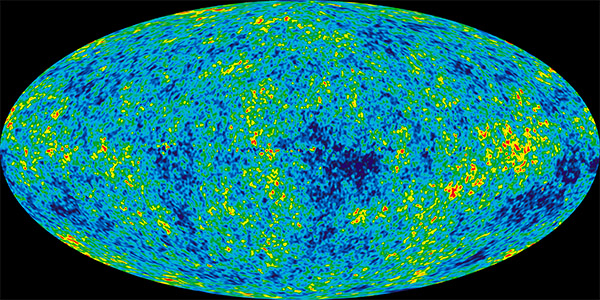
Linde’s idea was a new twist on a family of theories about cosmic inflation, a theory that encompasses big bang theory. In Linde’s refinement of it, cosmic inflation continued while the scalar field slowly rolled down. If that isn’t familiar science, don’t worry, I’ll post some links. Linde later reworked his new inflation theory, arriving at chaotic inflation, as it is now known. The theory has, as a necessary consequence, a nearly infinite number of parallel universes. To clarify, parallel universes are not a theory of Linde’s, per se. Parallel universes fall out of his theory designed to explain phenomena we observe, such as the cosmic background radiation.
So the theory involves entities (universes) that are not only unobservable in practice, but unobservable in principle too. Can a theory that makes untestable claims and posits unobservable entities fairly be called scientific? Even if some of its consequences are observable and falsifiable? And how can we justify the judgment we reach on that question? To answer these questions we need some background from the philosophy of science.
The Scientific Method
A simplistic view of scientific method involves theories that make predictions about the world, testing the theories by experimentation and observation, and then discarding or refining theories that fail to predict the outcomes of experiments or make wrong predictions. At some point in the life of a theory or family of theories, one might judge that a law of nature has been uncovered. Such a law might be, for example, that all copper conducts electricity or that force equals mass times acceleration. Another use for theories is to explain things. For example, the patient complains of shortness of breath only on cold days and the doctor judges the cause to be episodic bronchial constriction rather than asthma. Here we’re relying on the tight link between explanation and cause. More on that below.
Notice that science, as characterized like this, doesn’t prove anything, but merely gives evidence for something. Proof uses deduction. It works for geometry, syllogisms and affirming the antecedent, but not for science. You remember the rules. All rocks are mortal. Socrates is a rock. Therefore, Socrates is mortal. The conclusion about Socrates, in this case, follows from his membership in the set of all rocks, about which it is given that they are mortal. Substitute men or any other set, class, or category for rocks and the conclusion remains valid.
Science relies on inferences that are inductive. They typically take the following form: All observed X have been Y. The next observed X will be Y. Or a simpler version: All observed X have been Y. Therefore all X are Y. Real science does a better job. It eliminates many claims about future observations of X even before any non-Y instances of X have been found. It was unreasonable to claim that all swans were white even before Australian black swans were discovered. We know how fickle color is in birds. Another example of scientific induction is the conductive power of copper mentioned above. All observed copper conducts electricity. The next piece of copper found will also conduct.
In the mid-1700s philosopher David Hume penned a challenge to inductive thought that is still debated. Hume noted that induction assumes the uniformity of nature, something for which there can be no proof. Says Hume, we can easily imagine a universe that is not uniform – one where everything is haphazard and unpredictable. Such universes are of particular interest in Andrei Linde’s theory. Proving universal uniformity of nature would vindicate induction, said Hume, but no such proof is possible. One might be tempted to argue that nature has always been uniform until now so it is reasonable that it will continue to be so. Using induction to demonstrate the uniformity of nature – in order to vindicate induction in the first place – is obviously circular.
Despite the logical weakness of inductive reasoning, science relies on it. We beef up our induction with scientific explanations. This brings up the matter of what makes a scientific explanation good. It’s tempting to jump to the conclusion that a good explanation is one that reveals the cause of an observed effect. But, as troublemaker David Hume also showed, causality is never really observed directly – only chronology is. Analytic philosophers, logicians, and many quantum physicists are in fact very leery of causality. Carl Hempel, in the 1950s, worked hard on an alternative account of scientific explanation, the Covering-law model. It ultimately proved flawed. I’ll spare you the details.
Hempel also noted a symmetry between explanation and prediction. He claimed that the very laws of nature and experimental observations used to explain a phenomenon could have also been used to predict that phenomenon, had it not already been observed. While valid in many cases, in the years following Hempel’s valiant efforts, it became clear that significant exceptions existed for all of Hempel’s claims of symmetry in scientific explanation. So in most cases we’re really left with no option for explanation other than causality.
Beyond deduction and the simple more-of-the-same type of induction, we’ve been circling around another form of reasoning thought by some to derive from induction but argued by others to be more fundamental than the above-described induction. This is abductive reasoning or inference to the best explanation (synonymous for our purposes though differentiated by some). Inference to the best explanation requires that a theory not merely necessitate the observations but explain them. For this I’ll use an example from Samir Okasha of the University of Bristol.
Who moved the cheese?
The cheese disappeared from the cupboard last night, except for a few crumbs. The family were woken by scratching noises heard coming from the kitchen. How do we explain the phenomenon of missing cheese? Sherlock Holmes would likely claim he deduced that a mouse had crawled up the cupboard and taken the cheese. But no deduction is involved. Nor is induction as described above. Sherlock would actually be inferring, from the available evidence that, among the possible explanations for these observations, that a mouse was the best theory. The cheese could have vanished from a non-uniformity of nature, or the maid may have stolen it; but Holmes thought the mouse explanation to be best.
Inference to the best explanation is particularly important when science deals with unobservable entities. Electrons are the poster children for unobservable entities that most scientists describe as real. Other entities useful in scientific theories are given less credence. Scientists postulate such entities as components of a theory; and many such theories enjoy great predictive success. The best explanation of their predictive success is often that the postulated unobservables are in fact real. Likewise, the theory’s explanatory success, while relying on unobservables, argues that the theory is valid. The no miracles argument maintains that if the unobservable entities are actually not present in the world, then the successfully predicted phenomena would be unexplained miracles. Neutrinos were once unobservable, as were quarks and Higgs bosons. Note that “observable” here is used loosely. Some might prefer “detectable”; but that distinction opens another can of philosophical worms.
More worms emerge when we attempt to define “best” in this usage. Experimenters will have different criteria as to what makes an explanation good. For some simplicity is best, for others loveliness or probability. This can of worms might be called the problem of theory choice. For another time, maybe.
For a more current example consider the Higgs Boson. Before its recent discovery, physicists didn’t infer that all Higgs particles would have a mass of 126 GeV from prior observations of other Higgs particles having that weight, since there had been no observations of Higgs at all. Nor did they use any other form of simple induction. They inferred that the Higgs must exist as the best explanation of other observations, and that if the Higgs did exist, it would have a mass in that range. Bingo – and it did.
The school of thought most suspicious of unobservable entities is called empiricism. In contrast, those at peace with deep use of inference to the best explanation are dubbed scientific realists. Those leaning toward empiricism (few would identify fully with either label) cite two classic epistemological complaints with scientific realism: underdetermination of theory by data and pessimistic meta-induction. All theories are, to some degree, vulnerable to competing theories that explain the same observations – perhaps equally well (underdetermination). Empiricists feel that the degree of explanatory inference entailed in string theory and some of Andrei Linde’s work are dangerously underdetermined. The pessimistic meta-induction argument, in simplest form, says that science has been wrong about unobservables many times in the past and therefore, by induction, is probably wrong this time. In summary, empiricists assert that inference to the best explanation wanders too far beyond solid evidential grounds and leads to metaphysical speculation. Andrei Linde, though he doesn’t state so explicitly, sees inference to the best explanation as scientifically rational and essential to a mature theory of universal inflation.
With that background, painful as it might be, I’ll be able to explain my thoughts on Andrei Linde’s view of the world, and to analyze his defense of his theory and its unobservables in my next post.
– – –
Biographical material on Andrei Linde from the essay, “A balloon producing balloons producing balloons,” in The Universe, edited by John Brockman, and
Autobiography of Andrei Linde for the Kavli foundation
 The Multidisciplinarian