Bill Storage

This user hasn't shared any biographical information
Concrete Screws in Cave Exploration
Posted in Engineering & Applied Physics on June 18, 2025
This hastily assembled piece expresses concerns over the use of concrete screws in caving. It stems from a discussion with Max Elfelt last night. Two aspects of screw use underground interact adversely: 1) screws rely on rock tensile strength while wedge bolts rely on compressive strength, and 2) the uncharacteristically large difference between tensile and compressive strength in cave-forming limestone, particularly oolitic types. Combined, they raise significant concerns. Comments are welcome, either below or privately. Find me in the NSS directory, on X, or LinkedIn.
Cave exploration demands absolute trust in permanent rigging for pits, climbs, and traverses where falls could be fatal. Anchors, the critical connection points securing ropes to cave walls, must withstand the forces of climbers, falls, and environmental wear. While concrete screws have gained attention in some climbing communities for their ease of installation, their use as permanent or semi-permanent rigging in caves and in any cases where axial loads (pullout forces along the anchor’s axis) are possible may pose unacceptable risks.
Unlike wedge bolts, which rely on the rock’s compressive strength to create a secure grip, concrete screws depend heavily on the rock’s tensile and shear strength, properties that appear, on the basis of reported mechanical properties, to be inadequate for safe use of screws in cave-forming limestones, particularly oolitic and anisotropic varieties (those having different properties in different directions, typically caused by depositional discontinuities – bedding planes – or cemented planar fractures). A quick look at the mechanical differences between these materials reveals grounds for concern – possibly grave concern.
The Mechanics of Anchors: Wedge Bolts vs. Concrete Screws
Wedge bolts work by inserting a bolt into a drilled hole, then tightening it (torquing the nut) to push a cone-shaped wedge against the sides of the drilled hole. This action generates a high clamping force called preload. Preload allows the bolt to resist axial loads without any further movement of the bolt in the hole when even large loads are applied to the hanger. The preload is verifiable during installation: if torque is felt by hand or measured with a wrench (27 Nm or 20 foot pounds for 10 mm or 3/8 inch anchors), the rock is compressing adequately, the needed friction has been generated, and the desired preload exists. The physics and mechanics of wedge bolts ensures that applied axial or perpendicular loads, if they are less than the amount of axial preload (several thousand pounds, or greater than 10KN), do not alter the stress states of the installed bolt or the adjacent rock at all. The mechanics of wedge bolts and how they are misunderstood by climbers appears in a paper by Amy Skowronski and me in the Oct 2024 Journal of Search and Rescue.
Concrete screws, in contrast, operate somewhat like screws in wood. However, this analogy has serious limitations, discussed below. Concrete screws are threaded directly into a pre-drilled hole, cutting or crushing threads into the rock. Unlike wedge bolts, preload is not a significant factor of the gripping mechanics. Their resistance to axial loads depends on the mechanical interlock between threads and rock. When a caver applies force – either axial or perpendicular loading – the threads bear against the rock, inducing shear stress as threads resist sliding. Applied axial loads, if present, induce tensile stress as the rock resists radial pulling apart. This makes the rock’s tensile and shear strengths critical, as failure at the thread-rock interface will result in pullout. Cyclic loading – each time a load is added and removed during descending, ascending, or falling – causes wear, micro-fractures, and grain dislodgement. This increases the induced stresses by reducing the size of the surfaces under shear and tensile stress. Use of concrete screws in climbing is discussed in The Bolting Bible, about which I express several concerns below.
Material Mechanical Properties: Concrete vs. Limestone
The suitability of bolts and screw anchors hinges critically on the rock’s mechanical properties. The limestone that forms most caves has highly variable strength, unlike concrete, which is engineered for consistency. More critically, the relationship between compressive strength and tensile strength is predictable in concrete, but less so in limestone. Below are comparisons of compressive and tensile strengths, focusing on cave-relevant limestones, particularly oolitic and anisotropic types.
| Property | Structural Concrete | Oolitic Limestone | Anisotropic Limestone |
|---|
| Compressive Strength | 20–200 MPa | 20–60 MPa (varies with porosity and cementation) | ~20–180 MPa (depending on bedding and orientation) |
| Tensile Strength (Direct) | 2–5 MPa | ~0.5–4 MPa | Highly variable: ~0.5–6 MPa depending on bedding details |
| Modulus of Rupture | 3–7 MPa | ~0.5–5 MPa | ~0.5–12 MPa |
| Anisotropy | Highly isotropic | Weakly anisotropic | Strongly anisotropic (bedding planes matter greatly) |
| Failure Mode in Tension | Brittle fracture | Grain-boundary separation | Splitting along bedding or delamination |
| Elastic Modulus (Young’s) | 25–50 GPa (typical NSC) | ~5–30 GPa | ~10–50 GPa, highly dependent on direction |
* Granite, for comparison, often has a compressive strength of 100–200 MPa and a tensile strength of ~7–20 MPa. Tensile strength measurements are from splitting (ASTM C496) and flexure (ASTM C78) tests. Low-tensile oolite strength values from Ippolito (1975), Szechy (1966), and Paronuzzi (2009).
Why Concrete Screws in Caves Might Be Riskier than We Think
The disparity between compressive and tensile strengths in limestone, particularly oolitic and anisotropic types, is large. Wedge bolts rely on limestone’s compressive strength (20 MPa or greater), which is sufficient to develop preload in typical cave limestones. The preload reduces reliance on the rock’s tensile/shear strength and eliminates cyclic wear concerns for expected loads.
Concrete screws depend on limestone’s tensile and shear strength, not its compressive strength) to resist axial loads. Stresses induced by cavers’ weight or falls (e.g., 5–15 kN, translating to 1–3 MPa at the thread interface, depending on thread geometry – see sample calculations at the bottom of this post) are dangerously close to (and possibly exceed in cases) the tensile strengths of the limestone in which they are placed. In some oolitic limestone, the weak matrix fails under thread stresses, causing grain dislodgement or micro-fractures, especially under cyclic loading, though specific performance data in cyclic loading in material like oolitic limestone is lacking. Unlike wedge bolts, where preload is confirmed at installation, concrete screws offer no such assurance, and their performance necessarily degrades over time because each each load application results in fretting fatigue. Common caving field-tests for limestone compressive strength (e.g., the ring of a hammer blow) are unlikely to reliably predict tensile strength, particularly when the tensile strength of the matrix is low compared to that of the grains (clasts), as is the case with many oolitic limestones.
This disparity arises because both hard and soft rocks can undergo brittle fracture and are prone to tensile failure under localized stresses, whereas they resist compression better, due to grain-to-grain contact even after the matrix yields. In oolitic limestone, the rock consists of hard, spherical grains (ooids) cemented by a softer matrix (e.g., calcite). The matrix’s tensile and shear strengths are significantly lower than the bulk compressive strength, which is dominated by the hard grains. When a concrete screw is installed, its threads cut or crush into the matrix, and under axial load, the matrix must resist shearing or tensile failure. If the matrix is weak (e.g., porous or amorphous cement), the threads can dislodge grains by fracturing the matrix, reducing pullout strength over time, especially under cyclic loading. Manufacturers like Simpson Strong-Tie (Titen HD screws) report pullout strengths of 42–52 kN in hard limestone and concrete, but these assume isotropic substrates, not cave limestones with weak matrices or bedding planes.
Another consideration gives rise to even greater concern regarding placement in oolitic limestones, particularly those with large ooids. ASTM C496 tensile strength tests seem likely to overestimate oolitic limestone’s tensile strength for predicting concrete screw pullout. Overestimation of tensile strength for the screw scenario is likely because of the large size of the test specimen (152 mm, 6 inches), the test’s bulk measurement (e.g., 2–5 MPa) versus the matrix’s lower tensile/shear strength (e.g., 1–3 MPa) and the size of ooids compared to that of the threads (1–2 mm threads and .25–1 mm ooids). The test’s homogenized results probably don’t capture localized matrix failure adjacent to threads.
Cause for Concern in the Common Caving Use Case
Our discussions with cavers who use concrete screws suggest that they are used only for aid climbs (temporary placement) and only where the nominal applied load is not axial, i.e., they use horizontal screws with vertical applied loads. This, in theory, would eliminate concerns about the low tensile strength of certain limestones. One part of the allure of concrete screws is that no hammer or wrench is needed for installation. If hammer, wrench, and wedge anchors aren’t available at the top of a climb, screws then take on a role slightly more critical than their use on the climb itself. Many scenarios at the top of climbs entail a descent setup where some degree of axial loading is inevitable. All descents entail some degree of cyclic loading. Similarly, a fall when the climber is above a single bolt (first bolt placed only) in a climb will always result in significant axial loading.
Five factors combine to raise considerable concern for these and similar scenarios.
- The unusual relationship between compressive and tensile strength of common limestones.
- The absence of evidence for how many load cycles are needed to cause significant tensile yielding of the internal threads carved by screws
- The small margin between tensile strength (ultimate tensile stress) of certain limestones and normal working loads in use
- The lack of confirmation of a successful screw installation such as the resistance to torquing with wedge bolts
- Inability to assess tensile strength of the limestone by a means such as listening to the sound of a hammer blow
Intuitions about strength properties of common materials may further exacerbate the situation. Metals’ tensile strength is typically 80 or 90 percent of its compressive strength. In limestone, this ratio is 10 to 15%. In oolitic and anisotropic limestone, it can be below 5 percent.
Finally, the prominence of analyses of climbing gear – gear used on the surface – consisting mainly of dramatic measurement of ultimate strength may work against us. Pull-tests, while entertaining, are not particularly useful in evaluating the utility of any mechanical component. Cavers may face increased risk by extending conclusions drawn from non-representative test scenarios common on YouTube, for example.
This concludes the thrust of my concern about concrete screws in caves. I welcome comments and corrections. Below are sections on calculating expected pullout loads of screws, discussion of fatigue and fretting fatigue, and specific concerns on the discussion of concrete screws in the Bolting Bible. These are engineering/physics oriented, and the above concerns hold independent of the topics below. Stop here if you’re not drawn math, physics, or nit picking.
The Bolting Bible
The Bolting Bible offers much useful instruction and information on bolts and screws used in climbing. The article/chapter “The Book of Concrete Screws” by HowNOT2 aims to educate climbers about concrete screws as temporary or sometimes permanent anchors in rock climbing. While it provides practical insights and test data, it has, in my opinion, several shortcomings in terms of physics and engineering rigor. That rigor seems to me something that should be present in coverage of a relatively new technique, especially when any discussion of permanent rigging is present. The Bolting Bible explicitly disclaims scientific rigor but its comprehensiveness is understood by many to imply authority.
The article describes concrete screws as functioning “similarly to normal wood screws” where “threads bite into the sides of the hole.” The analogy may aid visual intuition, but it risks conflating fundamentally different material behaviors – elastic-plastic deformation in wood versus brittle fracture and micro-spalling in rock. It fails to explain how the threads interact with the rock substrate, particularly the stress concentrations at the thread-rock interface.
The article mentions that concrete screws are “not safe in soft rock” and can “strip the threads” in hard rock, but it provides no quantitative or mechanical reasoning. Hard and soft don’t adequately cover the variations in mechanical properties of rock to orient readers toward meaningful distinctions in substrate performance.
The article briefly notes that cyclic loading in soft rock can cause concrete screws to “lose grip” due to threads dislodging material. “Losing grip” is a casual phrase that erases the actual failure modes involved: local pulverization of rock around threads, progressive thread shearing, and fretting fatigue under micro-motion (see discussion of fatigue at bottom). The language reduces complex, cumulative damage to a vague sensation.
The article cites break tests (e.g., Simpson Strong-Tie Titen HD screws achieving 42–52 kN [9400–11700 pounds] before head shear. The head-shear test is meaningless to climbing or caving use cases and might create a false sense of safety margin. While empirical data is valuable, the absence of a theoretical framework (e.g., thread shear strength, rock compressive strength) limits the generalizability of the findings and utility of the conclusions.
The suggestion to “spit or squirt water,” though possibly derived from field experience, should be followed by some observed benefit with even a speculative mechanism: Does moisture reduce dust, increase thread cutting efficiency, or initiate micro-hydration in porous substrates? Without this, it reads as lore rather than low-tech science.
As is the case with most gear analyses that measure ultimate strength, the article’s focus on ultimate strength (e.g., head shear at high loads) misses the more relevant issue for climbers: long-term reliability under repeated sub-failure loads, particularly given the key difference in mechanism between wedge bolts, with which most cavers are familiar, and concrete screws, which have come onto the scene fairly recently.
The article emphasizes ease of installation and removal for temporary anchors but does not adequately address the ethical implications of leaving potentially compromised holes in rock, especially in public climbing areas. Drilling holes is a “permanent deformation to the rock,” as noted elsewhere in The Bolting Bible, yet the article does not discuss how concrete screw holes might affect future bolting. “Bolt-farm” problems of the past might shift to hole-farm problems.
An assoicated HowNot2 video mentions permanent rigging using screws, stating that the screws should be stainless steel. Stainless eliminates the problem of screw deterioration from corrosion. This is a distraction from the more relevant concern of hole degradation. The video mentions that repeated use has led to “spinners” without noting that if a screw spins, the threads it carved into the rock are completely compromised. If a screw spins, unlike the case with a wedge bolt, it has no resistance to pullout.
Expected Pullout Load in Low-Tensile Oolitic Limestone
To calculate the effective contact area of a 3/8-inch diameter, 3-inch long concrete screw in tension, we must estimate the area over which the threads engage the concrete and can transfer tensile load. This is not the same as the root cross-sectional area of the screw (which governs tensile failure of the screw itself); you’re asking about the interface area between the screw threads and the concrete, which governs pullout or bond failure.
Nominal Parameters
- Screw outer diameter: 3/8 inch = 0.375 in
- Length embedded in concrete: 3 inches
(Assuming full 3-inch embedment and no voids) - Thread type: typical concrete screw (e.g., Tapcon) with a coarse thread (approx. 7–8 threads per inch)
Basic Bond Area (Cylindrical Surface)
This is a simplification that treats the bond area as a cylinder with the mean thread diameter:
Total contact area = π ⋅ mean diameter ⋅ embedded length where:
mean diameter = (outer diameter – root diameter) / 2
For a 3/8″ 3-inch Tapcon-style screw:
Outer diameter ≈ 0.375 in.
Root diameter ≈ 0.275 in.
Mean diameter ≈ (0.375 + 0.275)/2 = 0.325 in
Therefore, total contact area ≈ π ⋅ 0.325 ⋅ 3 ≈ 3.06 sqin.
Thread Engagement Area
Threads only contact the concrete at the flank surfaces, not over the full cylindrical shell. Accounting for thread flank angle and spacing typically reduces effective contact area to 40–60% of the full cylindrical surface, depending on thread profile.
Assuming 50% effective contact: Contact area = 1.5 sqin.
Tensile strength of weak but not weakest oolitic limestone = 1MPa = 145 psi. Note that reports on limestone tensile tests indicate that strengths lower than 1MPa could be encountered in oolitic and anisotropic limestones. West Virginia’s Pickaway Limestone comes to mind.
Expected pullout load in limestone having 1MPa (145 psi) tensile strength = 150 psi ⋅ 1.5 sqin = 225 pounds (or 112 pounds for 0.5 MPa tensile limestone)
Fatigue
The term fatigue, as used in engineering, has specific technical meanings that might differ from how it is used casually in discussing gear. The most general use describes gradual reduction in strength after many cycles (typically 10,000 to 1 million cycles) of stress application where the applied stress involves superficially elastic deformation (as opposed to plastic deformation in which measurable yielding of material occurs).
Low cycle fatigue in metals describes strength reduction from cyclic loading up to about 10,000 cycles where measurable plastic (doesn’t bounce back) deformation occurs.
Both high and low-cycle fatigue in metals happen when, at the microscopic level, even when the macroscopic stress is elastic, dislocations move within favorably oriented grains of the crystalline metal. 304 stainless steel typically has an ASTM grain size number of 5 to 10, corresponding to grain diameters of about 15 to 65 microns. Repeated dislocation during cyclic loading can form persistent slip bands, which are localized zones of plastic deformation that can eventually break through the surface. These act as initiation sites for fatigue cracks.
Localized plastic deformation around slip bands creates intrusions and extrusions on the surface. Over thousands to millions of cycles, these become tiny microcracks, usually less than a grain diameter long. Initially, crack growth follows crystallographic planes (especially {111} slip planes in body-centered cubic or face-centered cubic structures – for those who are into crystals). This is called Stage I (shear-mode) propagation.
Once a crack crosses a few grains, it becomes long enough to be governed by stress intensity rather than just local slip. The crack then grows perpendicular to the maximum principal stress (Stage II, or tensile-mode crack growth). When the crack becomes long enough that the remaining material cross-section can’t support the applied load, sudden ductile or brittle fracture occurs, depending on material properties (particularly its toughness) and loading rate.
From this description, you can see that fatigue is unlikely to be a failure mode in either wedge bolts or concrete screws as used in caves or in rock climbing (in contrast to what is stated in climbing literature here and here); the applied loads are too small and the number of cycles is too low.
Above I used the term fretting fatigue to describe rock wear along the threads carved into the rock by a concrete screw. I want to be careful in using a term possibly in a non-standard way. This is a very different use of the general term fatigue in mechanics. Here I refer to a form of fatigue failure that occurs when a component (rock in this case, not the screw) experiences both cyclic loading and simultaneous small-amplitude oscillatory motion (microslip) at the contact surface with another component (the screw). This microscale rubbing involves very high contact forces and greatly reduces component life – to a degree that the term fatigue does not apply like it does in the cyclic loading of metal. Fretting fatigue usually describes a condition found at bolted joints, riveted connections, spline shafts, blade roots, or where two components are clamped but subjected to vibration or relative motion.
Render Unto Caesar His Complexion
Posted in History of Art on June 14, 2025
Imago Imperatoris
The ancient sources – Cassius Dio, Suetonius, and Tacitus – provide limited, unreliable details about Emperor Caligula’s (Gaius Julius Caesar Augustus Germanicus) physical appearance, as they wrote decades after his death and relied on secondhand accounts, often colored by political bias or sensationalism. Despite their limitations, these sources, combined with archaeological evidence and historical context, offer some clues about Caligula’s hair and eye color, though any conclusions remain speculative.
Suetonius, in his Life of Caligula (Chapter 50), describes Caligula as tall, pale, with a hairy body but thinning hair on his head, and notes he was sensitive about his baldness. He does not explicitly mention hair or eye color. Cassius Dio and Tacitus also lack specific references to these traits, focusing more on Caligula’s actions and reputation. The absence of direct descriptions forces us to consider secondary evidence and the broader context of Roman aristocratic genetics.
Archaeological evidence, such as busts and statues of Caligula, provides some insight. Surviving sculptures, like the one in the Ny Carlsberg Glyptotek in Copenhagen, depict him with short, wavy hair, typical of Roman portraiture, but these are marble and unpainted, so they reveal nothing about color. However, Roman statues were often painted, and trace pigments on other contemporary busts suggest that elite Romans were typically shown with dark hair – brown or black – to align with idealized Roman features. Eye color is harder to infer from statues, as even painted ones rarely preserve such details.
Genetically, Caligula came from the Julio-Claudian dynasty, a mix of Roman aristocratic families with likely Italic ancestry. Roman elites, based on descriptions of other figures and surviving frescoes (e.g., from Pompeii), often had dark hair, ranging from brown to black, though lighter shades like blonde or reddish hair were not unknown, especially in northern Italy or among those with mixed ancestry. For example, Nero, a later Julio-Claudian, was described by Suetonius as having light blonde or reddish hair (Life of Nero, Chapter 51). Caligula’s mother, Agrippina the Elder, and father, Germanicus, have no clear descriptions of hair or eye color, but Germanicus’ family ties to northern provinces might suggest a chance of lighter traits. Eye color in Roman populations likely varied, with brown being most common, but blue or green possible, especially in families with connections to northern regions.
Given the lack of definitive evidence, we can make an educated guess based on probabilities: Caligula likely had dark brown or black hair, consistent with Roman elite portraiture and the general Italic population, though a lighter shade (e.g., light brown) is also possible given his lineage. His eye color was probably brown, the most common in the region, but blue or green can’t be ruled out due to potential northern European ancestry via Germanicus.
Ultimately, without contemporary records or preserved organic material (e.g., a lock of hair or detailed colored portrait), any guess about Caligula’s hair and eye color remains speculative, grounded only in the limited context of Roman art, genetics, and the unreliable anecdotes of ancient historians.
I digitally painted three versions of the marble Caligula portrait at the Metropolitan Museum of Art, inv 14.37. See whatcha think:
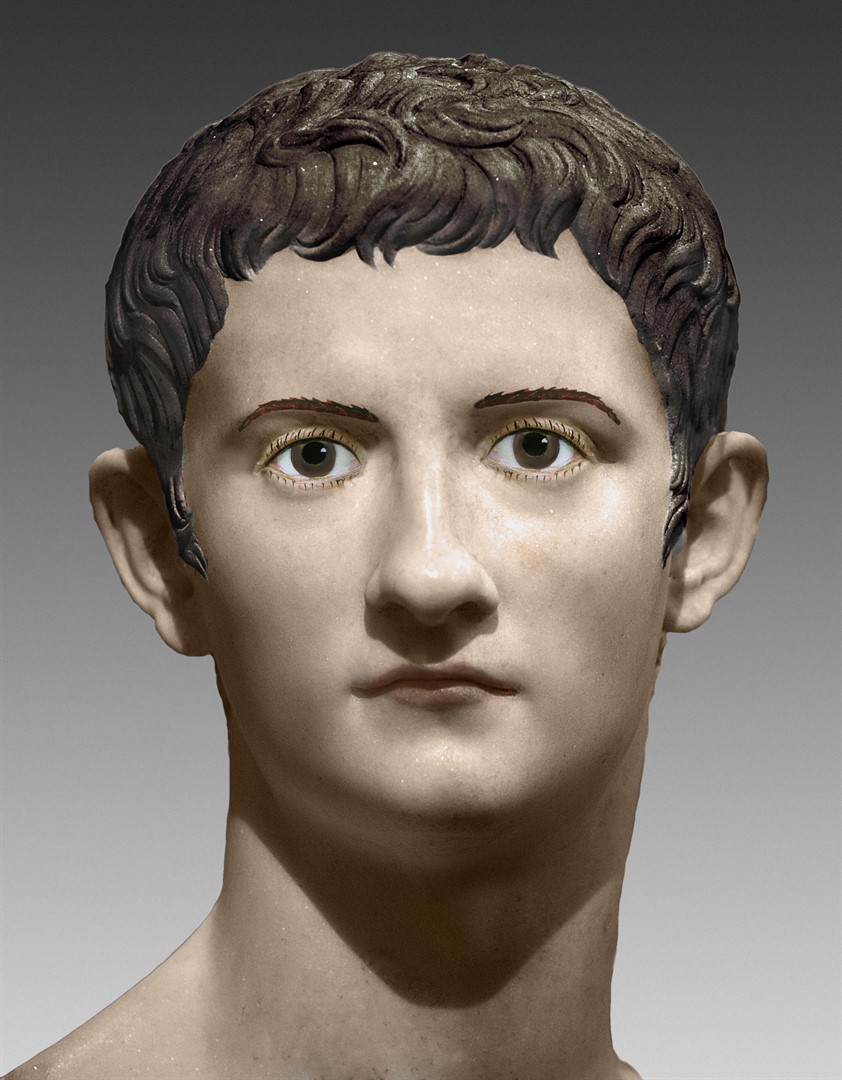
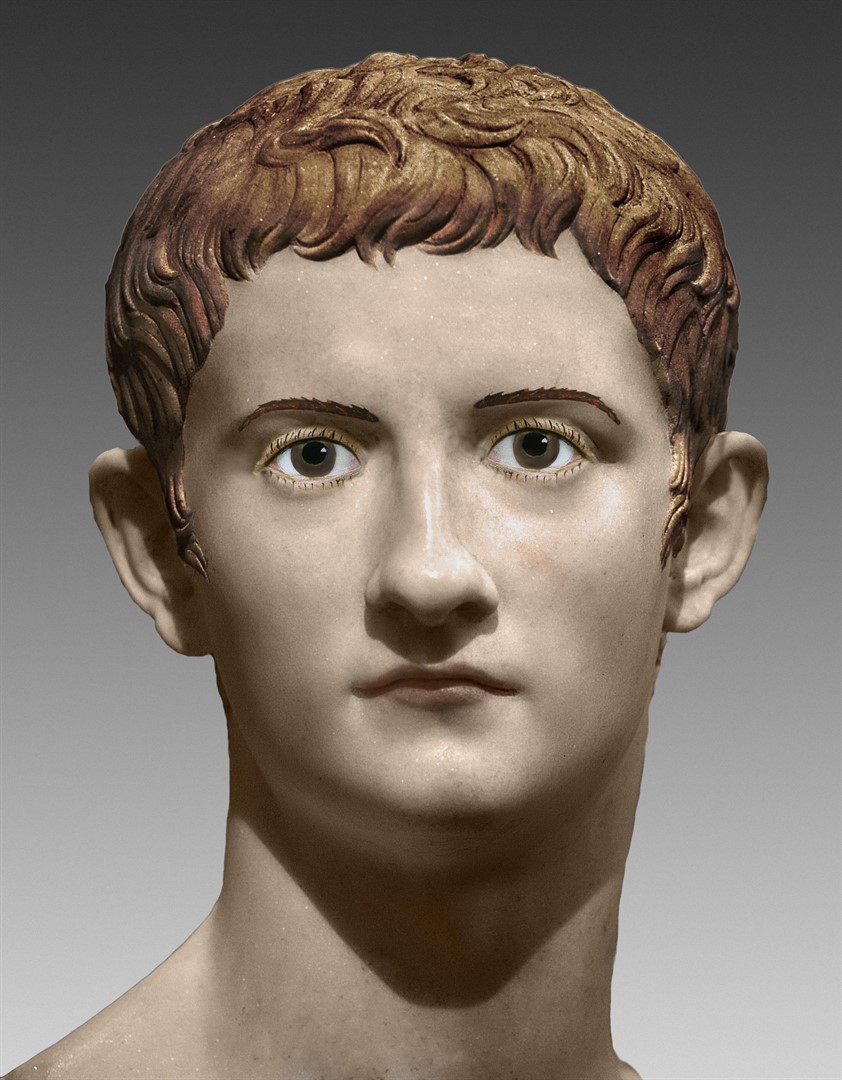
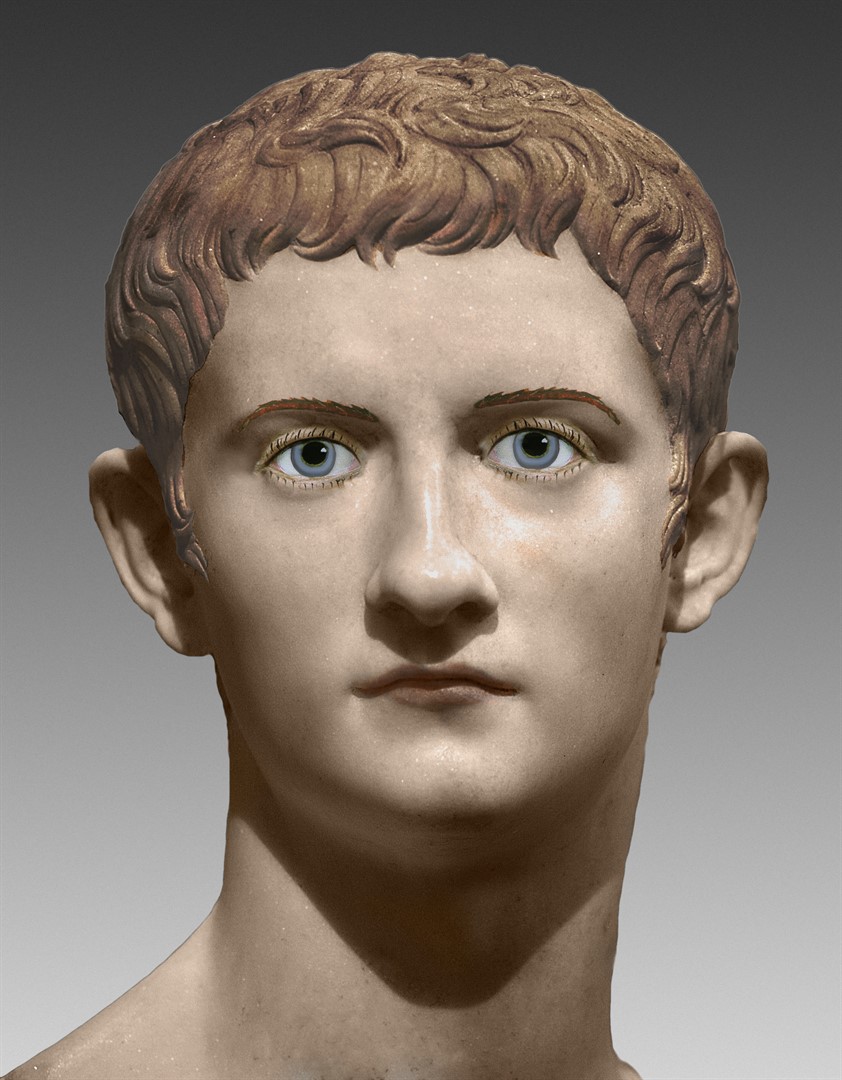
For many more photos of Caligula portraits, visit my Caligula page.
Keywords: ancient, marble, portraiture, Roman, Rome, imperial, iconography, physiognomy, princeps
After the Applause: Heilbron Rereads Feyerabend
Posted in History of Science, Philosophy of Science on June 4, 2025
A decade ago, in a Science, Technology and Society (STS) roundtable, I brought up Paul Feyerabend, who was certainly familiar to everyone present. I said that his demand for a separation of science and state – his call to keep science from becoming a tool of political authority – seemed newly relevant in the age of climate science and policy entanglement. Before I could finish the thought, someone cut in: “You can’t use Feyerabend to support republicanism!”
I hadn’t made an argument. Feyerabend was being claimed as someone who belonged to one side of a cultural war. His ideas were secondary. That moment stuck with me, not because I was misunderstood, but because Feyerabend was. And maybe he would have loved that. He was ambiguous by design. The trouble is that his deliberate opacity has hardened, over time, into distortion.
Feyerabend survives in fragments and footnotes. He’s the folk hero who overturned Method and danced on its ruins. He’s a cautionary tale: the man who gave license to science denial, epistemic relativism, and rhetorical chaos. You’ll find him invoked in cultural studies and critiques of scientific rationality, often with little more than the phrase “anything goes” as evidence. He’s also been called “the worst enemy of science.”
Against Method is remembered – or reviled – as a manifesto for intellectual anarchy. But “manifesto” doesn’t fit at all. It didn’t offer a vision, a list of principles, or a path forward. It has no normative component. It offered something stranger: a performance.
Feyerabend warned readers in the preface that the book would contradict itself, that it wasn’t impartial, and that it was meant to persuade, not instruct. He said – plainly and explicitly – that later parts would refute earlier ones. It was, in his words, a “tendentious” argument. And yet neither its admirers nor its critics have taken that warning seriously.
Against Method has become a kind of Rorschach test. For some, it’s license; for others, sabotage. Few ask what Feyerabend was really doing – or why he chose that method to attack Method. A few of us have long argued that Against Method has been misread. It was never meant as a guidebook or a threat, but as a theatrical critique staged to provoke and destabilize something that badly needed destabilizing.
That, I was pleased to learn, is also the argument made quietly and precisely in the last published work of historian John Heilbron. It may be the most honest reading of Feyerabend we’ve ever had.
John once told me that, unlike Kuhn, he had “the metabolism of a historian,” a phrase that struck me later as a perfect self-diagnosis: patient, skeptical, and slow-burning. He’d been at Berkeley when Feyerabend was still strutting the halls in full flair – the accent, the dramatic pronouncements, the partying. John didn’t much like him. He said so over lunch, on walks, at his house or mine. Feyerabend was hungry for applause, and John disapproved of his personal appetites and the way he flaunted them.
And yet… John’s recent piece on Feyerabend – the last thing he ever published – is microscopically delicate, charitable, and clear-eyed. John’s final chapter in Stefano Gattei’s recent book, Feyerabend in Dialogue, contains no score-settling, no demolition. Just a forensic mind trained to separate signal from noise. If Against Method is a performance, Heilbron doesn’t boo it offstage. He watches it again, closely, and tells us how it was done. Feyerabend through Heilbron’s lens is a performance reframed.
If anyone was positioned to make sense of Feyerabend, rhetorically, philosophically, and historically, it was Heilbron – Thomas Kuhn’s first graduate student, a lifelong physicist-turned-historian, and an expert on both early modern science and quantum theory’s conceptual tangles. His work on Galileo, Bohr, and the Scientific Revolution was always precise, occasionally sly, and never impressed by performance for performance’s sake.
That care is clearest in his treatment of Against Method’s most famous figure: Galileo. Feyerabend made Galileo the centerpiece of his case against scientific method – not as a heroic rationalist, but as a cunning rhetorician who won not because of superior evidence, but because of superior style. He compared Galileo to Goebbels, provocatively, to underscore how persuasion, not demonstration, drove the acceptance of heliocentrism. In Feyerabend’s hands, Galileo became a theatrical figure, a counterweight to the myth of Enlightenment rationality.
Heilbron dismantles this with the precision of someone who has lived in Galileo’s archives. He shows that while Galileo lacked a modern theory of optics, he was not blind to his telescope’s limits. He cross-checked, tested, and refined. He triangulated with terrestrial experiments. He understood that instruments could deceive, and worked around that risk with repetition and caution. The image of Galileo as a showman peddling illusions doesn’t hold up. Galileo, flaws acknowledged, was a working proto-scientist, attentive to the fragility of his tools.
Heilbron doesn’t mythologize Galileo; his 2010 Galileo makes that clear. But he rescues Galileo from Feyerabend’s caricature. In doing so, he models something Against Method never offered: a historically grounded, philosophically rigorous account of how science proceeds when tools are new, ideas unstable, and theory underdetermined by data.
To be clear, Galileo was no model of transparency. He framed the Dialogue as a contest between Copernicus and Ptolemy, though he knew Tycho Brahe’s hybrid system was the more serious rival. He pushed his theory of tides past what his evidence could support, ignoring counterarguments – even from Cardinal Bellarmine – and overstating the case for Earth’s motion.
Heilbron doesn’t conceal these. He details them, but not to dismiss. For him, these distortions are strategic flourishes – acts of navigation by someone operating at the edge of available proof. They’re rhetorical, yes, but grounded in observation, subject to revision, and paid for in methodological care.
That’s where the contrast with Feyerabend sharpens. Feyerabend used Galileo not to advance science, but to challenge its authority. More precisely, to challenge Method as the defining feature of science. His distortions – minimizing Galileo’s caution, questioning the telescope, reimagining inquiry as theater – were made not in pursuit of understanding, but in service of a larger philosophical provocation. This is the line Heilbron quietly draws: Galileo bent the rules to make a case about nature; Feyerabend bent the past to make a case about method.
In his final article, Heilbron makes four points. First, that the Galileo material in Against Method – its argumentative keystone – is historically slippery and intellectually inaccurate. Feyerabend downplays empirical discipline and treats rhetorical flourish as deception. Heilbron doesn’t call this dishonest. He calls it stagecraft.
Second, that Feyerabend’s grasp of classical mechanics, optics, and early astronomy was patchy. His critique of Galileo’s telescope rests on anachronistic assumptions about what Galileo “should have” known. He misses the trial-based, improvisational reasoning of early instrumental science. Heilbron restores that context.
Third, Heilbron credits Feyerabend’s early engagement with quantum mechanics – especially his critique of von Neumann’s no-hidden-variables proof and his alignment with David Bohm’s deterministic alternative. Feyerabend’s philosophical instincts were sharp.
And fourth, Heilbron tracks how Feyerabend’s stance unraveled – oscillating between admiration and disdain for Popper, Bohr, and even his earlier selves. He supported Bohm against Bohr in the 1950s, then defended Bohr against Popper in the 1970s. Heilbron doesn’t call this hypocrisy. He calls it instability built into the project itself: Feyerabend didn’t just critique rationalism – he acted out its undoing. If this sounds like a takedown, it isn’t. It’s a reconstruction – calm, slow, impartial. The rare sort that shows us not just what Feyerabend said, but where he came apart.
Heilbron reminds us what some have forgotten and many more never knew: that Feyerabend was once an insider. Before Against Method, he was embedded in the conceptual heart of quantum theory. He studied Bohm’s challenge to Copenhagen while at LSE, helped organize the 1957 Colston symposium in Bristol, and presented a paper there on quantum measurement theory. He stood among physicists of consequence – Bohr, Bohm, Podolsky, Rosen, Dirac, and Pauli – all struggling to articulate alternatives to an orthodoxy – Copenhagen Interpretation – that they found inadequate.
With typical wit, Heilbron notes that von Neumann’s no-hidden-variables proof “was widely believed, even by people who had read it.” Feyerabend saw that dogma was hiding inside the math – and tried to smoke it out.
Late in life, Feyerabend’s provocations would ripple outward in unexpected directions. In a 1990 lecture at Sapienza University, Cardinal Joseph Ratzinger – later Pope Benedict XVI – quoted Against Method approvingly. He cited Feyerabend’s claim that the Church had been more reasonable than Galileo in the affair that defined their rupture. When Ratzinger’s 2008 return visit was canceled due to protests about that quotation, the irony was hard to miss. The Church, once accused of silencing science, was being silenced by it, and stood accused of quoting a philosopher who spent his life telling scientists to stop pretending they were priests.
We misunderstood Feyerabend not because he misled us, but because we failed to listen the way Heilbron did.
Anarchy and Its Discontents: Paul Feyerabend’s Critics
Posted in History of Science, Philosophy of Science on June 3, 2025
(For and against Against Method)
Paul Feyerabend’s 1975 Against Method and his related works made bold claims about the history of science, particularly the Galileo affair. He argued that science progressed not because of adherence to any specific method, but through what he called epistemological anarchism. He said that Galileo’s success was due in part to rhetoric, metaphor, and politics, not just evidence.
Some critics, especially physicists and historically rigorous philosophers of science, have pointed out technical and historical inaccuracies in Feyerabend’s treatment of physics. Here are some examples of the alleged errors and distortions:
Misunderstanding Inertial Frames in Galileo’s Defense of Copernicanism
Feyerabend argued that Galileo’s arguments for heliocentrism were not based on superior empirical evidence, and that Galileo used rhetorical tricks to win support. He claimed that Galileo simply lacked any means of distinguishing heliocentric from geocentric models empirically, so his arguments were no more rational than those of Tycho Brahe and other opponents.
His critics responded by saying that Galileo’s arguments based on the phases of Venus and Jupiter’s moons were empirically decisive against the Ptolemaic model. This is unarguable, though whether Galileo had empirical evidence to overthrow Tycho Brahe’s hybrid model is a much more nuanced matter.
Critics like Ronald Giere, John Worrall, and Alan Chalmers (What Is This Thing Called Science?) argued that Feyerabend underplayed how strong Galileo’s observational case actually was. They say Feyerabend confused the issue of whether Galileo had a conclusive argument with whether he had a better argument.
This warrants some unpacking. Specifically, what makes an argument – a model, a theory – better? Criteria might include:
- Empirical adequacy – Does the theory fit the data? (Bas van Fraassen)
- Simplicity – Does the theory avoid unnecessary complexity? (Carl Hempel)
- Coherence – Is it internally consistent? (Paul Thagard)
- Explanatory power – Does it explain more than rival theories? (Wesley Salmon)
- Predictive power – Does it generate testable predictions? (Karl Popper, Hempel)
- Fertility – Does it open new lines of research? (Lakatos)
Some argue that Galileo’s model (Copernicanism, heliocentrism) was obviously simpler than Brahe’s. But simplicity opens another can of philosophical worms. What counts as simple? Fewer entities? Fewer laws? More symmetry? Copernicus had simpler planetary order but required a moving Earth. And Copernicus still relied on epicycles, so heliocentrism wasn’t empirically simpler at first. Given the evidence of the time, a static Earth can be seen as simpler; you don’t need to explain the lack of wind and the “straight” path of falling bodies. Ultimately, this point boils down to aesthetics, not math or science. Galileo and later Newtonians valued mathematical elegance and unification. Aristotelians, the church, and Tychonians valued intuitive compatibility with observed motion.
Feyerabend also downplayed Galileo’s use of the principle of inertia, which was a major theoretical advance and central to explaining why we don’t feel the Earth’s motion.
Misuse of Optical Theory in the Case of Galileo’s Telescope
Feyerabend argued that Galileo’s use of the telescope was suspect because Galileo had no good optical theory and thus no firm epistemic ground for trusting what he saw.
His critics say that while Galileo didn’t have a fully developed geometrical optics theory (e.g., no wave theory of light), his empirical testing and calibration of the telescope were rigorous by the standards of the time.
Feyerabend is accused of anachronism – judging Galileo’s knowledge of optics by modern standards and therefore misrepresenting the robustness of his observational claims. Historians like Mario Biagioli and Stillman Drake point out that Galileo cross-verified telescope observations with the naked eye and used repetition, triangulation, and replication by others to build credibility.
Equating All Theories as Rhetorical Equals
Feyerabend in some parts of Against Method claimed that rival theories in the history of science were only judged superior in retrospect, and that even “inferior” theories like astrology or Aristotelian cosmology had equal rational footing at the time.
Historians like Steven Shapin (How to be Antiscientific) and David Wootton (The Invention of Science) say that this relativism erases real differences in how theories were judged even in Galileo’s time. While not elaborated in today’s language, Galileo and his rivals clearly saw predictive power, coherence, and observational support as fundamental criteria for choosing between theories.
Feyerabend’s polemical, theatrical tone often flattened the epistemic distinctions that working scientists and philosophers actually used, especially during the Scientific Revolution. His analysis of “anything goes” often ignored the actual disciplinary practices of science, especially in physics.
Failure to Grasp the Mathematical Structure of Physics
Scientists – those broad enough to know who Feyerabend was – often claim that he misunderstood or ignored the role of mathematics in theory-building, especially in Newtonian mechanics and post-Galilean developments. In Against Method, Feyerabend emphasizes metaphor and persuasion over mathematics. While this critique is valuable when aimed at the rhetorical and political sides of science, it underrates the internal mathematical constraints that shape physical theories, even for Galileo.
Imre Lakatos, his friend and critic, called Feyerabend’s work a form of “intellectual sabotage”, arguing that he distorted both the history and logic of physics.
Misrepresenting Quantum Mechanics
Feyerabend wrote about Bohr and Heisenberg in Philosophical Papers and later essays. Critics like Abner Shimony and Mario Bunge charge that Feyerabend misrepresented or misunderstood Bohr’s complementarity as relativistic, when Bohr’s position was more subtle and aimed at objective constraints on language and measurement.
Feyerabend certainly fails to understand the mathematical formalism underpinning Quantum Mechanics. This weakens his broader claims about theory incommensurability.
Feyerabend’s erroneous critique of Neil’s Bohr is seen in his 1958 Complimentarity:
“Bohr’s point of view may be introduced by saying that it is the exact opposite of [realism]. For Bohr the dual aspect of light and matter is not the deplorable consequence of the absence of a satisfactory theory, but a fundamental feature of the microscopic level. For him the existence of this feature indicates that we have to revise … the [realist] ideal of explanation.” (more on this in an upcoming post)
Epistemic Complaints
Beyond criticisms that he failed to grasp the relevant math and science, Feyerabend is accused of selectively reading or distorting historical episodes to fit the broader rhetorical point that science advances by breaking rules, and that no consistent method governs progress. Feyerabend’s claim that in science “anything goes” can be seen as epistemic relativism, leaving no rational basis to prefer one theory over another or to prefer science over astrology, myth, or pseudoscience.
Critics say Feyerabend blurred the distinction between how theories are argued (rhetoric) and how they are justified (epistemology). He is accused of conflating persuasive strategy with epistemic strength, thereby undermining the very principle of rational theory choice.
Some take this criticism to imply that methodological norms are the sole basis for theory choice. Feyerabend’s “anarchism” may demolish authority, but is anything left in its place except a vague appeal to democratic or cultural pluralism? Norman Levitt and Paul Gross, especially in Higher Superstition: The Academic Left and Its Quarrels with Science (1994), argue this point, along with saying Feyerabend attacked a caricature of science.
Personal note/commentary: In my view, Levitt and Gross did some great work, but Higher Superstition isn’t it. I bought the book shortly after its release because I was disgusted with weaponized academic anti-rationalism, postmodernism, relativism, and anti-science tendencies in the humanities, especially those that claimed to be scientific. I was sympathetic to Higher Superstition’s mission but, on reading it, was put off by its oversimplifications and lack of philosophical depth. Their arguments weren’t much better than those of the postmodernists. Critics of science in the humanities critics overreached and argued poorly, but they were responding to legitimate concerns in the philosophy of science. Specifically:
- Underdetermination – Two incompatible theories often fit the same data. Why do scientists prefer one over another? As Kuhn argued, social dynamics play a role.
- Theory-laden Observations – Observations are shaped by prior theory and assumptions, so science is not just “reading the book of nature.”
- Value-laden Theories – Public health metrics like life expectancy and morbidity (opposed to autonomy or quality of life) trickle into epidemiology.
- Historical Variability of Consensus – What’s considered rational or obvious changes over time (phlogiston, luminiferous ether, miasma theory).
- Institutional Interest and Incentives – String theory’s share of limited research funding, climate science in service of energy policy and social agenda.
- The Problem of Reification – IQ as a measure of intelligence has been reified in policy and education, despite deep theoretical and methodological debates about what it measures.
- Political or Ideological Capture – Marxist-Leninist science and eugenics were cases where ideology shaped what counted as science.
Higher Superstition and my unexpected negative reaction to it are what brought me to the discipline of History and Philosophy of Science.
Conclusion
Feyerabend exaggerated the uncertainty of early modern science, downplayed the empirical gains Galileo and others made, and misrepresented or misunderstood some of the technical content of physics. His mischievous rhetorical style made it hard to tell where serious argument ended and performance began. Rather than offering a coherent alternative methodology, Feyerabend’s value lay in exposing the fragility and contingency of scientific norms. He made it harder to treat methodological rules as timeless or universal by showing how easily they fracture under the pressure of real historical cases.
In a following post, I’ll review the last piece John Heilbron wrote before he died, Feyerabend, Bohr and Quantum Physics, which appeared in Stefano Gattei’s Feyerabend in Dialogue, a set of essays marking the 100th anniversary of Feyerabend’s birth.
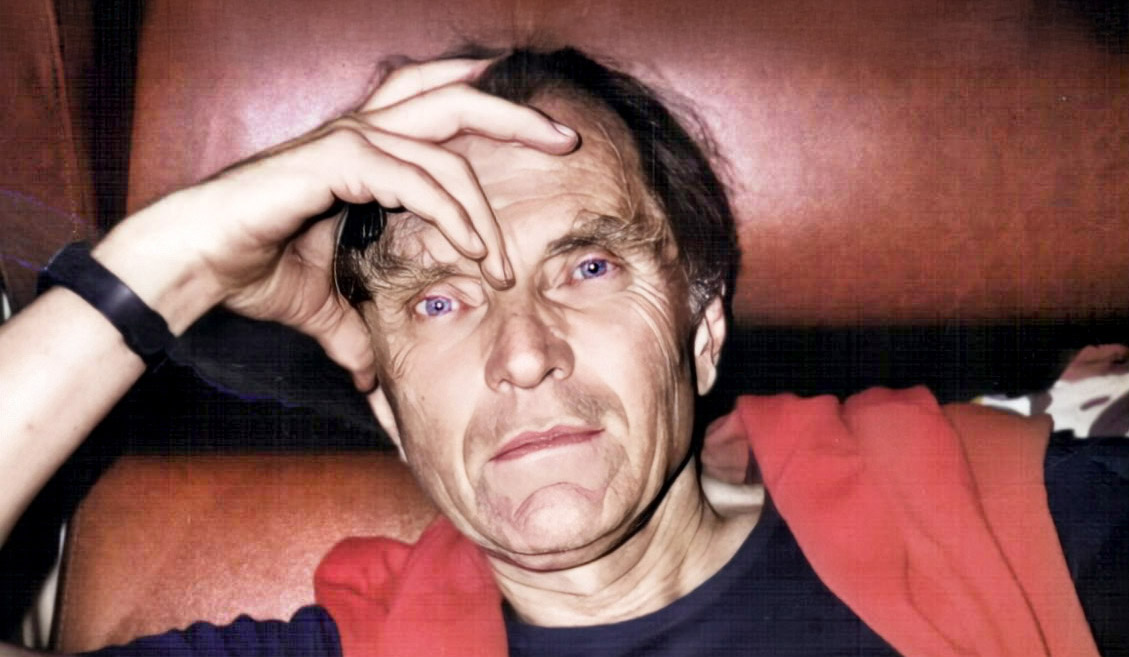
Paul Feyerabend. Photo courtesy of Grazia Borrini-Feyerabend.
John Heilbron Interview – June 2012
Posted in History of Science, Philosophy of Science on June 2, 2025
In 2012, I spoke with John Heilbron, historian of science and Professor Emeritus at UC Berkeley, about his career, his work with Thomas Kuhn, and the legacy of The Structure of Scientific Revolutions on its 50th anniversary. We talked late into the night. The conversation covered his shift from physics to history, his encounters with Kuhn and Paul Feyerabend, and his critical take on the direction of Science and Technology Studies (STS).
The interview marked a key moment. Kuhn and Feyerabend’s legacies were under fresh scrutiny, and STS was in the midst of redefining itself, often leaning toward sociological frameworks at the expense of other approaches.
Thirteen years later, in 2025, this commentary revisits that interview to illuminate its historical context, situate Heilbron’s critiques, and explore their relevance to contemporary STS and broader academic debates.
Over more than a decade, I had ongoing conversations with Heilbron about the evolution of the history of science – history of the history of science – and the complex relationship between History of Science and Science, Technology, and Society (STS) programs. At UC Berkeley, unlike at Harvard or Stanford, STS has long remained a “Designated Emphasis” rather than a department or standalone degree. Academic conservatism in departmental structuring, concerns about reputational risk, and questions about the epistemic rigor of STS may all have contributed to this decision. Moreover, Berkeley already boasted world-class departments in both History and Sociology.
That 2012 interview, the only one we recorded, brought together themes we’d explored over many years. Since then, STS has moved closer to engaging with scientific content itself. But it still draws criticism, both from scientists and from public misunderstanding. In 2012, the field was still heavily influenced by sociological models, particularly the Strong Programme and social constructivism, which stressed how scientific knowledge is shaped by social context. One of the key texts in this tradition, Shapin and Schaffer’s Leviathan and the Air-Pump (1985), argued that even Boyle’s experiments weren’t simply about discovery but about constructing scientific consensus.
Heilbron pushed back against this framing. He believed it sidelined the technical and epistemic depth of science, reducing STS to a sociological critique. He was especially wary of the dense, abstract language common in constructivist work. In his view, it often served as cover for thin arguments, especially from younger scholars who copied the style but not the substance. He saw it as a tactic: establish control of the conversation by embedding a set of terms, then build influence from there.
The influence of Shapin and Schaffer, Heilbron argued, created the impression that STS was dominated by a single paradigm, ironically echoing the very Kuhnian framework they analyzed. His frustration with a then-recent Isis review reflected his concern that constructivism had become doctrinaire, pressuring scholars to conform to its methods even when irrelevant to their work. His reference to “political astuteness” pointed to the way in which key figures in the field successfully advanced their terminology and frameworks, gaining disproportionate influence. While this gave them intellectual clout, Heilbron saw it as a double-edged sword: it strengthened their position while encouraging dogmatism among followers who prioritized jargon over genuine analysis.
Bill Storage: How did you get started in this curious interdisciplinary academic realm?
John Heilbron: Well, it’s not really very interesting, but I was a graduate student in physics but my real interest was history. So at some point I went down to the History department and found the medievalist, because I wanted to do medieval history. I spoke with the medievalist ad he said, “well, that’s very charming but you know the country needs physicists and it doesn’t need medievalists, so why don’t you go back to physics.” Which I duly did. But he didn’t bother to point out that there was this guy Kuhn in the History department who had an entirely different take on the subject than he did. So finally I learned about Kuhn and went to see him. Since Kuhn had very few students, I looked good; and I gradually I worked my way free from the Physics department and went into history. My PhD is in History; and I took a lot history courses and, as I said, history really is my interest. I’m interested in science too of course but I feel that my major concerns are historical and the writing of history is to me much more interesting and pleasant than calculations.
You entered that world at a fascinating time, when history of science – I’m sure to the surprise of most of its scholars – exploded onto the popular scene. Kuhn, Popper, Feyerabend and Lakatos suddenly appeared in The New Yorker, Life Magazine, and The Christian Century. I find that these guys are still being read, misread and misunderstood by many audiences. And that seems to be true even for their intended audiences – sometimes by philosophers and historians of science – certainly by scientists. I see multiple conflicting readings that would seem to show that at least some of them are wrong.
Well if you have two or more different readings then I guess that’s a safe conclusion. (Laughs.)
You have a problem with multiple conflicting truths…? Anyway – misreading Kuhn…
I’m more familiar with the misreading of Kuhn than of the others. I’m familiar with that because he was himself very distressed by many of the uses made of his work – particularly the notion that science is no different from art or has no stronger basis than opinion. And that bothered him a lot.
I don’t know your involvement in his work around that time. Can you tell me how you relate to what he was doing in that era?
I got my PhD under him. In fact my first work with him was hunting up footnotes for Structure. So I knew the text of the final draft well – and I knew him quite well during the initial reception of it. And then we all went off together to Copenhagen for a physics project and we were all thrown together a lot. So that was my personal connection and then of course I’ve been interested subsequently in Structure, as everybody is bound to be in my line of work. So there’s no doubt, as he says so in several places, that he was distressed by the uses made of it. And that includes uses made in the history of science particularly by the social constructionists, who try to do without science altogether or rather just to make it epiphenomenal on political or social forces.
I’ve read opinions by others who were connected with Kuhn saying there was a degree of back-peddling going by Kuhn in the 1970s. The implication there is that he really did intend more sociological commentary than he later claimed. Now I don’t see evidence of that in the text of Structure, and incidents like his telling Freeman Dyson that he (Kuhn) was not a Kuhnian would suggest otherwise. Do you have any thoughts on that?
I think that one should keep in mind the purpose of Structure, or rather the context in which it was produced. It was supposed to have been an article in this encyclopedia of unified science and Kuhn’s main interest was in correcting philosophers. He was not aiming for historians even. His message was that the philosophy practiced by a lot of positivists and their description of science was ridiculous because it didn’t pay any attention to the way science was actually done. So Kuhn was going to tell them how science was done, in order to correct philosophy. But then much to his surprise he got picked up by people for whom it was not written, who derived from it the social constructionist lesson that we’re all familiar with. And that’s why he was an unexpected rebel. But he did expect to be rebellious; that was the whole point. It’s just that the object of his rebellion was not history or science but philosophy.
So in that sense it would seem that Feyerabend’s question on whether Kuhn intended to be prescriptive versus descriptive is answered. It was not prescriptive.
Right – not prescriptive to scientists. But it was meant to be prescriptive to the philosophers – or at least normalizing – so that they would stop being silly and would base their conception of scientific progress on the way in which scientists actually went about their business. But then the whole thing got too big for him and he got into things that, in my opinion, really don’t have anything to do with his main argument. For example, the notion of incommensurability, which was not, it seems to me, in the original program. And it’s a logical construct that I don’t think is really very helpful, and he got quite hung up on that and seemed to regard that as the most important philosophical message from Structure.
I wasn’t aware that he saw it that way. I’m aware that quite a few others viewed it like that. Paul Feyerabend, in one of his last books, said that he and Kuhn kicked around this idea of commensurability in 1960 and had slightly different ideas about where to go with it. Feyerabend said Kuhn wanted to use it historically whereas his usage was much more abstract. I was surprised at the level of collaboration indicated by Feyerabend.
Well they talked a lot. They were colleagues. I remember parties at Kuhn’s house where Feyerabend would show up with his old white T shirt and several women – but that’s perhaps irrelevant to the main discussion. They were good friends. I got along quite well with Feyerabend too. We had discussions about the history of quantum physics and so on. The published correspondence between Feyerabend and Lakatos is relevant here. It’s rather interesting in that the person we’ve left out of the discussion so far, Karl Popper, was really the lighthouse for Feyerabend and Lakatos, but not for Kuhn. And I think that anybody who wants to get to the bottom of the relationship between Kuhn and Feyerabend needs to consider the guy out of the frame, who is Popper.
It appears Feyerabend was very critical of Kuhn and Structure at the time it was published. I think at that point Feyerabend was still essentially a Popperian. It seems Feyerabend reversed position on that over the next decade or so.
JH: Yes, at the time in question, around 1960, when they had these discussions, I think Feyerabend was still very much in Popper’s camp. Of course like any bright student, he disagreed with his professor about things.
How about you, as a bright student in 1960 – what did you disagree with your professor, Kuhn, about?
Well I believe in the proposition that philosophers and historians have different metabolisms. And I’m metabolically a historian and Kuhn was metabolically a philosopher – even though he did write history. But his most sustained piece of history of science was his book on black body theory; and that’s very narrowly intellectualist in approach. It’s got nothing to do with the themes of the structure of scientific revolutions – which does have something to say for the historian – but he was not by practice a historian. He didn’t like a whole lot of contingent facts. He didn’t like archival and library work. His notion of fun was take a few texts and just analyze and reanalyze them until he felt he had worked his way into the mind of their author. I take that to be a necromantic feat that’s not really possible.
I found that he was a very clever guy and he was excellent as a professor because he was very interested in what you were doing as soon it was something he thought he could make some use of. And that gave you the idea that you were engaged in something important, so I must give him that. On the other hand he just didn’t have the instincts or the knowledge to be a historian and so I found myself not taking much from his own examples. Once I had an argument with him about some way of treating a historical subject and I didn’t feel that I got anything out of him. Quite the contrary; I thought that he just ducked all the interesting issues. But that was because they didn’t concern him.
James Conant, president of Harvard who banned communists, chair of the National Science Foundation, etc.: how about Conant’s influence on Structure?
It’s not just Conant. It was the whole Harvard circle, of which Kuhn was part. There was this guy, Leonard Nash; there was Gerald Holton. And these guys would get together and l talk about various things having to do with the relationship between science and the public sphere. It was a time when Conant was fighting for the National Science Foundation and I think that this notion of “normal science” in which the scientists themselves must be left fully in charge of what they’re doing in order to maximize the progress within the paradigm to bring the profession swiftly to the next revolution – that this is essentially the Conant doctrine with respect to the ground rules of the National Science Foundation, which is “let the scientists run it.” So all those things were discussed. And you can find many bits of Kuhn’s Structure in that discussion. For example, the orthodoxy of normal science in, say, Bernard Cohen, who didn’t make anything of it of course. So there’s a lot of this Harvard group in Structure, as well as certain lessons that Kuhn took from his book on the Copernican Revolution, which was the textbook for the course he gave under Conant. So yes, I think Conant’s influence is very strong there.
So Kuhn was ultimately a philosopher where you are a historian. I think I once heard you say that reading historical documents does not give you history.
Well I agree with that, but I don’t remember that I was clever enough to say it.
Assuming you said it or believe it, then what does give you history?
Well, reading them is essential, but the part contributed by the historian is to make some sense of all the waste paper he’s been reading. This is essentially a construction. And that’s where the art, the science, the technique of the historian comes into play, to try to make a plausible narrative that has to satisfy certain rules. It can’t go against the known facts and it can’t ignore the new facts that have come to light through the study of this waste paper, and it can’t violate rules of verisimilitude, human action and whatnot. But otherwise it’s a construction and you’re free to manipulate your characters, and that’s what I like about it.
So I take it that’s where the historian’s metabolism comes into play – avoidance of leaping to conclusions with the facts.
True, but at some point you’ve got to make up a story about those facts.
Ok, I’ve got a couple questions on the present state of affairs – and this is still related to the aftermath of Kuhn. From attending colloquia, I sense that STS is nearly a euphemism for sociology of science. That bothers me a bit, possibly because I’m interested in the intersection of science, technology and society. Looking at the core STS requirements on Stanford’s website, I see few courses listed that would give a student any hint of what science looks like from the inside.
I’m afraid you’re only too right. I’ve got nothing against sociology of science, the study of scientific institutions, etc. They’re all very good. But they’re tending to leave the science out, and in my opinion, the further they get from science, the worse their arguments become. That’s what bothers me perhaps most of all – the weakness of the evidentiary base of many of the arguments and conclusions that are put forward.
I thought we all learned a bit from the Science Wars – thought that sort of indeterminacy of meaning and obfuscatory language was behind us. Either it’s back, or it never went away.
Yeah, the language part is an important aspect of it, and even when the language is relatively comprehensible as I think it is in, say, constructivist history of science – by which I mean the school of Schaffer and Shapin – the insistence on peculiar argot becomes a substitute for thought. You see it quite frequently in people less able than those two guys are, who try to follow in their footsteps. You get words strung together supposedly constituting an argument but which in fact don’t. I find that quite an interesting aspect of the business, and very astute politically on the part of those guys because if you can get your words into the discourse, why, you can still hope to have influence. There’s a doctrinaire aspect to it. I was just reading the current ISIS favorable book review by one of the fellow travelers of this group. The book was not written by one of them. The review was rather complimentary but then at the end says it is a shame that this author did not discuss her views as related to Schaffer and Shapin. Well, why the devil should she? So, yes, there’s issues of language, authority, and poor argumentation. STS is afflicted by this, no doubt.

Dialogue Concerning a Cup of Cooked Collards
Posted in Fiction, History of Science on May 27, 2025
in which the estimable Signora Sagreda, guided by the lucid reasoning of Salviatus and the amiable perplexities of Simplicius, doth inquire into the nature of culinary measurement, and wherein is revealed, by turns comic and calamitous, the logical dilemma and profound absurdity of quantifying cooked collards by volume, exposing thereby the nutritional fallacies, atomic impossibilities, and epistemic mischiefs that attend such a practice, whilst invoking with reverence the spectral wisdom of Galileo Galilei.
Scene: A modest parlor, with a view into a well-appointed kitchen. A pot of collards simmers.
Sagreda: Good sirs, I am in possession of a recipe, inherited from a venerable aunt, which instructs me to add one cup of cooked collards to the dish. Yet I find myself arrested by perplexity. How, I ask, can one trust such a measure, given the capricious nature of leaves once cooked?
Salviatus: Ah, Signora, thou hast struck upon a question of more gravity than may at first appear. In that innocent-seeming phrase lies the germ of chaos, the undoing of proportion, and the betrayal of consistency.
Simplicius: But surely, Salviatus, a cup is a cup! Whether one deals with molasses, barley, or leaves of collard! The vessel measures equal, does it not?

Salviatus: Ah, dear Simplicius, how quaint thy faith in vessels. Permit me to elaborate with the fullness this foolishness begs. A cup, as used here, is a measure of volume, not mass. Yet collards, when cooked, submit themselves to the will of the physics most violently. One might say that a plenty of raw collards, verdant and voluminous, upon the fire becomes but a soggy testament to entropy.
Sagreda: And yet if I, with ladle in hand, press them lightly, I may fill a cup with tender grace. But if I should tamp them down, as a banker tamps tobacco, I might squeeze thrice more into the same vessel.
Salviatus: Just so! And here lies its absurdity. The recipe calls for a cup, as though the collards were flour, or water, or some polite ingredient that hold the law of uniformity. But collards — and forgive my speaking plainly — are rogues. One cook’s gentle heap is another’s aggressive compression. Thus, a recipe using such a measure becomes not a method, but a riddle, a culinary Sphinx.
Simplicius: But might not tradition account for this? For is it not the case that housewives and cooks of yore prepared these dishes with their senses and not with scales?
Salviatus: A fair point, though flawed in its application. While the tongue and eye may suffice for the seasoned cook, the written recipe aspires to universality. It must serve the neophyte, the scholar, the gentleman abroad who seeks to replicate his mother’s collard pie with exactitude. And for these noble aims, only the scale may speak truth. Grams! Ounces! Units immutable, not subject to whim or squish!
Sagreda: You speak as though the collards, once cooked, engage in a deceit, cloaking their true nature.
Salviatus: Precisely. Cooked collards are like old courtiers — soft, pliable, and accustomed to hiding their substance beneath a veneer of humility. Only by weight can one know their worth. Or, more precisely, by its mass, the measure we know to not affect the rate at which objects fall.
Simplicius: But if all this be so, then is not every cookbook a liar? Is not every recipe suspect?
Salviatus: Not every recipe — only those who trade in volumetric folly where mass would bring enlightenment. The fault lies not in the recipe’s heart, but in its measurement. And this, dear Simplicius, we may yet amend.
Sagreda: Then shall we henceforth mark in our books, “Not a cup, but a weight; not a guess, but a truth“? For a measure of collards, like men, must be judged not by appearance, but by their substance.
Sagreda (reflecting): And yet, gentlemen, if I may permit a musing most unorthodox, does not all this emphasis on precision edge us perilously close to an unyielding, mechanical conception of science? Dare we call it… dogmatic?
Simplicius: Dogmatic? You surprise me, Signora. I thought it only the religion of Bellarmino and Barberini could carry such a charge.
Salviatus: Ha! Then you have not read the scribblings of Herr Paulus Feyerabend, who, proclaims with no small glee — and with more than of a trace of Giordano Bruno — that anything goes in the pursuit of knowledge. He teaches that the science, when constrained by method, becomes no different from myth.
Sagreda: Fascinating! And would this Feyerabend defend, then, the use of “a cup of cooked collards” as a sound epistemic act?
Salviatus: Indeed, he might. He would argue that inexactitude, even vagueness, can have its place. That Sagreda’s venerable aunt, the old wives, the village cooks, with their pinches and handfuls and mysteriously gestured “quanta bastas,” have no less a claim to truth than a chef armed with scales and thermocouples. He might well praise the “cup of cooked collards” as a liberating epistemology, a rejection of culinary tyranny.
Simplicius: Then Feyerabend would have me trust Sagreda’s aunt over the chemist?
Salviatus: Just so — he would, and be half right at least! Feyerabend’s quarrel is not with truth, but with monopoly over its definition. He seeks not the destruction of science, but the dethronement of science enthroned as sacred law. In this spirit, he might say: “Let the collards be measured by weight, or not at all, for the joy of the dish may reside not in precision, but in a dance of taste and memory.”
Sagreda: A heady notion! And perhaps, like a stew, the truth lies in the balance — one must permit both the grammar of measurement and the poetry of intuition. The recipe, then, is both science and art, its ambiguity not a flaw, but sometimes an invitation.
Salviatus: Beautifully said, Signora. Yet let us remember: Feyerabend champions chaos as a remedy for tyranny, not as an end in itself. He might defend the cook who ignores the scale, but not the recipe which claims false precision where none is due. And so, if we declare “a cup of cooked collards,” we ought either to define it, or admit with humility that we have no idea how many leaves is right to each observer.
Simplicius: Then science and the guessing of aunts may coexist — so long as neither pretends to be the other?
Salviatus: Precisely. The scale must not scorn the hunch, nor the cup dethrone the scale. But let us not forget: when preparing a dish to be replicated, mass is our anchor in the storm of leafy deception.
Sagreda (opening her laptop): Ah! Then let us dedicate this dish — to Feyerabend, to Bruno, to my venerable aunt. I will append to her recipe, notations from these reasonings on contradiction and harmony.
Cooked collards are like old courtiers — soft, pliable, and accustomed to hiding their substance beneath a veneer of humility — Salviatus
Sagreda (looking up from her laptop with astonishment): Gentlemen! I have stumbled upon a most curious nutritional claim. This USDA document — penned by government scientist or rogue dietitian — declares with solemn authority that a cup of cooked collards contains 266 grams calcium and a cup raw only 52.
Salviatus (arching an eyebrow): More calcium? From whence, pray, does this mineral bounty emerge? For collards, like men, cannot give what they do not possess.

Simplicius (waving a wooden spoon): It is well known, is it not, that cooking enhances healthfulness? The heat releases the virtues hidden within the leaf, like Barberini stirring the piety of his reluctant congregation!
Salviatus: Simplicius, your faith outpaces your chemistry. Let us dissect this. Calcium, as an element, is not born anew in the pot. It is not conjured by flame nor summoned by steam. It is either present, or it is not.
Simplicius: So how, then, can it be that the cooked collards have more calcium than their raw counterparts — cup for cup?
Sagreda: Surely, again, the explanation is compression. The cooking drives out water, collapses volume, and fills the cup more densely with matter formerly bulked by air and hubris.
Salviatus: Exactly so! A cup of cooked collards is, in truth, the compacted corpse of many cups raw — and with them, their calcium. The mineral content has not changed; only the volume has bowed before heat’s stern hand.
Simplicius: But surely the USDA, a most probable power, must be seen as sovereign on the matter. Is there no means, other than admitting the slackness of their decree, by which we can serve its authority?
Salviatus: Then, Simplicius, let us entertain absurdity. Suppose for a moment — as a thought experiment — that the cooking process does, in fact, create calcium.
By what alchemy? What transmutation?
Let us assume, in a spirit of lunatic (and no measure anachronous) generosity, that the humble collard leaf contains also magnesium — plentiful, impudent magnesium — and that during cooking, it undergoes nuclear transformation. Though they have the same number of valence electrons, to turn magnesium (atomic number 12) into calcium (atomic number 20), we must add 8 protons and a healthy complement of neutrons.
Sagreda: But whence come these subatomic parts? Shall we pluck nucleons from the steam?
Salviatus (solemnly): We must raid the kitchen for protons as a burglar raids a larder. Perhaps the protons are drawn from the salt, or the neutrons from baking powder, or perhaps our microwave is a covert collider, transforming our soup pot into CERN-by-candlelight.
But alas — this would take more energy than a dozen suns, and the vaporizing of the collards in a burst of gamma rays, leaving not calcium-rich greens but a crater and a letter of apology due. But, we know, do we not, that the universe is indifferent to apology; the earth still goes round the sun.
Sagreda: Then let us admit: the calcium remains the same. The difference is illusion — an artifact of measurement, not of matter.
Salviatus: Precisely. And the USDA, like other sovereigns, commits nutritional sophistry — comparing unlike volumes and implying health gained by heat alone, or, still worse, that we hold it true by unquestioned authority.
Let this be our final counsel: whenever the cup is invoked, ask, “Cup of what?” If it be cooked, know that you measure the ghost of raw things past, condensed, wilted, and innocent of transmutation.
The scale must not scorn the hunch, nor the cup dethrone the scale. – Salviatus
Thus ends the matter of the calcium-generating cauldron, in which it hath been demonstrated to the satisfaction of reason and the dismay of the USDA that no transmutation of elements occurs in the course of stewing collards, unless one can posit a kitchen fire worthy of nuclear alchemy; and furthermore, that the measure of leafy matter must be governed not by the capricious vulgarity of volume, but by the steady hand of mass, or else be entrusted to the most excellent judgment of aunts and cooks, whose intuitive faculties may triumph over quantification outright. The universe, for its part, remains intact, and the collards, alas, are overcooked.

Giordano Bruno discusses alchemy with Paul Feyerabend. Campo de’ Fiori, Rome, May 1591.
Galileo’s Dialogue Concerning the Two Chief World Systems is a proto-scientific work presented as a conversation among three characters: Salviati, Sagredo, and Simplicio. It compares the Copernican heliocentric model (Earth revolves around Sun) and the traditional Ptolemaic geocentric model (Earth as center). Salviati represents Galileo’s own views and advocates for the Copernican system, using logic, mathematics, observation, and rhetoric. Sagredo is an intelligent, neutral layman who asks questions and weighs the arguments, representing the open-minded reader. Simplicio, a supporter of Aristotle and the geocentric model held by the church, struggles to defend his views and is portrayed as naive. Through their discussion, Galileo gives evidence for the heliocentric model and critiques the shortcomings of the geocentric, making a strong case for scientific reasoning based on observation rather than tradition and authority. Cardinal Roberto Bellarmino and Maffeo Barberini (Pope Urban VIII) were the central clergy figures in Galileo’s trial. In 1970 Paul Feyerabend argued that modern institutional science resembled the church more than it did Galileo. The Dominican monk, Giordano Bruno, held unorthodox ideas in science and theology. Bellarmino framed the decision leading to his conviction of heresy in 1600. He was burned at the stake in the plaza of Campo de’ Fiori, where I stood not one hour before writing this.

Galileo with collard vendors in Pisa
New Marble Portrait of Augustus
Posted in History of Art on May 24, 2025
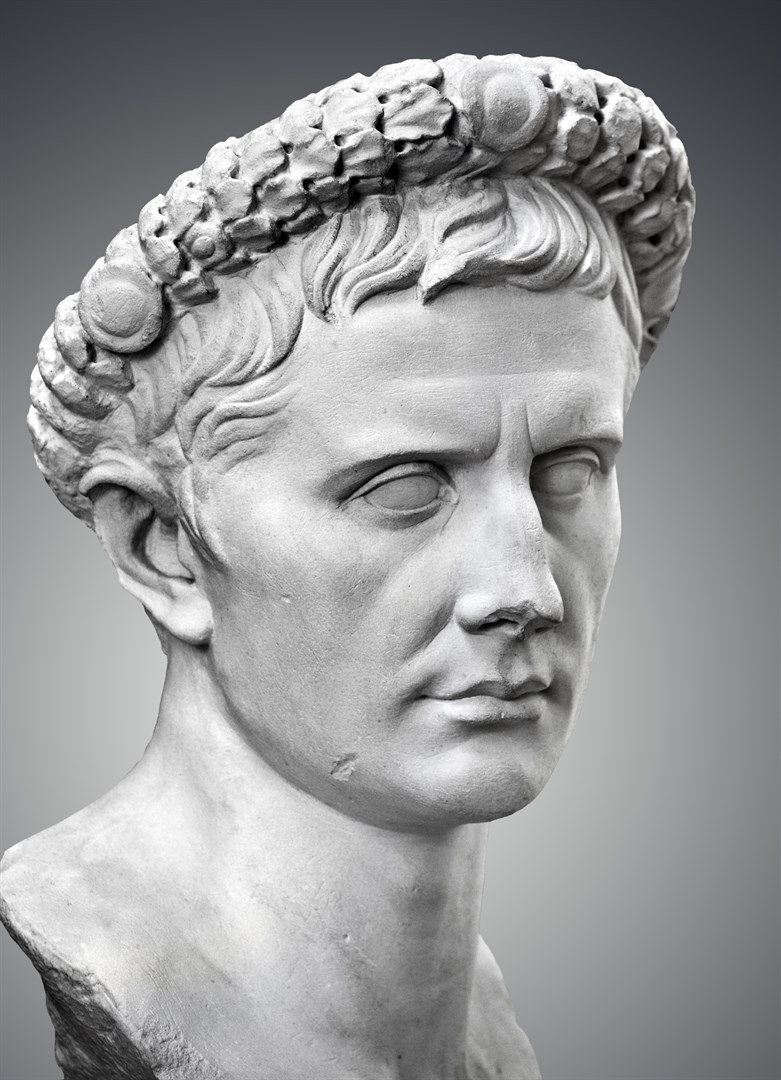


For 23 years Laura Maish and I have been shooting photos of republican and imperial portraits. We’ve accumulated 30,000 photos of ancient marble and bronze heads.
Our latest addition, just photographed this week in Rome, is the below Alcudia-type head of Augustus discovered in 2019 along Via Alessandrina in Rome Mercati di Traiano and recently put on display in the Trajan’s Market museum. This typology, named after a similar portrait found in Alcudia, Spain, dates to 40–38 BCE and depicts Octavian in his early twenties. This type aligns with Augustus’ adoption of the title Divi Filius (Son of the Deified*) following Julius Caesar’s deification. Alcudia-type portraits of Augustus are rare, so this was a significant find.
* This is often incorrectly translated as “Son of the Divine.” Divus (from which Divi comes) refers specifically to a mortal who has been deified after death, not to an eternal or inherently divine being (like a traditional god such as Jupiter). Deus, by contrast, refers to a god or divine being in a more traditional, eternal sense.


This Alcúdia type bust portrays Augustus with a youthful face, featuring a broad forehead, sharp brow, and almond-shaped eyes with thin lids. The facial modeling is restrained, part realistic individualism and part classicizing elements inspired by Greek sculpture, particularly the works like the Doryphoros of Polykleitos. His expression is calm and dignified, reflecting the Augustan ideal of serene authority.
A defining feature is the distinctive arrangement of hair, with thick, comma-shaped locks combed forward, often with a pronounced central “clip” formed by two locks curving to the right and one to the left. The hair over the forehead is voluminous, with some strands undercut for a three-dimensional effect, and it closely follows the skull, contrasting with later types like the Prima Porta, where the hair is more simplified. As with the other Alcúdia-type portraits the rest of the hair is smoother and less detailed compared to later Augustan portraits.
This piece appears to be carved from Parian marble. I could not find any info on it and I’m unskilled in petrography. It is some kind of high-quality, fine-grained, homogeneous lychnite.
Visit this page for photos of many more portraits of Augustus.

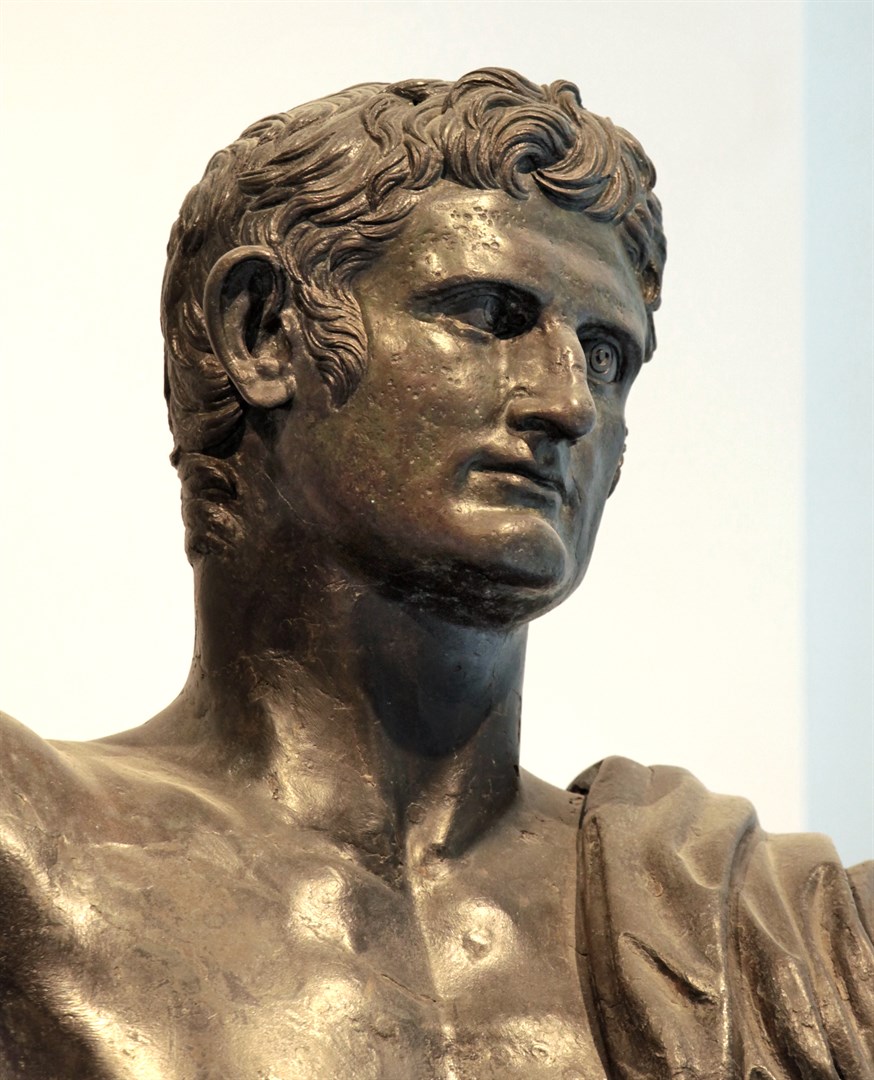

Bad Science, Broken Trust: Commentary on Pandemic Failure
Posted in History of Science on May 20, 2025
In my three previous posts (1, 2, 3) on the Covid-19 response and statistical reasoning, I deliberately sidestepped a deeper, more uncomfortable truth that emerges from such analysis: that ideologically driven academic and institutional experts – credentialed, celebrated, and deeply embedded in systems of authority – played a central role in promoting flawed statistical narratives that served political agendas and personal advancement. Having defended my claims in two previous posts – from the perspective of a historian of science – I now feel I justified in letting it rip. Bad science, bad statistics, and institutional arrogance directly shaped a public health disaster.
What we witnessed was not just error, but hubris weaponized by institutions. Self-serving ideologues – cloaked in the language of science – shaped policies that led, in no small part, to hundreds of thousands of preventable deaths. This was not a failure of data, but of science and integrity, and it demands a historical reckoning.
The Covid-19 pandemic exacted a devastating toll: a 13% global GDP collapse in Q2 2020, and a 12–15% spike in adolescent suicidal ideation, as reported by Nature Human Behaviour (2020) and JAMA Pediatrics (2021). These catastrophic outcomes –economic freefall and a mental health crisis – can’t be blamed on the pathogen. Its lethality was magnified by avoidable policy blunders rooted in statistical incompetence and institutional cowardice. Five years on, the silence from public health authorities is deafening. The opportunity to learn from these failures – and to prevent their repetition – is being squandered before our eyes.
One of the most glaring missteps was the uncritical use of raw case counts to steer public policy – a volatile metric, heavily distorted by shifting testing rates, as The Lancet (2021, cited earlier) highlighted. More robust measures like deaths per capita or infection fatality rates, advocated by Ioannidis (2020), were sidelined, seemingly for facile politics. The result: fear-driven lockdowns based on ephemeral, tangential data. The infamous “6-foot rule,” based on outdated droplet models, continued to dominate public messaging through 2020 and beyond – even though evidence (e.g., BMJ, 2021) solidly pointed to airborne transmission. This refusal to pivot toward reality delayed life-saving ventilation reforms and needlessly prolonged school closures, economic shutdowns, and the cascading psychological harm they inflicted.
At the risk of veering into anecdote, this example should not be lost to history: In 2020, a surfer was arrested off Malibu Beach and charged with violating the state’s stay-at-home order. As if he might catch or transmit Covid – alone, in the open air, on the windswept Pacific. No individual could possibly believe that posed a threat. It takes a society – its institutions, its culture, its politics – to manufacture collective stupidity on that scale.
The consequences of these reasoning failures were grave. And yet, astonishingly, there has been no comprehensive, transparent institutional reckoning. No systematic audits. No revised models. No meaningful reforms from the CDC, WHO, or major national agencies. Instead, we see a retrenchment: the same narratives, the same faces, and the same smug complacency. The refusal to account for aerosol dynamics, mental health trade-offs, or real-time data continues to compromise our preparedness for future crises. This is not just negligence. It is a betrayal of public trust.
If the past is not confronted, it will be repeated. We can’t afford another round of data-blind panic, policy overreach, and avoidable harm. What’s needed now is not just reflection but action: independent audits of pandemic responses, recalibrated risk models that incorporate full-spectrum health and social impacts, and a ruthless commitment to sound use of data over doctrine.
The suffering of 2020–2022 must mean something. If we want resilience next time, we must demand accountability this time. The era of unexamined expert authority must end – not to reject expertise – but to restore it to a foundation of integrity, humility, and empirical rigor.
It’s time to stop forgetting – and start building a public health framework worthy of the public it is supposed to serve.
___ ___ ___
Covid Response – Case Counts and Failures of Statistical Reasoning
Posted in History of Science on May 19, 2025
In my previous post I defended three claims made in an earlier post about relative successes in statistics and statistical reasoning in the American Covid-19 response. This post gives support for three claims regarding misuse of statistics and poor statistical reasoning during the pandemic.
Misinterpretation of Test Results (4)
Early in the COVID-19 pandemic, many clinicians and media figures misunderstood diagnostic test accuracy, misreading PCR and antigen test results by overlooking pre-test probability. This caused false reassurance or unwarranted alarm, though some experts mitigated errors with Bayesian reasoning. This was precisely the type of mistake highlighted in the Harvard study decades earlier. (4)
Polymerase chain reaction (PCR) tests, while considered the gold standard for detecting SARS-CoV-2, were known to have variable sensitivity (70–90%) depending on factors like sample quality, timing of testing relative to infection, and viral load. False negatives were a significant concern, particularly when clinicians or media interpreted a negative result as definitively ruling out infection without considering pre-test probability (the likelihood of disease based on symptoms, exposure, or prevalence). Similarly, antigen tests, which are less sensitive than PCR, were prone to false negatives, especially in low-prevalence settings or early/late stages of infection.
A 2020 article in Journal of General Internal Medicine noted that physicians often placed undue confidence in test results, minimizing clinical reasoning (e.g., pre-test probability) and deferring to imperfect tests. This was particularly problematic for PCR false negatives, which could lead to a false sense of security about infectivity.
A 2020 Nature Reviews Microbiology article reported that during the early pandemic, the rapid development of diagnostic tests led to implementation challenges, including misinterpretation of results due to insufficient consideration of pre-test probability. This was compounded by the lack of clinical validation for many tests at the time.
Media reports often oversimplified test results, presenting PCR or antigen tests as definitive without discussing limitations like sensitivity, specificity, or the role of pre-test probability. Even medical professionals struggled with Bayesian reasoning, leading to public confusion about test reliability.
Antigen tests, such as lateral flow tests, were less sensitive than PCR (pooled sensitivity of 64.2% in pediatric populations) but highly specific (99.1%). Their performance varied significantly with pre-test probability, yet early in the pandemic, they were sometimes used inappropriately in low-prevalence settings, leading to misinterpretations. In low-prevalence settings (e.g., 1% disease prevalence), a positive antigen test with 99% specificity and 64% sensitivity could have a high false-positive rate, but media and some clinicians often reported positives as conclusive without contextualizing prevalence. Conversely, negative antigen tests were sometimes taken as proof of non-infectivity, despite high false-negative rates in early infection.
False negatives in PCR tests were a significant issue, particularly when testing was done too early or late in the infection cycle. A 2020 study in Annals of Internal Medicine found that the false-negative rate of PCR tests varied by time since exposure, peaking at 20–67% depending on the day of testing. Clinicians who relied solely on a negative PCR result without considering symptoms or exposure history often reassured patients they were not infected, potentially allowing transmission.
In low-prevalence settings, even highly specific tests like PCR (specificity ~99%) could produce false positives, especially with high cycle threshold (Ct) values indicating low viral loads. A 2020 study in Clinical Infectious Diseases found that only 15.6% of positive PCR results in low pre-test probability groups (e.g., asymptomatic screening) were confirmed by an alternate assay, suggesting a high false-positive rate. Media amplification of positive cases without context fueled public alarm, particularly during mass testing campaigns.
Antigen tests, while rapid, had lower sensitivity and were prone to false positives in low-prevalence settings. An oddly credible 2021 Guardian article noted that at a prevalence of 0.3% (1 in 340), a lateral flow test with 99.9% specificity could still yield a 5% false-positive rate among positives, causing unnecessary isolation or panic. In early 2020, widespread testing of asymptomatic individuals in low-prevalence areas led to false positives being reported as “new cases,” inflating perceived risk.
Many Covid professionals mitigated errors with Bayesian reasoning, using pre-test probability, test sensitivity, and specificity to calculate the post-test probability of disease. Experts who applied this approach were better equipped to interpret COVID-19 test results accurately, avoiding over-reliance on binary positive/negative outcomes.
Robert Wachter, MD, in a 2020 Medium article, explained Bayesian reasoning for COVID-19 testing, stressing that test results must be interpreted with pre-test probability. For example, a negative PCR in a patient with a 30% pre-test probability (based on symptoms and prevalence) still carried a significant risk of infection, guiding better clinical decisions. In Germany, mathematical models incorporating pre-test probability optimized PCR allocation, ensuring testing was targeted to high-risk groups.
Cases vs. Deaths (5)
One of the most persistent statistical missteps during the pandemic was the policy focus on case counts, devoid of context. Case numbers ballooned or dipped not only due to viral spread but due to shifts in testing volume, availability, and policies. Covid deaths per capita rather than case count would have served as a more stable measure of public health impact. Infection fatality rates would have been better still.
There was a persistent policy emphasis on cases alone. Throughout the COVID-19 pandemic, public health policies, such as lockdowns, mask mandates, and school closures, were often justified by rising case counts reported by agencies like the CDC, WHO, and national health departments. For example, in March 2020, the WHO’s situation reports emphasized confirmed cases as a primary metric, influencing global policy responses. In the U.S., states like California and New York tied reopening plans to case thresholds (e.g., California’s Blueprint for a Safer Economy, August 2020), prioritizing case numbers over other metrics. Over-reliance on case-based metrics was documented by Trisha Greenhalgh in Lancet (Ten scientific reasons in support of airborne transmission…).
Case counts, without context, were frequently reported without contextualizing factors like testing rates or demographics, leading to misinterpretations. A 2021 BMJ article criticized the overreliance on case counts, noting they were used to “justify public health measures” despite their variability, supporting the claim of a statistical misstep. Media headlines, such as “U.S. Surpasses 100,000 Daily Cases” (CNN, November 4, 2020), amplified case counts, often without clarifying testing changes, fostering fear-driven policy decisions.
Case counts were directly tied to testing volume, which varied widely. In the U.S., testing increased from ~100,000 daily tests in April 2020 to over 2 million by November 2020 (CDC data). Surges in cases often coincided with testing ramps, e.g., the U.S. case peak in July 2020 followed expanded testing in Florida and Texas. Testing access was biased (in the statistical sense). Widespread testing including asymptomatic screening inflated counts. Policies like mandatory testing for hospital admissions or travel (e.g., New York’s travel testing mandate, November 2020) further skewed numbers. 2020 Nature study highlighted that case counts were “heavily influenced by testing capacity,” with countries like South Korea detecting more cases due to aggressive testing, not necessarily higher spread. This supports the claim that testing volume drove case fluctuations beyond viral spread (J Peto, Nature – 2020).
Early in the pandemic, testing was limited due to supply chain issues and regulatory delays. For example, in March 2020, the U.S. conducted fewer than 10,000 tests daily due to shortages of reagents and swabs, underreporting cases (Johns Hopkins data). This artificially suppressed case counts. A 2021 Lancet article (R Horton) noted that “changes in testing availability distorted case trends,” with low availability early on masking true spread and later increases detecting more asymptomatic cases, aligning with the claim.
Testing policies, such as screening asymptomatic populations or requiring tests for specific activities, directly impacted case counts. For example, in China, mass testing of entire cities like Wuhan in May 2020 identified thousands of cases, many asymptomatic, inflating counts. In contrast, restrictive policies early on (e.g., U.S. CDC’s initial criteria limiting tests to symptomatic travelers, February 2020) suppressed case detection.
In the U.S., college campuses implementing mandatory weekly testing in fall 2020 reported case spikes, often driven by asymptomatic positives (e.g., University of Wisconsin’s 3,000+ cases, September 2020). A 2020 Science study (Assessment of SARS-CoV-2 screening) emphasized that “testing policy changes, such as expanded screening, directly alter reported case numbers,” supporting the claim that policy shifts drove case variability.
Deaths per capita, calculated as total Covid-19 deaths divided by population, are less sensitive to testing variations than case counts. For example, Sweden’s deaths per capita (1,437 per million by December 2020, Our World in Data) provided a clearer picture of impact than its case counts, which fluctuated with testing policies. Belgium and the U.K. used deaths per capita to compare regional impacts, guiding resource allocation. A 2021 JAMA study argued deaths per capita were a “more reliable indicator” of pandemic severity, as they reflected severe outcomes less influenced by testing artifacts. Death reporting had gross inconsistencies (e.g., defining “Covid-19 death”), but it was more standardized than case detection.
Infection Fatality Rates (IFR) reports the proportion of infections resulting in death, making it less prone to testing biases. A 2020 Bulletin of the WHO meta-analysis estimated a global IFR of ~0.6% (range 0.3-1.0%), varying by age and region. IFR gave a truer measure of lethality. Seroprevalence studies in New York City (April 2020) estimated an IFR of ~0.7%, offering insight into true mortality risk compared to case fatality rates (CFR), which were inflated by low testing (e.g., CFR ~6% in the U.S., March 2020).
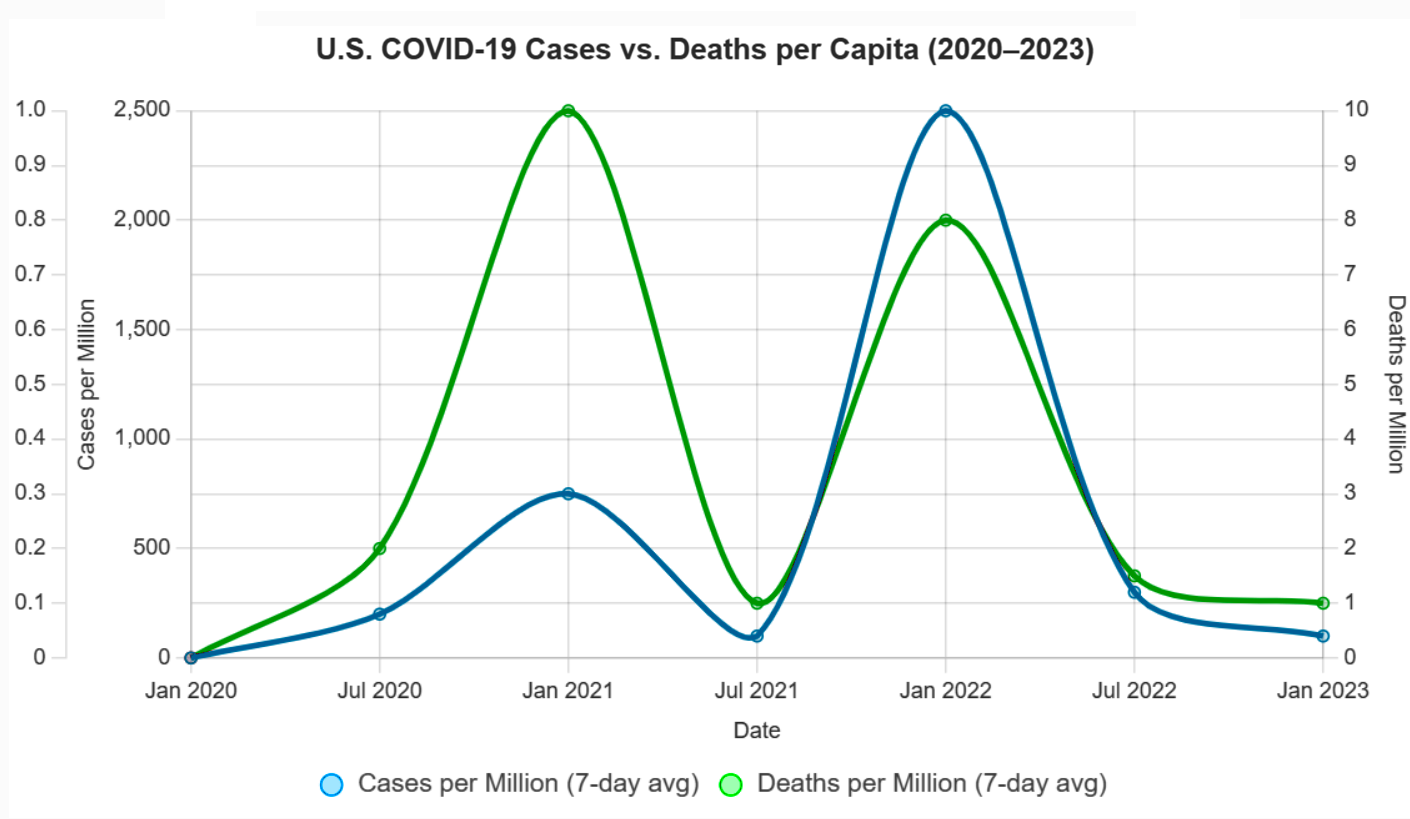
Shifting Guidelines and Aerosol Transmission (6)
The “6-foot rule” was based on outdated models of droplet transmission. When evidence of aerosol spread emerged, guidance failed to adapt. Critics pointed out the statistical conservatism in risk modeling, its impact on mental health and the economy. Institutional inertia and politics prevented vital course corrections.
The 6-foot (or 2-meter) social distancing guideline, widely adopted by the CDC and WHO in early 2020, stemmed from historical models of respiratory disease transmission, particularly the 1930s work of William F. Wells on tuberculosis. Wells’ droplet model posited that large respiratory droplets fall within 1–2 meters, implying that maintaining this distance reduces transmission risk. The CDC’s March 2020 guidance explicitly recommended “at least 6 feet” based on this model, assuming most SARS-CoV-2 transmission occurred via droplets.
The droplet model was developed before modern understanding of aerosol dynamics. It assumed that only large droplets (>100 μm) were significant, ignoring smaller aerosols (<5–10 μm) that can travel farther and remain airborne longer. A 2020 Nature article noted that the 6-foot rule was rooted in “decades-old assumptions” about droplet size, which did not account for SARS-CoV-2’s aerosol properties, such as its ability to spread in poorly ventilated spaces beyond 6 feet.
Studies, like a 2020 Lancet article by Morawska and Milton, argued that the 6-foot rule was inadequate for aerosolized viruses, as aerosols could travel tens of meters in certain conditions (e.g., indoor settings with low air exchange). Real-world examples, such as choir outbreaks (e.g., Skagit Valley, March 2020, where 53 of 61 singers were infected despite spacing), highlighted transmission beyond 6 feet, undermining the droplet-only model.
The WHO initially downplayed aerosol transmission, stating in March 2020 that COVID-19 was “not airborne” except in specific medical procedures (e.g., intubation). After the July 2020 letter, the WHO updated its guidance on July 9, 2020, to acknowledge “emerging evidence” of airborne spread but maintained droplet-focused measures (e.g., 1-meter distancing) without emphasizing ventilation or masks for aerosols. A 2021 BMJ article criticized the WHO for “slow and risk-averse” updates, noting that full acknowledgment of aerosol spread was delayed until May 2021.
The CDC also failed to update its guidance. In May 2020, it emphasized droplet transmission and 6-foot distancing. A brief September 2020 update mentioning “small particles” was retracted days later, reportedly due to internal disagreement. The CDC fully updated its guidance to include aerosol transmission in May 2021, recommending improved ventilation, but retained the 6-foot rule in many contexts (e.g., schools) until 2022. Despite aerosol evidence, the 6-foot rule remained a cornerstone of policies. For example, U.S. schools enforced 6-foot desk spacing in 2020–2021, delaying reopenings despite studies (e.g., a 2021 Clinical Infectious Diseases study).
Early CDC and WHO models overestimated droplet transmission risks while underestimating aerosol spread, leading to rigid distancing rules. A 2021 PNAS article by Prather et al. criticized these models as “overly conservative,” noting they ignored aerosol physics and real-world data showing low outdoor transmission risks. Risk models overemphasized close-contact droplet spread, neglecting long-range aerosol risks in indoor settings. John Ioannidis, in a 2020 European Journal of Clinical Investigation commentary, criticized the “precautionary principle” in modeling, which prioritized avoiding any risk over data-driven adjustments, leading to policies like prolonged school closures based on conservative assumptions about transmission.
Risk models rarely incorporated Bayesian updates with new data, specifically low transmission in well-ventilated spaces. A 2020 Nature commentary by Tang et al. noted that models failed to adjust for aerosol decay rates or ventilation, overestimating risks in outdoor settings while underestimating them indoors.
Researchers and public figures criticized prolonged social distancing and lockdowns, driven by conservative risk models, for exacerbating mental health issues. A 2021 The Lancet Psychiatry study reported a 25% global increase in anxiety and depression in 2020, attributing it to isolation from distancing measures. Jay Bhattacharya, co-author of the Great Barrington Declaration, argued in 2020 that rigid distancing rules, like the 6-foot mandate, contributed to social isolation without proportional benefits.
Tragically, A 2021 JAMA Pediatrics study concluded that Covid school closures increased adolescent suicide ideation by 12–15%. Economists and policy analysts, such as those at the American Institute for Economic Research (AIER), criticized the economic fallout of distancing policies. The 6-foot rule led to capacity restrictions in businesses (e.g., restaurants, retail), contributing to economic losses. A 2020 Nature Human Behaviour study estimated a 13% global GDP decline in Q2 2020 due to lockdowns and distancing measures.
Institutional inertia and political agendas prevented course corrections, such as prioritizing ventilation over rigid distancing. The WHO’s delay in acknowledging aerosols was attributed to political sensitivities. A 2020 Nature article (Lewis) reported that WHO advisors faced pressure to align with member states’ policies, slowing updates.
Next post, I’ll offer commentary on Covid policy from the perspective of a historian of science.
Covid Response – Signs of Statistical Success
Posted in History of Science, Philosophy of Science on May 18, 2025
In a recent post, I suggested that the Covid response demonstrated success in several areas of statistical reasoning, including clear communication of mRNA vaccine efficacy, data-driven ICU triage using the SOFA score, and the use of wastewater epidemiology. The following points support this claim.
Risk Communication in Vaccine Trials (1)
The early mRNA vaccine announcements in 2020 offered clear statistical framing by emphasizing a 95% relative risk reduction in symptomatic Covid for vaccinated individuals compared to placebo, sidelining raw case counts for a punchy headline. While clearer than many public health campaigns, this focus omitted absolute risk reduction and uncertainties about asymptomatic spread, falling short of the full precision needed to avoid misinterpretation.
Pfizer/BioNTech’s November 18, 2020, press release announced a 95% efficacy for its mRNA vaccine (BNT162b2) in preventing symptomatic Covid-19, based on 170 cases (162 in the placebo group, 8 in the vaccinated group) in a trial of ~43,538 participants. Moderna’s November 16, 2020, press release reported a 94.5% efficacy for its mRNA vaccine (mRNA-1273), based on 95 cases (90 placebo, 5 vaccinated) in a 30,000-participant trial. Both highlighted relative risk reduction (RRR) as the primary metric. For Pfizer, placebo risk was ~0.88% (162/18,325), vaccinated risk was ~0.04% (8/18,198), yielding ~95% RRR.

The focus omitted absolute risk reduction (ARR), as described by Brown in Outcome Reporting Bias in COVID mRNA Vaccine Clinical Trials. ARR is the difference in event rates between placebo and vaccinated groups. For Pfizer, placebo risk was ~0.88% (162/18,325), vaccinated risk was ~0.04% (8/18,198), giving an ARR of ~0.84%. Moderna’s ARR was ~0.6% (90/15,000 = 0.6% placebo risk, 5/15,000 = 0.03% vaccinated risk). Neither Pfizer’s nor Moderna’s November 2020 press releases mentioned ARR, focusing solely on RRR. The NEJM publications (Polack, 2020; Baden, 2021) reported RRR and case counts but not ARR explicitly. Both CDC and WHO messaging in 2020 emphasized efficacy rates, not ARR (e.g., CDC’s “Vaccine Effectiveness,” December 2020).
The focus omitted uncertainties about asymptomatic spread, as described by Oran & Topol Prevalence of Asymptomatic SARS-CoV-2 Infection (2020). Pfizer and Moderna trials primarily measured efficacy against symptomatic Covid, with no systematic testing for asymptomatic infections in initial protocols. Pfizer later included N-antibody testing for a subset, but this was not reported in November 2020. Studies (e.g., Oran & Topol, 2020) estimated 40-50% of infections were asymptomatic, but vaccine effects on this were unknown. A CDC report (December 2020) noted uncertainty about transmission.
While generally positive, framing fell short of the precision needed to avoid misinterpretation. The RRR focus without ARR or baseline risk context could exaggerate benefits. High-visibility figures like Bill Gates amplified vaccine optimism, fostering overconfidence in transmission control. For Pfizer, a 95% RRR contrasted with a 0.84% ARR, which was less emphasized. The lack of clarity about transmission led to public misconceptions, with surveys (e.g., Kaiser Family Foundation, January 2021) showing that many people believed vaccines would prevent transmission.
Clinical Triage via Quantitative Models (2)
During peak ICU shortages, hospitals adopted the SOFA score, originally a tool for assessing organ dysfunction, to guide resource allocation with a semi-objective, data-driven approach. While an improvement over ad hoc clinical judgment, SOFA faced challenges like inconsistent application and biases that disadvantaged older or chronically ill patients, limiting its ability to achieve fully equitable triage.
The SOFA score, developed to assess organ dysfunction in critically ill patients, was widely adopted during the Covid pandemic to guide ICU triage and resource allocation in hospitals facing overwhelming demand. Studies and guidelines from 2020–2022 document its use.
Several articles described the incorporation of SOFA scores were incorporated into triage protocols in hospitals in New York, Italy, and Spain to prioritize patients for ventilators and ICU beds, e.g., Fair allocation of scarce medical resources in the time of Covid (NEJM), Adult ICU triage during the Covid pandemic (Lancet), and A framework for rationing ventilators… (Critical Care Medicine).
A 2022 study in Critical Care reported variability in how SOFA was implemented, with some hospitals modifying the scoring criteria or weighting certain organ systems differently, leading to discrepancies in patient prioritization (Maves, 2022). A 2021 analysis in BMJ Open found that SOFA’s application varied due to differences in clinician training, data availability (e.g., incomplete lab results), and local protocol adaptations, which undermined its reliability in some settings (Cook, 2021).
Still, the SOFA score’s design and application introduced biases that disproportionately disadvantaged older adults and patients with chronic illnesses. A 2020 study in The Lancet pointed out that SOFA scores often penalize patients with pre-existing organ dysfunction, as baseline comorbidities (common in older or chronically ill patients) result in higher scores, suggesting worse outcomes even if acute illness was treatable (Grasselli, 2020). A 2021 article in JAMA Internal Medicine criticized SOFA-based triage for its lack of adjustment for age or chronic conditions, noting that older patients were frequently deprioritized due to higher baseline SOFA scores, even when their acute prognosis was favorable (Wunsch, 2021).
Wastewater Epidemiology (3)
Public health researchers used viral RNA in wastewater to monitor community spread, reducing the sampling biases of clinical testing. This statistical surveillance, conducted outside clinics, offered high public health relevance but faced biases and interpretive challenges that tempered its precision.
Wastewater-based epidemiology (WBE) emerged as a critical tool during the Covid pandemic to monitor SARS-CoV-2 RNA in wastewater, providing a population-level snapshot of viral prevalence. Infected individuals, including symptomatic, asymptomatic, and presymptomatic cases, shed viral RNA in their feces, which is detectable in wastewater, enabling community-wide surveillance.
The Centers for Disease Control and Prevention (CDC) launched the National Wastewater Surveillance System (NWSS) in September 2020 to coordinate tracking of SARS-CoV-2 in wastewater across the U.S., transforming local efforts into a national system. A 2020 study in Nature Biotechnology demonstrated that SARS-CoV-2 RNA concentrations in primary sewage sludge in New Haven, Connecticut, tracked the rise and fall of clinical cases and hospital admissions, confirming WBE’s ability to monitor community spread. Similarly, a 2021 study in Scientific Reports monitored SARS-CoV-2 RNA in wastewater from Frankfurt, Germany, showing correlations with reported cases.
Globally, WBE was applied in countries like India, Australia, and the Netherlands, with a 2021 systematic review in ScienceDirect reporting SARS-CoV-2 detection in 29.2% of 26,197 wastewater samples across 34 countries. These studies highlight WBE’s scalability but also underscore challenges in standardizing methods across diverse settings, which could affect data reliability.
Clinical testing for SARS-CoV-2 exposed biases, including selective sampling, testing fatigue, and underreporting from home-based rapid tests. WBE mitigates these by capturing viral RNA from entire communities, including asymptomatic and untested individuals. A 2021 article in Clinical Microbiology Reviews noted that WBE avoids selective population sampling biases, as it does not depend on individuals seeking testing or healthcare access. Daily wastewater sampling provides data comparable to random testing of hundreds of individuals, but is more cost-effective and less invasive.
In practice, WBE’s ability to detect viral RNA in wastewater from diverse populations was demonstrated in settings like university dormitories, where early detection prompted targeted clinical testing.
Next time, I’ll explain why I believe several other aspects of statistical reasoning in the Covid response were poorly handled, some even deeply flawed.

