Bill Storage

This user hasn't shared any biographical information
Multiple-Criteria Decision Analysis in the Engineering and Procurement of Systems
Posted in Aerospace, Multidisciplinarians, Systems Engineering on March 26, 2014
The use of weighted-sum value matrices is a core component of many system-procurement and organizational decisions including risk assessments. In recent years the USAF has eliminated weighted-sum evaluations from most procurement decisions. They’ve done this on the basis that system requirements should set accurate performance levels that, once met, reduce procurement decisions to simple competition on price. This probably oversimplifies things. For example, the acquisition cost for an aircraft system might be easy to establish. But life cycle cost of systems that includes wear-out or limited-fatigue-life components requires forecasting and engineering judgments. In other areas of systems engineering, such as trade studies, maintenance planning, spares allocation, and especially risk analysis, multi-attribute or multi-criterion decisions are common.
Weighted-sum criterion matrices (and their relatives, e.g., weighted-product, AHP, etc.) are often criticized in engineering decision analysis for some valid reasons. These include non-independence of criteria, difficulties in normalizing and converting measurements and expert opinions into scores, and logical/philosophical concerns about decomposing subjective decisions into constituents.
Years ago, a team of systems engineers and I, while working through the issues of using weighted-sum matrices to select subcontractors for aircraft systems, experimented with comparing the problems we encountered in vendor selection to the unrelated multi-attribute decision process of mate selection. We met the same issues in attempting to create criteria, weight those criteria, and establish criteria scores in both decision processes, despite the fact that one process seems highly technical, the other one completely non-technical. This exercise emphasized the degree to which aircraft system vendor selection involves subjective decisions. It also revealed that despite the weaknesses of using weighted sums to make decisions, the process of identifying, weighting, and scoring the criteria for a decision greatly enhanced the engineers’ ability to give an expert opinion. But this final expert opinion was often at odds with that derived from weighted-sum scoring, even after attempts to adjust the weightings of the criteria.
Weighted-sum and related numerical approaches to decision-making interest me because I encounter them in my work with clients. They are central to most risk-analysis methodologies, and, therefore, central to risk management. The topic is inherently multidisciplinary, since it entails engineering, psychology, economics, and, in cases where weighted sums derive from multiple participants, social psychology.
This post is an introduction-after-the-fact, to my previous post, How to Pick a Spouse. I’m writing this brief prequel to address the fact that blog excerpting tools tend to use only the first few lines of a post, and on that basis, my post appeared to be on mate selection rather than decision analysis, it’s main point.
If you’re interested in multi-attribute decision-making in the engineering of systems, please continue now to How to Pick a Spouse.
.

.
————-
Katz’s Law: Humans will act rationally when all other possibilities have been exhausted.
How to Pick a Spouse
Posted in Aerospace, Systems Engineering on March 19, 2014
Bekhap’s Law asserts that brains times beauty equals a constant. Can this be true? Are intellect and beauty quantifiable? Is beauty a property of the subject of investigation, or a quality of the mind of the beholder? Are any other relevant variables (attributes) intimately tied to brains or beauty? Assuming brains and beauty both are desirable, Backhap’s Law implies an optimization exercise – picking a point on the reciprocal function representing the best compromise between brains and beauty. Presumably, this point differs for all evaluators. It raises questions about the marginal utility of brains and beauty. Is it possible that too much brain or too much beauty could be a liability? (Engineers would call this an edge-case check of Beckhap’s validity.) Is Beckhap’s Law of any use without a cost axis? Other axes? In practice, if taken seriously, Backhap’s Law might be merely one constraint in a multi-attribute decision process for selecting a spouse. It also sheds light on the problems of Air Force procurement of the components of a weapons system and a lot of other decisions. I’ll explain why.

I’ll start with an overview of how the Air Force oversees contract awards for aircraft subsystems – at least how it worked through most of USAF history, before recent changes in procurement methods. Historically, after awarding a contract to an aircraft maker, the aircraft maker’s engineers wrote specs for its systems. Vendors bid on the systems by creating designs described in proposals submitted for competition. The engineers who wrote the specs also created a list of a few dozen criteria, with weightings for each, on which they graded the vendors’ proposals. The USAF approved this criteria list and their weightings before vendors submitted their proposals to ensure the fairness deserved by taxpayers. Pricing and life-cycle cost were similarly scored by the aircraft maker. The bidder with the best total score got the contract.
A while back I headed a team of four engineers, all single men, designing and spec’ing out systems for a military jet. It took most of a year to write these specs. Six months later we received proposals hundreds of pages long. We graded the proposals according to our pre-determined list of criteria. After computing the weighted sums (sums of score times weight for each criteria) I asked the engineers if the results agreed with their subjective judgments. That is, did the scores agree with the subjective judgment of best bidder made by these engineers independent of the scoring process. Only about half of them were. I asked the team why they thought the score results differed from their subjective judgments.
They proposed several theories. A systems engineer, viewing the system from the perspective of its interactions and interfaces with the entire aircraft may not be familiar with all the internal details of the system while writings specs. You learn a lot of these details by reading the vendors’ proposals. So you’re better suited to create the criteria list after reading proposals. But the criteria and their weightings are fixed at that point because of the fairness concern. Anonymized proposals might preserve fairness and allow better criteria lists, one engineer offered.
But there was more to the disconnect between their subjective judgments of “best candidate” and the computed results. Someone immediately cited the problem of normalization. Converting weight in pounds, for example, to a dimensionless score (e.g., a grade of 0 to 100) was problematic. If minimum product weight is the goal, how you do you convert three vendors’ product weights into grades on the 100 scale. Giving the lowest weight 100 points and subtracting the percentage weight delta of the others feels arbitrary – because it is. Doing so compresses the scores excessively – making you want to assign a higher weighting to product-weight to compensate for the clustering of the product-weight scores. Since you’re not allowed to do that, you invent some other ad hoc means of increasing the difference between scores. In other words, you work around the weighted-sum concept to try to comply with the spirit of the rules without actually breaking the rules. But you still end up with a method in which you’re not terribly confident.
A bright young engineer named Hui then hit on a major problem of the weighted-sum scoring approach. He offered that the criteria in our lists were not truly independent; they interacted with each other. Further, he noted, it would be impossible to create a list of criteria that were truly independent. Nature, physics and engineering design just don’t work like that. On that thought, another engineer said that even if the criteria represented truly independent attributes of the vendors’ proposed systems, they might not be independent in a mental model of quality judgment. For example, there may be a logical quality composed of a nonlinear relationship between reliability, spares cost, support equipment, and maintainability. Engineering meets philosophy.
We spent lunch critiquing and philosophizing about multi-attribute decision-making. Where else is this relevant, I asked. Hui said, “Hmmm, everywhere?” “Dating!” said Eric. “Dating, or marriage?”, I asked. They agreed that while their immediate dating interests might suggest otherwise, all four were in fact interested in finding a spouse at some point. I suggested we test multi-attribute decision matrices on this particular decision. They accepted the challenge. Each agreed to make a list of past and potential future candidates to wed, without regard for the likelihood of any mutual interest the candidate might have. Each also would independently prepare a list of criteria on which they would rate the candidates. To clarify, each engineer would develop their own criteria, weightings, and scores for their own candidates only. No multi-party (participatory) decisions were involved; these involve other complex issues beyond our scope here (e.g., differing degrees of over/under-confidence in participants, doctrinal paradox, etc.). Sharing the list would be optional.
Nevertheless, on completing their criteria lists, everyone was happy to share criteria and weightings. There were quite a few non-independent attributes related to appearance, grooming and dress, even within a single engineer’s list. Likewise with intelligence. Then there was sense of humor, quirkiness, religious compatibility, moral virtues, education, type A/B personality, all the characteristics of Myers-Briggs, Eysenck, MMPI, and assorted personality tests. Each engineer rated a handful of candidates and calculated the weighted sum for each.
I asked everyone if their winning candidate matched their subjective judgment of who the winner should have been. A resounding no, across the board.
Some adherents of rigid multi-attribute decision processes address such disconnects between intuition and weighted-sum decision scores by suggesting that in this case we merely adjust the weightings. For example, MindTools suggests:
“If your intuition tells you that the top scoring option isn’t the best one, then reflect on the scores and weightings that you’ve applied. This may be a sign that certain factors are more important to you than you initially thought.”
To some, this sounds like an admission that subjective judgment is more reliable than the results of the numerical exercise. Regardless, no amount of adjusting scores and weights left the engineers confident that the method worked. No adjustment to the weight coefficients seemed to properly express tradeoffs between some of the attributes. I.e., no tweaking of the system ordered the candidates (from high to low) in a way that made sense to each evaluator. This meant the redesigned formula still wasn’t trustworthy. Again, the matter of complex interactions of non-independent criteria came up. The relative importance of attributes seems to change as one contemplates different aspects of a thing. A philosopher’s perspective would be that normative statements cannot be made descriptive by decomposition. Analytic methods don’t answer normative questions.
Interestingly, all the engineers felt that listing criteria and scoring them helped them make better judgments about the ideal spouse, but not the judgments resulting directly from the weighted-sum analysis.
Fact is, picking which supplier should get the contract and picking the best spouse candidate are normative, subjective decisions. No amount of dividing a subjective decision into components makes it objective. Nor does any amount of ranking or scoring. A quantified opinion is still an opinion. This doesn’t mean we shouldn’t use decision matrices or quantify our sentiments, but it does mean we should not hide behind such quantifications.
From the perspective of psychology, decomposing the decision into parts seems to make sense. Expert opinion is known to be sometimes marvelous, sometimes terribly flawed. Daniel Kahneman writes extensively on associative coherence, finding that our natural, untrained tendency is to reach conclusions first, and justify them second. Kahneman and Gary Klein looked in detail at expert opinions in “Conditions for Intuitive Expertise: a Failure to Disagree” (American Psychologist, 2009). They found that short-answer expert opinion can be very poor. But they found that the subjective judgments of experts forced to examine details and contemplate alternatives – particularly when they have sufficient experience to close the intuition feedback loop – are greatly improved.
Their findings seem to support the aircraft engineers’ views of the weight-sum analysis process. Despite the risk of confusing reasons with causes, enumerating the evaluation criteria and formally assessing them aids the subjective decision process. Doing so left them more confident about their decisions, for spouse and for aircraft system, though those decision differed from the ones produced by weighted sums. In the case of the aircraft systems, the engineers had to live with the results of the weighted-sum scoring.
I was one of the engineers who disagreed with the results of the aircraft system decisions. The weighted-sum process awarded a very large contract to the firm whose design I judged inferior. Ten years later, service problems were severe enough that the Air Force agreed to switch to the vendor I had subjectively judged best. As for the engineer-spouse decisions, those of my old engineering team are all successful so far. It may not be a coincidence that the divorce rates of engineers are among the lowest of all professions.
——————-
Hedy Lamarr was granted a patent for spread-spectrum communication technology, paving the way for modern wireless networking.

A New Era of Risk Management?
Posted in Probability and Risk, Risk Management on February 9, 2014
The quality of risk management has mostly fallen for the past few decades. There are signs of change for the better.
Risk management is a broad field; many kinds of risk must be managed. Risk is usually defined in terms of probability and cost of a potential loss. Risk management, then, is the identification, assessment and prioritization of risks and the application of resources to reduce the probability and/or cost of the loss.
The earliest and most accessible example of risk management is insurance, first documented in about 1770 BC in the Code of Hammurabi (e.g., rules 23, 24, and 48). The Code addresses both risk mitigation, through threats and penalties, and minimizing loss to victims, through risk pooling and insurance payouts.
 Insurance was the first example of risk management getting serious about risk assessment. Both the frequentist and quantified subjective risk measurement approaches (see recent posts on belief in probability) emerged from actuarial science developed by the insurance industry.
Risk assessment, through its close relatives, decision analysis and operations research, got another boost from World War II. Big names like Alan Turing, John Von Neumann, Ian Fleming (later James Bond author) and teams at MIT, Columbia University and Bletchley Park put quantitative risk analyses of several flavors on the map.
Today, “risk management” applies to security guard services, portfolio management, terrorism and more. Oddly, much of what is called risk management involves no risk assessment at all, and is therefore inconsistent with the above definition of risk management, paraphrased from Wikipedia.
Most risk assessment involves quantification of some sort. Actuarial science and the probabilistic risk analyses used in aircraft design are probably the “hardest” of the hard risk measurement approaches, Here, “hard” means the numbers used in the analyses come from measurements of real world values like auto accidents, lightning strikes, cancer rates, and the historical failure rates of computer chips, valves and motors. “Softer” analyses, still mathematically rigorous, involve quantified subjective judgments in tools like Monte Carlo analyses and Bayesian belief networks. As the code breakers and submarine hunters of WWII found, trained experts using calibrated expert opinions can surprise everyone, even themselves.
A much softer, yet still quantified (barely), approach to risk management using expert opinion is the risk matrix familiar to most people: on a scale of 1 to 4, rate the following risks…, etc. It’s been shown to be truly worse than useless in many cases, for a variety of reasons by many researchers. Yet it remains the core of risk analysis in many areas of business and government, across many types of risk (reputation, credit, project, financial and safety). Finally, some of what is called risk management involves no quantification, ordering, or classifying. Call it expert intuition or qualitative audit.
These soft categories of risk management most arouse the ire of independent and small-firm risk analysts. Common criticisms by these analysts include:
1. “Risk management” has become jargonized and often involves no real risk analysis.
2. Quantification of risk in some spheres is plagued by garbage-in-garbage-out. Frequency-based models are taken as gospel, and believed merely because they look scientific (e.g., Fukushima).
3. Quantified/frequentist risk analyses are not used in cases where historical data and a sound basis for them actually exists (e.g., pharmaceutical manufacture).
4. Big consultancies used their existing relationships to sell unsound (fluff) risk methods, squeezing out analysts with sound methods (accused of Arthur Anderson, McKinsey, Bain, KPMG).
5. Quantitative risk analyses of subjective type commonly don’t involve training or calibration of those giving expert opinions, thereby resulting in incoherent (in the Bayesian sense) belief systems.
6. Groupthink and bad management override rational input into risk assessment (subprime mortgage, space shuttle Challenger).
7. Risk management is equated with regulatory compliance (banking operations, hospital medicine, pharmaceuticals, side-effect of Sarbanes-Oxley).
8. Some professionals refuse to accept any formal approach to risk management (medical practitioners and hospitals).
While these criticisms may involve some degree of sour grapes, they have considerable merit in my view, and partially explain the decline in quality of risk management. I’ve worked in risk analysis involving uranium processing, nuclear weapons handling, commercial and military aviation, pharmaceutical manufacture, closed-circuit scuba design, and mountaineering. If the above complaints are valid in these circles – and they are – it’s easy to believe they plague areas where softer risk methods reign.
Several books and scores of papers specifically address the problems of simple risk-score matrices, often dressed up in fancy clothes to look rigorous. The approach has been shown to have dangerous flaws by many analysts and scholars, e.g., Tony Cox, Sam Savage, Douglas Hubbard, and Laura-Diana Radu. Cox shows examples where risk matrices assign higher qualitative ratings to quantitatively smaller risks. He shows that risks with negatively correlated frequencies and severities can result in risk-matrix decisions that are worse than random decisions. Also, such methods are obviously very prone to range compression errors. Most interestingly, in my experience, the stratification (highly likely, somewhat likely, moderately likely, etc.) inherent in risk matrices assume common interpretation of terms across a group. Many tests (e.g., Kahneman & Tversky and Budescu, Broomell, Por) show that large differences in the way people understand such phrases dramatically affect their judgments of risk. Thus risk matrices create the illusion of communication and agreement where neither are present.
Nevertheless, the risk matrix has been institutionalized. It is embraced by government (MIL-STD-882), standards bodies (ISO 31000), and professional societies (Project Management Institute (PMI), ISACA/COBIT). Hubbard’s opponents argue that if risk matrices are so bad, why do so many people use them – an odd argument, to say the least. ISO 31000, in my view, isn’t a complete write-off. In places, it rationally addresses risk as something that can be managed through reduction of likelihood, reduction of consequences, risk sharing, and risk transfer. But elsewhere it redefines risk as mere uncertainty, thereby reintroducing the positive/negative risk mess created by economist Frank Knight a century ago. Worse, from my perspective, like the guidelines of PMI and ISACA, it gives credence to structure in the guise of knowledge and to process posing as strategy. In short, it sets up a lot of wickets which, once navigated, give a sense that risk has been managed when in fact it may have been merely discussed.
A small benefit of the subprime mortgage meltdown of 2008 was that it became obvious that the financial risk management revolution of the 1990s was a farce, exposing a need for deep structural changes. I don’t follow financial risk analysis closely enough to know whether that’s happened. But the negative example made public by the housing collapse has created enough anxiety in other disciplines to cause some welcome reappraisals.
There is surprising and welcome activity in nuclear energy. Several organizations involved in nuclear power generation have acknowledged that we’ve lost competency in this area, and have recently identified paths to address the challenges. The Nuclear Energy Institute recently noted that while Fukushima is seen as evidence that probabilistic risk analysis (PRA) doesn’t work, if Japan had actually embraced PRA, the high risk of tsunami-induced disaster would have been immediately apparent. Late last year the Nuclear Energy Institute submitted two drafts to the U.S. Nuclear Regulatory Commission addressing lost ground in PRA and identifying a substantive path forward: Reclaiming the Promise of Risk-Informed Decision-Making and Restoring Risk-Informed Regulation. These documents acknowledge that the promise of PRA has been stunted by distrust of the method, focus on compliance instead of science, external audits by unqualified teams, and the above-mentioned Fukushima fallacy.
Likewise, the FDA, often criticized for over-regulating and over-reach – confusing efficacy with safety – has shown improvement in recent years. It has revised its decades-old process validation guidance to focus more on verification, scientific evidence and risk analysis tools rather than validation and documentation. The FDA’s ICH Q9 (Quality Risk Management) guidelines discuss risk, risk analysis and risk management in terms familiar to practitioners of “hard” risk analysis, even covering fault tree analysis (the “hardest” form of PRA) in some detail. The ASTM E2500 standard moves these concepts further forward. Similarly, the FDA’s recent guidelines on mobile health devices seem to accept that the FDA’s reach should not exceed its grasp in the domain of smart phones loaded with health apps. Reading between the lines, I take it that after years of fostering the notion that risk management equals regulatory compliance, the FDA realized that it must push drug safety far down into the ranks of the drug makers in the same way the FAA did with aircraft makers (with obvious success) in the late 1960s. Fostering a culture of safety rather than one of compliance distributes the work of providing safety and reduces the need for regulators to anticipate every possible failure of every step of every process in every drug firm.
This is real progress. There may yet be hope for financial risk management.
Common-Mode Failure Driven Home
Posted in Probability and Risk, Risk Management, Uncategorized on February 3, 2014
 In a recent post I mentioned that probabilistic failure models are highly vulnerable to wrong assumptions of independence of failures, especially in redundant system designs. Common-mode failures in multiple channels defeats the purpose of redundancy in fault-tolerant designs. Likewise, if probability of non-function is modeled (roughly) as historical rate of a specific component failure times the length of time we’re exposed to the failure, we need to establish that exposure time with great care. If only one channel is in control at a time, failure of the other channel can go undetected. Monitoring systems can detect such latent failures. But then failures of the monitoring system tend to be latent.
For example, your car’s dashboard has an engine oil warning light. That light ties to a monitor that detects oil leaks from worn gaskets or loose connections before the oil level drops enough to cause engine damage. Without that dashboard warning light, the exposure time to an undetected slow leak is months – the time between oil changes. The oil warning light alerts you to the condition, giving you time to deal with it before your engine seizes.
But what if the light is burned out? This failure mode is why the warning lights flash on for a short time when you start your car. In theory, you’d notice a burnt-out warning light during the startup monitor test. If you don’t notice it, the exposure time for an oil leak becomes the exposure time for failure of the warning light. Assuming you change your engine oil every 9 months, loss of the monitor potentially increases the exposure time from minutes to months, multiplying the probability of an engine problem by several orders of magnitude. Aircraft and nuclear reactors contain many such monitoring systems. They need periodic maintenance to ensure they’re able to detect failures. The monitoring systems rarely show problems in the check-ups; and this fact often lures operations managers, perceiving that inspections aren’t productive, into increasing maintenance intervals. Oops. Those maintenance intervals were actually part of the system design, derived from some quantified level of acceptable risk.
Common-mode failures get a lot press when they’re dramatic. They’re often used by risk managers as evidence that quantitative risk analysis of all types doesn’t work. Fukushima is the current poster child of bad quantitative risk analysis. Despite everyone’s agreement that any frequencies or probabilities used in Fukushima analyses prior to the tsunami were complete garbage, the result for many was to conclude that probability theory failed us. Opponents of risk analysis also regularly cite the Tacoma Narrows Bridge collapse, the Chicago DC-10 engine-loss disaster, and the Mount Osutaka 747 crash as examples. But none of the affected systems in these disasters had been justified by probabilistic risk modeling. Finally, common-mode failure is often cited in cases where it isn’t the whole story, as with the Sioux City DC-10 crash. More on Sioux City later.
On the lighter side, I’d like to relate two incidents – one personal experience, one from a neighbor – that exemplify common-mode failure and erroneous assumptions of exposure time in everyday life, to drive the point home with no mathematical rigor.
I often ride my bicycle through affluent Marin County. Last year I stopped at the Molly Stone grocery in Sausalito, a popular biker stop, to grab some junk food. I locked my bike to the bike rack, entered the store, grabbed a bag of chips and checked out through the fast lane with no waiting. Ninety seconds at most. I emerged to find no bike, no lock and no thief.
I suspect that, as a risk man, I unconsciously model all risk as the combination of some numerical rate (occurrence per hour) times some exposure time. In this mental model, the exposure time to bike theft was 90 seconds. I likely judged the rate to be more than zero but still pretty low, given broad daylight, the busy location with lots of witnesses, and the affluent community. Not that I built such a mental model explicitly of course, but I must have used some unconscious process of that sort. Thinking like a crook would have served me better.
If you were planning to steal an expensive bike, where would you go to do it? Probably a place with a lot of expensive bikes. You might go there and sit in your pickup truck with a friend waiting for a good opportunity. You’d bring a 3-foot long set of chain link cutters to make quick work of the 10 mm diameter stem of a bike lock. Your friend might follow the victim into the store to ensure you were done cutting the lock and throwing the bike into the bed of your pickup to speed away before the victim bought his snacks.
After the fact, I had much different thought thoughts about this specific failure rate. More important, what is the exposure time when the thief is already there waiting for me, or when I’m being stalked?
My neighbor just experienced a nerve-racking common mode failure. He lives in a San Francisco high-rise and drives a Range Rover. His wife drives a Mercedes. He takes the Range Rover to work, using the same valet parking-lot service every day. He’s known the attendant for years. He takes his house key from the ring of vehicle keys, leaving the rest on the visor for the attendant. He waves to the attendant as he leaves the lot on way to the office.
One day last year he erred in thinking the attendant had seen him. Someone else, now quite familiar with his arrival time and habits, got to his Range Rover while the attendant was moving another car. The thief drove out of the lot without the attendant noticing. Neither my neighbor nor the attendant had reason for concern. This gave the enterprising thief plenty of time. He explored the glove box, finding the registration, which includes my neighbor’s address. He also noticed the electronic keys for the Mercedes.
The thief enlisted a trusted colleague, and drove the stolen car to my neighbor’s home, where they used the electronic garage entry key tucked neatly into its slot in the visor to open the gate. They methodically spiraled through the garage, periodically clicking the button on the Mercedes key. Eventually they saw the car lights flash and they split up, each driving one vehicle out of the garage using the provided electronic key fobs. My neighbor lost two cars though common-mode failures. Fortunately, the whole thing was on tape and the law men were effective; no vehicle damage.
Should I hide my vehicle registration, or move to Michigan?
—————–
In theory, there’s no difference between theory and practice. In practice, there is.
Sun Follows the Solar Car
Posted in Engineering & Applied Physics, Sustainable Energy on January 25, 2014
Bill Storage once got an A in high school Physics and suggests no further credentials are needed to evaluate the claims of most eco-fraud.
Once a great debate raged in America over the matter of whether man-mad climate change had occurred. Most Americans believed that it had. There were theories, models, government-sponsored studies, and various factions arguing with religious fervor. The time was 1880 and the subject was whether rain followed the plow – whether the westward expansion of American settlers beyond the 100th meridian had caused an increase in rain that would make agricultural life possible in the west. When the relentless droughts of the 1890s offered conflicting evidence, the belief died off, leavings its adherents embarrassed for having taken part in a mass delusion.
 We now know the dramatic greening of the west from 1845 to 1880 was due to weather, not climate. It was not brought on by Mormon settlements, vigorous tilling, or the vast amounts of dynamite blown off to raise dust around which clouds could form. There was a shred of scientific basis for the belief; but the scale was way off.
It seems that the shred of science was not really a key component of the widespread belief that rain would follow the plow. More important was human myth-making and the madness of crowds. People got swept up in it. As ancient Jewish and Roman writings show, public optimism and pessimism ebbs and flows across decades. People confuse the relationship between man and nature. They either take undue blame or undo credit for processes beyond their influence, or they assign their blunders to implacable cosmic forces. The period of the Western Movement was buoyant, across political views and religions. Some modern writers force-fit the widely held belief about rain following the plow in the 1870s into the doctrine of Manifest Destiny. These embarrassing beliefs were in harmony, but were not tied genetically. In other words, don’t blame the myth that rain followed the plow on the Christian right.
Looking back, one wonders how farmers, investors and politicians, possibly including Abraham Lincoln, could so deeply indulge in belief held on irrational grounds rather than evidence and science. Do modern humans do the same? I’ll vote yes.
Today’s anthropogenic climate theories have a great deal more scientific basis than those of the 1870s. But many of our efforts at climate cure do not. Blame shameless greed for some of the greenwashing; but corporations wouldn’t waste their time if consumers weren’t willing to waste their dollars and hopes.
Take Ford’s solar-powered hybrid car, about which a SmartPlanet writer recently said:
Imagine an electric car that can charge without being plugged into an outlet and without using electricity from dirty energy sources, like coal.
He goes on to report that Ford plans to experiment with such a solar-hybrid concept car having a 620-mile range. I suspect many readers will understand that experimentation to mean experimenting in the science sense rather than in the marketability sense. Likewise I’m guessing many readers will allow themselves to believe that such a car might derive a significant part of the energy used in a 620-mile run from solar cells.
We can be 100% sure that Ford is not now experimenting on – nor will ever experiment on – a solar-powered car that will get a significant portion of its energy from solar cells. It’s impossible now, and always will be. No technology breakthrough can alter the laws of nature. Only so much solar energy hits the top of a car. Even if you collected every photon of it, which is again impossible because of other laws of physics, you couldn’t drive a car very far on it.
Most people – I’d guess – learned as much in high school science. Those who didn’t might ask themselves, based on common sense and perhaps seeing the size of solar panels needed to power a telephone in the desert, if a solar car seems reasonable.
The EPA reports that all-electric cars like the Leaf and Tesla S get about 3 miles per kilowatt-hour of energy. The top of a car is about 25 square feet. At noon on June 21st in Phoenix, a hypothetically perfect, spotless car-top solar panel could in theory generate 30 watts per square foot. You could therefore power half of a standard 1500 watt toaster with that car-top solar panel. If you drove your car in the summer desert sun for 6 hours and the noon sun magically followed it into the shade and into your garage – like rain following the plow – you could accumulate 4500 watt-hours (4.5 kilowatt hours) of energy, on which you could drive 13.5 miles, using the EPA’s numbers. But experience shows that 30 watts per square foot is ridiculously optimistic. Germany’s famous solar parks, for example, average less than one watt per square foot; their output is a few percent of my perpetual-noon-Arizona example. Where you live, it probably doesn’t stay noon, and you’re likely somewhat north of Phoenix, where the sun is far closer to the horizon, and it’s not June 21st all year (hint: sine of 35 degrees times x, assuming it’s not dark). Oh, and then there’s clouds. If you live in Bavaria or Cleveland, or if your car roof’s dirty – well, your mileage may vary.
Recall that this rather dim picture cannot be made much brighter by technology. Physical limits restrict the size of the car-top solar panel, nature limits the amount of sun that hits it, and the Shockley–Queisser limit caps the conversion efficiency of solar cells.
Curbing CO2 emissions is not a lost cause. We can apply real engineering to the problem. Solar panels on cars isn’t real engineering; it’s pandering to public belief. What would Henry Ford think?
—————————-
.
Tom Hight is my name, an old bachelor I am,
You’ll find me out West in the country of fame,
You’ll find me out West on an elegant plain,
And starving to death on my government claim.
Hurrah for Greer County!
The land of the free,
The land of the bed-bug,
Grass-hopper and flea;
I’ll sing of its praises
And tell of its fame,
While starving to death
On my government claim.
Opening lyrics to a folk song by Daniel Kelley, late 1800s
Belief in Probability – Part 2
Posted in Probability and Risk, Systems Engineering on December 19, 2013
 Last time I started with my friend Willie’s bold claim that he doesn’t believe in probability; then I gave a short history of probability. I observed that defining probability is a controversial matter, split between objective and subjective interpretations. About the only thing these interpretations agree on is that probability values range from zero to one, where P = 1 means certainty. When you learn probability and statistics in school, you are getting the frequentist interpretation, which is considered objective. Frequentism relies on directly equating observed frequencies with probabilities. In this model, the probability of an event exactly equals the limit of the relative frequency of that outcome in an infinitely large number of trials.
The problem with this interpretation in practice – in medicine, engineering, and gambling machines – isn’t merely the impossibility of an infinite number of trials. A few million trials might be enough. Running trials works for dice but not for earthquakes and space shuttles. It also has problems with things like cancer, where plenty of frequency data exists. Frequentism requires placing an individual specimen into a relevant population or reference class. Doing this is easy for dice, harder for humans. A study says that as a white males of my age I face a 7% probability of having a stroke in the next 10 years. That’s based on my membership in the reference class of white males. If I restrict that set to white men who don’t smoke, it drops to 4%. If I account for good systolic blood pressure, no family history of atrial fibrillation or ventricular hypertrophy, it drops another percent or so.
Ultimately, if I limit my population to a set of one (just me) and apply the belief that every effect has a cause (i.e., some real-world chunk of blockage causes an artery to rupture), you can conclude that my probability of having a stroke can only be one of two values – zero or one.
Frequentism, as seen by its opponents, too closely ties probabilities to observed frequencies. They note that the limit-of-relative-frequency concept relies on induction, which might mean it’s not so objective after all. Further, those frequencies are unknowable in many real-world cases. Still further, finding an individual’s correct reference class is messy, possibly downright subjective. Finally, no frequency data exists for earthquakes that haven’t happened yet. All that seems to do some real damage to frequentism’s utility score.
The subjective interpretations of probability propose fixes to some of frequentism’s problems. The most common subjective interpretation is Bayesianism, which itself comes in several flavors. All subjective interpretations see probability as a degree of belief in a specific outcome, as held by a rational person. Think of it as a fair bet with odds. The odds you’re willing to accept for a bet on your race horse exactly equals your degree of belief in that horse’s ability to win. If your filly were in the same race an infinite number of times, you’d expect to break even, based on those odds, whether you bet on her or against her.
Subjective interpretations rely on logical coherence and belief. The core of Bayesianism, for example, is that beliefs must 1) originate with a numerical probability estimate, 2) adhere to the rules of probability calculation, and 3) follow an exact rule for updating belief estimates based on new evidence. The second rule deals with the common core of probability math used in all interpretations. These include things like how to add and multiply probabilities and Bayes theorem, not to be confused with Bayesianism, the belief system. Bayes theorem is an uncontroversial equation relating the probability of A given B to the probability of A and the probability of B. The third rule of Bayesianism is similarly computational, addressing how belief is updated after new evidence. The details aren’t needed here. Note that while Bayesianism is generally considered subjective, it is still computationally exacting.
The obvious problem with all subjective interpretations, particularly as applied to engineering problems, is that they rely, at least initially, on expert opinion. Life and death rides on the choice of experts and the value of their opinions. As Richard Feynman noted in his minority report on the Challenger, official rank plays too large a part in the choice of experts, and the higher (and less technical) the rank, the more optimistic the probability estimates.
The engineering risk analysis technique most consistent with the frequentist (objective) interpretation of probability is fault tree analysis. Other risk analysis techniques, some embodied in mature software products, are based on Bayesian (subjective) philosophy.
When Willie said he didn’t believe in probability, he may have meant several things. I’ll try to track him down and ask him, but I doubt the incident stuck in his mind as it did mine. If he meant that he doesn’t believe that probability was useful in system design, he had a rational belief; but I disagree with it. I doubt he meant that though.
Willie may have been leaning toward the ties between probability and redundancy in system design. Probability is the calculus by which redundancy is allocated to redundant systems. Willie may think that redundancy doesn’t yield the expected increase in safety because having more equipment means more things than can fail. This argument fails to face that, ideally speaking, a redundant path does double the chance having a component failure, but squares the probability of system failure. That’s a good thing, since squaring a number less than one makes it smaller. In other words, the benefit in reducing the chance of system failure vastly exceeds the deficit of having more components to repair. If that was his point, I disagree in principle, but accept that redundancy is no excuse for lack of component design excellence.
He may also think system designers can be overly confident of the exponential increase in modeled probability of system reliability that stems from redundancy. That increase in reliability is only valid if the redundancy creates no common mode failures and no latent (undetected for unknown time intervals) failures of redundant paths that aren’t currently operating. If that’s his point, then we agree completely. This is an area where pairing the experience and design expertise of someone like Willie with rigorous risk analysis using fault trees yields great systems.
Unlike Willie, Challenger-era NASA gave no official statement on its belief in probability. Feynman’s report points to NASA’s use of numeric probabilities for specific component failure modes. The Rogers Commission report says that NASA management talked about degrees of probability. From this we might guess that NASA believed in probability and its use in measuring risk. On the other hand, the Rogers Commission report also gives examples of NASA’s disbelief in probability’s usefulness. For example, the report’s Technical Management section states that, “NASA has rejected the use of probability on the basis that such techniques are insufficient to assure that adequate safety margins can be applied to protect the lives of the crew.”
Regardless of what NASA’s beliefs about porbability, it’s clear that NASA didn’t use fault tree analysis for the space shuttle program prior to the Challenger disaster. Nor did it use Bayesian inference methods, any hybrid probability model, or any consideration of probability beyond opinions about failures of critical items. Feynman was livid about this. A Bayesian (subjective, but computational) approach would have at least forced NASA to make it subjective judgments explicit and would have produced a rational model of its judgments. Post-Challenger Bayesian analyses, including one by NASA, varied widely, but all indicated unacceptable risk. NASA has since adopted risk management approaches more consistent with those used in commercial and military aircraft design.
An obvious question arises when you think about using a frequentist model on nearly one-of-a-kind vehicles. How accurate can any frequency data be for something as infrequent as a shuttle flight? Accurate enough, in my view. If you see the shuttle as monolithic and indivisible, the data is too sparse; but not if you view it as a system of components, most of which, like o-ring seals, have close analogs in common use, with known failure rates.
The FAA mandated probabilistic risk analyses of the frequentist variety (effectively mandating fault trees) in 1968. Since then flying has become safe, by any measure. In no other endeavor has mankind made such an inherently dangerous activity so safe. Aviation safety progressed through many innovations, redundant systems being high on the list. Probability is the means by which you allocate redundancy. You can’t get great aircraft systems without designers like Willie. Nor can you get them without probability. Believe it or not.
Belief in Probability – Part 1
Posted in Aerospace, Probability and Risk, Risk Management, Systems Engineering on December 18, 2013
Years ago in a meeting on design of a complex, redundant system for a commercial jet, I referred to probabilities of various component failures. In front of this group of seasoned engineers, a highly respected, senior member of the team interjected, “I don’t believe in probability.” His proclamation stopped me cold. My first thought was what kind a backward brute would say something like that, especially in the context of aircraft design. But Willie was no brute. In fact he is a legend in electro-hydro-mechanical system design circles; and he deserves that status. For decades, millions of fearless fliers have touched down on the runway, unaware that Willie’s expertise played a large part in their safe arrival. So what can we make of Willie’s stated disbelief in probability?

Friends and I have been discussing risk science a lot lately – diverse aspects of it including the Challenger disaster, pharmaceutical manufacture in China, and black swans in financial markets. I want to write a few posts on risk science, as a personal log, and for whomever else might be interested. Risk science relies on several different understandings of risk, which in turn rely on the concept of probability. So before getting to risk, I’m going to jot down some thoughts on probability. These thoughts involve no computation or equations, but they do shed some light on Willie’s mindset. First a bit of background.
Oddly, the meaning of the word probability involves philosophy much more than it does math, so Willie’s use of belief might be justified. People mean very different things when they say probability. The chance of rolling a 7 is conceptually very different from the chance of an earthquake in Missouri this year. Probability is hard to define accurately. A look at its history shows why.
Mathematical theories of probability only first appeared in the late 17th century. This is puzzling, since gambling had existed for thousands of years. Gambling was enough of a problem in the ancient world that the Egyptian pharaohs, Roman emperors and Achaemenid satraps outlawed it. Such legislation had little effect on the urge to deal the cards or roll the dice. Enforcement was sporadic and halfhearted. Yet gamblers failed to develop probability theories. Historian Ian Hacking (The Emergence of Probability) observes, “Someone with only the most modest knowledge of probability mathematics could have won himself the whole of Gaul in a week.”
Why so much interest with so little understanding? In European and middle eastern history, it seems that neither Platonism (determinism derived from ideal forms) nor the Judeo/Christian/Islamic traditions (determinism through God’s will) had much sympathy for knowledge of chance. Chance was something to which knowledge could not apply. Chance meant uncertainty, and uncertainty was the absence of knowledge. Knowledge of chance didn’t seem to make sense. Plus, chance was the tool of immoral and dishonest gamblers.
The term probability is tied to the modern understanding of evidence. In medieval times, and well into the renaissance, probability literally referred to the level of authority – typically tied to the nobility – of a witness in a court case. A probable opinion was one given by a reputable witness. So a testimony could be highly probable but very incorrect, even false.
Through empiricism, central to the scientific method, the notion of diagnosis (inference of a condition from key indicators) emerged in the 17th century. Diagnosis allowed nature to be the reputable authority, rather than a person of status. For example, the symptom of skin spots could testify, with various degrees of probability, that measles had caused it. This goes back to the notion of induction and inference from the best explanation of evidence, which I discussed in past posts. Pascal, Fermat and Huygens brought probability into the respectable world of science.
But outside of science, probability and statistics still remained second class citizens right up to the 20th century. You used these tools when you didn’t have an exact set of accurate facts. Recognition of the predictive value of probability and statistics finally emerged when governments realized that death records had uses beyond preserving history, and when insurance companies figured out how to price premiums competitively.
Also around the turn of the 20th century, it became clear that in many realms – thermodynamics and quantum mechanics for example – probability would take center stage against determinism. Scientists began to see that some – perhaps most – aspects of reality were fundamentally probabilistic in nature, not deterministic. This was a tough pill for many to swallow, even Albert Einstein. Einstein famously argued with Niels Bohr, saying, “God does not play dice.” Einstein believed that some hidden variable would eventually emerge to explain why one of two identical atoms would decay while the other did not. A century later, Bohr is still winning that argument.
What we mean when we say probability today may seem uncontroversial – until you stake lives on it. Then it gets weird, and definitions become important. Defining probability is a wickedly contentious matter, because wildly conflicting conceptions of probability exist. They can be roughly divided into the objective and subjective interpretations. In the next post I’ll focus on the frequentist interpretation, which is objective, and the subjectivist interpretations as a group. I’ll look at the impact of accepting – or believing in – each of these on the design of things like airliners and space shuttles from the perspectives of Willie, Richard Feynman, and NASA. Then I’ll defend my own views on when and where to hold various beliefs about probability.
On Imperatives for Innovation
Posted in Innovation management, Multidisciplinarians on December 9, 2013

Last year, innovation guru Julian Loren introduced me to Kim Chandler McDonald, who was researching innovators and how they think. Julian co-founded the Innovation Management Institute,and has helped many Fortune 500 firms with key innovation initiatives. I’ve had the privilege of working with Julian on large game conferences (gameferences) that prove just how quickly collaborators can dissolve communication barriers and bridge disciplines. Out of this flows proof that design synthesis, when properly facilitated, can emerge in days, not years. Kim is founder/editor of the “Capital I” Innovation Interview Series. She has built a far-reaching network of global thought leaders that she studies, documents, encourages and co-innovates with. I was honored to be interviewed for her 2013 book, !nnovation – how innovators think, act, and change our world. Find it on Amazon, or the online enhanced edition at innovationinterviews.com (also flatworld.me) to see what makes innovators like Kim, Julian and a host of others tick. In light of my recent posts on great innovators in history, reinvigorated by Bruce Vojac’s vibrant series on the same topic, Kim has approved my posting an excerpt of her conversations with me here.
How do you define Innovation?
Well that term is a bit overloaded these days. I think traditionally Innovation meant the creation of better or more effective products, services, processes, & ideas. While that’s something bigger than just normal product refinement, I think it pertained more to improvement of an item in a category rather than invention of a new category. More recently, the term seems to indicate new categories and radical breakthroughs and inventions. It’s probably not very productive to get too hung up on differentiating innovation and invention.
Also, many people, perhaps following Clayton Christensen, have come to equate innovation with market disruption, where the radical change results in a product being suddenly available to a new segment because some innovator broke a price or user-skill barrier. Then suddenly, you’re meeting previously unmet customer needs, generating a flurry of consumption and press, which hopefully stimulates more innovation. That seems a perfectly good definition too.
Neither of those definitions seem to capture the essence of the iPhone, the famous example of successful innovation, despite really being “merely” a collection of optimizations of prior art. So maybe we should expand the definitions to include things that improve quality of life very broadly or address some compelling need that we didn’t yet know we had – things that just have a gigantic “wow” factor.
I think there’s also room for seeing innovation as a new way of thinking about something. That doesn’t get much press; but I think it’s a fascinating subject that interacts with the other definitions, particularly in the sense that there are sometimes rather unseen innovations behind the big visible ones. Some innovations are innovations by virtue of spurring a stream of secondary ones. This cascade can occur across product spaces and even across disciplines. We can look at Galileo, Kepler, Copernicus and Einstein as innovators. These weren’t the plodding, analytical types. All went far out on a limb, defying conventional wisdom, often with wonderful fusions of logic, empiricism and wild creativity.
Finally, I think we have to include innovations in government, ethics and art. They occasionally do come along, and are important. Mankind went a long time without democracy, women’s rights or vanishing point perspective. Then some geniuses came along and broke with tradition – in a rational yet revolutionary way that only seemed self-evident after the fact. They fractured the existing model and shifted the paradigm. They innovated.
How important do you envisage innovation going forward?
Almost all businesses identify innovation as a priority, but despite the attention given to the topic, I think we’re still struggling to understand and manage it. I feel like the information age – communications speed and information volume – has profoundly changed competition in ways that we haven’t fully understood. I suppose every era is just like its predecessor in the sense that it perceives itself to be completely unlike its predecessors. That said, I think there’s ample evidence that a novel product with high demand, patented or not, gets you a much shorter time to milk the cow than it used to. Business, and hopefully our education system, is going to need to face the need for innovation (whether we continue with that term or not) much more directly and centrally, not as an add-on, strategy du jour, or department down the hall.
What do you think is imperative for Innovation to have the best chance of success; and what have you found to be the greatest barrier to its success?
A lot has been written about nurturing innovation and some of it is pretty good. Rather than putting design or designers on a pedestal, create an environment of design throughout. Find ways to reward design, and reward well.
One aspect of providing for innovation seems underrepresented in print – planning for the future by our education system and larger corporations. Innovating in all but the narrowest of product spaces – or idea spaces for that matter – requires multiple skills and people who can integrate and synthesize. We need multidisciplinarians, interdisciplinary teams and top-level designers, coordinators and facilitators. Despite all out talk and interest in synthesis as opposed to analysis – and our interest in holism and out-of-the-box thinking – we’re still praising ultra-specialists and educating too many of them. Some circles use the term tyranny of expertise. It’s probably applicable here.
I’ve done a fair amount of work in the world of complex systems – aerospace, nuclear, and pharmaceutical manufacture. In aerospace you cannot design an aircraft by getting a hundred specialists, one expert each in propulsion, hydraulics, flight controls, software, reliability, etc., and putting them in a room for a year. You get an airplane design by combining those people plus some who are generalists that know enough about each of those subsystems and disciplines to integrate them. These generalists aren’t jacks of all trades and masters of none, nor are they mere polymaths; they’re masters of integration, synthesis and facilitation – expert generalists. The need for such a role is very obvious in the case of an airplane, much less obvious in the case of a startup. But modern approaches to product and business model innovation benefit tremendously from people trained in multidisciplinarity.
I’m not sure if it’s the greatest barrier, but it seems to me that a significant barrier to almost any activity that combines critical thinking and creativity is to write a cookbook for that activity. We are still bombarded by consultancies, authors and charismatic speakers who capitalize on innovation by trivializing it. There’s a lot of money made by consultancies who reduce innovation to an n-step process or method derived from shallow studies of past success stories. You can get a lot of press by jumping on the erroneous and destructive left-brain/right-brain model. At best, it raises awareness, but the bandwagon is already full. I don’t think lack of interest in innovation is a problem; lack of enduring commitment probably is. Jargon-laden bullet-point lists have taken their toll. For example, it’s hard to even communicate meaningfully about certain tools or approaches to innovation using terms like “design thinking” or “systems thinking” because they’ve been diluted and redefined into meaninglessness.
What is your greatest strength?
Perspective.
What is your greatest weaknesses?
Brevity, on occasion.
Is Fault Tree Analysis Deductive?
Posted in Engineering & Applied Physics, Probability and Risk, Risk Management on December 2, 2013
 An odd myth persists in systems engineering and risk analysis circles. Fault tree analysis (FTA), and sometimes fault trees themselves, are said to be deductive. FMEAs are called inductive. How can this be?
By fault trees I mean Boolean logic modeling of unwanted system states by logical decomposition of equipment fault states into combinations of failure states of more basic components. You can read more on fault tree analysis and its deductive nature at Wikipedia. By FMEA (Failure Mode & Effects Analysis) I mean recording all the things that can go wrong with the components of a system. Writers who find fault trees deductive also find FMEAs, their complement, to be inductive. I’ll argue here that building fault trees is not a deductive process, and that there is possible harm in saying so. Secondarily, I’ll offer that while FMEA creation involves inductive reasoning, the point carries little weight, since the rest of engineering is inductive reasoning too.
Word meanings can vary with context; but use of the term deductive is consistent across math, science, law, and philosophy. Deduction is the process of drawing a logically certain conclusion about a particular instance from a rule or premise about the general. Assuming all men are mortal, if Socrates is a man, then he is mortal. This is true regardless of the meaning of the word mortal. It’s truth is certain, even if Socrates never existed, and even if you take mortal to mean living forever.
Example from a software development website:
FMECA is an inductive analysis of system failure, starting with the presumed failure of a component and analyzing its effect on system stability: “What will happen if valve A sticks open?” In contrast, FTA is a deductive analysis, starting with potential or actual failures and deducing what might have caused them: “What could cause a deadlock in the application?”
The well-intended writer says we deduce the causes of the effects in question. Deduction is not up to that task. When we infer causes from observed effects, we are using induction, not deduction.
How did the odd claims that fault trees and FTAs are deductive arise? It might trace to William Vesely, NASA’s original fault tree proponent. Vesely sometimes used the term deductive in his introductions to fault trees. If he meant that the process of reducing fault trees into cut sets (sets of basic events or initiators) is deductive, he was obviously correct. But calculation isn’t the critical aspect of fault trees; constructing them is where the effort and need for diligence lie. Fault tree software does the math. If Vesely saw the critical process of constructing fault trees and supplying them with numerical data (often arduous, regardless of software) as deductive – which I doubt – he was certainly wrong.
Inductive reasoning, as used in science, logic and philosophy, means inferring general rules or laws from observations of particular instances. The special use of the term math induction actually refers to deduction, as mathematicians are well aware. Math induction is deductive reasoning with a confusing title. Induction in science and engineering stems from our need to predict future events. We form theories about how things will behave in the future based on observations of how similar things behaved in the past. As I discussed regarding Bacon vs. Descartes, science is forced into the realm of induction because deduction never makes contact with the physical world – it lives in the mind.
Inductive reasoning is exactly what goes on when you construct a fault tree. You are making inferences about future conditions based on modeling and historical data – a purely inductive process. The fact that you use math to solve fault trees does not make fault trees any more deductive than the presence of math in lab experiments makes empirical science deductive.
Does this matter?
It’s easy enough to fix this technical point in descriptions fault tree analysis. We should do so, if merely to avoid confusing students. But more importantly, quantitative risk analysis – including FTA – has its enemies. They range from several top consultancies selling subjective, risk-score matrix methodologies dressed up in fancy clothes (see Tony Cox’s SIRA presentation on this topic) to some of NASA’s top management – those flogged by Richard Feynman in his minority report on the Challenger disaster. The various criticisms of fault tree analysis say it is too analytical and correlates poorly with the real world. Sound familiar? It echoes a feud between the heirs of Bacon (induction) and the heirs of Descartes (deduction). Some of fault trees’ foes find them overly deductive. They then imply that errors found in past quantitative analyses impugn objectivity itself, preferring subjective analyses based on expert opinion. This curious conclusion would not follow, even if fault tree analyses were deductive, which they are not.
.
——————————————
Science is the belief in the ignorance of experts. – Richard Feynman
.
.
Great Innovative Minds: A Discord on Method
Posted in Innovation management, Multidisciplinarians on November 19, 2013
Great minds do not think alike. Cognitive diversity has served us well. That’s not news to those who study innovation; but I think you’ll find this to be a different take on the topic, one that gets at its roots.
The two main figures credited with setting the scientific revolution in motion did not agree at all on what the scientific method actually was. It’s not that they differed on the finer points; they disagreed on the most basic aspect of what it meant to do science – though they didn’t yet use that term. At the time of Francis Bacon and Rene Descartes, there were no scientists. There were natural philosophers. This distinction is important for showing just how radical and progressive Descartes and Bacon were.
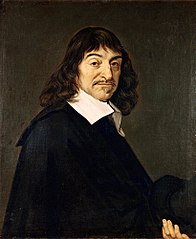 In Discourse on Method, Descartes argued that philosophers, over thousands of years of study, had achieved absolutely nothing. They pursued knowledge, but they had searched in vain. Descartes shared some views with Aristotle, but denied Aristotelian natural philosophy, which had been woven into Christian beliefs about nature. For Aristotle, rocks fell to earth because the natural order is for rocks to be on the earth, not above it – the Christian version of which was that it was God’s plan. In medieval Europe truths about nature were revealed by divinity or authority, not discovered. Descartes and Bacon were both devout Christians, but believed that Aristotelian philosophy of nature had to go. Observing that there is no real body of knowledge that can be claimed by philosophy, Descartes chose to base his approach to the study of nature on mathematics and reason. A mere 400 years after Descartes, we have trouble grasping just how radical this notion was. Descartes believed that the use of reason could give us knowledge of nature, and thus give us control over nature. His approach was innovative, in the broad sense of that term, which I’ll discuss below. Observation and experience, however, in Descartes’ view, could be deceptive. They had to be subdued by pure reason. His approach can be called rationalism. He sensed that we could use rationalism to develop theories – predictive models – with immense power, which would liberate mankind. He was right.
Francis Bacon, Descartes slightly older counterpart in the scientific revolution, was a British philosopher and statesman who became attorney general in 1613 under James I. He is now credited with being the father of empiricism, the hands-on, experimental basis for modern science, engineering, and technology. Bacon believed that acquiring knowledge of nature had to be rooted in observation and sensory experience alone. Do experiments and then decide what it means. Infer conclusions from the facts. Bacon argued that we must quiet the mind and apply a humble, mechanistic approach to studying nature and developing theories. Reason biases observation, he said. In this sense, the theory-building models of Bacon and Descartes were almost completely opposite. I’ll return to Bacon after a clarification of terms needed to make a point about him.
Innovation has many meanings. Cicero said he regarded it with great suspicion. He saw innovation as the haphazard application of untested methods to important matters. For Cicero, innovators were prone to understating the risks and overstating the potential gains to the public, while the innovators themselves had a more favorable risk/reward quotient. If innovation meant dictatorship for life for Julius Caesar after 500 years of self-governance by the Roman people, Cicero’s position might be understandable.
Today, innovation usually applies specifically to big changes in commercial products and services, involving better consumer value, whether by new features, reduced prices, reduced operator skill level, or breaking into a new market. Peter Drucker, Clayton Christensen and the tech press use innovation in roughly this sense. It is closely tied to markets, and is differentiated from invention (which may not have market impact), improvement (may be merely marginal), and discovery.
 That business-oriented definition of innovation is clear and useful, but it leaves me with no word for what earlier generations meant by innovation. In a broader sense, it seems fair that innovation also applies to what vanishing point perspective brought to art during the renaissance. John Locke, a follower of both Bacon and Descartes, and later Thomas Jefferson and crew, conceived of the radical idea that a nation could govern itself by the application of reason. Discovery, invention and improvement don’t seem to capture the work of Locke and Jefferson either. Innovation seems the best fit. So for discussion purposes, I’ll call this innovation in the broader sense as opposed to the narrower sense, where it’s tied directly to markets.
In the broader sense, Descartes was the innovator of his century. But in the narrow sense (the business and markets sense), Francis Bacon can rightly be called the father of innovation – and it’s first vocal advocate. Bacon envisioned a future where natural philosophy (later called science) could fuel industry, prosperity and human progress. Again, it’s hard to grasp how radical this was; but in those days the dominant view was that mankind had reached its prime in ancient times, and was on a downhill trajectory. Bacon’s vision was a real departure from the reigning view that philosophy, including natural philosophy, was stuff of the mind and the library, not a call to action or a route to improving life. Historian William Hepworth Dixon wrote in 1862 that everyone who rides in a train, sends a telegram or undergoes a painless surgery owes something to Bacon. In 1620, Bacon made, in The Great Instauration, an unprecedented claim in the post-classical world:
“The explanation of which things, and of the true relation between the nature of things and the nature of the mind … may spring helps to man, and a line and race of inventions that may in some degree subdue and overcome the necessities and miseries of humanity.”
In Bacon’s view, such explanations would stem from a mechanistic approach to investigation; and it must steer clear of four dogmas, which he called idols. Idols of the tribe are the set of ambient cultural prejudices. He cites our tendency to respond more strongly to positive evidence than to negative evidence, even if they are equally present; we leap to conclusions. Idols of the cave are one’s individual preconceptions that must be overcome. Idols of the theater refer to dogmatic academic beliefs and outmoded philosophies; and idols of the marketplace are those prejudices stemming from social interactions, specifically semantic equivocation and terminological disputes.
Descartes realized that if you were to strictly follow Bacon’s method of fact collecting, you’d never get anything done. Without reasoning out some initial theoretical model, you could collect unrelated facts forever with little chance of developing a usable theory. Descartes also saw Bacon’s flaw in logic to be fatal. Bacon’s method (pure empiricism) commits the logical sin of affirming the consequent. That is, the hypothesis, if A then B, is not made true by any number of observations of B. This is because C, D or E (and infinitely more letters) might also cause B, in the absence of A. This logical fallacy had been well documented by the ancient Greeks, whom Bacon and Descartes had both studied. Descartes pressed on with rationalism, developing tools like analytic geometry and symbolic logic along the way.
Interestingly, both Bacon and Descartes were, from our perspective, rather miserable scientists. Bacon denied Copernicanism, refused to accept Kepler’s conclusion that planet orbits were elliptical, and argued against William Harvey’s conclusion that the heart pumped blood to the brain through a circulatory system. Likewise, by avoiding empiricism, Descartes reached some very wrong conclusions about space, matter, souls and biology, even arguing that non-human animals must be considered machines, not organisms. But their failings were all corrected by time and the approaches to investigation they inaugurated. The tension between their approaches didn’t go unnoticed by their successors. Isaac Newton took a lot from Bacon and a little from Descartes; his rival Gottfried Leibniz took a lot from Descartes and a little from Bacon. Both were wildly successful. Science made the best of it, striving for deductive logic where possible, but accepting the problems of Baconian empiricism. Despite reliance on affirming the consequent, inductive science seems to work rather well, especially if theories remain open to revision.
Bacon’s idols seem to be as relevant to the boardroom as they were to the court of James I. Seekers of innovation, whether in the classroom or in the enterprise, might do well to consider the approaches and virtues of Bacon and Descartes, of contrasting and fusing rationalism and observation. Bacon and Descartes envisioned a brighter future through creative problem-solving. They broke the bonds of dogma and showed that a new route forward was possible. Let’s keep moving, with a diversity of perspectives, interpretations, and predictive models.
 The Multidisciplinarian